AP European History Unit 5: Crisis, Revolution, and Reaction (1648–1815)
5.1 Contextualizing the 18th-Century States
The Balance of Power and Global Rivalries
By the 18th century, the geopolitical landscape of Europe was defined by the struggle for the Balance of Power. This concept dictated that no single nation should dominate the continent. The decline of the Holy Roman Empire paved the way for the rise of distinct sovereign states.
- The Great Powers: The dominant players were Great Britain, France, Austria, Prussia, and Russia. Spain and the Netherlands, while still wealthy, were declining in relative military power.
- Warfare: Wars in this era were generally limited compared to the religious wars of the 17th century or the total wars of the 20th. They were fought by professional armies for specific territorial or economic objectives rather than religious ideology.
Enlightened Absolutism
While the previous unit focused on the Enlightenment as a philosophical movement, Unit 5 examines its political application. Enlightened Absolutists were monarchs who adopted Enlightenment ideals of rationalism, progress, and tolerance, but without relinquishing their absolute authority.
- Frederick the Great (Prussia): Promoted religious tolerance and legal reform; called himself the "First Servant of the State."
- Catherine the Great (Russia): Attempted legal codification and corresponded with Voltaire, but clamped down on serfdom after the Pugachev Rebellion.
- Joseph II (Austria): The most radical reformer; abolished serfdom and granted religious freedom to Jews and Protestants (Edict of Toleration), though many reforms were rolled back after his death.
5.2 The Rise of Global Markets
Mercantilism vs. Capitalism
The 18th century witnessed a shift in economic theory and practice.
- Mercantilism (Old System): State-driven economic policy. Believed wealth was finite (zero-sum game). Governments hoarded gold/silver, sought positive trade balances, and strictly regulated colonies (e.g., Navigation Acts).
- Capitalism (New System): Pioneered by Adam Smith in The Wealth of Nations (1776). He advocated for Laissez-Faire economics—the idea that the government should intervene as little as possible. He argued that the "invisible hand" of supply and demand would allocate resources most efficiently.
The Atlantic Economy
The expansion of the Atlantic System created a global network of trade that fueled European wealth.
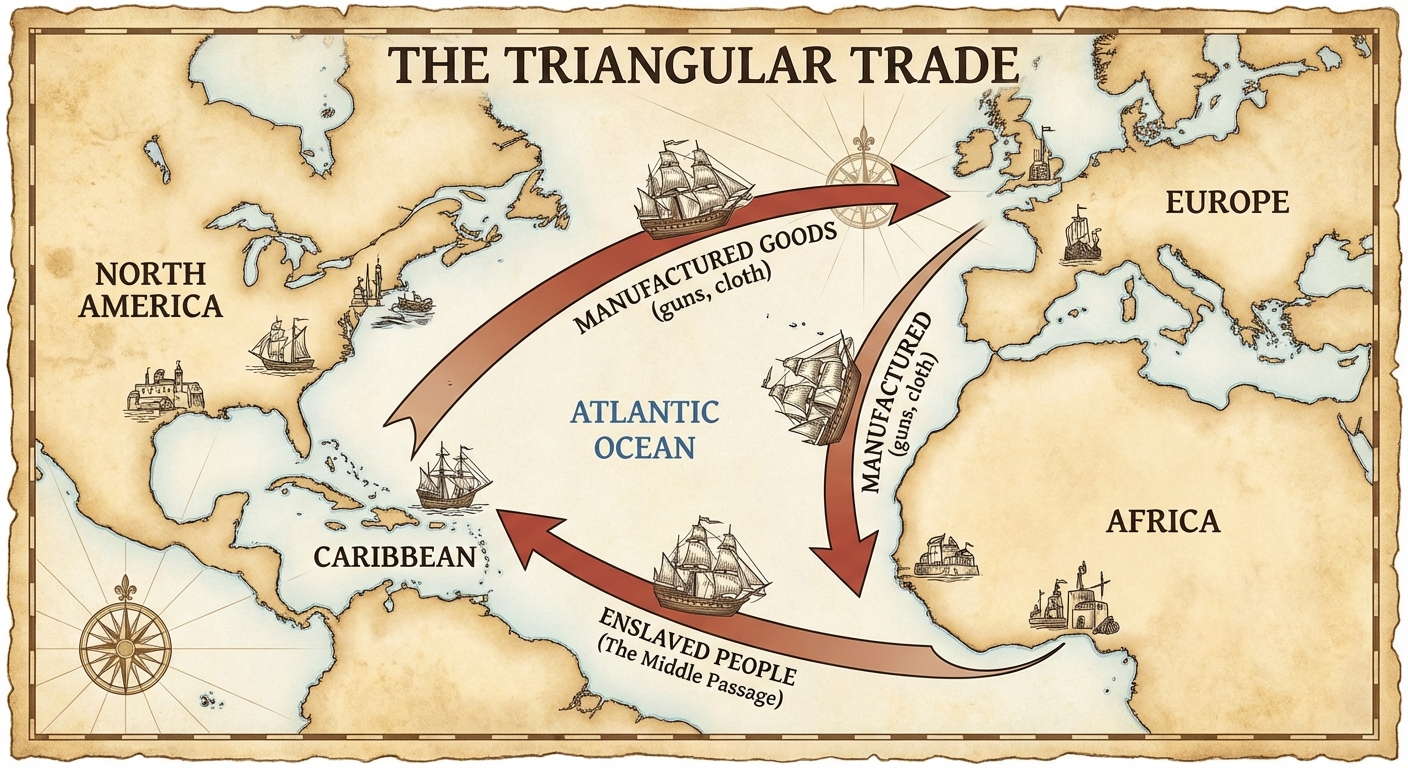
- Triangle Trade: A three-way system of trade:
- Europe to Africa: Guns, textiles, and manufactured goods.
- Africa to Americas (The Middle Passage): Enslaved Africans.
- Americas to Europe: Raw materials (sugar, tobacco, cotton, coffee).
- Sugar Islands: The Caribbean colonies (like Saint-Domingue) were the economic engines of France and Britain, producing massive profits through slave labor.
The Transatlantic Slave Trade
- Scope: Between the 16th and 19th centuries, over 12 million Africans were forcibly transported. The peak occurred during the 18th century.
- Impact:
- Africa: Destabilized societies, increased distinct internal warfare, and depopulation.
- Europe: Capital accumulation from the slave trade helped fund the upcoming Industrial Revolution.
- Americas: Created the plantation economy and entrenched racial hierarchies.
Population Explosion
After 1750, Europe experienced a massive population boom.
- Causes: The disappearance of the bubonic plague, the introduction of the potato (providing high calories per acre), and improved transport of food (less famine).
- Consequence: Increased urbanization and a surplus of labor, which would eventually staff the factories of the Industrial Revolution.
5.3 Britain's Ascendancy
The Seven Years' War (1756–1763)
Often called the "first true world war," this conflict cemented Britain's status as the global superpower.
- Alliances:
- Britain & Prussia vs. France, Austria, & Russia.
- Theaters of War:
- Europe: Prussia barely survived attacks from all sides.
- India: British forces (led by Robert Clive) defeated the French, securing control over the Indian subcontinent.
- North America (French and Indian War): Britain defeated France, seizing Canada.
- Treaty of Paris (1763): France lost almost all its colonial possessions in North America and India to Britain. Britain became the master of the seas.
The American Revolution (1775–1783)
Ironically, Britain's victory in 1763 helped cause the American Revolution. The war debt led Britain to tax the colonies (Stamp Act), sparking cries of "No Taxation Without Representation."
- European Impact: France supported the American rebels to spite Britain. This victory for America bankrupted the French monarchy, directly leading to the French Revolution.
5.4 The French Revolution (1789–1799)
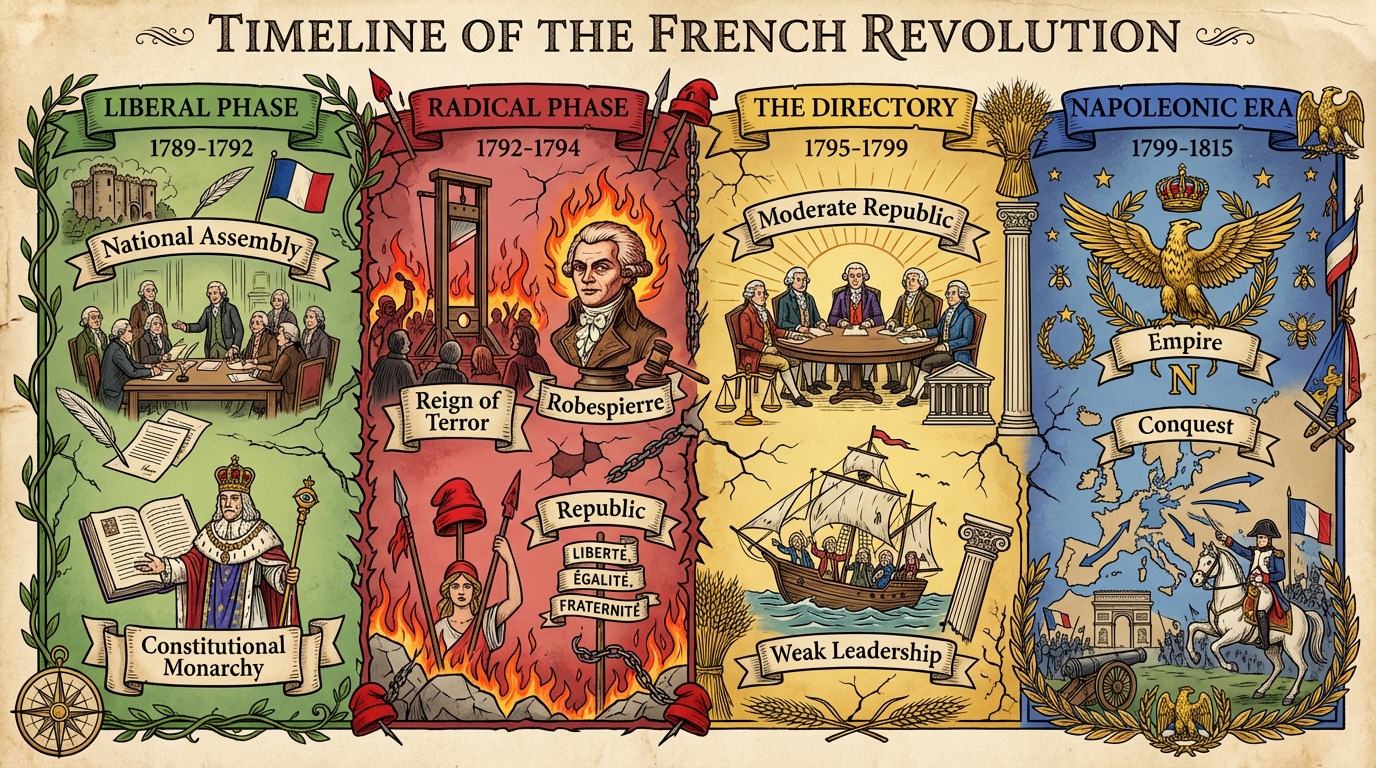
The French Revolution is the pivotal event of modern European history. It is generally divided into phases.
Causes
- Social Inequality: The Three Estates system.
- First Estate (Clergy): Owned 10% of land, paid no taxes.
- Second Estate (Nobility): Owned 25% of land, paid almost no taxes.
- Third Estate (Everyone else): 97% of population, paid all taxes (Taille, Gabelle), had no political power.
- Economic Crisis: War debt (American Revolution), bad harvests (hungry people riot), and royal overspending (Versailles).
- Enlightenment Ideas: The bourgeoisie (middle class) wanted the rights championed by Locke and Rousseau.
Phase 1: The Liberal Phase (1789–1791)
- Estates-General (1789): Louis XVI called a meeting to solve the debt. The Third Estate was outvoted, walked out, and formed the National Assembly via the Tennis Court Oath (vowing to create a constitution).
- Storming of the Bastille (July 14, 1789): Urban workers attacked the royal prison to get gunpowder. Symbolized the fall of despotism.
- Decisions of the National Assembly:
- Abolished Feudalism (The Great Fear peasants' revolt forced this).
- Declaration of the Rights of Man and Citizen: Guaranteed equality before the law, speech, and religion.
- Civil Constitution of the Clergy: Made the Catholic Church a department of the state (major mistake—alienated religious peasants).
- Women's March on Versailles: Women demanding bread forced the King to move back to Paris.
5.5 The Radical Phase & Effects
Phase 2: The Radical Phase (1792–1794)
The Revolution turned violent due to foreign war (Austria/Prussia attacked) and internal paranoia.
- The Jacobins: Radical political club led by Maximilien Robespierre. They wanted a Republic, not a Constitutional Monarchy.
- Execution of Louis XVI: The King was tried for treason and guillotined in 1793. France became a Republic.
- The Reign of Terror: The Committee of Public Safety (led by Robespierre) suspended rights to "save the revolution." 40,000 were executed, including the Queen (Marie Antoinette) and fellow revolutionaries (Danton).
- Culture: They tried to "De-Christianize" France (new Calendar, Cult of the Supreme Being).
Reactions and The Directory (1795–1799)
- Thermidorian Reaction: People grew tired of the Terror. Robespierre was executed in 1794.
- The Directory: A five-man executive body took over. It was moderate but corrupt and ineffective, relying on the military to stay in power.
Women in the Revolution
- Olympe de Gouges: Wrote the Declaration of the Rights of Woman, arguing women should have equal rights. She was guillotined during the Terror.
- Mary Wollstonecraft: English writer who observed the revolution; wrote A Vindication of the Rights of Woman.
- outcome: Women participated heavily (March on Versailles) but gained few legal rights and were eventually banned from political clubs.
The Haitian Revolution (1791–1804)
Inspired by the French Revolution, enslaved people in the French colony of Saint-Domingue revolted.
- Toussaint L'Ouverture: A former slave who led the rebellion against French, British, and Spanish forces.
- Outcome: Haiti became the first black-led republic and the second independent nation in the Americas. It shocked European slaveholders.
5.6 Napoleon's Rise, Dominance, and Defeat
Rise to Power
Napoleon Bonaparte, a successful general, overthrew the corrupt Directory in the Coup of 18 Brumaire (1799). He declared himself First Consul, then Emperor (1804).
Domestic Reforms (The "Good")
- Napoleonic Code (Civil Code of 1804): Unified French law. Guaranteed equality of all male citizens, security of wealth, and private property. Negative: It severely restricted women's rights (patriarchy restored).
- Concordat of 1801: Healed the break with the Catholic Church. The Pope acknowledged the revolution's land sales; Napoleon acknowledged Catholicism as the religion of the majority.
- Meritocracy: Government jobs went to the most qualified, not the nobility.
Napoleonic Wars & Empire
Napoleon conquered much of Europe, spreading revolutionary ideals (ending feudalism in conquered lands) but installing his relatives as kings.
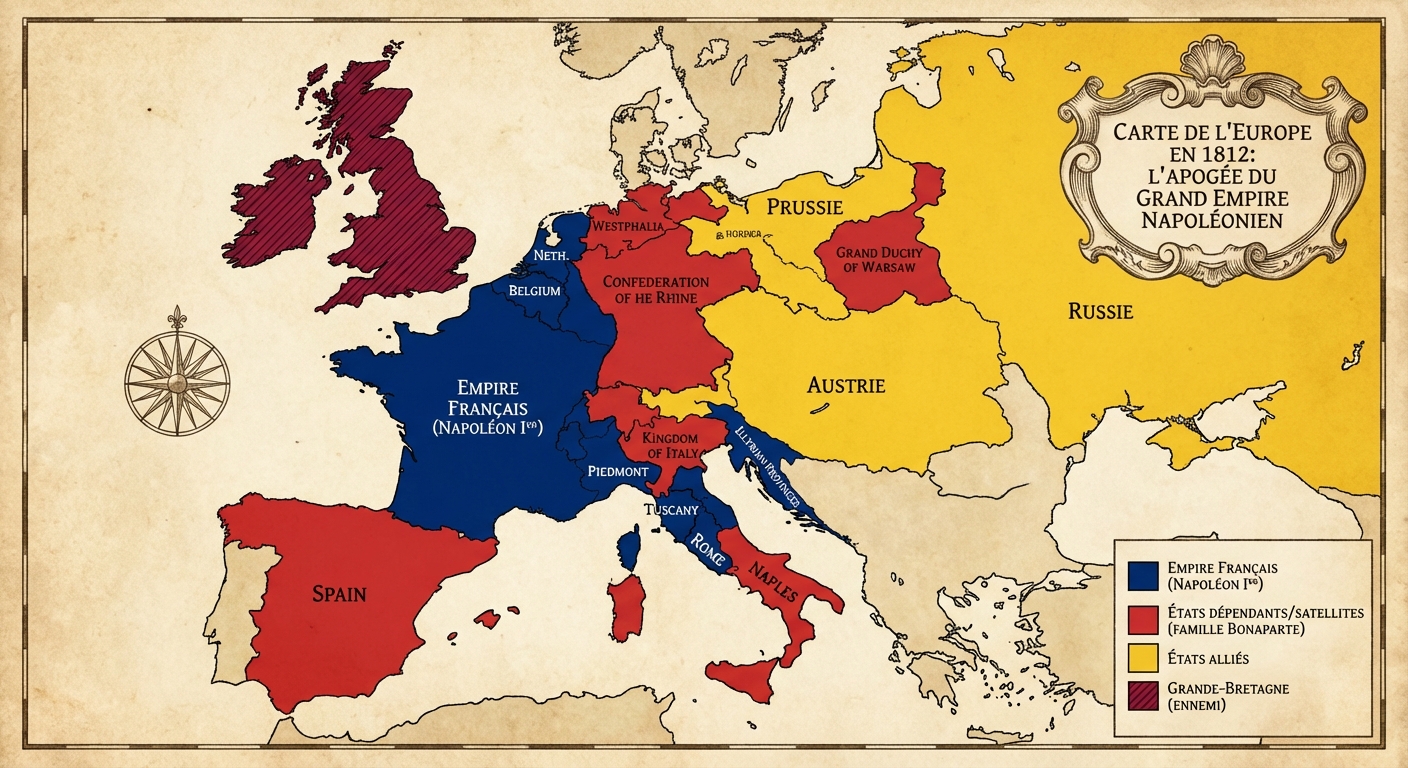
- The Grand Empire: Included an enlarged France, satellite kingdoms (Italy, Spain, Holland), and forced allies (Austria, Prussia).
Downfall
Napoleon's three major mistakes:
- The Continental System: An economic blockade trying to starve Britain of trade. It failed; Britain had other markets (Americas), and Europe suffered from lack of British goods.
- The Peninsular War: Guerrilla warfare in Spain drained French resources.
- Invasion of Russia (1812): Napoleon invaded with 600,000 men. The Russians used "scorched earth" tactics and retreated. Winter destroyed the Grand Army; only ~40,000 returned.
Waterloo (1815): After a brief return (The Hundred Days), Napoleon was finally defeated by a coalition of British (Duke of Wellington) and Prussian forces.
5.7 The Congress of Vienna & The Conservative Order
After Napoleon's defeat, the Great Powers (Britain, Russia, Prussia, Austria) met in Vienna (1814–1815) to fix Europe.
Key Principles (Led by Klemens von Metternich of Austria)
- Legitimacy: Restore legitimate monarchs deposed by Napoleon (Bourbons returned to France).
- Balance of Power: Surround France with strong countries so it can't attack again, but don't destroy France (prevent resentment).
- Conservatism: Maintain tradition, hierarchy, and religion to prevent chaos. The "Concert of Europe" was an agreement to crush future liberal or nationalist revolutions.
Political Ideologies Re-cap
- Conservatism (Burke/Metternich): Tradition, monarchy, stability.
- Liberalism (Locke/Smith): Individual rights, constitutions, free trade.
- Nationalism: Self-determination for ethnic groups (dangerous for multi-ethnic empires like Austria).
5.8 Romanticism (c. 1790–1840)
A cultural reaction against the Enlightenment's focus on reason and the Industrial Revolution's focus on mechanization.
Key Characteristics
- Emotion over Reason: Trust your gut and feelings.
- Nature: Nature is awesome, powerful, and uncontrollable (The Sublime), not a machine to be dissected by science.
- The Individual: Celebration of the lone genius or hero.
- History: Nostalgia for the Middle Ages (Gothic Revival).
Key Figures
- Rousseau: Early influence; "Man is born free, but everywhere is in chains."
- Goethe: The Sorrows of Young Werther (model of the romantic hero).
- Wordsworth: English poet who glorified nature.
- Caspar David Friedrich: Painter (Wanderer above the Sea of Fog) depicting lone figures facing vast landscapes.
5.9 Common Mistakes & Pitfalls
- Confusing the Treaties of Paris:
- 1763: Ended Seven Years' War (Britain wins, France kicked out of North America).
- 1783: Ended American Revolution (US independence).
- The "Mob" vs. The Bourgeoisie: Students often think the poor started the French Revolution. It was the wealthy middle class (Bourgeoisie) who started it in the Estates-General; the poor (Sans-Culottes) radicalized it later.
- Napoleon's Politics: Don't label him strictly "Liberal" or "Conservative." He was both—he kept revolutionary equality (Liberal) but was an authoritarian dictator (Conservative).
- Romanticism is not "Romance": It is not about love stories. It is about intensity of emotion, awe of nature, and stormy struggles.