Comprehensive Guide to Properties of Waves and Physical Optics
1. The Electromagnetic Spectrum and Wave Nature
The Nature of Electromagnetic Waves
Unlike mechanical waves (sound, water strings) which require a medium, Electromagnetic (EM) radiation consists of oscillating electric ($E$) and magnetic ($B$) fields that propagate through space. These fields oscillate perpendicular to each other and to the direction of wave propagation, making EM waves transverse waves.
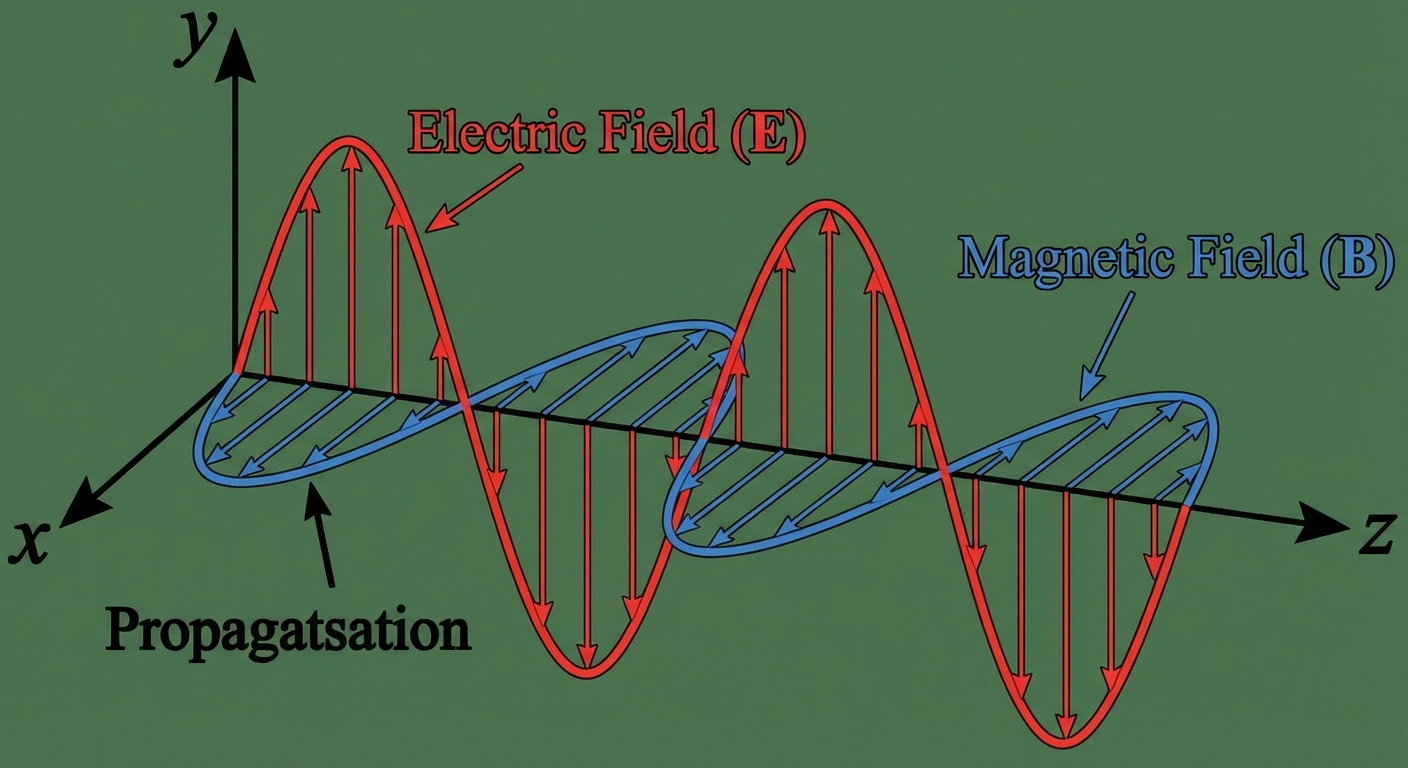
Key Properties
- Vacuum Speed: All EM waves travel at the speed of light ($c$) in a vacuum.
- The Wave Equation: The relationship between speed, frequency ($f$), and wavelength ($\lambda$) is:
- Energy: Energy is directly proportional to frequency ($E = hf$). High frequency $\rightarrow$ High Energy.
The Electromagnetic Spectrum
You must know the order of the spectrum by frequency/wavelength. From Longest $\lambda$ (Lowest $f$) to Shortest $\lambda$ (Highest $f$):
- Radio Waves
- Microwaves
- Infrared (IR)
- Visible Light (Red $\approx 700$nm to Violet $\approx 400$nm)
- Ultraviolet (UV)
- X-Rays
- Gamma Rays
Propagation Through Media
When light enters a medium (like glass or water) from a vacuum:
- Speed decreases: Defined by the Index of Refraction ($n$).
(Where $n \geq 1$ always) - Frequency remains constant: The "color" or identity of the wave does not change.
- Wavelength decreases: Since $v$ drops and $f$ stays the same, $\lambda$ must get shorter.
2. Interference and Superposition
The Superposition Principle
The defining characteristic of all waves (Sound and Light) is Superposition. When two waves overlap, the resulting amplitude is the algebraic sum of the individual amplitudes.
- Constructive Interference: Crest meets crest (or trough meets trough). Amplitudes add up. Result = Bright spot (light) or Loud sound.
- Destructive Interference: Crest meets trough. Amplitudes subtract/cancel. Result = Dark spot (light) or Silence/Quiet (sound).
Path Length Difference ($\Delta L$)
Whether waves interfere constructively or destructively depends on how far they traveled to get to a specific point. The difference in distance traveled is the Path Length Difference ($\Delta L$).
Condition for Constructive Interference (Maxima):
(The difference is a whole number integer of wavelengths)Condition for Destructive Interference (Minima):
(The difference is a half-integer of wavelengths)
3. Young's Double-Slit Experiment
This experiment provided the definitive proof that light behaves as a wave.
The Setup
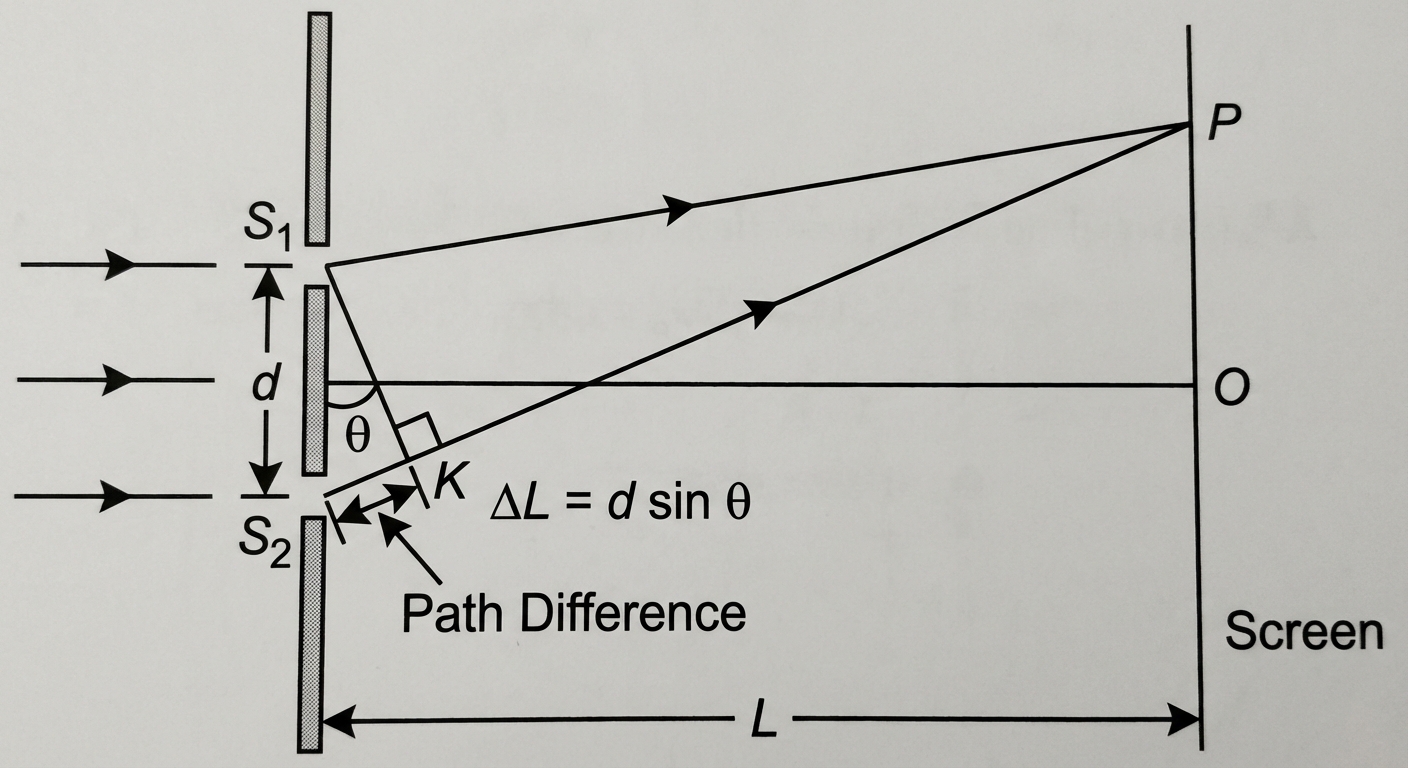
Monochromatic light passes through two narrow slits separated by a distance $d$. A pattern of bright and dark fringes appears on a screen a distance $L$ away.
Geometry and Formulas
For a point on the screen located at an angle $\theta$ from the center line:
Path Difference Geometry:
Location of Bright Fringes (Maxima):
Location of Dark Fringes (Minima):
Small Angle Approximation:
If $L \gg d$ (screen is far away) and angle $\theta$ is small, we can approximate $\sin\theta \approx \tan\theta \approx \frac{y}{L}$, where $y$ is the linear distance from the central max to the fringe.
Important Relationships
Looking at $y = \frac{\lambda L}{d}$ (focusing on the spacing between fringes):
- Increase wavelength (Red light vs Blue light) $\rightarrow$ Fringes spread out (larger $y$).
- Increase slit separation ($d$) $\rightarrow$ Fringes get closer together (smaller $y$).
- Increase screen distance ($L$) $\rightarrow$ Pattern magnifies (larger $y$).
4. Diffraction Gratings and Single Slit Diffraction
Diffraction Gratings
A grating has thousands of slits. The physics is identical to the Double Slit, but the maxima are much sharper, brighter, and narrower.
- Formula: $d\sin\theta = m\lambda$ (Same as double slit)
- Note: Because maxima are often at large angles, do not use the small angle approximation ($y = m\lambda L / d$). Stick to trigonometry: $\tan\theta = y/L$.
Single Slit Diffraction
Even a single opening causes interference because light from one side of the slit interferes with light from the other side (Huygens' Principle).
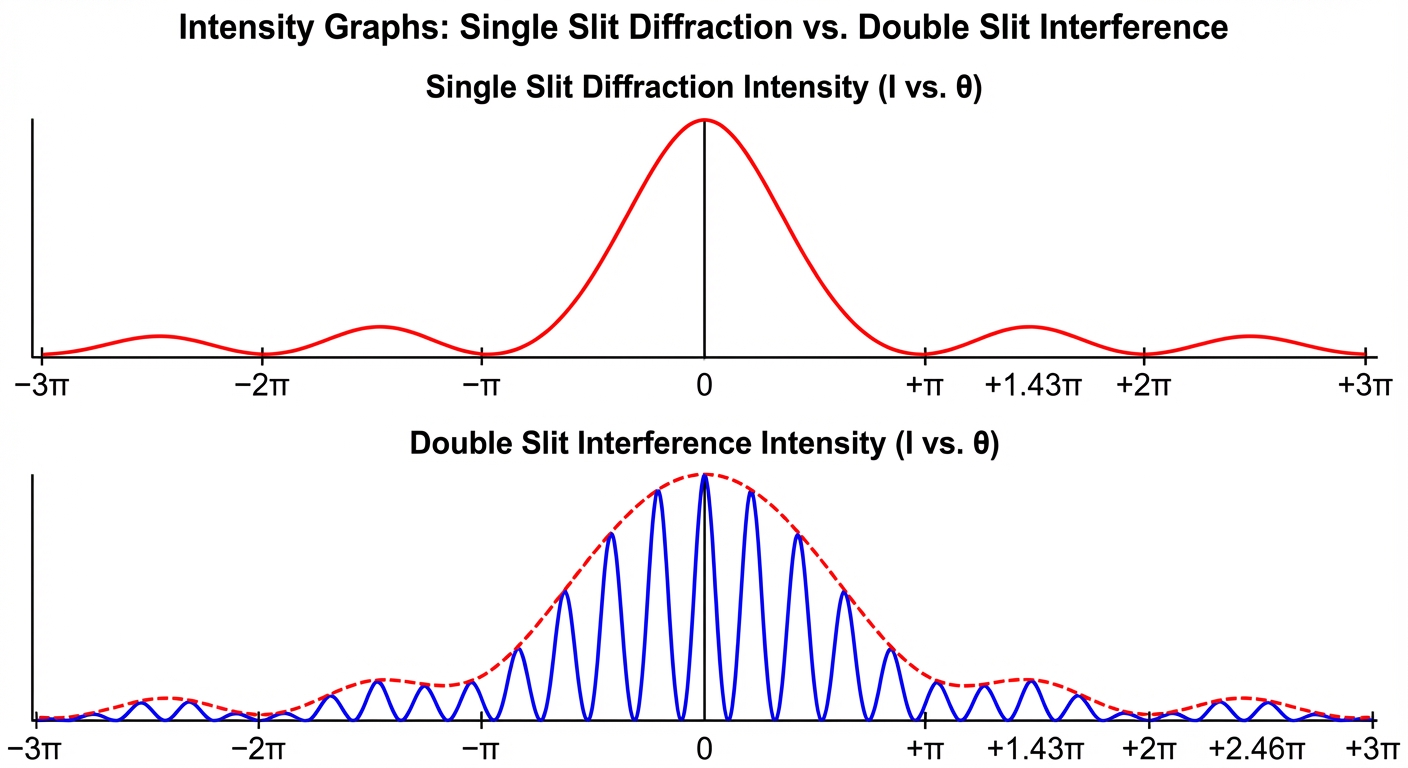
- Central Maximum: A single slit produces a very wide, bright central maximum (twice the width of side fringes).
- The Minima (Dark Spots) Formula:
- WARNING: Here, $a$ (sometimes $w$ or $D$) is the width of the single slit. Note that $m$ corresponds to dark spots (destructive interference), which is the opposite of the double-slit formula structure.
5. Thin Film Interference
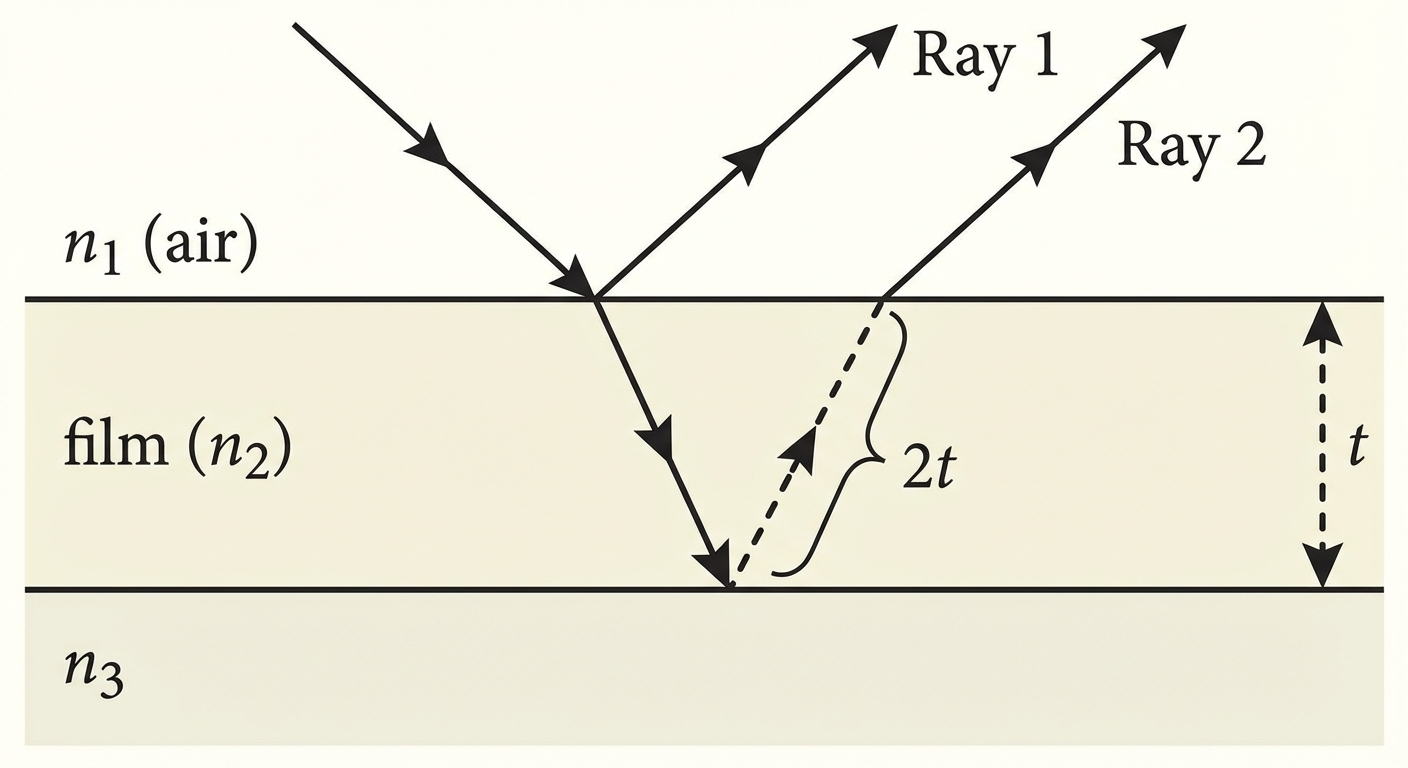
This phenomenon explains the rainbow colors seen in soap bubbles or oil slicks. Interference occurs between light reflecting off the top surface and light reflecting off the bottom surface of a thin film.
Phase Changes Upon Reflection
- Hard Reflection (Low $n$ $\rightarrow$ High $n$): Light reflects off a "denser" medium (higher refractive index). $\pi$ phase shift (flip 180° or $\frac{1}{2}\lambda$).
- Soft Reflection (High $n$ $\rightarrow$ Low $n$): Light reflects off a "less dense" medium. No phase shift.
Determining the Formula
Relative path length is $2t$ (down and up through film thickness $t$).
- Count the Phase Shifts: Look at the top reflection and bottom reflection.
- Case A: 0 or 2 Phase Shifts (e.g., film in air, or film between two denser glasses).
- Constructive: $2t = m\lambda_{film}$
- Destructive: $2t = (m + \frac{1}{2})\lambda_{film}$
- Case B: 1 Phase Shift (e.g., Oil on water, Soap bubble in air). The single flip compensates for the $1/2$ term.
- Constructive: $2t = (m + \frac{1}{2})\lambda_{film}$
- Destructive: $2t = m\lambda_{film}$
Crucial Step: Always use the wavelength inside the film:
6. Polarization
Polarization is the alignment of the electric field oscillation direction. This property proves that light is a transverse wave (Sound cannot be polarized as it is longitudinal).
- Unpolarized Light: E-fields oscillate in random directions.
- Polarizer: Filters light, allowing only components parallel to the transmission axis to pass.
- First Filter: Reduces intensity of unpolarized light by exactly 50% ($I = I_0 / 2$).
- Malus' Law (Analyzer): If polarized light with intensity $I0$ hits a second filter at angle $\theta$ relative to the polarization axis:
- If $\theta = 90^\circ$ (Crossed Polarizers), Intensity $I = 0$ (Blackout).
7. Common Mistakes & Pitfalls
Confusing Slit Width ($a$) vs. Slit Separation ($d$):
- $d$ is for Double Slit interference (distance between centers of slits).
- $a$ (or $w$) is for Single Slit diffraction (width of the gap).
- Double slit patterns appear inside the envelope of the single slit pattern.
Using Vacuum Wavelength in Thin Films:
- In equations like $2t = m\lambda$, the $\lambda$ must be $\lambda{film} = \lambda{vac}/n$. Students often forget to divide by $n$.
Small Angle Approximation Errors:
- $y = m\lambda L / d$ only works if angles are small (<15°). If a problem gives a diffraction grating with angles like 30° or 45°, you MUST use $d\sin\theta = m\lambda$.
Single Slit Integer Confusion:
- In Double Slit, integer $m$ gives Bright spots.
- In Single Slit, integer $m$ gives Dark spots.
Frequency Changes:
- Remember: When light moves from air to water, Frequency never changes. Only Speed and Wavelength change.