Module Overview: From Sensory Input to Conscious Experience
Fundamentals of Sensation: Psychophysics
Sensation is the process by which our sensory receptors and nervous system receive and represent stimulus energies from our environment. It is the "hardware" processing.
Key Concepts in Psychophysics
Transduction: The transformation of stimulus energy (sights, sounds, smells) into neural impulses our brain can interpret. This is the bridge between the physical world and the mental world.
Thresholds:
- Absolute Threshold: The minimum stimulation needed to detect a particular stimulus 50% of the time (e.g., seeing a candle flame 30 miles away on a clear night).
- Difference Threshold (Just Noticeable Difference/JND): The minimum difference between two stimuli required for detection 50% of the time.
Weber’s Law: To be perceived as different, two stimuli must differ by a constant percentage (or proportion), not a constant amount.
(Where $I$ is intensity and $k$ is the constant).- Example: If you are lifting 100 lbs, you might need to add 2 lbs to notice a difference. If you are lifting 10 lbs, you might only need 0.2 lbs.
Sensory Adaptation: Diminished sensitivity as a consequence of constant stimulation (e.g., getting used to the temperature of a swimming pool or the smell of your own house). This allows us to focus on changing stimuli.
The Visual System
Vision is the dominant sense in humans. Light travels in waves; the amplitude determines brightness, and the wavelength determines hue (color).
Anatomy of the Eye
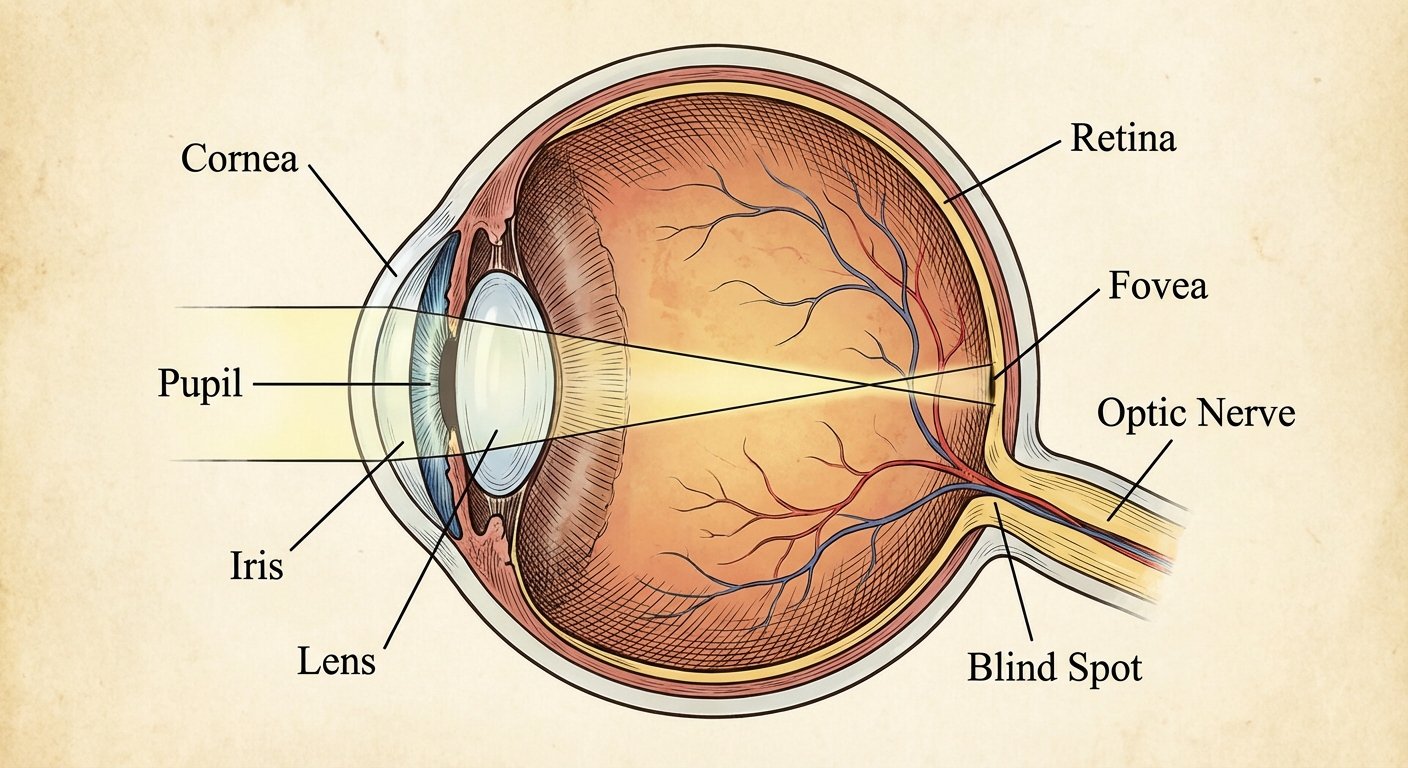
- Cornea: The clear protective outer layer; bends light to help focus.
- Pupil & Iris: The pupil is the adjustable opening; the iris is the colored muscle that controls the pupil size based on light intensity.
- Lens: Transparent structure behind the pupil that changes shape to focus images on the retina (Accommodation).
- Retina: The light-sensitive inner surface containing receptor rods and cones.
Photoreceptors: Rods vs. Cones
| Feature | Rods | Cones |
|---|---|---|
| Function | Detect black, white, gray; twilight vision | Detect fine detail and color |
| Location | Peripheral retina | Concentrated in the Fovea (center) |
| Condition | Perform well in low light | Required bright light |
| Quantity | ~120 Million | ~6 Million |
Mnemonic: Cones = Color, Center, Clarity.
Visual Processing Theories
- Young-Helmholtz Trichromatic Theory: The retina contains three separate color receptors: Red, Green, and Blue. All colors are combinations of these.
- Opponent-Process Theory: Visual processing happens in opposing pairs (Red-Green, Yellow-Blue, White-Black). This explains afterimages (staring at a red flag and seeing green when looking away).
Audition (Hearing)
Sound waves are vibrations of air molecules. Amplitude determines loudness (decibels), and Frequency determines pitch (Hertz).
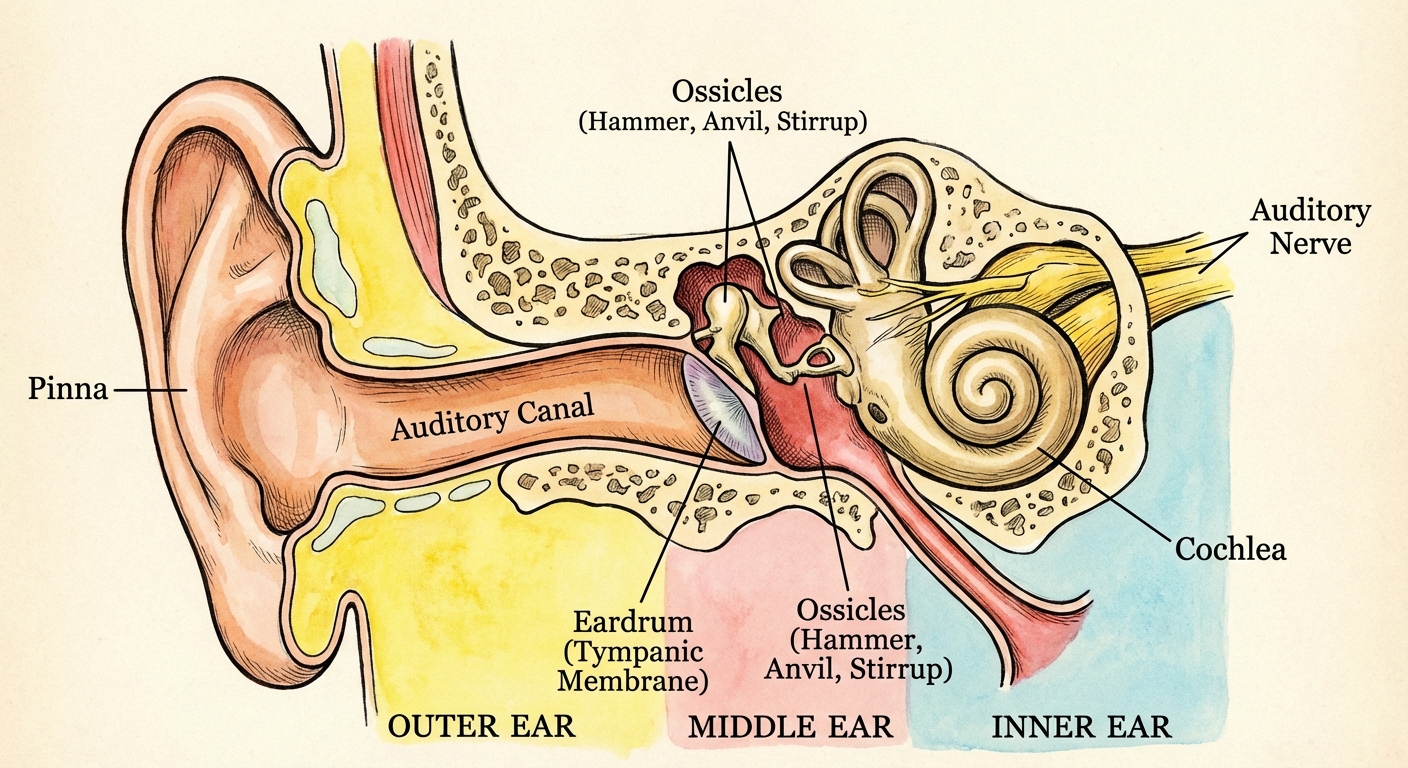
Anatomy of the Ear
- Outer Ear: Pinna and Auditory Canal funnel waves to the eardrum.
- Middle Ear: The Typanic Membrane (Eardrum) vibrates, moving the Ossicles (Hammer, Anvil, Stirrup/Stapes). These bones amplify the vibrations.
- Inner Ear: The Cochlea is a coiled, fluid-filled tube.
- Vibrations cause ripples in the Basilar Membrane.
- Hair cells (cilia) on the membrane bend, triggering nerve impulses.
Pitch Perception Theories
- Place Theory: We hear different pitches because different sound waves trigger activity at different places along the cochlea’s basilar membrane (best for high pitches).
- Frequency Theory: The rate of nerve impulses traveling up the auditory nerve matches the frequency of a tone (best for low pitches).
The Chemical and Body Senses
Gustation (Taste) & Olfaction (Smell)
- Taste Sensations: Sweet, Sour, Salty, Bitter, and Umami (savory/meaty).
- Interaction: Smell and taste interact closely (Sensory Interaction). Without smell, flavor is drastically reduced.
- Olfactory Bulb: Smell is the only sense that bypasses the sensory switchboard (Thalamus) and goes directly to the olfactory bulb near the limbic system (explaining why smells trigger strong memories/emotions).
Somatosensation (Touch) & Body Position
- Four Skin Senses: Pressure, Warmth, Cold, Pain.
- Gate-Control Theory: The spinal cord contains a neurological "gate" that blocks pain signals or allows them to pass to the brain. Large nerve fibers (touch) close the gate; small fibers (pain) open it.
- Vestibular Sense: Monitors the head's position and movement (balance). Located in the semicircular canals of the inner ear.
- Kinesthesis: The system for sensing the position and movement of individual body parts (receptors in joints/muscles).
Perception and Attention
Perception is the process of organizing and interpreting sensory information (the "software").
Processing Styles
- Bottom-Up Processing: Analysis begins with the sensory receptors and works up to the brain's integration (Data-driven).
- Top-Down Processing: Information processing guided by higher-level mental processes, drawing on experience and expectations (Concept-driven).
Selective Attention
- Cocktail Party Effect: The ability to attend to only one voice among many.
- Inattentional Blindness: Failing to see visible objects when our attention is directed elsewhere (e.g., the famous gorilla basketball experiment).
Gestalt Principles
German for "form" or "whole." "The whole is greater than the sum of its parts."
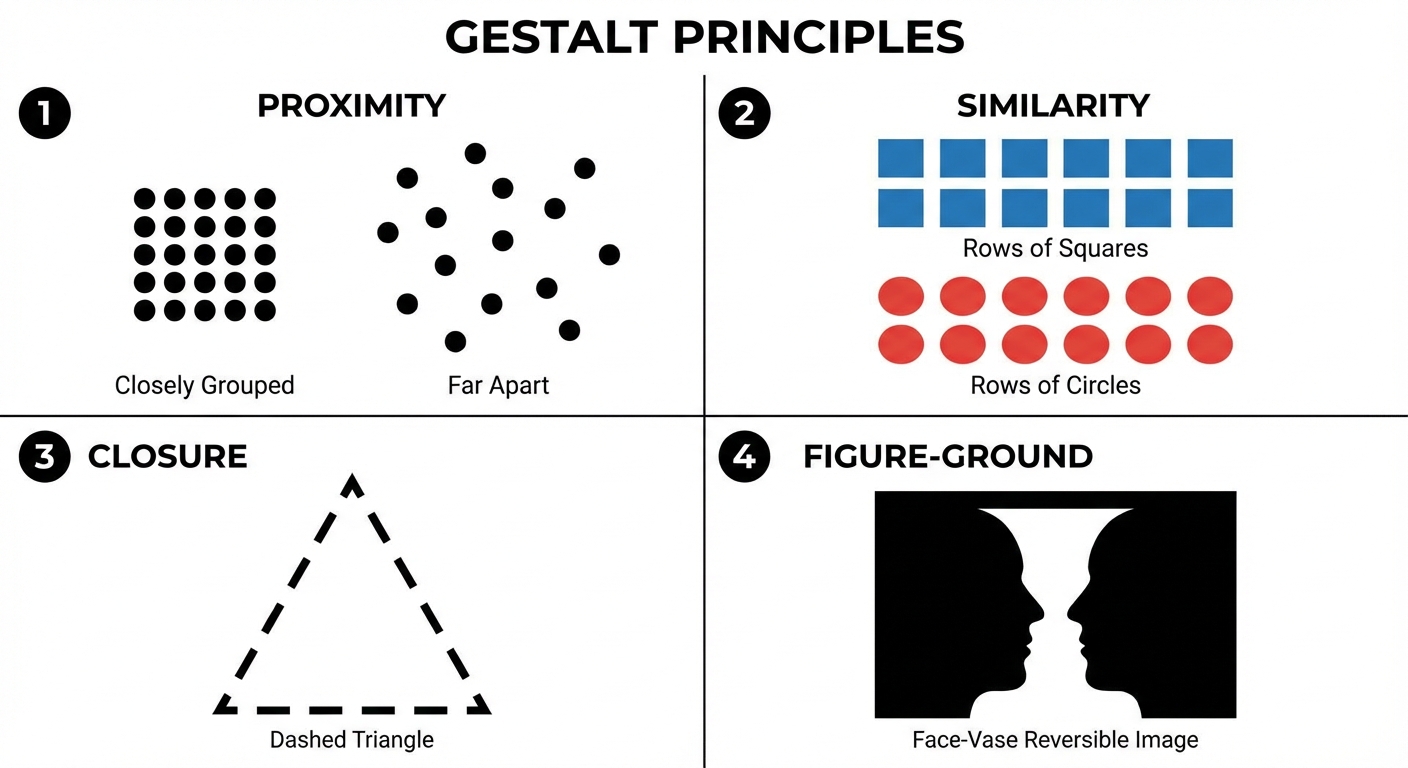
- Figure-Ground: Organization of the visual field into objects (figures) that stand out from their surroundings (ground).
- Proximity: We group nearby figures together.
- Closure: We fill in gaps to create a complete, whole object.
- Similarity: We group figures that are similar.
Depth Perception
- Binocular Cues (Require two eyes):
- Retinal Disparity: By comparing images from the retinas in the two eyes, the brain computes distance. Greater disparity = closer object.
- Monocular Cues (Require one eye): Linear perspective (parallel lines converge), interposition (overlap), relative size.
States of Consciousness and Sleep
Consciousness is our awareness of ourselves and our environment.
The Sleep Cycle
Circadian Rhythm is our biological clock (roughly 24 hours), controlled by the Suprachiasmatic Nucleus (SCN) which adjusts melatonin production.
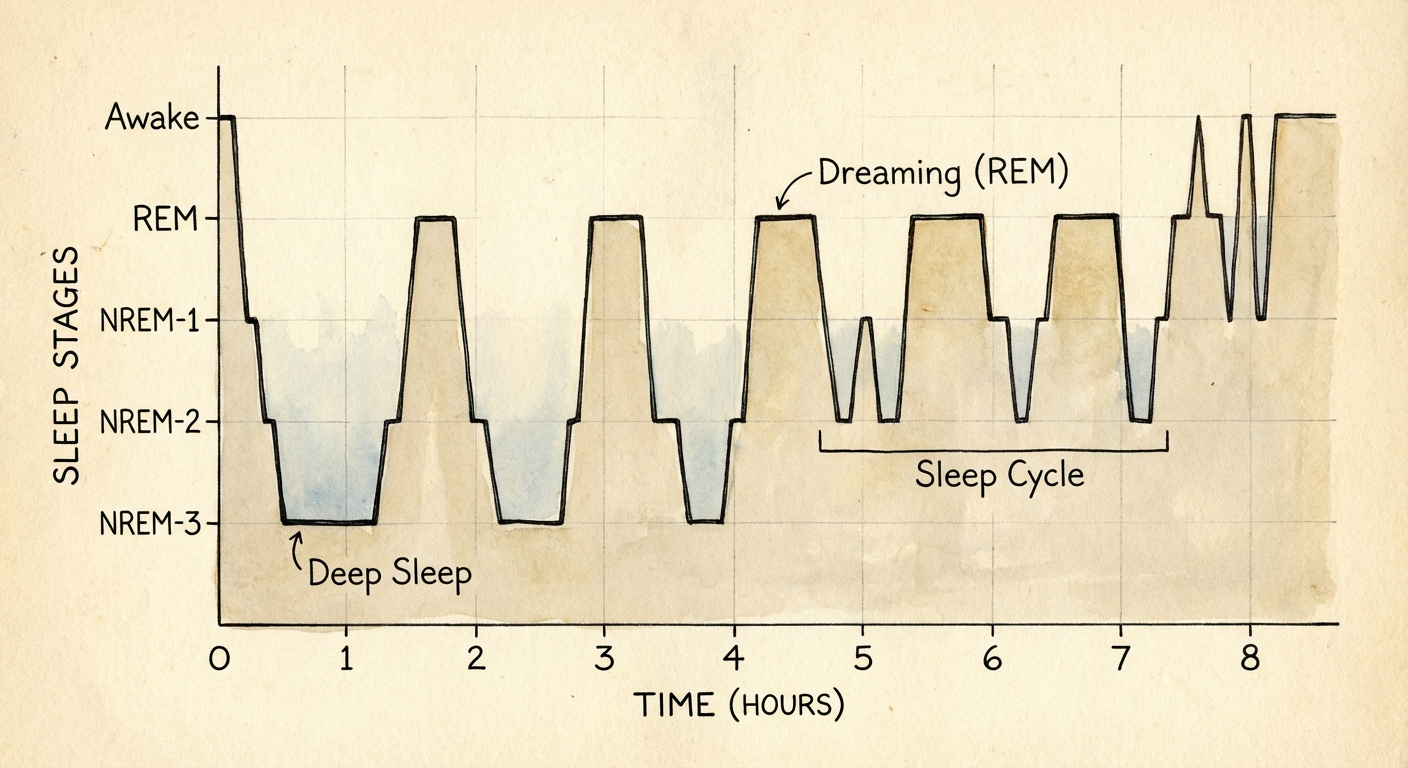
We cycle through roughly 90-minute sleep stages:
- NREM-1: Light sleep, theta waves, hypnagogic sensations (falling feeling).
- NREM-2: Sleep spindles (bursts of brain activity). You spend the most time here.
- NREM-3: Deep sleep, Delta waves. Hard to wake; growth hormones released.
- REM (Rapid Eye Movement):
- Vivid dreaming occurs here.
- Paradoxical Sleep: The motor cortex is active, but the brainstem blocks messages, leaving muscles relaxed (paralyzed).
Sleep Disorders
- Insomnia: Persistent problems in falling or staying asleep.
- Narcolepsy: Uncontrollable sleep attacks (lapsing directly into REM).
- Sleep Apnea: Temporary cessations of breathing during sleep and repeated momentary awakenings.
Drugs and Consciousness
Chemicals that change perceptions and moods (Psychoactive Drugs) usually work at the synapse by mimicking (agonists) or blocking (antagonists) neurotransmitters.
- Depressants: Slow neural activity (Alcohol, Barbiturates, Opiates).
- Stimulants: Excite neural activity (Caffeine, Nicotine, Cocaine, Amphetamines).
- Hallucinogens: Distort perceptions and evoke sensory images (LSD, Marijuana).
Common Mistakes & Pitfalls
- Sensation vs. Perception: Students often treat them as the same. Remember: Sensation is detection (eyes seeing light); Perception is interpretation (brain recognizing a face).
- Rods vs. Cones: Confusing their functions. Use the mnemonic Cones = Color, Center (fovea).
- Negative Reinforcement vs. Punishment: (Often confused in unit 2, but relevant to behavior) vs. Negative Afterimages: Don't confuse behavioral terms with sensory opponent-process outcomes.
- Place vs. Frequency Theory:
- Place = High pitch (where it hits).
- Frequency = Low pitch (how fast it hits).
- REM Sleep: It is not the deepest sleep (that is NREM-3). It is the most active sleep (Paradoxical).