Unit 1: Scientific Foundations of Psychology
Scientific Foundations of Psychology
History and Approaches to Psychology
Psychology is formally defined as the scientific study of behavior and mental processes. The field has evolved from philosophical roots to a rigorous science relying on empirical evidence.
The Birth of Psychology
- Wilhelm Wundt (1879): Known as the "Father of Psychology." He established the first psychology laboratory in Leipzig, Germany. He utilized introspection—a technique where subjects objectively report their conscious experiences (e.g., describing the brightness or sound of a ticking metronome).
- G. Stanley Hall: Established the first U.S. psychology lab and founded the APA (American Psychological Association).
Early Schools of Thought
| School | Key Figure | Core Concept | Methods |
|---|---|---|---|
| Structuralism | Edward Titchener | Focused on breaking down mental processes into their most basic components (structures). | Introspection |
| Functionalism | William James | Influenced by Darwin; focused on the purpose (function) of consciousness and behavior. How does the mind help us survive? | Observation of behavior |
| Gestalt | Max Wertheimer | "The whole is greater than the sum of its parts." Focused on how we perceive patterns and whole figures. | Perceptual tasks |
Note: Mary Whiton Calkins was a student of William James and the first female president of the APA, though she was denied a PhD by Harvard. Margaret Floy Washburn was the first woman to officially receive a psychology PhD.
Modern Approaches (Perspectives)
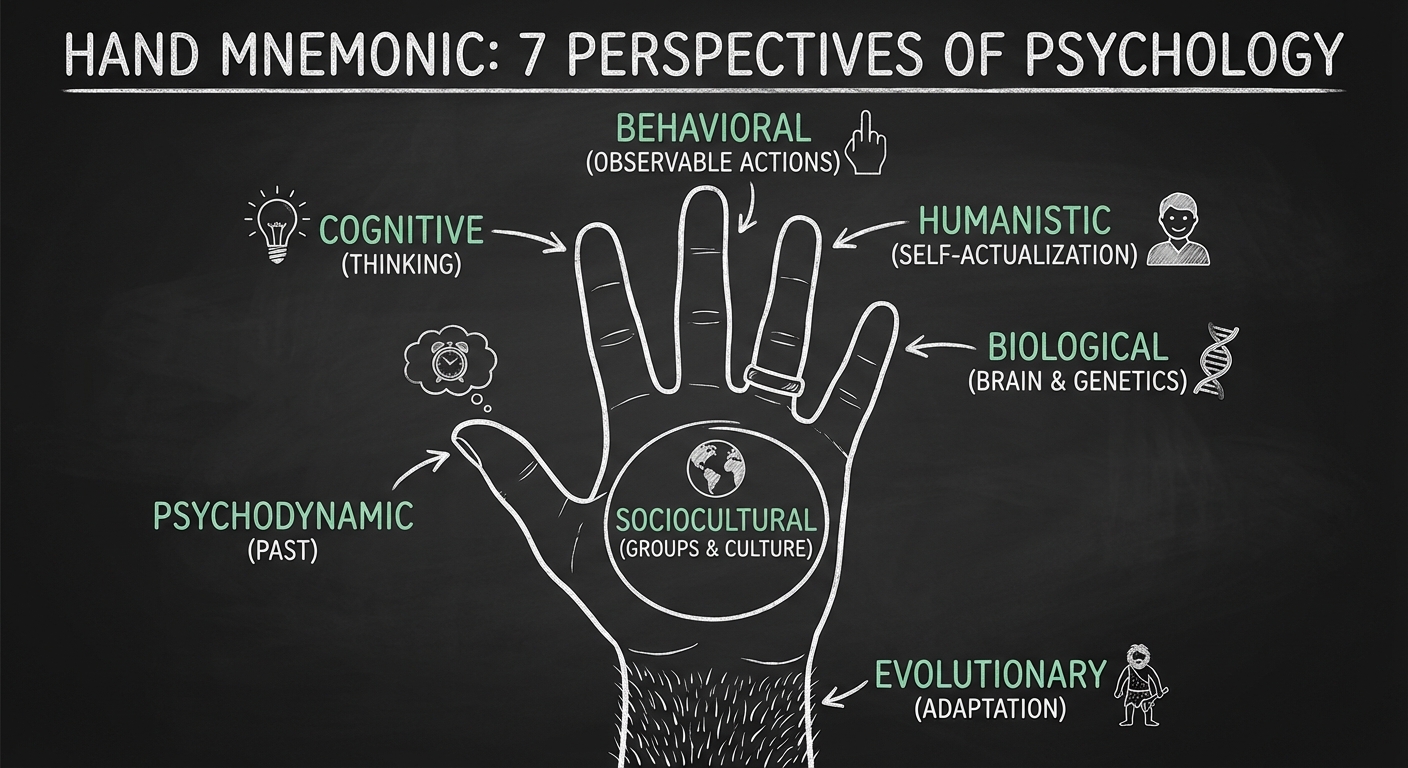
Contemporary psychology is broadly divided into different "lenses" or approaches to explaining behavior.
- Biological/Neuroscience: Explains behavior through brain chemistry, genetics, and hormonal changes. (Key: Physical body).
- Evolutionary: Based on natural selection. Traits that allow survival and reproduction are passed down. (Key: Survival of the fittest).
- Psychodynamic (Psychoanalytic): Stemming from Sigmund Freud. Emphasizes unconscious conflicts, repressed memories, and childhood experiences.
- Behavioral: Contrasts with Freud. Focuses only on observable behavior, learning, reflex, and reinforcement. (Figures: Watson, Skinner, Pavlov).
- Cognitive: Focuses on mental processes: thinking, memory, language, and problem-solving. How we encode and store information.
- Humanistic: Emphasizes human potential, growth, and free will. Choosing to be your best self. (Figures: Rogers, Maslow).
- Sociocultural: How culture and social situations affect behavior (e.g., norms in Japan vs. the USA).
Research Methods in Psychology
Psychologists use the scientific method to overcome common flaws in human intuition, such as Hindsight Bias (the "I knew it all along" phenomenon) and Overconfidence.
1. Descriptive Research
These methods describe behavior but do not prove causation.
- Case Study: In-depth examination of one individual or group. Great for rare phenomena (e.g., Phineas Gage) but cannot be generalized to the population.
- Naturalistic Observation: Observing subjects in their natural environment without manipulating variables. Provides realistic data but lacks control.
- Survey: Self-reported attitudes of a large group. dependent on question wording (wording effects).
2. Correlational Research
Measures the relationship between two variables. Denoted by the correlation coefficient ($r$).
- Range: $-1.0$ to $+1.0$.
- Positive Correlation: Variables move in the same direction (e.g., study time $\uparrow$, grades $\uparrow$).
- Negative Correlation: Variables move in opposite directions (e.g., missed classes $\uparrow$, grades $\downarrow$).
- Zero Correlation: No relationship.
CRITICAL RULE: Correlation does NOT imply Causation. Just because ice cream sales and shark attacks correlate does not mean ice cream causes shark attacks (the confounding variable is summer heat).
3. The Experimental Method
This is the only method that can prove cause and effect because the researcher manipulates one variable to observe the effect on another.
Key Components of an Experiment
- Hypothesis: A testable prediction (e.g., "Caffeine improves memory").
- Operational Definition: Exact procedures used to measure a variable. This makes the experiment replicable.
- Bad: "Participants will sleep less."
- Good: "Participants will sleep fewer than 6 hours per night as measured by a Fitbit tracker."
- Independent Variable (IV): The variable usually manipulated (The "Cause").
- Dependent Variable (DV): The variable being measured (The "Effect").
- Confounding Variables: Outside factors that might skew results (e.g., time of day, room temperature).
Grouping & Sampling
- Population: Everyone you want to study.
- Random Sample: A subset of the population where every member has an equal chance of being picked. Ensures generalizability.
- Random Assignment: Assigning participants to control or experimental groups by chance (e.g., coin flip). This minimizes preexisting differences between groups.
| Group | Function |
|---|---|
| Experimental Group | Receives the treatment (IV). |
| Control Group | Does not receive the treatment; serves as a comparison. May receive a Placebo. |
Double-Blind Procedure: Neither the participants nor the researchers know who is in which group. This eliminates Experimenter Bias and the Placebo Effect (expectations alone causing change).
Statistics, Tests, and Ethics
Descriptive Statistics
Techniques to organize and summarize data.
Measures of Central Tendency
- Mean: The arithmetic average. (Sensitive to outliers).
- Median: The middle score within a distribution.
- Mode: The most frequently occurring score.
Measures of Variation
- Range: The gap between the lowest and highest scores.
- Standard Deviation (SD): A computed measure of how much scores vary around the mean.
- Low SD = data is clustered near the mean.
- High SD = data is spread out.
Distributions
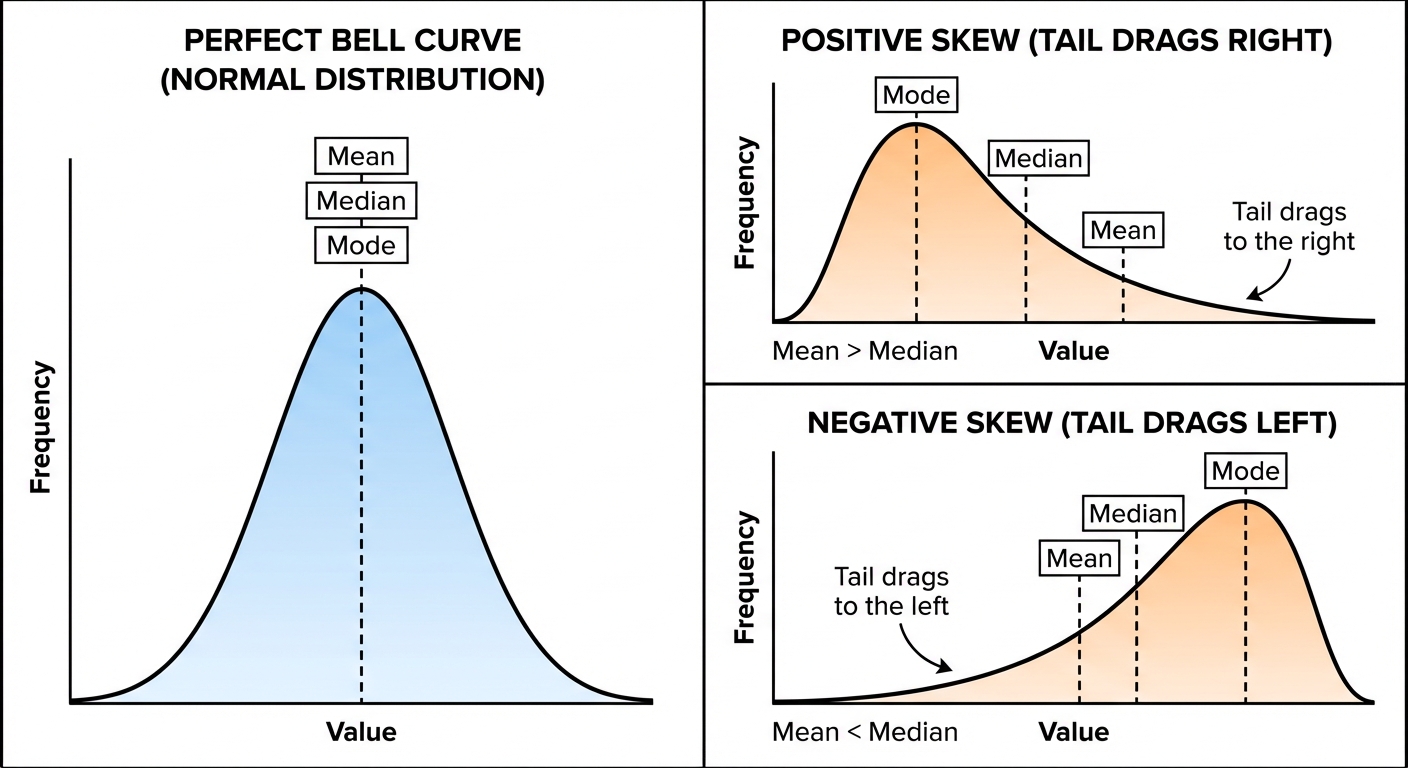
- Normal Distribution (Bell Curve): Symmetrical. Mean, median, and mode are the same.
- 68-95-99.7 Rule: 68% of scores fall within 1 SD of the mean; 95% within 2 SDs.
- Skewed Distribution: Outliers pull the mean.
- Positive Skew: Long tail to the right (many low scores, one high outlier). Mean > Median.
- Negative Skew: Long tail to the left (many high scores, one low outlier). Mean < Median.
Inferential Statistics
Used to determine if results can be generalized to the larger population.
- Statistical Significance: Indicates the likelihood that a result occurred by chance.
- P-Value: The calculated probability.
- If $p \leq 0.05$ (5%), the results are statistically significant (not due to chance). We reject the null hypothesis.
- If $p > 0.05$, the results might just be luck.
Ethics in Psychology (APA Guidelines)
Researchers must adhere to strict ethical standards, overseen by an IRB (Institutional Review Board).
Key Rules (Mnemonic: ICED-P):
- Informed Consent: Participants must know enough about the study to choose whether to participate.
- Confidentiality: Data must remain private; no names connected to results.
- Experiment requires Debriefing: After the study, participants must be told the true purpose and any deception must be explained.
- Protection from Harm: Researchers must minimize physical and mental risk.
Common Mistakes & Pitfalls
- Random Sample vs. Random Assignment:
- Sample is how you get them (allows generalization).
- Assignment is how you sort them (allows cause-and-effect).
- Mistake: "I used random assignment so I can generalize to the whole world." (False, you need a random sample for that).
- Negative Correlation vs. No Correlation:
- Negative correlation acts like a seesaw (one up, one down) and is a strong predictor.
- No correlation means the data is random scatered.
- Descriptive vs. Inferential:
- Descriptive just summarizes the graph you have.
- Inferential tells you if you can trust that graph to apply to real people.
- Skewed Directions: The "skew" is the tail. If the tail points to the right (positive numbers), it is Positively Skewed.