AP Physics 2: Unit 6 - Mechanical Waves and Acoustics
Unit 6: Waves, Sound, and Physical Optics
Properties of Waves
Basics of Wave Motion
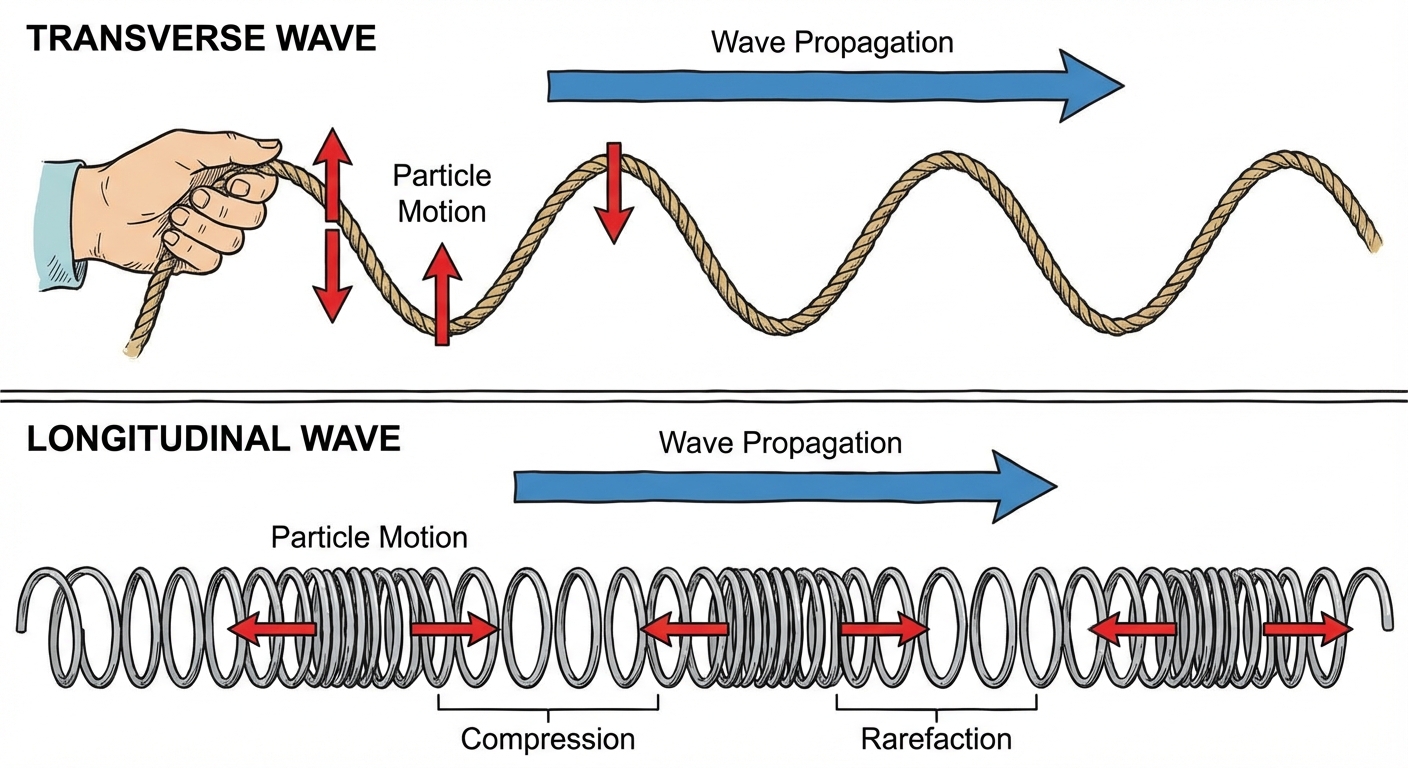
A mechanical wave is a disturbance that travels through a medium, transporting energy and momentum from one location to another without transporting matter. In AP Physics 2, understanding the distinction between the motion of the particles and the motion of the wave pulse is critical.
There are two primary classifications of waves based on particle motion:
- Transverse Waves: The vibration of particles is perpendicular to the direction of energy propagation. (e.g., waves on a string, electromagnetic waves).
- Longitudinal Waves: The vibration of particles is parallel to the direction of energy propagation. These waves consist of compressions (high density) and rarefactions (low density). (e.g., sound waves).
Wave Parameters and Equations
To describe periodic waves quantitatively, we use specific nomenclature:
- Period ($T$): The time it takes for one complete cycle to pass a point. Measured in seconds (s).
- Frequency ($f$): The number of cycles per second. Measured in Hertz (Hz).
- Wavelength ($λ$): The distance between two consecutive identical points on a wave (e.g., crest to crest). Measured in meters (m).
- Amplitude ($A$): The maximum displacement from the equilibrium position.
The Wave Equation:
The relationship between wave speed, frequency, and wavelength is fundamental:
Alternatively, since $f = 1/T$:
The Golden Rules of Waves
Students often miss these two critical conceptual rules:
- Speed depends on the medium: The velocity of a wave ($v$) is determined only by the physical properties of the medium (e.g., tension and linear density for a string; temperature and pressure for air). It does not depend on frequency or amplitude.
- Frequency depends on the source: When a wave passes from one medium to another (e.g., sound moving from air into water), the speed changes, and the wavelength changes, but the frequency remains constant.
Energy and Amplitude
The energy carried by a mechanical wave is proportional to the square of its amplitude. This is crucial for understanding intensity.
For sound, this translates to Loudness. If you double the amplitude of a wave, you quadruple the energy it carries.
The Principle of Superposition
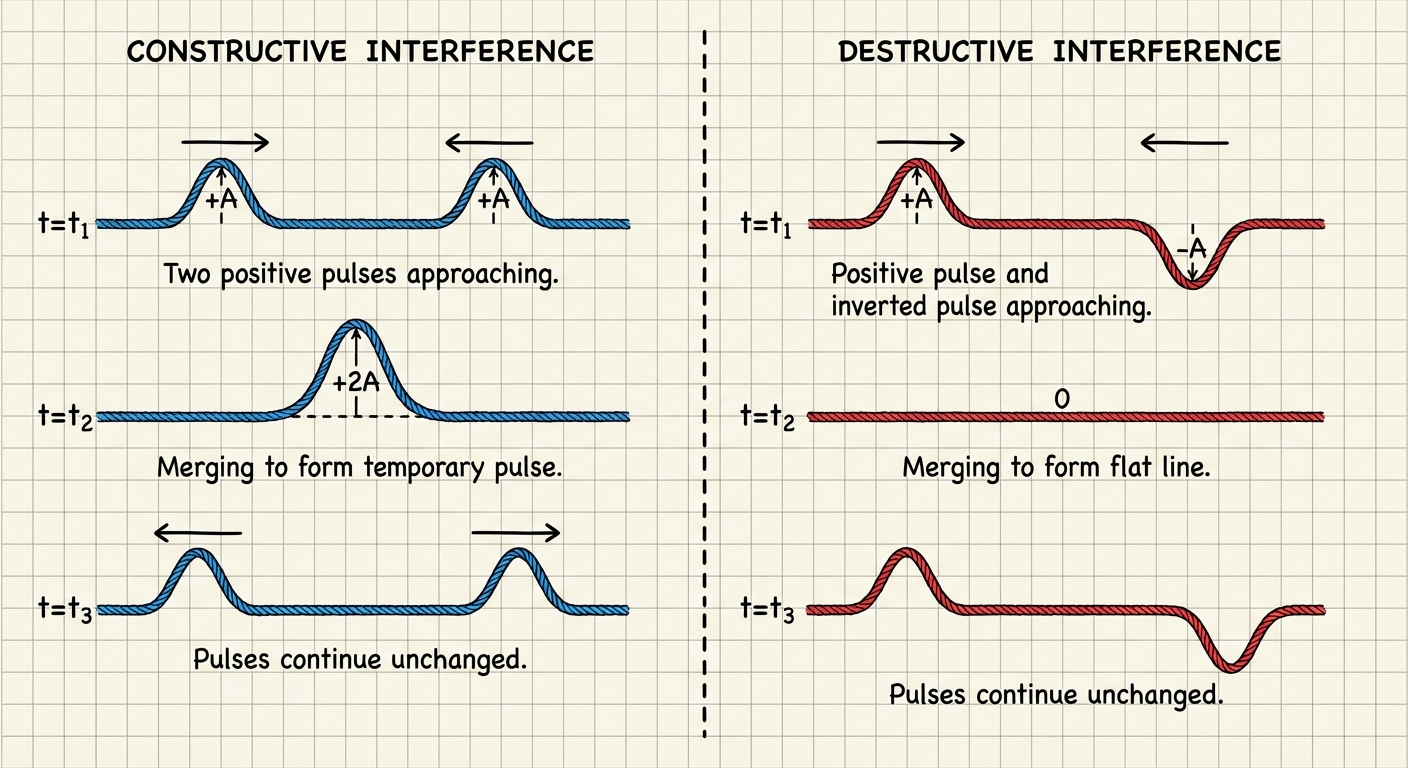
When two or more waves overlap in space, the resultant displacement at any point is the vector sum of the individual displacements. This is called interference.
- Constructive Interference: Waves meet in phase (crest meets crest). The resultant amplitude is the sum of the individual amplitudes ($A{total} = A1 + A_2$).
- Destructive Interference: Waves meet out of phase (crest meets trough). The resultant amplitude is the difference ($A{total} = |A1 - A_2|$).
Sound Waves and Resonance
Nature of Sound
Sound is a longitudinal mechanical wave. It travels as a pressure wave involving compressions (high pressure) and rarefactions (low pressure).
Speed of Sound:
- Speed generally increases with the density and stiffness of the medium.
- $v{solids} > v{liquids} > v_{gases}$.
- In air, speed increases with temperature ($≈ 343 ext{ m/s}$ at $20^° ext{C}$).
Beats
When two sound sources emit frequencies that are slightly different, the waves interfere constructively and destructively at a periodic rate, producing a variation in volume known as beats.
The Beat Frequency is the magnitude of the difference between the two frequencies:
Example: If two tuning forks oscillate at $440 ext{ Hz}$ and $443 ext{ Hz}$, you will hear a pulsating volume (wa-wa-wa sound) at a frequency of $3 ext{ Hz}$ (3 beats per second).
The Doppler Effect
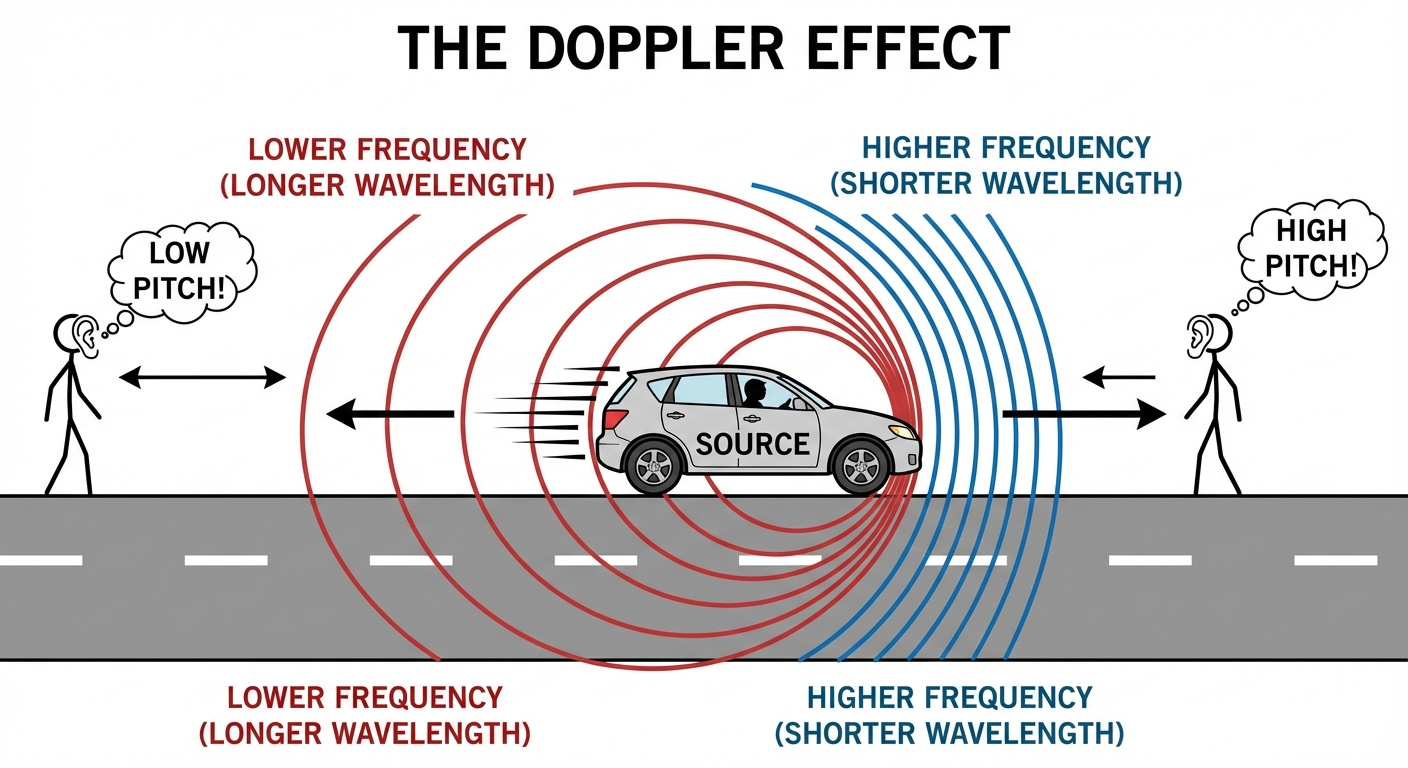
The Doppler Effect is the apparent change in frequency of a wave detected by an observer because the source and the observer have different velocities with respect to the medium.
The Formula:
Variable Definitions:
- $f_{obs}$: Frequency heard by the observer
- $f_s$: Frequency emitted by the source
- $v$: Speed of sound in the medium (usually $≈ 340 ext{ m/s}$)
- $v_{obs}$: Speed of the observer
- $v_s$: Speed of the source
Sign Convention Trick (Top = Towards):
- If motion is Towards, use the Top sign.
- Observer moves toward source (+ in numerator).
- Source moves toward observer (- in denominator).
- If motion is Away, use the Bottom sign.
Standing Waves
Standing waves occur when a wave reflects off a boundary and interferes with the incident wave, creating a pattern that appears stationary. This is the physics behind musical instruments.
Anatomy of a Standing Wave
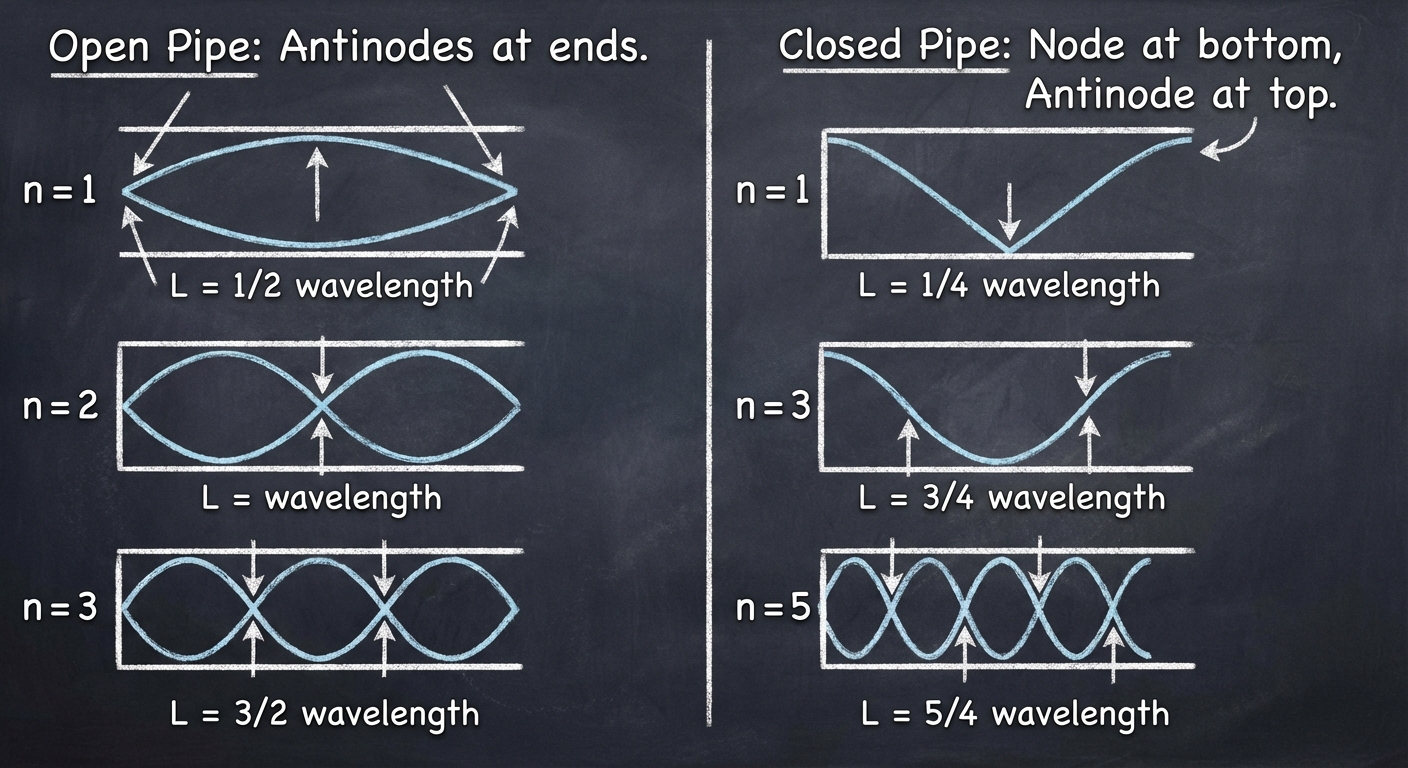
- Nodes: Points of zero amplitude (destructive interference). No displacement occurs here.
- Antinodes: Points of maximum amplitude (constructive interference).
- Distance between adjacent nodes = $λ/2$.
Harmonics Equations
We categorize standing waves by the boundary conditions at the ends of the medium (Open or Closed).
Case 1: Strings and Open Pipes
(Fixed at both ends or Open at both ends)
- Boundary Rules: Nodes at both ends (strings) OR Antinodes at both ends (open pipes).
- Pattern: All integer harmonics are present ($n = 1, 2, 3…$).
Formulas:
- $n$: Harmonic number ($1, 2, 3…$)
- $L$: Length of string or pipe
Case 2: Closed Pipes
(Open at one end, Closed at one end)
- Boundary Rules: Node at the closed end, Antinode at the open end.
- Pattern: Only ODD integer harmonics are possible ($n = 1, 3, 5…$). You cannot have a 2nd or 4th harmonic in a closed pipe.
Formulas:
- $n$: Harmonic number ($1, 3, 5…$)
Comparison Table: Harmonics
| Feature | String / Open Pipe | Closed Pipe |
|---|---|---|
| Ends | Node-Node / Anti-Anti | Node-Antinode |
| Fundamental ($n=1$) | $L = 1/2 λ$ | $L = 1/4 λ$ |
| Allowed Harmonics | $n = 1, 2, 3, 4, …$ | $n = 1, 3, 5, 7, …$ |
| Wavelength Formula | $λ = 2L/n$ | $λ = 4L/n$ |
Common Mistakes & Pitfalls
Frequency vs. Speed Confusion:
- Misconception: Students often think increasing the frequency of a sound wave makes it travel faster.
- Correction: Speed is a property of the medium. Increasing frequency decreases wavelength, but speed ($v$) stays constant (unless you change the air temperature or the medium itself).
Changing Media:
- Misconception: Changing the medium changes the frequency.
- Correction: Frequency is determined by the source. When sound goes from air to water, $v$ increases, $λ$ increases, but $f$ stays the same.
Doppler Sign Errors:
- Misconception: Selecting the wrong signs in the Doppler fraction.
- Correction: Always ask: "Does this motion bring them closer?" If yes, the frequency should go UP. (Add to numerator OR subtract from denominator). "Does this motion separate them?" Freq should go DOWN.
Closed Pipe Harmonic Numbering:
- Misconception: Calling the second available mode in a closed pipe the "2nd harmonic."
- Correction: Because closed pipes only allow odd multiples, the first overtone is actually the 3rd harmonic ($n=3$). There is no $n=2$ for a closed pipe.