Anatomy of the Mind: Physiological Psychology Review
Unit 1: Biological Bases of Behavior
Understanding psychology requires a firm grasp of the biological hardware that powers our thoughts, feelings, and behaviors. This section explores how physiology drives psychology.
Neural Firing and Neurotransmitters
Before understanding the brain as a whole, we must understand its basic building block: the Neuron. Neurons are specialized cells that transmit information through electrical and chemical signals.
The Anatomy of a Neuron
Function follows structure. The design of the neuron allows it to send signals rapidly across long distances.
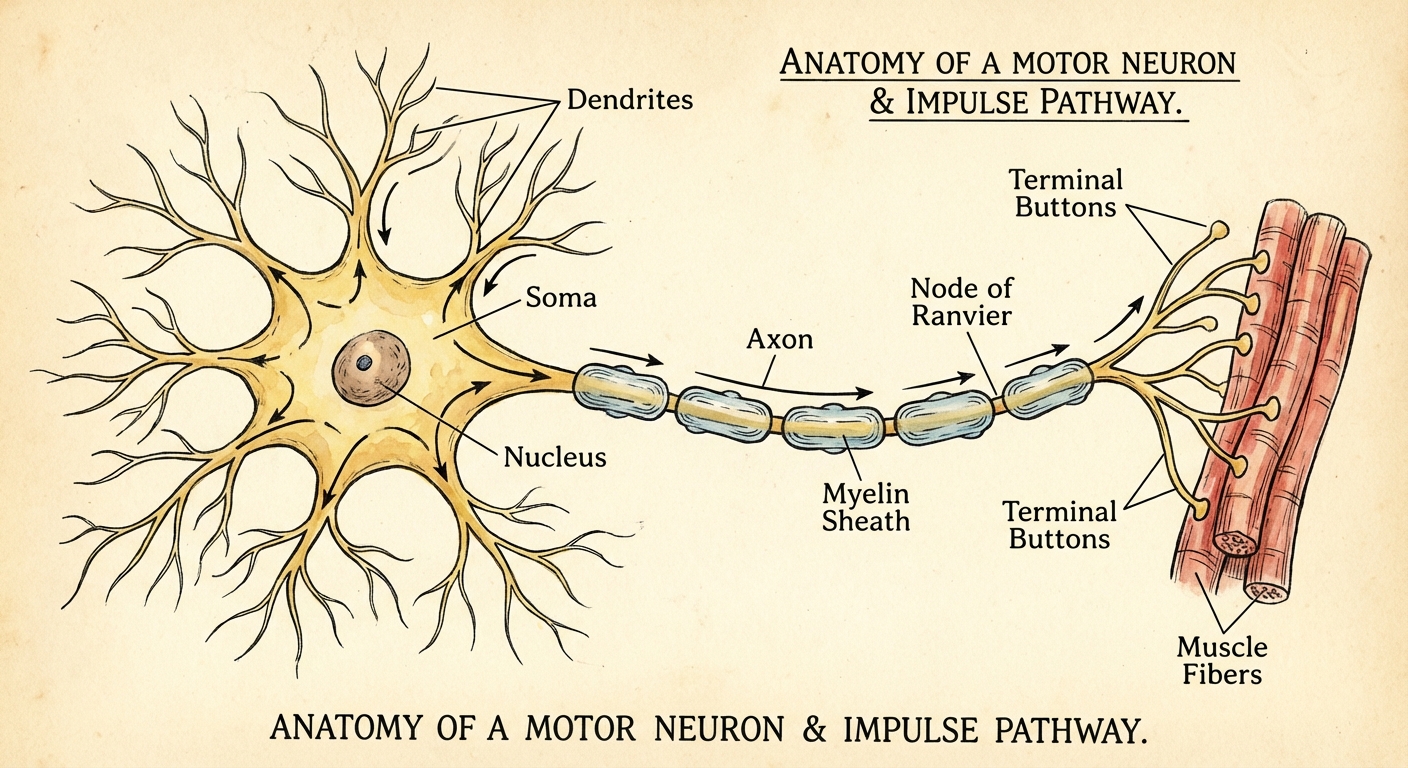
- Dendrites: Branch-like extensions that receive messages from other neurons.
- Soma (Cell Body): Contains the nucleus and maintains the life of the cell.
- Axon: The long, tube-like structure that carries the neural message away from the soma to the terminal buttons.
- Myelin Sheath: A fatty substance produced by glial cells that coats axons to insulate, protect, and speed up the neural impulse.
- Note: Multiple Sclerosis (MS) involves the degeneration of the myelin sheath, slowing communication to muscles.
- Terminal Buttons: The endpoints of the axon that release neurotransmitters into the synapse.
- Synapse: The microscopic gap between the sending neuron and the receiving neuron.
The Action Potential (Neural Firing)
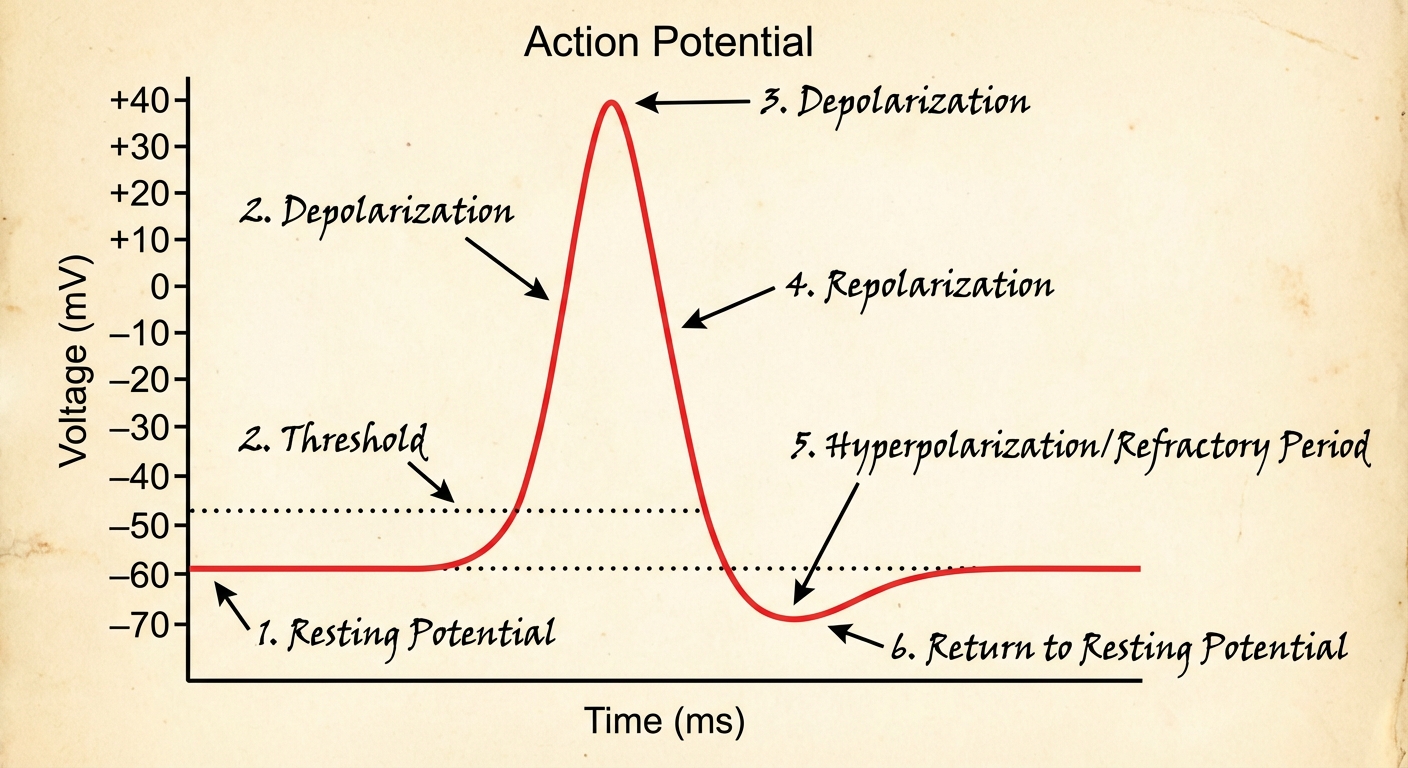
Neuronal communication is electrochemical. The electrical part helps the signal travel within the neuron.
- Resting Potential: The neuron is polarized. The inside is negatively charged relative to the outside (approx $-70mV$). We say the neuron is "at rest."
- Threshold: If the neuron receives enough excitatory signals to reach a specific threshold, the membrane becomes permeable.
- Action Potential (Depolarization): Sodium ions ($Na^+$) rush IN, causing a rapid spike in positive charge (up to $+40mV$). This electrical charge travels down the axon like a fuse burning.
- All-or-None Principle: A neuron either fires at full strength or not at all. There is no "strong" or "weak" firing, only more frequent firing.
- Refractory Period: After firing, the neuron pumps positive ions back out to reset. It cannot fire again during this brief recharging phase.
Neurotransmitters (The Chemical Messengers)
When the electrical signal reaches the terminal buttons, it triggers the release of chemicals called neurotransmitters (NTs). These cross the synapse to bind with receptor sites on the next neuron.
| Neurotransmitter | Function | Malfunction Examples |
|---|---|---|
| Acetylcholine (ACh) | Muscle action, learning, memory | deterioration = Alzheimer’s disease |
| Dopamine | Movement, learning, attention, emotion (reward) | Excess = Schizophrenia; Deficit = Parkinson’s |
| Serotonin | Mood, hunger, sleep, arousal | Deficit = Depression |
| Norepinephrine | Alertness, arousal (flight/fight) | Deficit = Depressed mood |
| GABA | Major inhibitory NT (calms firing) | Deficit = Seizures, tremors, insomnia |
| Glutamate | Major excitatory NT (encourages firing) | Excess = Migraines, seizures |
| Endorphins | Pain control and pleasure | "Runner's high"; artificial opiates mimic this |
Drugs and Neurotransmission
Drugs affect brain chemistry at synapses.
- Agonists: Mimic a neurotransmitter (e.g., Morphine mimics endorphins).
- Antagonists: Block a neurotransmitter's function (e.g., Curare blocks ACh, causing paralysis).
The Nervous System
The body's electrochemical communication network is divided into two main parts.
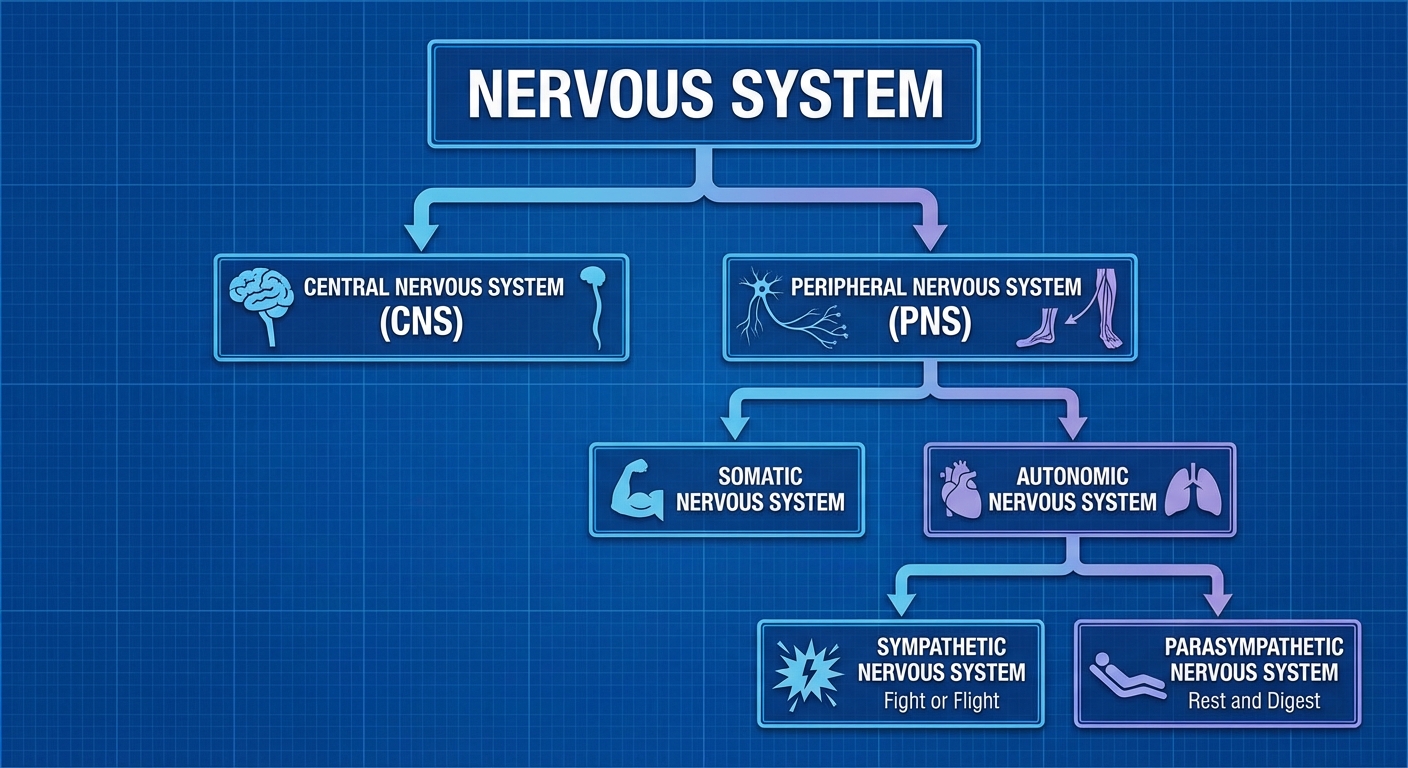
1. Central Nervous System (CNS)
Composed of the Brain and the Spinal Cord.
- The spinal cord acts as the highway connecting the brain to the rest of the body.
- Reflexes: Simple, automatic responses (like pulling your hand away from fire) are processed by the spinal cord before the information reaches the brain.
2. Peripheral Nervous System (PNS)
Connects the CNS to the rest of the body. It is subdivided into:
- Somatic Nervous System: Controls voluntary movements of skeletal muscles.
- Autonomic Nervous System (ANS): Controls self-regulated action of internal organs and glands (automatic). The ANS is further split into:
- Sympathetic NS: Arousing. Mobilizes energy in stressful situations (Fight-or-Flight). Accelerates heartbeat, raises blood pressure, slows digestion.
- Parasympathetic NS: Calming. Conserves energy (Rest-and-Digest). Decelerates heartbeat, stimulates digestion.
Memory Aid:
- Sympathetic = Stress
- Parasympathetic = Peace
The Brain and Its Functions
Evolution has built the brain from the bottom up. The lower structures are primal (survival), while the higher structures enable complex thought.
The Brainstem (Old Brain)
Responsible for automatic survival functions.
- Medulla: Controls heartbeat and breathing. (Damage here is usually fatal).
- Pons: Coordinates movement and controls sleep.
- Reticular Formation: A nerve network that controls arousal and alertness.
- Thalamus: The brain's sensory control center (the switchboard). Receives all senses except smell.
- Cerebellum: The "little brain" at the rear. Processes sensory input, coordinates movement/balance, and enables non-verbal memory.
The Limbic System
Located between the oldest and newest brain areas; associated with emotions and drives.
- Amygdala: Linked to emotion, specifically fear and aggression.
- Hypothalamus: Directs maintenance activities (eating, drinking, body temperature) and governs the endocrine system via the pituitary gland. It is the reward center.
- Hippocampus: Processes explicit memories for storage (the "save button").
The Cerebral Cortex
The intricate fabric of interconnected neural cells covering the cerebral hemispheres (the wrinkled outer layer).
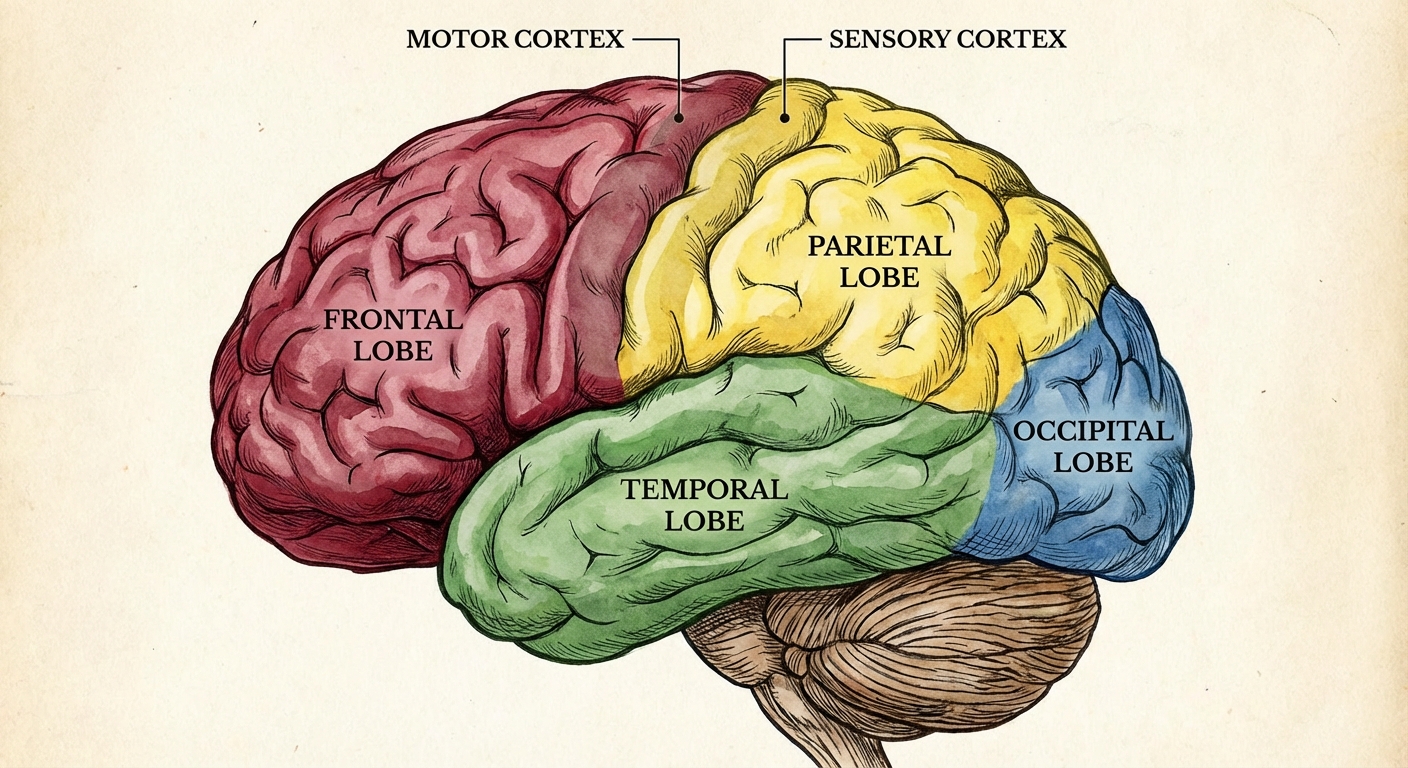
The Four Lobes
- Frontal Lobes: Speaking, muscle movements (Motor Cortex), making plans, and judgment (Prefrontal Cortex).
- Parietal Lobes: Receives sensory input for touch and body position (Somatosensory Cortex).
- Occipital Lobes: Receives information from the visual fields (Visual Cortex).
- Temporal Lobes: Includes the auditory areas (Auditory Cortex).
Language Areas (Association Areas)
Usually located in the Left Hemisphere for most rights-handed people.
- Broca’s Area: Controls language expression/production (muscle movements for speech).
- Wernicke’s Area: Controls language reception/comprehension.
Hemispheric Specialization
- Corpus Callosum: Large band of neural fibers connecting the two brain hemispheres and carrying messages between them.
- Split-Brain: A condition resulting from surgery that cuts the corpus callosum (often to stop seizures). Studies (Sperry/Gazzaniga) show the left hemisphere handles logic/language, while the right handles spatial/creative tasks.
The Endocrine System
The body's "slow" chemical communication system; a set of glands that secrete hormones into the bloodstream.
- Hormones vs. Neurotransmitters:
- Neurotransmitters: Fast, specific, nervous system.
- Hormones: Slow, widespread, bloodstream.
Key Glands
- Pituitary Gland: The "Master Gland." Under the influence of the hypothalamus, it regulates growth and controls other endocrine glands.
- Adrenal Glands: Sit above the kidneys; secrete epinephrine (adrenaline) and norepinephrine to arouse the body in times of stress.
Common Mistakes & Pitfalls
- Afferent vs. Efferent Neurons: Students often mix these up.
- Correction: Remember the acronym SAME. Sensory = Afferent (input to brain); Motor = Efferent (output to muscles).
- Agonists vs. Antagonists:
- Correction: An Agonist is a "Go" (enhances/mimics). An Antagonist is "Anti" (blocks/stops).
- Neurotransmitters vs. Hormones: Some chemicals (like Norepinephrine) act as both.
- Correction: The difference is where they are released. If released at a synapse $\rightarrow$ Neurotransmitter. If released into blood $\rightarrow$ Hormone.
- Broca vs. Wernicke:
- Correction: Broca is for Broken speech (if damaged, you can't speak). Wernicke is for What? (if damaged, you can't understand).