Mastering Java Scope, Static Modifiers, and Object References
Static Variables and Methods
In Java, the keyword static indicates that a member (variable or method) belongs to the class itself, rather than to any specific instance (object) of that class. Understanding the difference between static and instance members is crucial for the AP Computer Science A exam, particularly for tracing code and understanding memory management.
Static Variables (Class Variables)
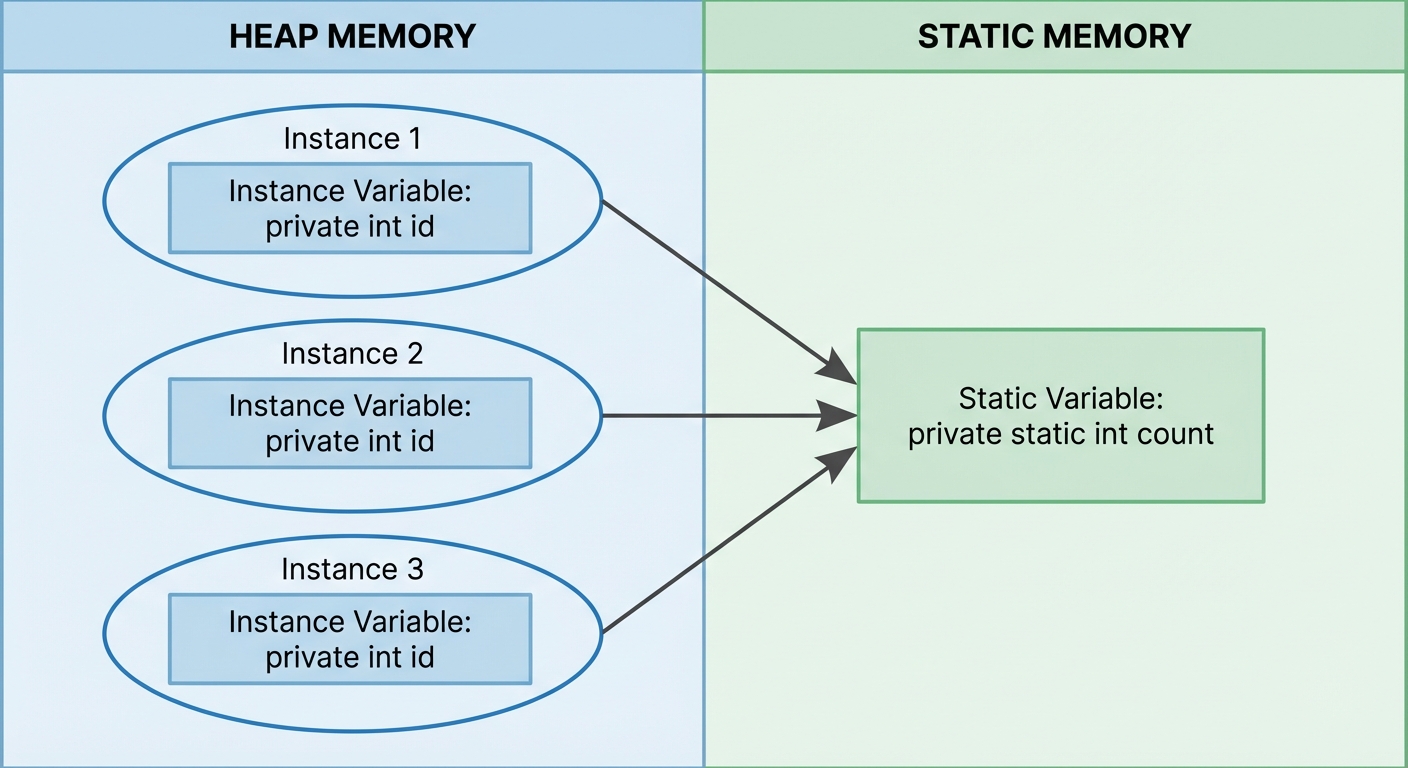
A static variable is shared among all instances of a class. There is only one copy of a static variable in memory, regardless of how many objects of the class are created.
- Initialization: Static variables are initialized only once, when the class is loaded into memory.
- Sharing: If one object changes the value of a static variable, that change is reflected for all other objects.
- Usage: Commonly used for constants (e.g.,
Math.PI) or counters (e.g., counting how many objects of a class have been created).
Static Methods (Class Methods)
A static method is a method that can be called without creating an instance of the class. It performs an operation for the class as a whole, rather than for a specific object.
- Access: Called using the class name (dots notation):
ClassName.methodName(). - Restrictions: Static methods cannot access instance variables or instance methods (non-static methods) directly. They lack a
thisreference because they are not associated with a specific object. - Standard Library Example: The
Mathclass contains only static methods (e.g.,Math.sqrt(),Math.random()).
Comparison Table: Static vs. Instance
| Feature | Instance Member | Static Member |
|---|---|---|
| Belongs to | Specific Object | The Class |
| Memory Copies | One per object | One per class |
| Keyword | (none) | static |
| Access inside class | Can access static & instance | Can only access static |
| Called via | objectName.member | ClassName.member |
Code Example: ID Generator
public class Student {
    private String name;           // Instance variable (unique per student)
    private int studentId;         // Instance variable

    // Static variable (shared counter)
    // private prevents external access, static makes it shared
    private static int nextId = 1000;

    public Student(String name) {
        this.name = name;
        this.studentId = nextId;   // Assign current counter value
        nextId++;                  // Increment shared counter
    }

    // Static method
    public static int getNextAvailableId() {
        return nextId;
    }
}
Scope and Access
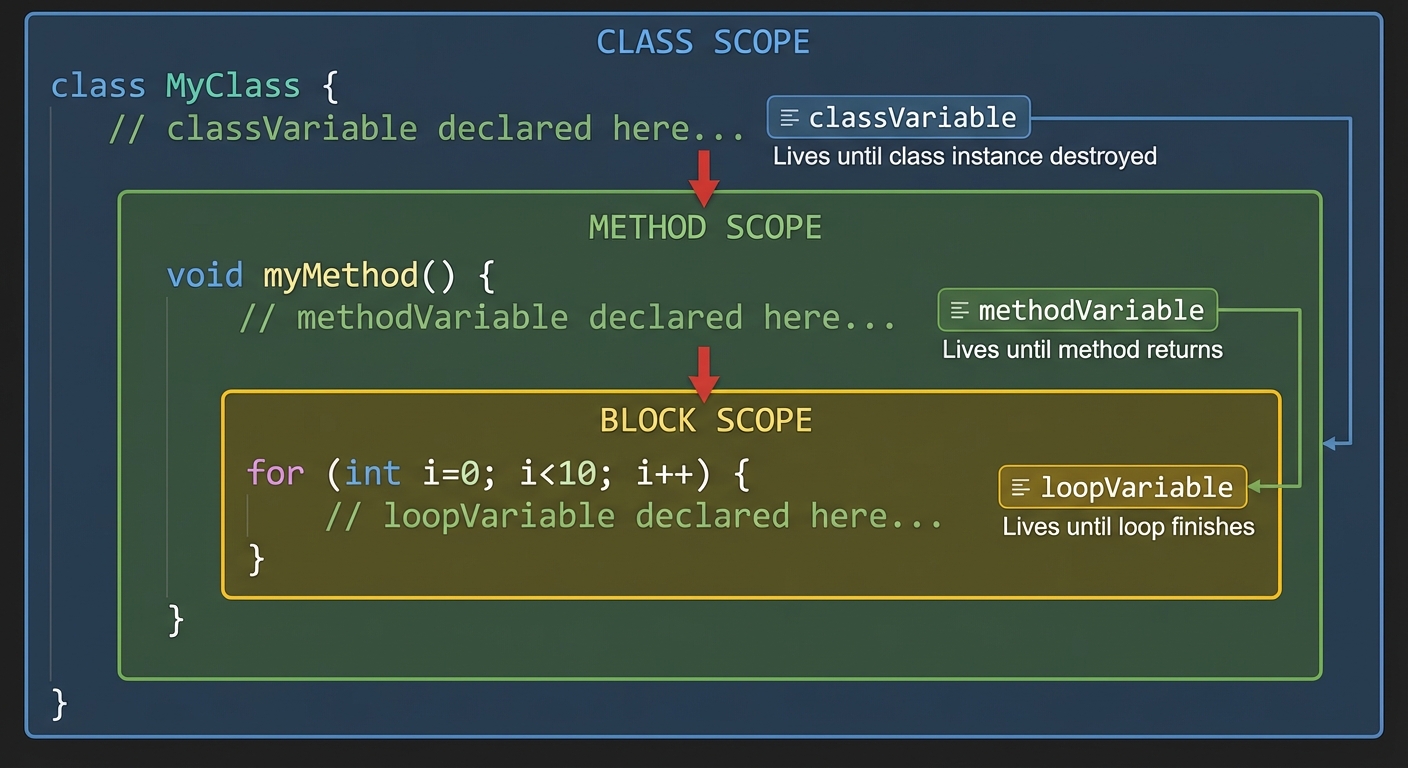
Scope defines the region of the code where a variable is visible and can be accessed. In AP Computer Science A, you must distinguish primarily between instance variables and local variables.
Types of Scope
Class Scope (Instance Variables):
- Declared inside the class but outside any method.
- Visible to all methods within the class.
- Lifetime: Exists as long as the object exists.
- Default Values: Automatically initialized to default values (0, 0.0, false, null) if not explicitly assigned.
Local Scope (Local Variables):
- Declared inside a method, constructor, or block (e.g., inside a loop or
ifstatement). - Visible only within the block
{ }where they are declared. - Lifetime: Created when the block is entered, destroyed when the block is exited.
- Default Values: No default values. Must be initialized before use, or a compile-time error occurs.
- Declared inside a method, constructor, or block (e.g., inside a loop or
Variable Shadowing
Shadowing occurs when a local variable (often a parameter) has the same name as an instance variable. Within the local scope, the local variable takes precedence, effectively "hiding" the instance variable.
To resolve shadowing and refer to the instance variable, you must use the this keyword.
The this Keyword
The keyword this is a reference to the current object—the object upon which the current method or constructor is being called.
Primary Uses in AP CSA
Resolving Ambiguity (Shadowing):
This is the most common use case. When a constructor parameter has the same name as an instance variable,this.variableNameexplicitly refers to the instance variable, whilevariableNamerefers to the parameter.public class Box { private int width;
}// Constructor parameter 'width' shadows instance variable 'width' public Box(int width) { this.width = width; // LHS: instance variable // RHS: local parameter }Passing the Object as a Parameter:
Sometimes a method needs to pass the current object to another method or object.public void registerPair(Partner other) { // 'this' passes the current object to the other object's method other.setPartner(this); }
Common Mistakes & Pitfalls
Static Accessing Non-Static:
- Mistake: Trying to access an instance variable (like
name) inside astatic void main(String[] args)or any static method. - Correction: Static methods do not know which object you are talking about. You must create an object first.
- Error:
Non-static field ... cannot be referenced from a static context.
- Mistake: Trying to access an instance variable (like
Local Variable Initialization:
- Mistake: Declaring a local variable inside a method and trying to print it without assigning a value.
- Correction: Unlike instance variables, local variables do not get default values (like 0 or null). You must explicitly initialize them.
Variable Shadowing Logic:
- Mistake: Writing
width = width;in a constructor when parameters match field names. - Result: This assigns the parameter to itself. The instance variable remains uninitialized (0 or null). You must use
this.width = width;.
- Mistake: Writing
Misunderstanding Static Persistence:
- Mistake: Assuming a static variable resets when a new object is created.
- Reality: A static variable keeps its value across the entire program execution unless explicitly changed. If Object A increments a static counter, Object B sees the incremented value.