Transformation of Europe: Mechanisms of Industry (1750–1914)
Unit 6: Industrialization and Its Effects
The Industrial Revolution in Britain
Origins and Preconditions
The Industrial Revolution was not a singular event but a gradual, transformative process that began in Great Britain around 1750 before spreading to the continent. It marked a fundamental shift from an agrarian, handicraft economy to one dominated by machine manufacturing and division of labor.
Why Britain First?
Historians often categorize the reasons for Britain's primacy using the following factors:
- Agricultural Revolution: The Enclosure Movement privatized common lands, increasing efficiency but forcing small farmers off the land. This created a surplus labor force ready for urban factory work.
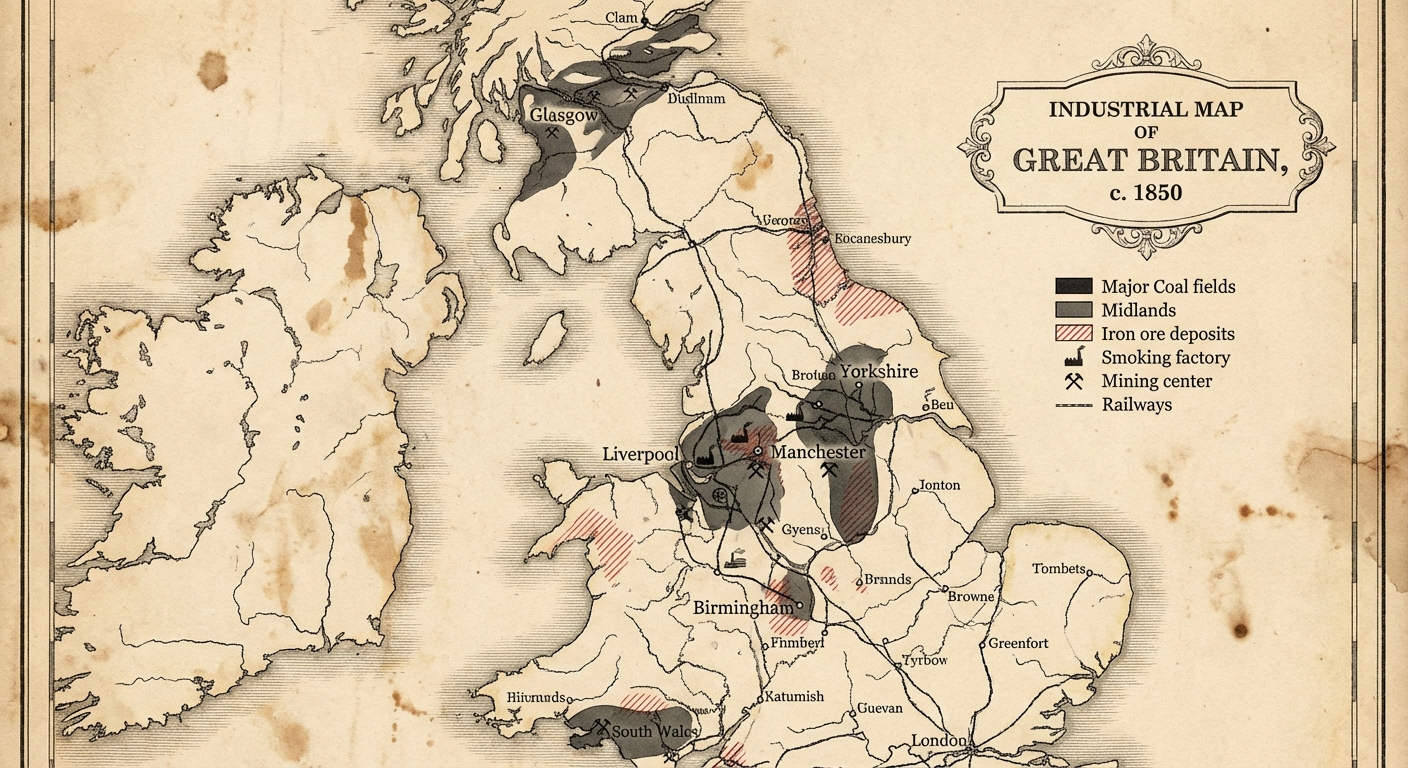
- Geography and Infrastructure: Britain is an island with an irregular coastline, making water transport accessible. The natural abundance of navigable rivers and a vast network of canals reduced the cost of shipping raw materials.
- Natural Resources: Britain possessed vast, accessible deposits of coal (energy) and iron ore (construction).
- Capital and Banking: A highly developed central bank (Bank of England) and flexible credit markets allowed entrepreneurs to invest in new machinery.
- Political Stability: Unlike the continent, which was ravaged by the French Revolution and Napoleonic Wars, Britain had a stable government that protected private property and issued patents to inventors.
Key Innovations in Textiles and Steam
The revolution began in the textile industry to meet the growing demand for cotton cloth.
The Mechanization of Textiles:
- Flying Shuttle (1733): Allowed weavers to work faster.
- Spinning Jenny (1764): James Hargreaves' invention allowed spinners to spin multiple threads at once.
- Water Frame (1769): Richard Arkwright's machine used water power, necessitating the move from home-based cottage industries to factories.
The Steam Engine:
The most critical invention of the era. While early engines (Newcomen) pumped water from mines, James Watt patented a more efficient steam engine in 1769.
Context Point: Watt’s engine allowed factories to move away from rivers and into urban centers near coal sources. It was later adapted for transportation, leading to the steam locomotive (George Stephenson’s Rocket, 1829).
The Crystal Palace: Symbol of Dominance
By 1851, Great Britain was the "Workshop of the World." To showcase this dominance, Britain hosted the Great Exhibition in the Crystal Palace, a massive structure made entirely of glass and iron. It displayed over 100,000 exhibits of industrial machinery and imperial goods, symbolizing Britain's economic and technological hegemony.
The Spread of Industrialization
Continental Challenges and the "Gap"
Industrialization on the European continent lagged behind Britain by roughly 50 years. This delay was caused by:
- The chaos of the French Revolution and Napoleonic Wars (1789–1815).
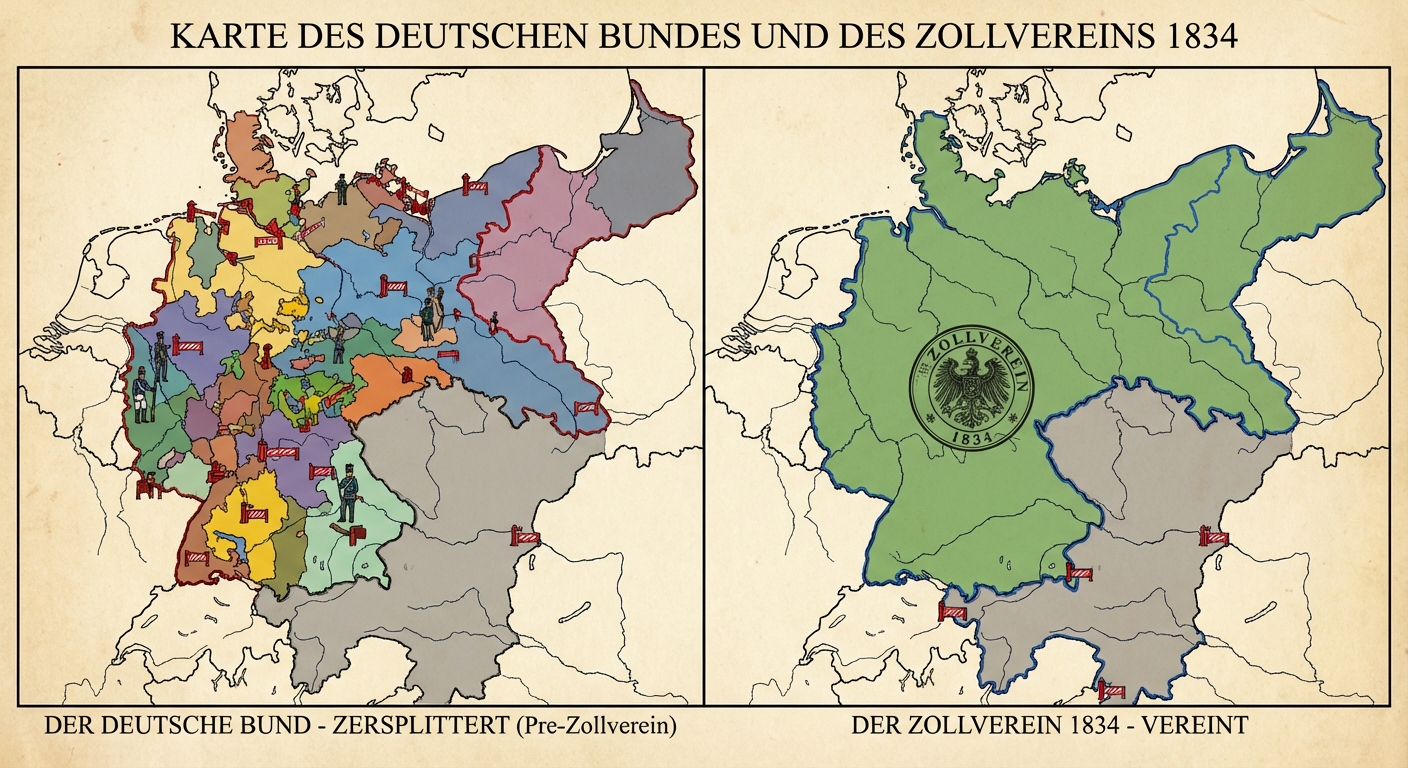
- Trade barriers and tolls within fragmented German states.
- Investment in more traditional, luxury goods rather than mass production.
The Role of Government and Banks
Unlike in Britain, where industrialization was largely private and spontaneous, continental industrialization was often state-sponsored.
- Government Subsidies: Governments in France and Prussia paid for railroad construction and guaranteed interest on railroad bonds to reduce risk for investors.
- Corporate Banking: New banks, such as the Crédit Mobilier in France, were formed specifically to pool resources for massive industrial investments (heavy industry/railroads) involving limited liability protection.
Friedrich List and the Zollverein
German economist Friedrich List (1789–1846) was a proponent of economic nationalism. He argued that for Germany to compete with Britain, it needed a unified industrial policy.
Key Concepts:
- The Zollverein (1834): A customs union among German, states. It eliminated internal tariffs and created a free-trade zone within Germany, while maintaining protective tariffs against non-German nations (specifically Britain). This laid the economic foundation for German political unification.
- National System: List argued that free trade only benefited advanced economies (Britain). Developing nations needed protective tariffs to nurture infant industries.
Geographical Variation
- Early Adopters: Belgium (rich in coal/iron like Britain), France, and the German states.
- Lagging Regions: Southern and Eastern Europe (Italy, Austria-Hungary, Russia) lagged due to serfdom, lack of resources, and rigid aristocratic dominance. Russia would not begin serious industrialization until the late 19th century under Sergei Witte.
The Second Industrial Revolution (c. 1870–1914)
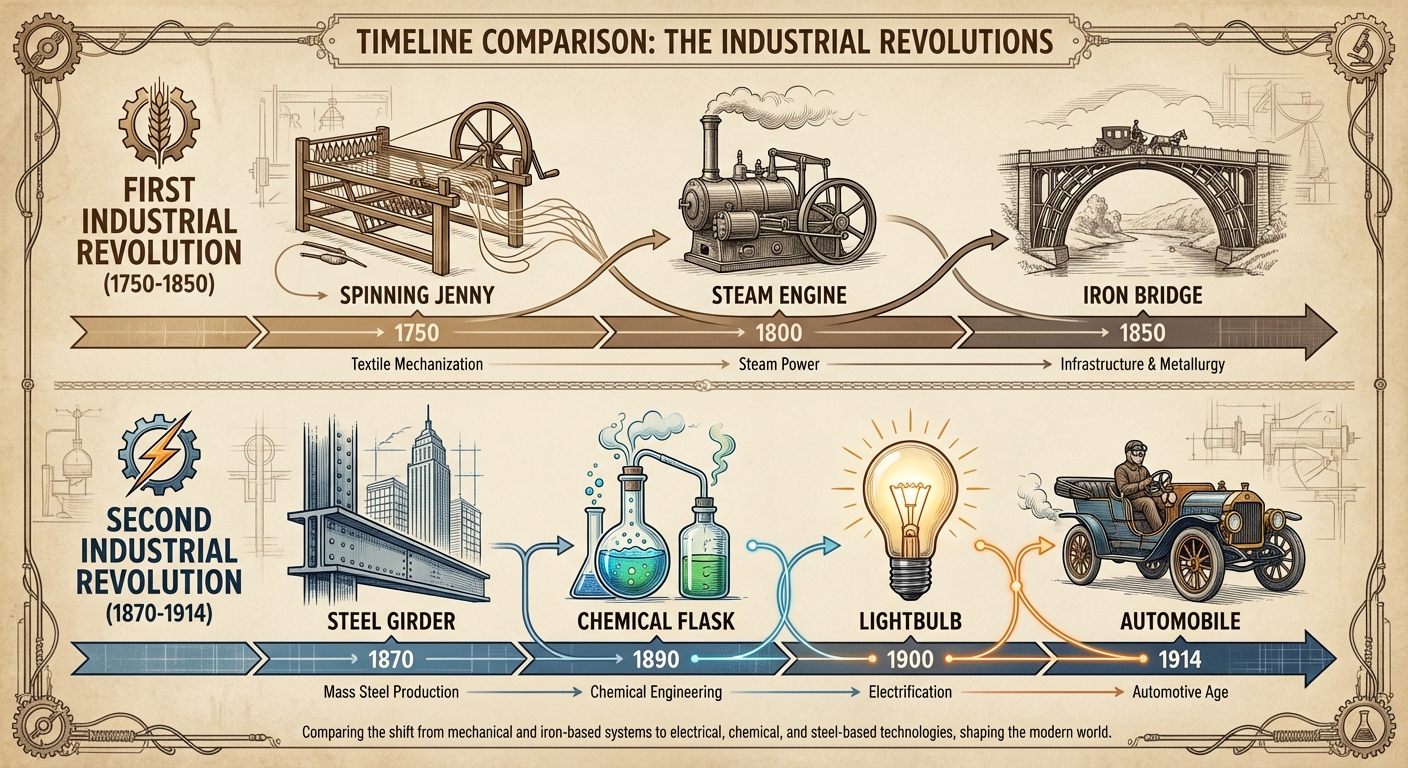
While the First Industrial Revolution focused on textiles, steam, and iron, the Second Industrial Revolution saw the rise of steel, chemicals, electricity, and petroleum. Germany and the United States emerged as the new industrial leaders, surpassing Britain.
Shift in Key Industries
| Feature | First Industrial Rev. (1750–1850) | Second Industrial Rev. (1870–1914) |
|---|---|---|
| Primary Metal | Iron (wrought/cast) | Steel (stronger, lighter, more flexible) |
| Energy Source | Steam (Coal) | Electricity and Petroleum |
| Key Industries | Textiles, Railroads | Chemicals, Steel, Autos, Consumer Goods |
| Leading Nation | Great Britain | Germany, USA |
Key Innovations:
- The Bessemer Process (1850s): Henry Bessemer developed a way to mass-produce steel cheaply. Steel replaced iron in machinery, ships, and skyscrapers.
- Chemical Industry: Germany dominated this sector, producing synthetic dyes, soaps, pharmaceuticals, and fertilizers.
- Electricity: Replaced steam engines in factories, allowing for 24-hour production (thanks to the lightbulb) and conveyor belts.
Communication and Transportation
technological advancements shrank the world, facilitating global trade and imperialism.
- Internal Combustion Engine: Powered by petroleum, this led to the automobile (Daimler/Benz) and eventually the airplane (Wright Brothers).
- Communication:
- Telegraph: Instant communication across continents (underwater cables).
- Telephone (Bell): Direct voice communication.
- Radio (Marconi): Wireless communication effective for ships and military.
Common Mistakes & Pitfalls
- Confusing the Timelines: Students often conflate the First and Second Industrial Revolutions. Remember:
- 1st = Textiles/Iron/Steam (Britain led).
- 2nd = Steel/Chemicals/Electricity (Germany/USA led).
- "Instant" Revolution: Avoid writing that the Industrial Revolution happened overnight. It was a slow, uneven process that coexisted with traditional farming for decades.
- Ignoring the State's Role: A common error is assuming the rest of Europe industrialized exactly like Britain (free market). On the continent, the government played a much larger, direct role (e.g., the Zollverein, state-funded railroads).
- Geographic Generalization: Do not claim "Europe Industrialized." Industrialization was regional. The Ruhr Valley (Germany) and Manchester (UK) were industrial hubs, while Southern Italy and Eastern Russia remained largely agrarian well into the 20th century.