Unit 9 Review: The Reshaping of Modern Europe (1989–Present)
The Collapse of Communism and the Soviet Union
The final decade of the 20th century witnessed one of the most rapid geopolitical shifts in history: the dismantling of the Iron Curtain and the disintegration of the USSR. This shift moved Eastern Europe from totalitarian command economies toward democracy and capitalism.
Gorbachev and the Reform Era
In 1985, Mikhail Gorbachev became the general secretary of the Communist Party. Realizing the Soviet economy was stagnating due to the arms race and inefficiency, he introduced two vital concepts:
- Glasnost (Openness): Political liberalization allowed for public criticism of the government, reduced censorship, and allowed limited democratic elections.
- Perestroika (Restructuring): Economic restructuring that introduced limited free-market practices to the command economy.
Note: Gorbachev intended to Save the USSR, not destroy it. However, these freedoms allowed long-suppressed nationalist sentiments to explode.
The Revolutions of 1989
Often called the "Year of Miracles," 1989 saw the collapse of Soviet satellite regimes across Eastern Europe. Unlike previous uprisings (Hungary 1956, Prague 1968), Gorbachev refused to send the Red Army to intervene (the repudiation of the Brezhnev Doctrine).
| Country | Key Events & Leaders |
|---|---|
| Poland | Led by the labor union Solidarity (Solidarność) and Lech Wałęsa; forced the first free elections in the Eastern Bloc. |
| Hungary | Opened its border with Austria, creating a hole in the Iron Curtain through which East Germans fled. |
| East Germany | Massive protests led to the fall of the Berlin Wall (Nov 9, 1989). Reunification occurred in 1990. |
| Czechoslovakia | The Velvet Revolution: A peaceful, non-violent transition of power led by playwright Václav Havel. |
| Romania | The only violent revolution; dictator Nicolae Ceaușescu ordered troops to fire on protesters but was overthrown and executed. |
The Dissolution of the Soviet Union (1991)
Following the loss of the satellite states and rising nationalism within Soviet republics (like Lithuania and Ukraine), hardliners attempted a coup against Gorbachev in August 1991. The coup failed largely due to resistance led by Boris Yeltsin.
- Result: The Communist Party was banned, and by December 1991, the Soviet Union was officially dissolved.
- Post-Soviet Russia: Under Yeltsin, Russia underwent "shock therapy" (rapid privatization), leading to the rise of Oligarchs (wealthy elites) and economic instability before Vladimir Putin stabilized (and centralized) power starting in 2000.
Ethnic Conflict in the Balkans
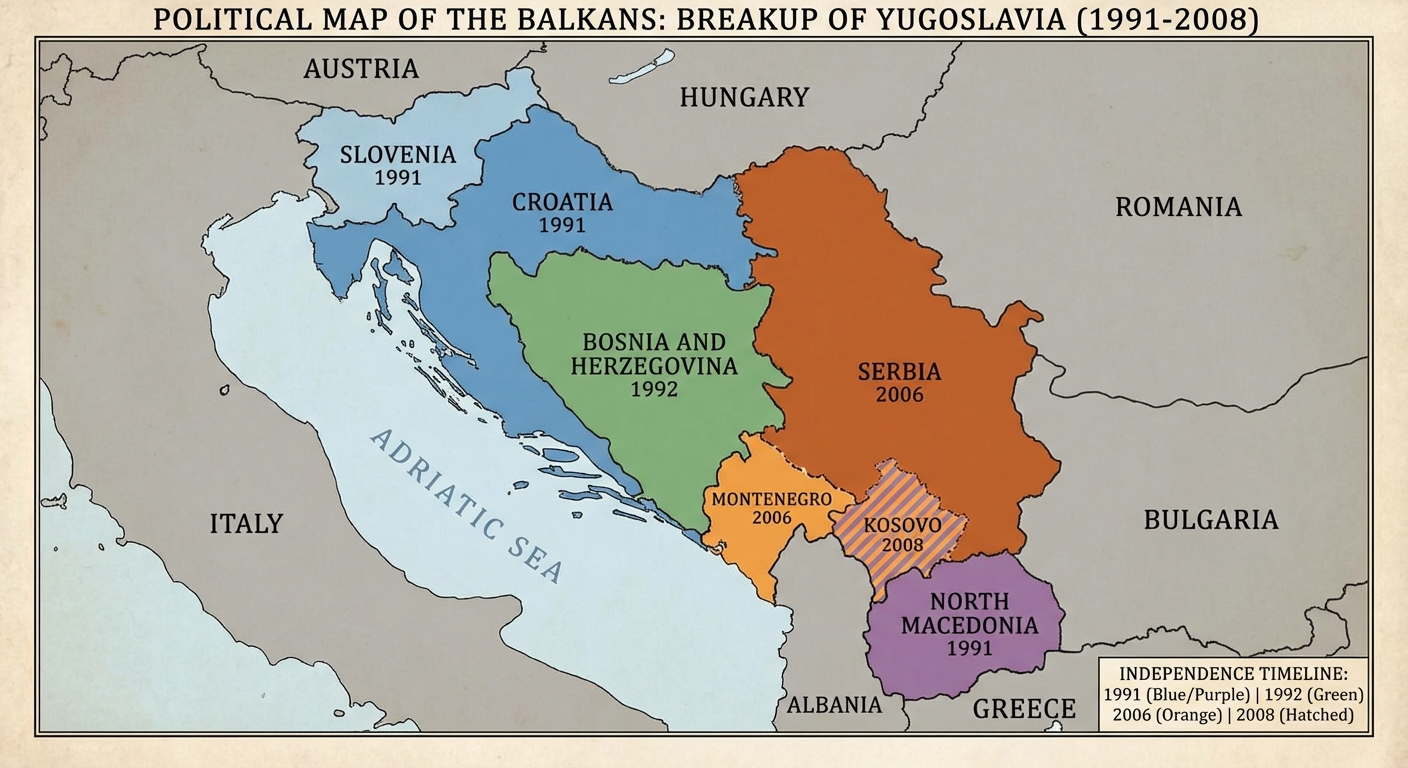
The power vacuum left by the death of Josip Broz Tito and the fall of communism led to the violent breakup of Yugoslavia.
- Slobodan Milošević: Serbian president who sought to unite all Serbs in a "Greater Serbia."
- Ethnic Cleansing: The systematic forced removal or extermination of ethnic groups, most notably termed against Bosnian Muslims by Bosnian Serbs.
- Dayton Accords (1995): Peace agreement mediated by the U.S. that ended the war in Bosnia.
- Kosovo (1999): NATO bombed Serbia to stop attacks on ethnic Albanians in Kosovo.
European Integration and the European Union (EU)
As the Cold War ended, Western European nations accelerated their move from economic cooperation to political and monetary union. This represents a shift toward Supranationalism—where member states yield some sovereignty to a higher authority.
From Common Market to European Union
The integration process followed a specific trajectory:
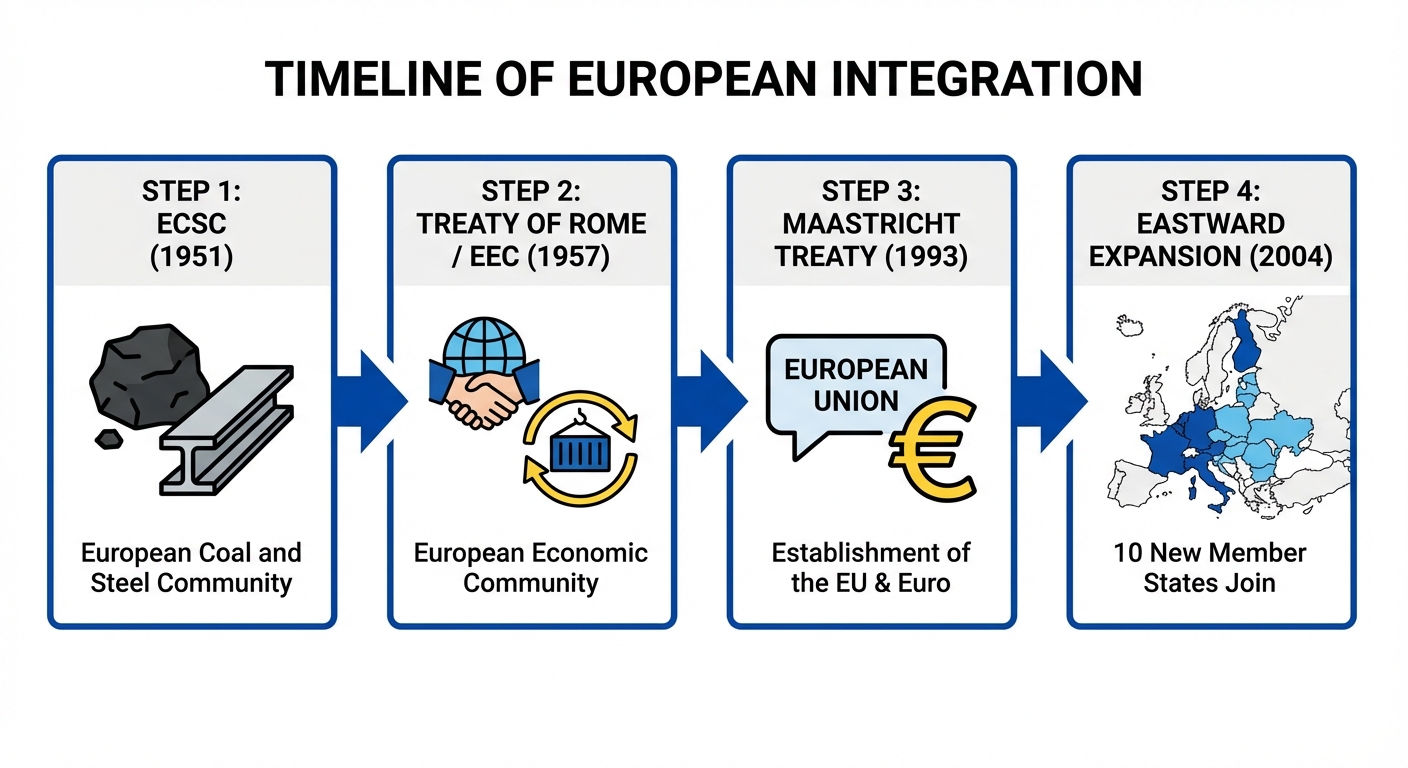
- ECSC (1951): European Coal and Steel Community.
- EEC (1957): European Economic Community (Common Market) via the Treaty of Rome.
- The European Union (1993): Established by the Maastricht Treaty.
The Maastricht Treaty and the Euro
The Maastricht Treaty (1991/1993) was the pivotal agreement that transformed the European Community into the EU. It established:
- Common citizenship.
- Cooperation on defense and justice.
- A roadmap for a single currency.
The Euro (€) was introduced in 1999 (physically in 2002).
- Pros: Eliminated exchange rates, facilitated trade, unified the market.
- Cons: Member states lost control over their own monetary policy (interest rates/printing money). This became a crisis in 2008-2012 when economies like Greece collapsed, but could not devalue their currency to recover.
Expansion and Brexit
- The 2004 Expansion: The EU welcomed 10 new members, mostly from the former Eastern Bloc (e.g., Poland, Hungary). This marked the symbolic reunification of Europe but introduced economic disparities.
- Brexit (2016): The United Kingdom voted to leave the EU, driven by concerns over sovereignty, migration, and contribution costs. It highlighted the friction between Euroskeptics and integrationists.
21st-Century Challenges
Modern Europe faces complex social and political issues related to demographics, globalization, and human rights.
Migration and The Refugee Crisis
Europe has transitioned from a continent of emigration (19th century) to one of immigration.
- Guest Workers (Gastarbeiter): Post-WWII, Western Europe invited workers (often from Turkey or North Africa) to fill labor shortages. many stayed, changing the religious and cultural landscape.
- 2015 Refugee Crisis: Civil war in Syria and instability in the Middle East led to over 1 million refugees seeking asylum in Europe.
- Angela Merkel (Germany) accepted large numbers, arguing humanitarian duty.
- Eastern European nations (like Hungary) largely closed borders, creating internal EU conflict.
Demographics and the Welfare State
Europe is experiencing an aging population due to low birth rates.
- Inverted Population Pyramid: Fewer young workers are paying taxes to support a growing number of retirees.
- Impact: Strain on the Cradle-to-Grave welfare states established post-WWII. Governments struggle to fund pensions and healthcare.
Populism and National Identity
A resurgence of nationalist and far-right parties (right-wing Populism) has occurred in response to globalization, migration, and the EU.
- Characteristics: Anti-immigrant, Euroskeptic, emphasis on traditional national identity.
- Examples: National Rally (France), AfD (Germany), Fidesz (Hungary).
- The Debate: Europe is currently debating whether to embrace a multicultural, secular identity or revert to traditional national/Christian roots.
Memory Aids & Exam Tips
Mnemonic: "G-P" for Gorbachev
- Glasnost = Go speak (Free speech/Openness)
- Perestroika = Production/Price (Economic restructuring)
Common Mistakes & Pitfalls
- Confusing 1989 and 1991: The Berlin Wall fell and satellites broke free in 1989. The Soviet Union itself did not collapse until 1991. Do not say "The USSR fell in 1989."
- The Euro vs. The EU: Not all EU members use the Euro (e.g., Sweden, Denmark). Conversely, some non-EU microstates use the Euro. They are not synonymous.
- Simplifying the Balkans: Students often just say "religious war." It is vital to use the term Ethnic Cleansing and identify it as an issue of ethno-nationalism (Serb vs. Croat vs. Bossniak/Albanian) fueled by the political vacuum left by Tito.
- Maastricht Mistake: Don't forget the Maastricht Treaty. If an essay asks about the formation of the modern EU or the Euro, this treaty is the required evidence point.