Unit 6 Review: Urbanization, Size, and Global Connectivity
The Origin and Influences of Urbanization
Urbanization does not happen by accident. The formation of the first cities and the continuous growth of modern urban areas are driven by changes in agriculture, transportation, communication, and government policies. To understand where we are going, you first need to understand where we came from.
Foundations of Urban Life
The very first urban hearths (like Mesopotamia and the Nile Valley) required two fundamental factors to exist:
- Agricultural Surplus: Advancements in irrigation and farming allowed fewer people to feed a larger population, freeing others to specialize in non-agricultural work.
- Social Stratification: A surplus allowed for the creation of a leadership class (kings, priests) to organize society, collect taxes, and defend the settlement.
Site and Situation
One of the most frequently tested concepts on the AP exam is the distinction between Site and Situation. These factors determine why a city was founded and whether it grows or declines.
- Site: The physical characteristics of a place. Think of the intrinsic qualities of the land.
- Examples: Climate, availability of water, soil quality, topography (e.g., New Orleans is located on low-lying delta land; Mexico City is located in a high-altitude basin).
- Situation: The location of a place relative to other places. Think of the connectivity.
- Examples: Being near a major trade route, a railroad intersection, or a harbor (e.g., Singapore grew because it sits at a choke point for shipping between India and East Asia).
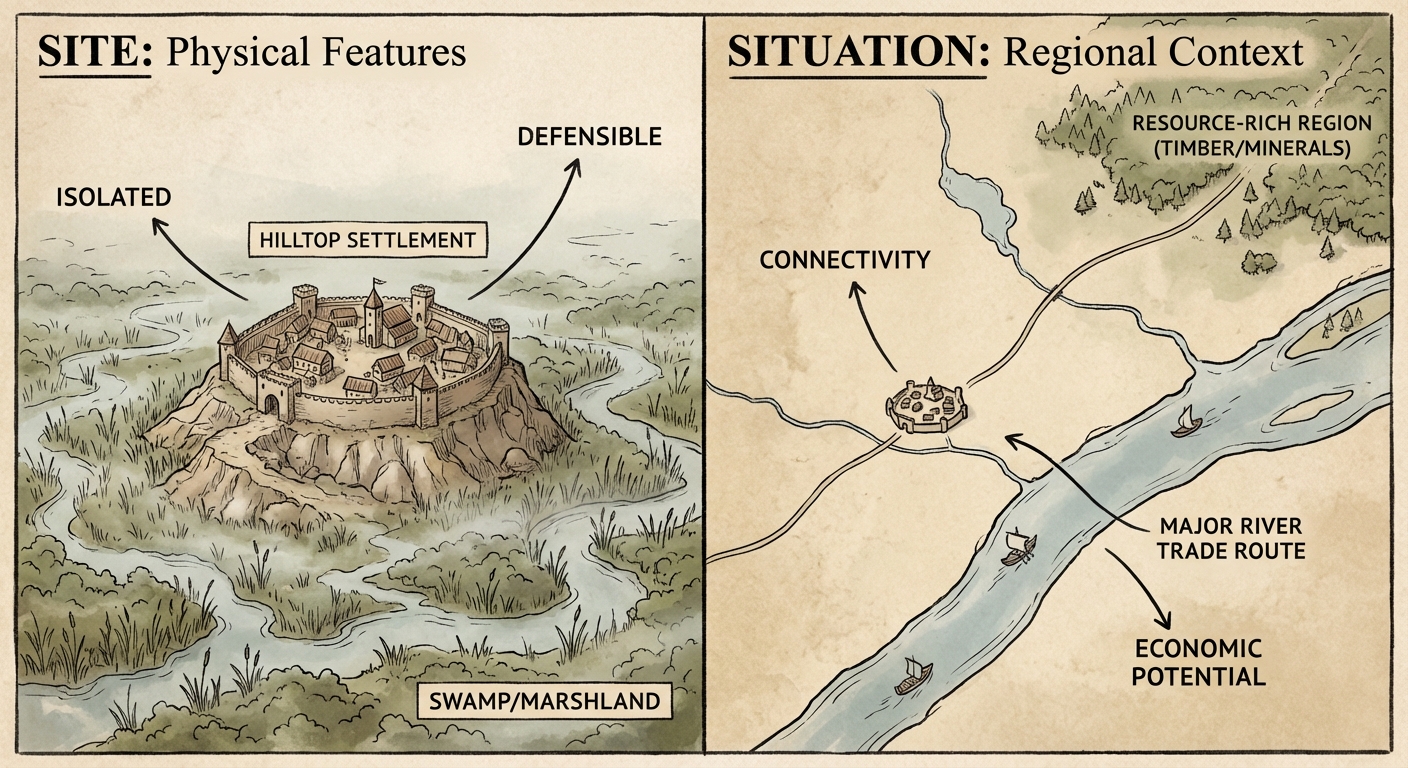
Note: A city's site rarely changes (unless through major engineering), but its situation changes frequently. For example, the Silk Road cities declined when sea trade became dominant.
Borchert’s Epochs of Urban Growth
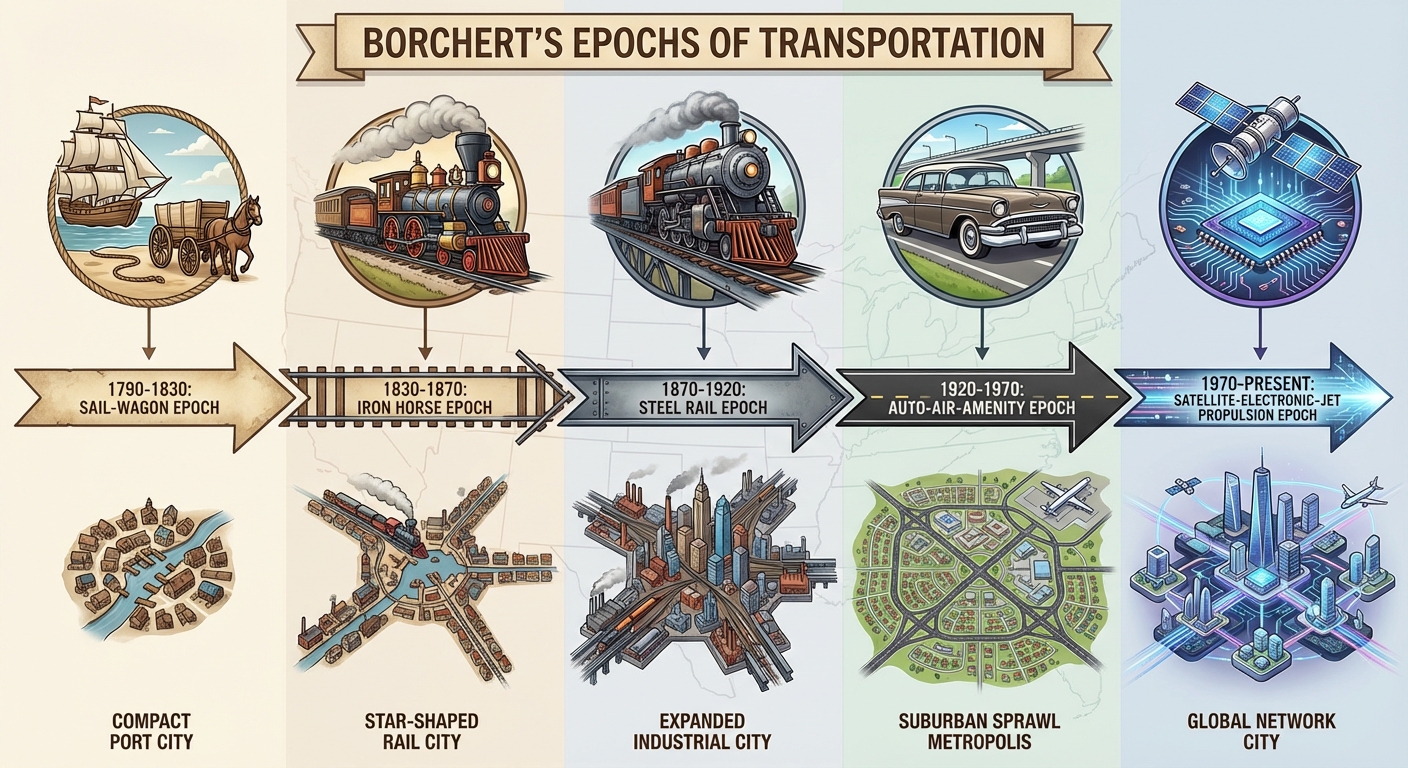
John Borchert developed a model explaining how transportation technology determines the size and shape of American cities. As transportation gets faster, cities can expand outward.
| Epoch | Time Period | Key Transport | Urban Form Impact |
|---|---|---|---|
| Sail-Wagon | 1790–1830 | Water ports; Wagons | Compact, coastal cities; very dense |
| Iron Horse | 1830–1870 | Steam engines; Steamboats | Expansion along river/rail corridors |
| Steel Rail | 1870–1920 | Long-haul rail | Manufacturing belt cities grow (Chicago, Pittsburgh) |
| Auto-Air-Amenity | 1920–1970 | Cars; Internal Combustion | Suburbs explode; sprawl begins |
| Satellite-Electronic | 1970–Present | Jet / Digital | High-tech corridors; telecommuting |
Cities Across the World
Urbanization is capturing the globe, but it looks different depending on where you are. We classify cities based on population size and their specific developmental patterns.
The Urban Hierarchy
Cities generally fit into a hierarchy based on the services they offer. Small settlements offer basic needs (gas stations, grocery stores), while large settlements offer specialized services (brain surgery, stock exchanges, professional sports).
- Hamlet: A tiny cluster of homes (a few dozen people).
- Village: Larger than a hamlet, offering basic services.
- Town: Has a defined boundary and local government.
- City: Large population with a distinct commercial center (CBD).
Megacities and Metacities
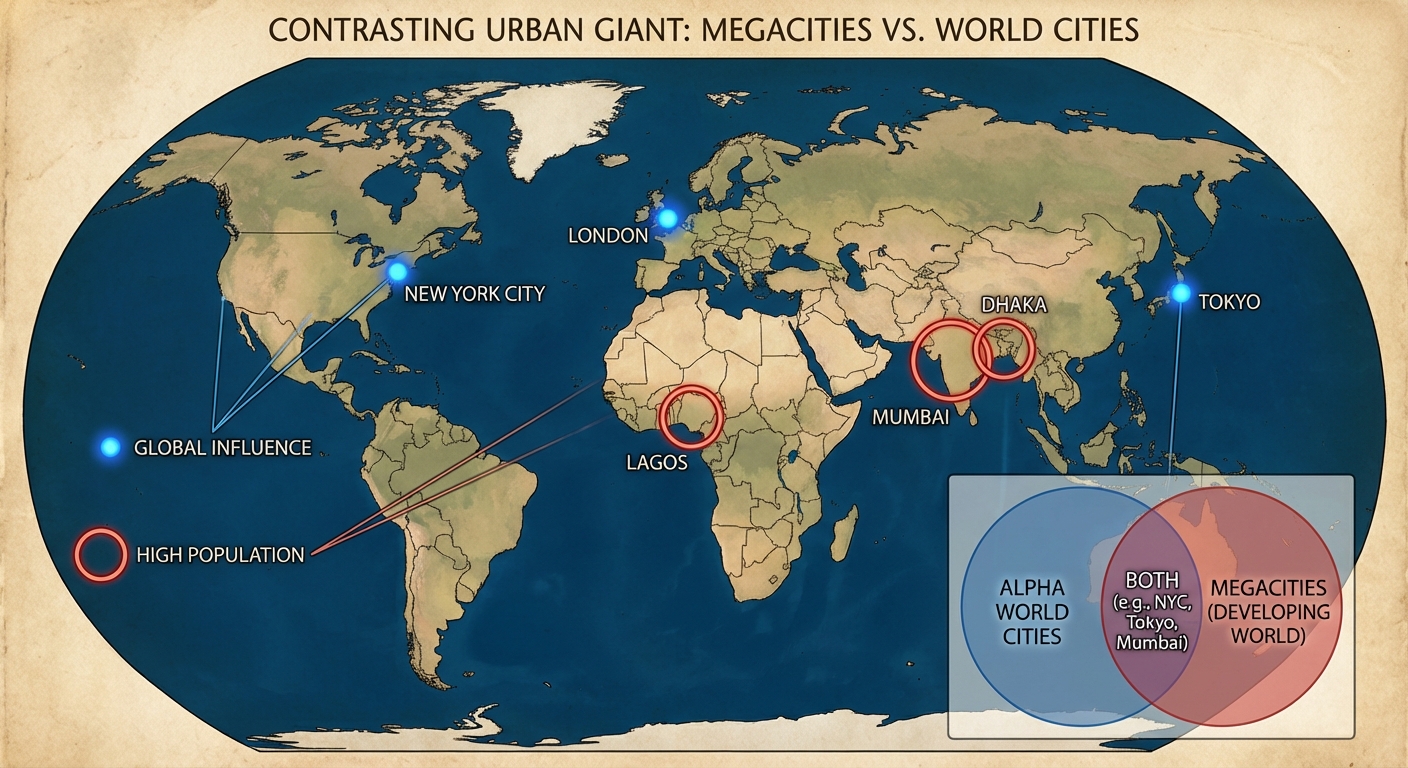
As the periphery and semi-periphery (LDCs/NICs) urbanize rapidly due to rural-to-urban migration, we are seeing massive population centers emerge. These definitions are based strictly on population size, not influence.
- Megacities: Cities with more than 10 million people.
- Examples: Dhaka (Bangladesh), Lagos (Nigeria), Sao Paulo (Brazil).
- Trend: Most new megacities are in the Global South (Asia, Africa, Latin America).
- Metacities: Sprawling urban regions with more than 20 million people.
- Examples: Tokyo (Japan), Delhi (India), Shanghai (China).
Suburbanization and Sprawl
In the developed world (and increasingly elsewhere), cities are spreading outward. This decentralization creates unique urban forms:
- Suburbanization: The movement of people from urban core areas to the surrounding outskirts.
- Sprawl: The unrestricted growth of housing, commercial development, and roads over large expanses of land, with little concern for urban planning.
New Urban Classifications (Must-Know Terms)
- Boomburbs: Rapidly growing suburban cities that have a population over 100,000. They are not the "core" city but are large enough to be cities themselves. (e.g., Mesa, Arizona).
- Exurbs: Prosperous residential districts beyond the suburbs. People here often commute via technology or drive long distances for a semi-rural lifestyle.
- Edge Cities: Nodes of economic activity that develop in the suburbs. Unlike a traditional bedroom community, an Edge City has more jobs than bedrooms. Features include office parks, shopping malls, and hotels near highway intersections.
Cities and Globalization
While megacities are defined by size, World Cities (or Global Cities) are defined by power and influence. Globalization has created a network of cities that drive the world economy.
What Makes a "World City"?
These cities function as control centers for the global economy. Their influence transcends their national borders.
Key Characteristics:
- Headquarters: Home to multinational corporations (MNCs) and international organizations (e.g., the UN in NYC).
- Financial Power: Major stock exchanges and banking institutions.
- Advanced Services: High concentration of corporate law firms, advertising agencies, and consulting groups.
- Cultural Influence: Media hubs, fashion capability, and world-renowned museums.
The Hierarchy of World Cities
Often categorized into tiers:
- Alpha Cities: The primary nodes in the global economic network. (London, New York City, Tokyo).
- Beta Cities: Important but slightly less dominant linking cities (Chicago, Frankfurt, Sydney).
- Gamma Cities: Connect smaller regional economies to the world system (Amsterdam, Johannesburg, Melbourne).
Urban Linkages
World cities are often more connected to each other than they are to the rural areas of their own countries. Examples of these linkages include:
- Air Traffic: Heavy flight volume between London and NYC.
- Digital Connectivity: Submarine fiber-optic cables connecting financial markets for milli-second trading.
Common Mistakes & Pitfalls
Here are the most frequent errors students make on the AP exam regarding urbanization:
Confusing Megacities with World Cities:
- The Trap: Assuming that because a city is huge (Megacity), it is powerful (World City).
- The Reality: Lagos, Nigeria is a Megacity (huge population) but not a top-tier World City (financial control). Zurich, Switzerland is too small to be a Megacity, but it is a World City because of its banking power.
Mixing up Site and Situation:
- The Trap: Thinking "Situation" means "where it sits."
- The Fix: Remember Site = Soil (physical traits). Situation = Relations (relative location).
Assuming Urbanization = Development:
- The Trap: Thinking that highly urbanized countries are always wealthy.
- The Reality: While MDCs are highly urbanized, the rate of urbanization is currently fastest in LDCs due to massive rural-to-urban migration.
Misidentifying Edge Cities:
- The Trap: Calling any suburb an Edge City.
- The Fix: An Edge City must be a destination for work and shopping, not just a place where people sleep.