Unit 5: The Unification of Electromagnetism
Maxwell's Equations (Qualitative and Quantitative)
In previous units, we studied electricity and magnetism separately. We learned that stationary charges produce collisions (Gauss's Law), moving charges produce magnetic fields (Ampère's Law), and changing magnetic flux produces electric fields (Faraday's Law).
Maxwell's Equations are a set of four partial differential equations that combine these concepts into a single, unified theory of electromagnetism. They describe how electric and magnetic fields are generated and altered by each other and by charges and currents.
1. Gauss’s Law for Electricity
This equation relates electric flux to the charge enclosed by a surface. It essentially states that electric field lines diverge away from positive charges and converge onto negative charges.
- Qualitative Meaning: Electric charge acts as a source ($+$) or sink ($-$) of the electric field.
- Key implication: Electric monopoles (charges) exist.
2. Gauss’s Law for Magnetism
This equation calculates the magnetic flux through a closed surface. Unlike electric fields, magnetic field lines are continuous loops; they have no beginning or end.
- Qualitative Meaning: The net magnetic flux through any closed surface is zero.
- Key implication: Magnetic Monopoles do not exist. You cannot isolate a North pole from a South pole. If you cut a magnet in half, you get two smaller magnets.
3. Faraday’s Law of Induction
This law describes how a changing magnetic environment induces an electric field. This is the operating principle behind generators and transformers.
- Qualitative Meaning: A time-varying magnetic flux induces a distinct type of non-conservative electric field that curls around the area of flux change.
- Note: The negative sign represents Lenz's Law (conservation of energy).
4. Ampère-Maxwell Law
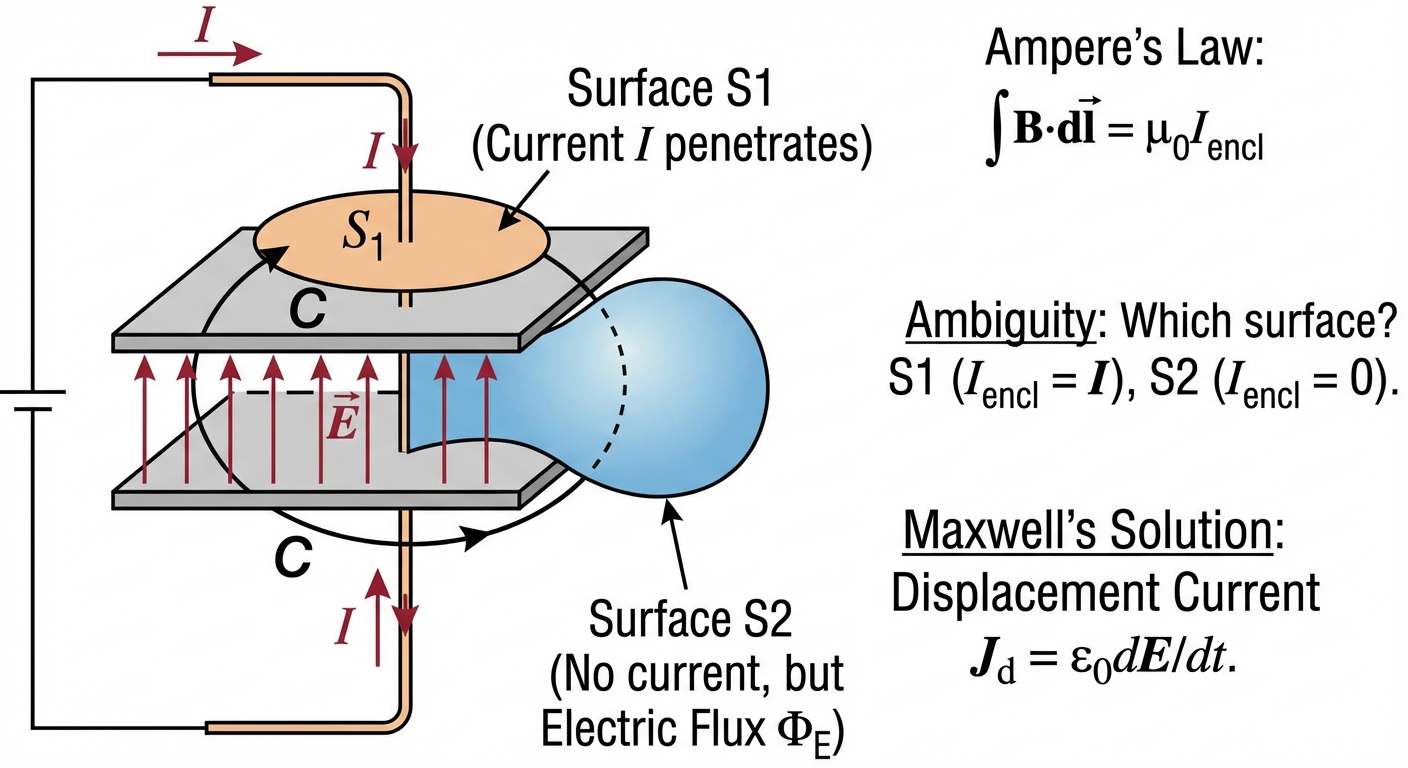
This is the final piece of the puzzle. Originally, Ampère's Law stated that magnetic fields are generated by electric current ($I$). However, Maxwell realized this was incomplete. He added a term called the Displacement Current, which showed that a changing electric flux also generates a magnetic field.
- Qualitative Meaning: Magnetic fields are created by two sources:
- Physical conduction current ($I$).
- Changing electric fields ($d\Phi_E/dt$).
The Displacement Current
Before Maxwell, Ampère's law failed when applied to a capacitor being charged. If you draw an Amperian loop around the wire, there is enclosed current ($I$). If you draw a surface bounded by that same loop but passing between the capacitor plates, there is no physical charge flowing ($I=0$), yet the magnetic field is still there.
Maxwell fixed this by defining Displacement Current ($I_d$):
Where $\Phi_E$ is the electric flux $EA$. This "current" doesn't involve the motion of real charge, but it creates a magnetic field just as a real current does. This symmetry allows electromagnetic waves to exist.
Electromagnetic Waves
Maxwell's modification to Ampère's Law led to a profound specific prediction: Electric and Magnetic fields can sustain each other in empty space.
- A changing electric field creates a magnetic field (Ampère-Maxwell).
- This changing magnetic field creates an electric field (Faraday).
- This cycle repeats, allowing energy to propagate through space as a wave, without needing a medium (like air or water).
Properties of EM Waves
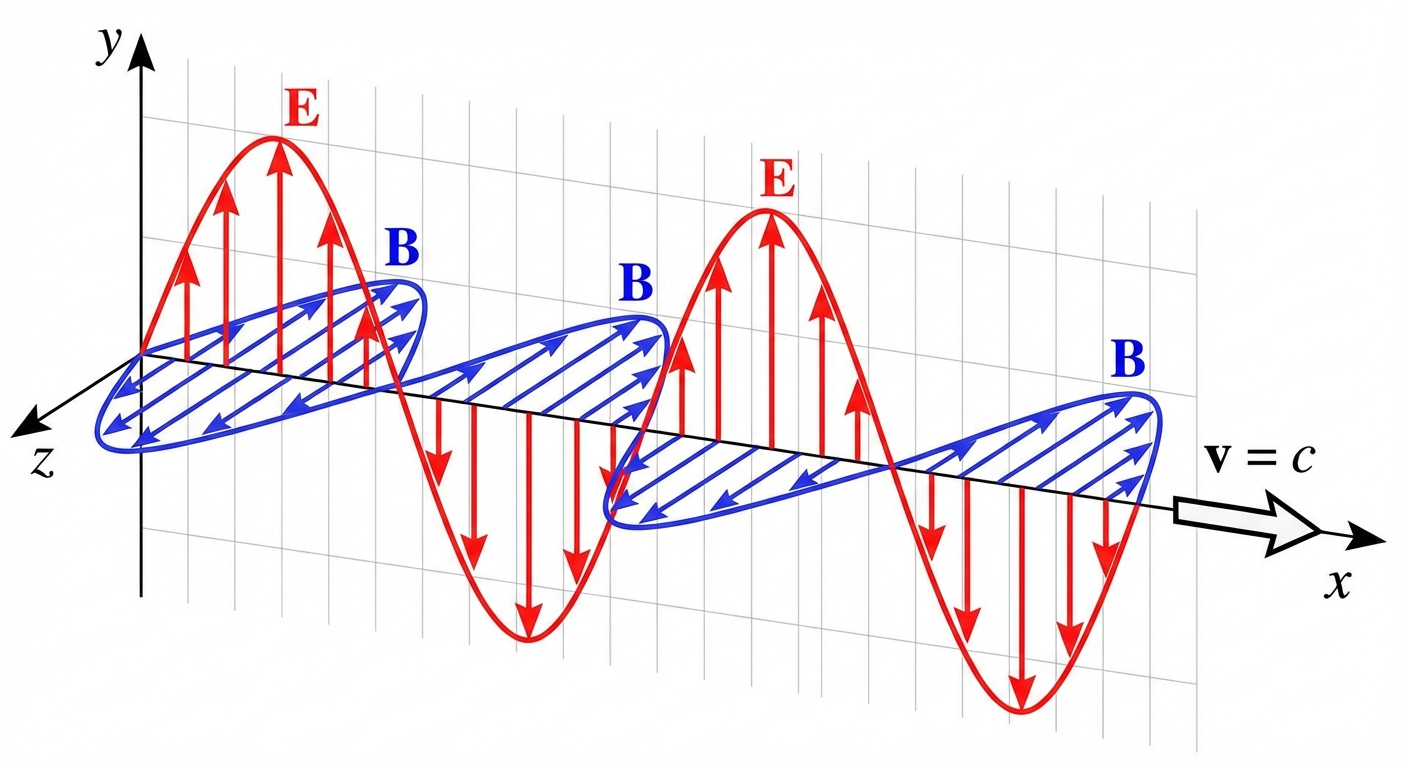
- Transverse Nature: The Electric field ($\mathbf{E}$), Magnetic field ($\mathbf{B}$), and the direction of propagation (velocity $\mathbf{v}$ or vector $\mathbf{k}$) are all mutually perpendicular (orthogonal).
- Phase: In a vacuum, $\mathbf{E}$ and $\mathbf{B}$ oscillate in phase (they reach their maximums and zeros at the same time).
- Speed: The speed of these waves can be calculated using the permeability and permittivity constants found in Maxwell's Equations.
The Speed of Light ($c$)
By solving the wave equations derived from Maxwell's laws, the speed of an EM wave in a vacuum ($c$) is:
This calculation united the fields of Optics and Electromagnetism. Light is an electromagnetic wave.
Mathematical Representation
If a wave propagates in the $+x$ direction, the fields can be described as:
Relationship between Magnitude:
At any instant in a vacuum:
Or commonly: $E{max} = c B{max}$.
Energy Transport: The Poynting Vector
EM waves carry energy. The rate of energy flow per unit area is described by the Poynting Vector ($\mathbf{S}$).
- Direction: The direction of $\mathbf{S}$ is the direction of wave propagation.
- Intensity ($IV$): The average magnitude of the Poynting vector is the Intensity ($I$), measured in $W/m^2$.
Common Mistakes & Pitfalls
Confusing $\mathbf{E}$ and $\mathbf{B}$ Orientations:
- Mistake: Thinking $\mathbf{E}$ and $\mathbf{B}$ are parallel.
- Correction: They are always perpendicular to each other and perpendicular to the direction of travel. Use the Right-Hand Rule on $\mathbf{E} \times \mathbf{B}$ to find the velocity direction.
Displacement Current Misconception:
- Mistake: Thinking displacement current involves electrons jumping between capacitor plates.
- Correction: $I_d$ is a mathematical term representing the changing electric flux. No physical charge crosses the gap of an ideal capacitor.
Magnitude Ratios:
- Mistake: Thinking $E = B$ because they are in phase.
- Correction: In SI units, $E$ is much larger than $B$ ($E = cB$). $E$ is in N/C (or V/m) and $B$ is in Tesla.
Gauss's Law for Magnetism:
- Mistake: Looking for terms like $Q_{mag}$ or trying to calculate flux from a single pole.
- Correction: $\oint \mathbf{B} \cdot d\mathbf{A}$ is always zero. If a problem asks for the flux through a closed surface surrounding a magnet… write 0 and move on!