Comprehensive Guide to Electrostatics: Forces, Fields, and Energy
Electric Charge and Fundamental Properties
Electrostatics is the study of electric charges at rest. In AP Physics 2, understanding the microscopic nature of charge is the foundation for analyzing complex fields and potentials.
Properties of Electric Charge
There are two types of charge: positive (protons) and negative (electrons). The interaction between them is governed by a simple heuristic: Like charges repel; opposite charges attract.
Quantization of Charge: Charge is not continuous. It comes in discrete packets. The smallest fundamental unit of charge is the elementary charge ($e$).
Total charge ($q$) on an object is always an integer multiple ($n$) of this fundamental unit:Conservation of Charge: The net charge of an isolated system remains constant. Charge cannot be created or destroyed, only transferred from one object to another.
Conductors vs. Insulators
- Conductors (e.g., metals): Materials where electrons are free to move throughout the atomic lattice. When excess charge is placed on a conductor, it pushes itself apart to reside entirely on the surface.
- Insulators (e.g., rubber, glass): Materials where electrons are bound tightly to atoms. Charge placed on an insulator stays where it is put.
Charging Methods
- Friction/Triboelectric Effect: Physically stripping electrons from one material to another.
- Conduction: Direct contact allows charge to flow from one object to another.
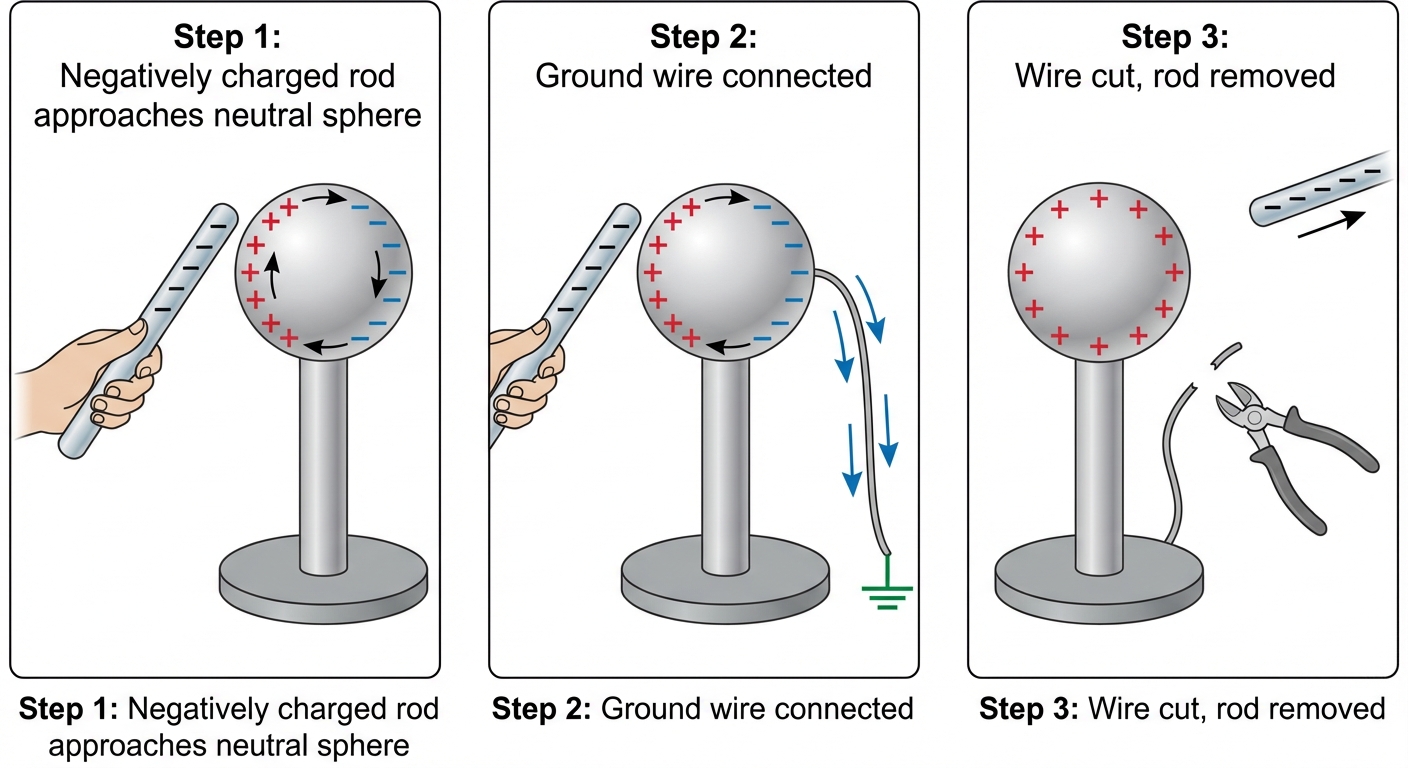
- Induction: Charging without physical contact. A charged object is brought near a neutral conductor, polarizing it. If the conductor is grounded, electrons flow in or out, leaving a net charge when the ground is cut.
Electric Force: Coulomb's Law
The electrostatic force between two point charges is described by Coulomb's Law. It is an inverse-square law, mathematically similar to Newton's Law of Universal Gravitation.
The Formula
Where:
- $F_E$ is the magnitude of the electric force (Newtons, N)
- $k$ is Coulomb's constant ($8.99 \times 10^9 \text{ N}\cdot\text{m}^2/\text{C}^2$)
- $q1, q2$ are the magnitudes of the charges (Coulombs, C)
- $r$ is the distance between the centers of the charges (meters, m)
Note: Sometimes $k$ is written using the permittivity of free space ($\epsilon0$):
Where $\epsilon_0 = 8.85 \times 10^{-12} \text{ C}^2/(\text{N}\cdot\text{m}^2)$.
Superposition of Forces
Electric force is a vector. If multiple charges act on a test charge, you must calculate the force vectors individually and sum them using vector addition (breaking them into $x$ and $y$ components).
Electric Field
The Electric Field ($E$) is a vector field that describes how a source charge affects the space around it. It defines the force per unit charge.
Definition and Formula
Substituting Coulomb's Law, the magnitude of the electric field created by a single point charge ($Q$) is:
- Unit: Newtons per Coulomb (N/C) or Volts per meter (V/m).
- Direction: The direction a positive test charge would move. (Away from positive sources, toward negative sources).
Electric Field Lines
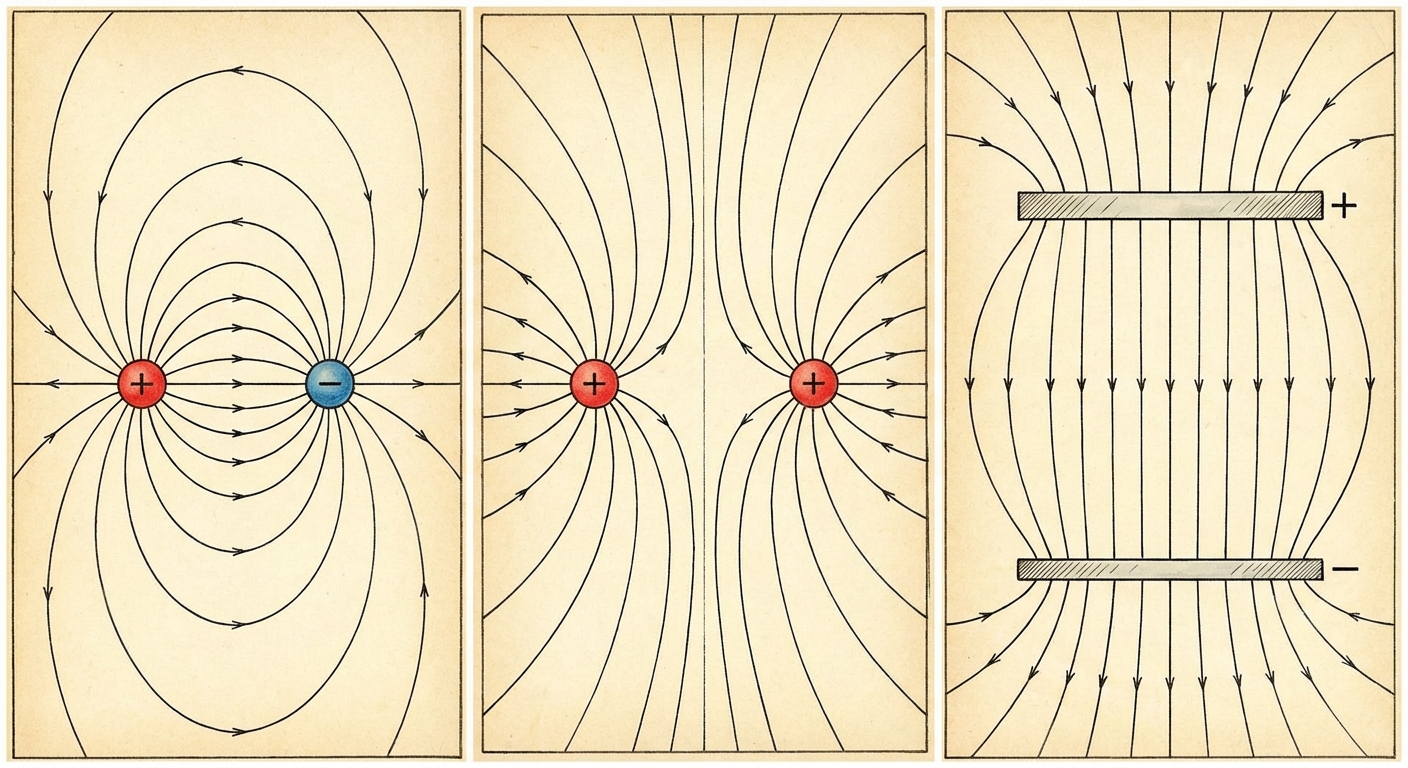
Field lines are visual tools used to represent the field.
Rules for Drawing Field Lines:
- Lines originate on positive charges and terminate on negative charges.
- The number of lines leaving/entering a charge is proportional to the magnitude of the charge.
- The density of lines indicates field strength (closer lines = stronger field).
- Field lines never cross.
Electric Potential Energy ($U_E$)
Moving from forces (vectors) to energy (scalars) simplifies many AP Physics 2 problems. Electric Potential Energy is the energy stored in a system of charges due to their relative positions.
System of Two Point Charges
- Scalar Quantity: No direction, but sign matters!
- Sign Convention:
- Positive (+) $U_E$: Like charges (repulsive). You must do work to bring them together. The system wants to fly apart.
- Negative (-) $U_E$: Opposite charges (attractive). You must do work to pull them apart.
Work and Energy
The work done by the electric field corresponds to the negative change in potential energy:
If an external agent moves a charge at constant velocity against the field:
Electric Potential (Voltage)
Electric Potential ($V$) is the energy per unit charge at a specific location in space. It is a property of the location, not the object placed there.
Definition
For a single point charge ($Q$), the potential at a distance $r$ is:
- Unit: Volts (V), which is equivalent to Joules per Coulomb (J/C).
- Scalar: Potentials add algebraically ($V{net} = V1 + V_2$). No vectors required!
The "Height" Analogy
Think of Electric Potential as "electrical height":
- Positive charges roll "downhill" (from High $V$ to Low $V$).
- Negative charges roll "uphill" (from Low $V$ to High $V$).
Equipotential Lines (Isolines)
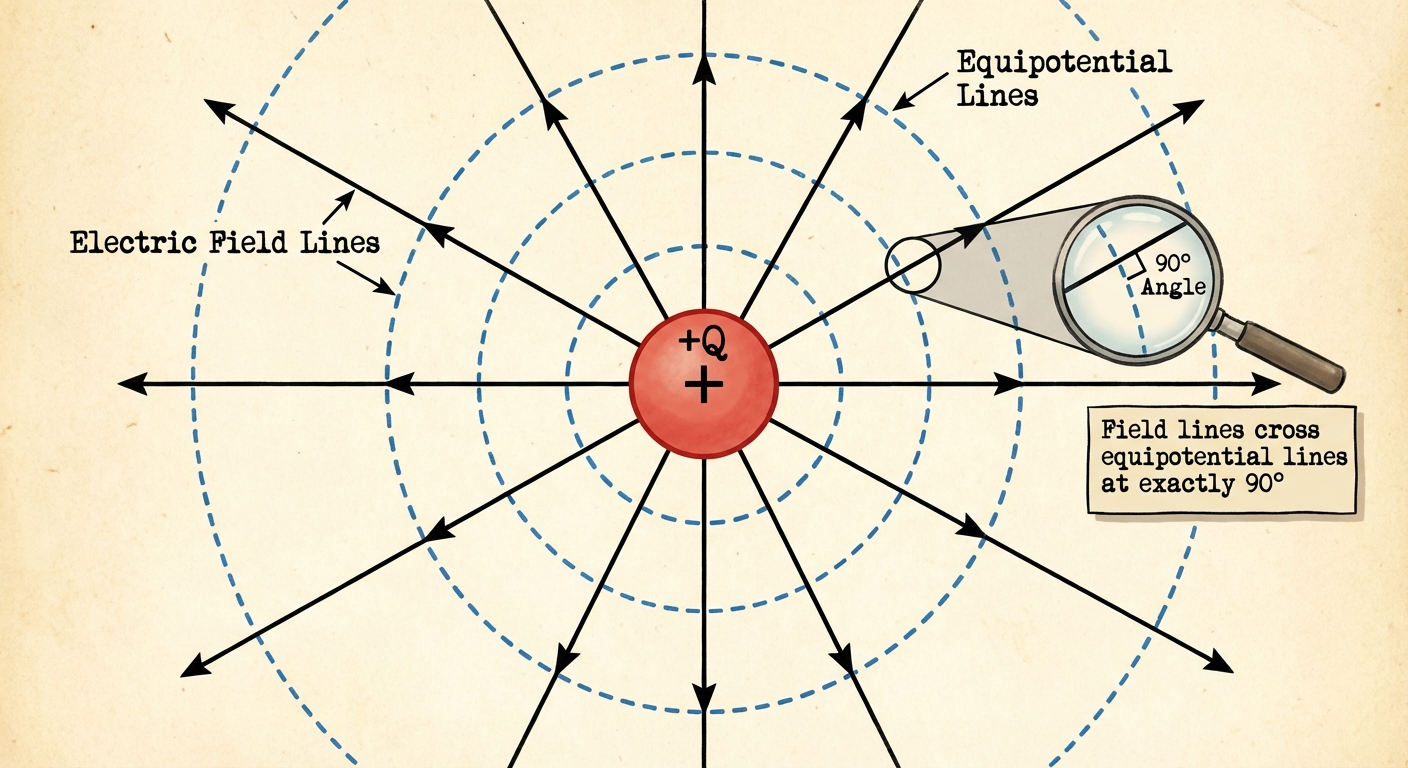
Equipotential lines represent paths where the electric potential is constant (like contour lines on a topographical map).
Key Relationships:
- Work: No work is done moving a charge along an equipotential line ($W = q\Delta V$, and $\Delta V = 0$).
- Perpendicularity: Electric field lines are always perpendicular to equipotential lines.
- Gradient: Electric field points from high potential to low potential.
Electrostatics in Conductors and Uniform Fields
Electrostatic Equilibrium
When charges on a conductor are stationary:
- The Electric Field inside the conductor is zero ($E=0$).
- Net charge resides entirely on the surface.
- The Electric Field just outside the surface is perpendicular to the surface.
- The entire conductor is an equicrucial volume (Voltage is constant throughout).
Uniform Electric Field (Parallel Plates)
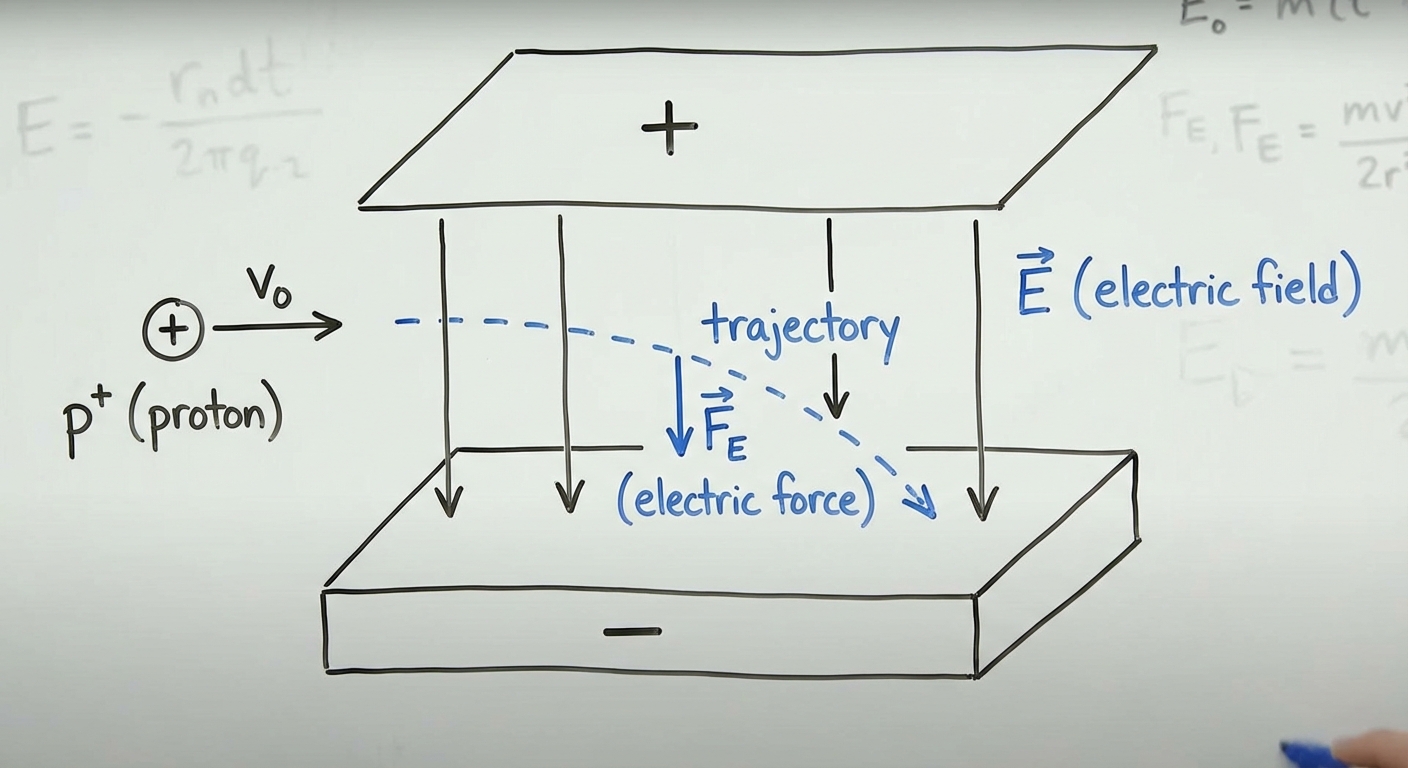
Between two large, oppositely charged parallel plates, the electric field is uniform (constant magnitude and direction).
Where:
- $\Delta V$ is the potential difference (voltage) between plates.
- $d$ is the distance between plates.
This is the only scenario in AP Physics 2 where $E$ is constant regardless of position between the source charges.
Common Mistakes & Pitfalls
Mixing up $r$ and $r^2$:
- Forces ($F$) and Fields ($E$) fall off as $1/r^2$.
- Energy ($U_E$) and Potential ($V$) fall off as $1/r$.
- Mnemonic: Vectors (harder math) use the "harder" denominator ($r^2$). Scalars (easier math) use the "easier" denominator ($r$).
Ignoring Signs in Scalars:
- When calculating Force or Field (vectors), use absolute values for magnitude ($|q|$) and determine direction using logic/diagrams.
- When calculating Potential or Energy (scalars), you MUST plug in the negative signs for charges (e.g., $-3\mu C$).
The "Zero" Confusions:
- $E = 0$ does not imply $V = 0$ (e.g., center of a square with four identical positive charges: Fields cancel, Potentials add up).
- $V = 0$ does not imply $E = 0$ (e.g., center of a dipole: Potentials cancel, Fields add up).
Trajectory vs. Field Lines:
- A charged particle released in a field does not necessarily follow the field line. It follows the force creates acceleration. The field line indicates the direction of force, not velocity.