Unit 7 Study Guide: Nationalism, Realism, and Imperialism (1815–1914)
Unit 7: 19th-Century Perspectives and Political Developments
7.1: Ideologies and Upheaval (c. 1815–1848)
The Concert of Europe and its Challenges
Following the Congress of Vienna (1815), the resulting Concert of Europe sought to maintain the balance of power and suppress revolution. However, new ideologies emerged to challenge this conservative order.
Key Political Ideologies
| Ideology | Key Goal | Social Base | Key Thinkers | View on Change |
|---|---|---|---|---|
| Conservatism | Preserve tradition, monarchy, and social hierarchy. | Aristocracy, Church | Edmund Burke, Klemens von Metternich | Slow/evolutionary if necessary; mostly resist change. |
| Liberalism | Protect individual rights, constitutions, free trade, limited government. | Bourgeoisie (Middle Class) | John Stuart Mill, Adam Smith | Reform through legislation; non-violent evolution. |
| Nationalism | Unity based on shared language, culture, and history; self-determination. | All classes (gradual) | Mazzini, Hegel | Radical change; redrawing borders. |
| Socialism | Economic equality, cooperation over competition, state intervention. | Working Class | Saint-Simon, Fourier, Blanc | Restructuring of society to aid the poor. |
| Marxism | Abolition of private property; violent revolution to create a classless society. | Proletariat | Karl Marx, Friedrich Engels | Violent revolutionary overthrow of capitalism. |
The Revolutions of 1848
Often called the "Springtime of the Peoples," violent uprisings erupted across France, Austria, the German states, and Italy.
- Causes: Poor harvests ("Hungry Forties"), economic depression, and discontent with conservative monarchies.
- Outcome: Failed. While they initially toppled governments, conservative forces (monarchies and armies) regrouped and crushed the rebellions. The middle class and working class failed to maintain a united front.
- Significance: It marked the end of "romantic" revolutions. Future changes (like unification) would be achieved through Realpolitik (pragmatic politics) rather than idealism.
7.2: Nationalism and State Building (1848–1914)
Nationalism transformed from a radical, democratic force into a tool used by conservative leaders to strengthen the state.
The Politics of Realpolitik
Realpolitik refers to a system of politics based on practical and material factors (power, economics, military) rather than moral or ideological objectives. Leaders like Cavour and Bismarck utilized this to unify their nations.
The Unification of Italy
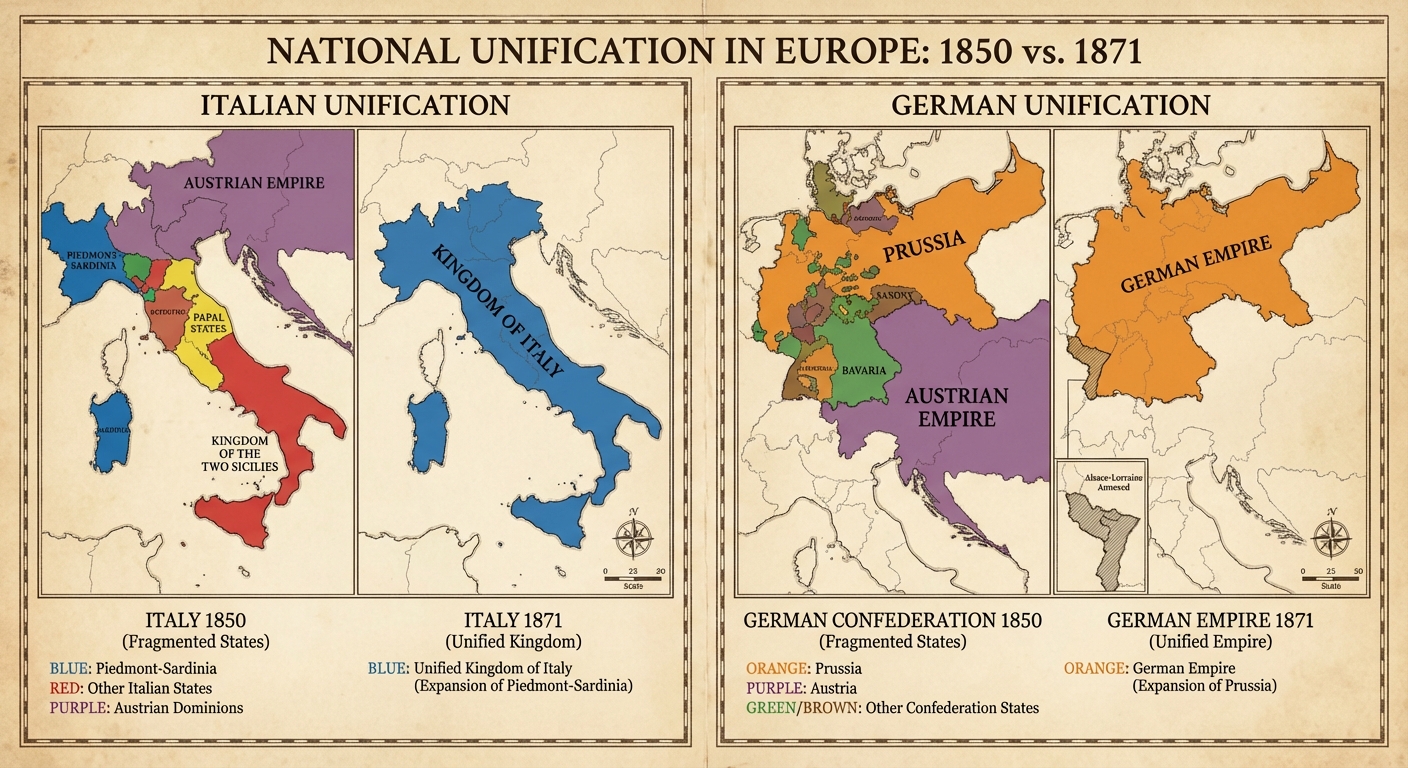
Italy was a patchwork of small states dominated by Austria and the Papacy. Unification was achieved through a combination of diplomacy and warfare.
- Mazzini (The Heart): Early romantic struggles; founded "Young Italy"; failed in 1848.
- Cavour (The Brain): Prime Minister of Piedmont-Sardinia. He practiced Realpolitik by modernizing the economy and forging an alliance with France (Napoleon III) to provoke war with Austria in 1859.
- Garibaldi (The Sword): Led the Red Shirts in a military campaign conquering southern Italy (Kingdom of the Two Sicilies).
- Victor Emmanuel II: Crowned the first King of Italy in 1861.
The Unification of Germany
German unification altered the balance of power in Europe forever. It was driven by Prussia under Otto von Bismarck.
- Blood and Iron: Bismarck's famous speech declaring that great questions of the day would be settled by military might, not speeches.
- Wars of Unification:
- Danish War (1864): Prussia/Austria vs. Denmark.
- Austro-Prussian War (1866): Prussia defeated Austria in 7 weeks; solidified Prussian dominance over German states.
- Franco-Prussian War (1870–1871): Bismarck manipulated diplomatic telegrams (Ems Dispatch) to provoke France. Prussia won easily.
- Outcome: The German Empire was proclaimed in the Hall of Mirrors at Versailles (humiliating France) in 1871. Wilhelm I became Kaiser.
Destabilizing Nationalism: Austria-Hungary & Russia
While nationalism built Italy and Germany, it tore apart multi-ethnic empires.
- Austria-Hungary: Defeat by Prussia led to the Compromise of 1867, creating the Dual Monarchy. Hungary gained internal autonomy, but ethnic minorities (Slavs, Czechs) remained dissatisfied, causing chronic instability.
- Russia: Defeat in the Crimean War (1853–1856) exposed Russia's backwardness. Tsar Alexander II attempted reforms, most notably the Emancipation of the Serfs (1861). However, progress was slow, and subsequent Tsars returned to repression, leading to the Revolution of 1905 after a humiliating defeat to Japan.
7.3: Intellectual Developments: Science and Realism
From Romanticism to Realism in Art & Literature
- Romanticism (c. 1800–1850): Emphasized emotion, nature, individualism, and the past. (e.g., Delacroix, Wordsworth).
- Realism (c. 1850–1900): A reaction against Romanticism. Artists and writers sought to depict life exactly as it was, focusing on the working class, urban grit, and social inequalities without idealization.
- Literature: Charles Dickens, Émile Zola, Leo Tolstoy.
- Art: Gustave Courbet, Jean-François Millet (depicting laborers).
Darwinism and Social Darwinism
- Charles Darwin: Published On the Origin of Species (1859). Proposed the theory of Natural Selection—species evolve over time through survival of the fittest. This challenged religious literalism.
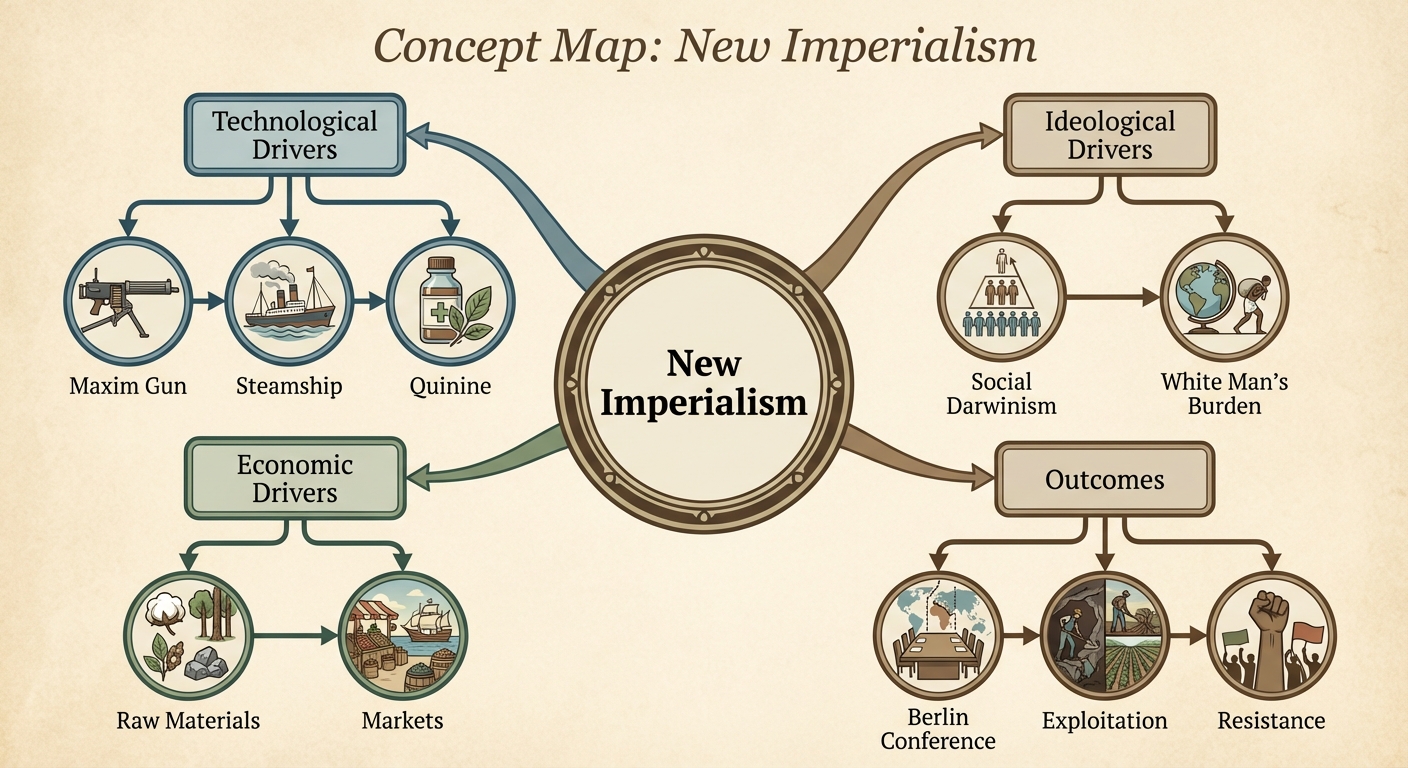
- Social Darwinism: A misapplication of Darwin's biological theory to human society by thinkers like Herbert Spencer. It claimed that powerful nations and races were "fitter" and therefore had the right to dominate "weaker" ones. This pseudoscience became a primary justification for New Imperialism and racism.
The Crisis of Modernism
By the late 19th century, rationality was questioned:
- Friedrich Nietzsche: Claimed "God is dead" and rejected conventional morality, praising the "Ubermensch" (Superman) who creates their own values.
- Sigmund Freud: Developed psychoanalysis; argued human behavior is driven by irrational subconscious desires (Id, Ego, Superego).
- Physics: Marie Curie (radiation), Max Planck (quantum theory), and Einstein (relativity) shattered the Newtonian view of a predictable, mechanical universe.
7.4: The Age of New Imperialism (c. 1880–1914)
Unlike "Old Imperialism" (16th–18th century), which focused on coastal trade, New Imperialism involved the total military, political, and economic subjugation of vast territories in Africa and Asia.
Motivations (The "Three Gs" Updated)
- Economic: Industrial Revolution created a need for cheap raw materials (rubber, oil, tin) and new markets to sell manufactured goods.
- Political/Nationalistic: Colonies were status symbols. Britain wanted to protect the Suez Canal; France wanted to restore prestige after 1871; Germany wanted a "place in the sun."
- Ideological:
- Social Darwinism: The belief in European biological superiority.
- "White Man's Burden": The paternalistic belief (Rudyard Kipling) that it was the Western duty to "civilize" non-Western peoples through Christianity, medicine, and education.
The Scramble for Africa
- Technological Facilitators: The machine gun (Maxim gun), Quinine (malaria medicine), and the steamship allowed Europeans to penetrate the African interior.
- Berlin Conference (1884–1885): Organized by Bismarck to prevent war between European powers over Africa. They established rules for effective occupation. Note: No African leaders were invited. By 1914, 90% of Africa was controlled by Europe (except Ethiopia and Liberia).
Imperialism in Asia
- India: Controlled directly by the British Crown ("The Jewel in the Crown") after the Sepoy Mutiny (1857).
- China: Subjected to Spheres of Influence rather than direct colonization. European powers forced China to sign unequal treaties (e.g., after the Opium Wars).
- Japan: Unlike China, Japan engaged in rapid state-sponsored modernization during the Meiji Restoration, becoming an imperial power itself.
Responses to Imperialism
- The Sepoy Mutiny (India, 1857): Failed military rebellion against British disrespect of cultural/religious traditions.
- The Boxer Rebellion (China, 1899–1901): Anti-foreign uprising attempting to drive Westerners out; crushed by a multi-national coalition.
- Zulu Resistance: Brief victories against the British in South Africa, but ultimately defeated by superior technology.
7.5: Diplomatic Tensions and the Road to WWI
The breakdown of the Concert of Europe led to rigid alliance systems.
The Breakdown of Diplomacy
- Crimean War (1853–1856): Destroyed the Concert of Europe. Britain/France fought Russia. Effect: Russia withdrew from European affairs to modernize; Austria was isolated.
- Balkan Instability: The decline of the Ottoman Empire created a power vacuum. Austria-Hungary and Russia competed for influence over the new Balkan states (Serbia, Bulgaria, etc.).
System of Alliances
By 1907, Europe was divided into two armed camps:
- Triple Alliance: Germany, Austria-Hungary, Italy.
- Triple Entente: France, Russia, Great Britain.
- The Spark: The extensive alliance system meant that a local conflict in the Balkans (assassination of Archduke Franz Ferdinand) could escalate into a general European war.
7.6: Mass Politics and Social Challenges
Anti-Semitism and Zionism
Despite legal emancipation in the mid-19th century, Jews faced rising biological anti-Semitism connected to nationalism.
- Dreyfus Affair (France): A Jewish army captain was falsely accused of treason. The case polarized France, exposing deep anti-Semitism in the army and Church.
- Zionism: In response to persecution (like pogroms in Russia and the Dreyfus Affair), Theodor Herzl founded the Zionist movement, advocating for a separate Jewish national homeland.
Feminism and Suffrage
Women pressed for legal and political rights.
- Suffragettes: The Women's Social and Political Union (WSPU) in Britain, led by Emmeline Pankhurst, used militant tactics (hunger strikes, arson) to demand the right to vote.
Common Mistakes & Pitfalls
- Confusing 1848 and 1871: Students often think the Revolutions of 1848 unified Germany and Italy. Correction: The 1848 revolutions failed. Unification happened two decades later (1860s-1870s) driven by conservative governments, not revolutionary crowds.
- Social Darwinism vs. Biology: Do not confuse Darwin's scientific theory with Social Darwinism. Darwin wrote about animals; Spencer and others aggressively misapplied it to sociology and race.
- American Civil War Relevance: In AP Euro, the U.S. Civil War is only relevant regarding the "cotton famine" affecting European textiles and as an example of a nation-building war occurring simultaneously with European unifications. Do not write an essay about Lincoln.
- Isms: Be careful distinguishing Utopian Socialism (early, idealistic) from Marxist Socialism (scientific, revolutionary).