Power Dynamics and Challenges to State Sovereignty
Forms of Governance: Unitary vs. Federal States
To understand how states maintain sovereignty, you must first understand how they organize power spatially within their borders. The way a national government interacts with its subnational units (provinces, states, counties) determines its classification.
Unitary States
In a Unitary State, the central government holds almost all valid power. Local governments exist only as extensions of the central government to implement policies.
- Characteristics: Highly centralized, homogeneous population (usually), strong national identity.
- Pros: Efficient law-making, standardized laws across the country, reduced administrative redundancy.
- Cons: Disconnect with local needs, slower response to local disasters, potential marginalization of peripheral minority groups.
- Examples: France, Japan, China, United Kingdom (though the UK involves devolution, it is constitutionally unitary).
Federal States
In a Federal State, power is constitutionally divided between a central authority and constituent political units (like states or provinces).
- Characteristics: Large landmass (usually), diverse populations, multiple levels of power.
- Pros: Local issues handled locally, protection against tyranny of the majority, more suitable for large, diverse nations.
- Cons: Conflicts between state and federal laws, redundancy in services, slower national policy implementation.
- Examples: United States, Canada, Russia, Nigeria, Germany.
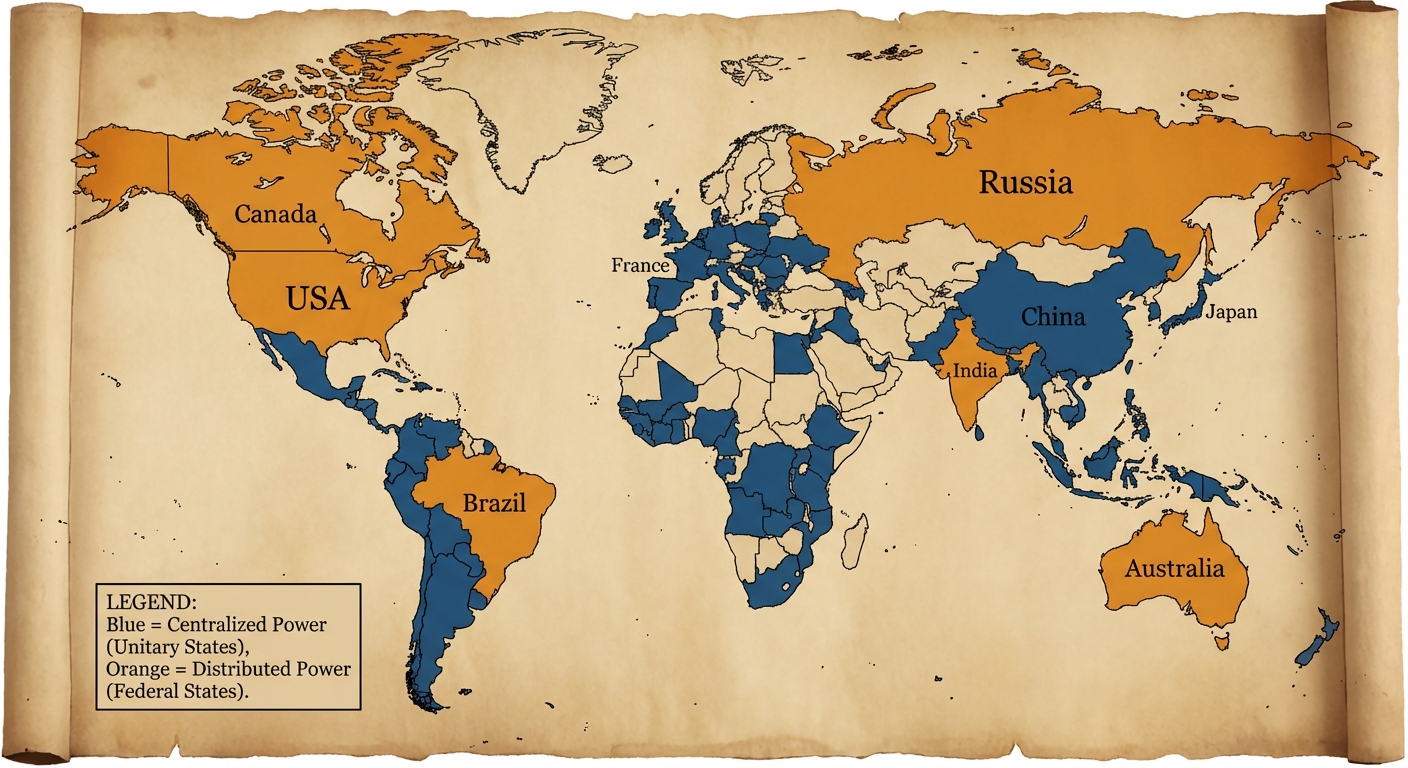
Comparison Table
| Feature | Unitary State | Federal State |
|---|---|---|
| Power Center | Relayed from Central Govt | Shared (Central + Local) |
| Best for… | Small, Nation-States | Large, Multinational States |
| Laws | Uniform nationwide | Vary by region |
| Flexibility | Low (rigid hierarchy) | High (regional autonomy) |
Forces of Unity and Division
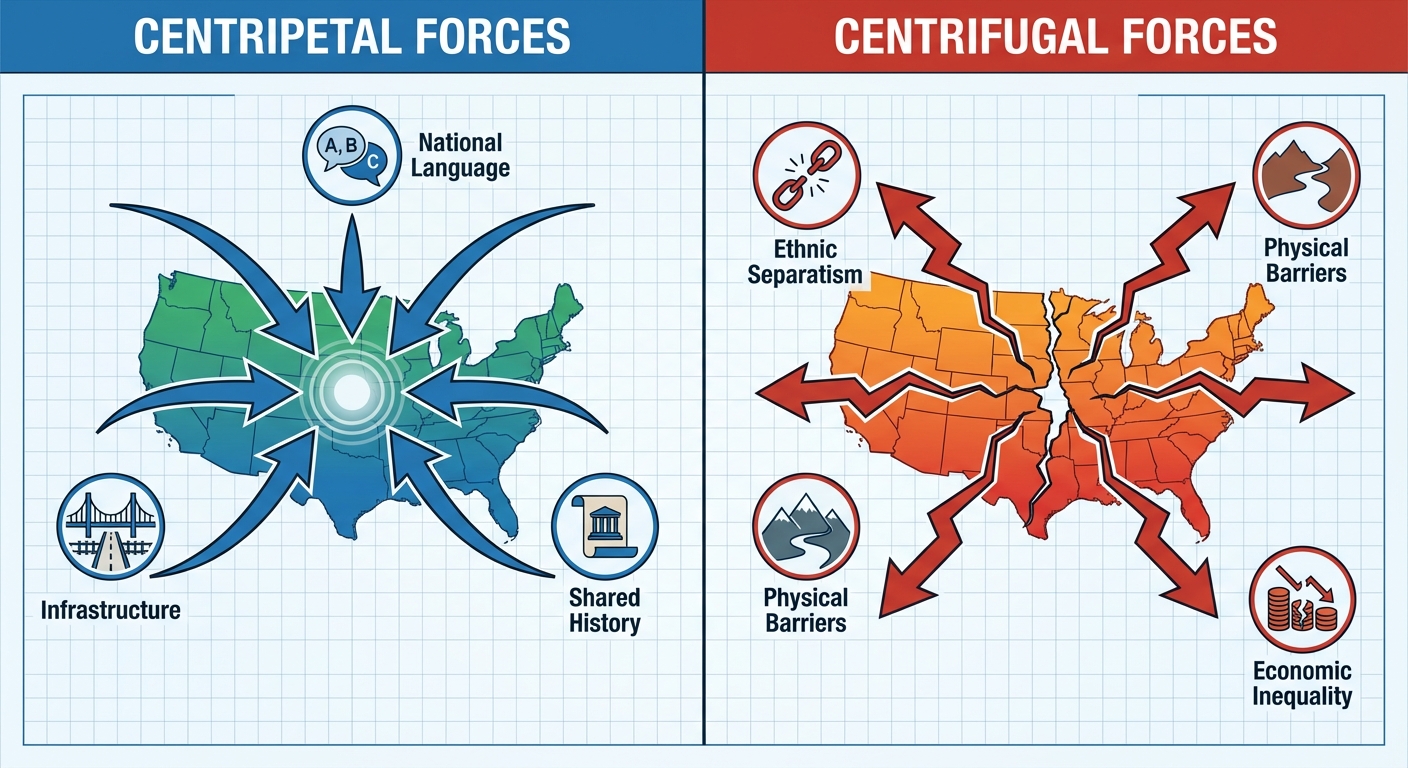
States are constantly acted upon by forces that either bind them together or pull them apart. These are concepts borrowed from physics but applied to political geography.
Centripetal Forces
Centripetal Forces are events or circumstances that help bind a state together and promote national unity.
- National Identity: A strong sense of nationalism (e.g., the "American Dream," Japanese homogeneity).
- Equitable Infrastructure: Efficient transportation and communication systems that link the core to the periphery.
- Institutions: A unified education system, a national holiday (Bastille Day in France), or a state religion (in theocratic states).
- External Threat: War often unites a population against a common enemy.
Centrifugal Forces
Centrifugal Forces are forces that divide a state and destabilize it.
- Ethnocultural Differences: Conflicting languages or religions (e.g., Fleming vs. Walloon communities in Belgium).
- Uneven Development: Economic gaps where one region is significantly richer than another (e.g., Northern vs. Southern Italy).
- Physical Geography: Fragmented land (islands) or mountains isolating populations (e.g., Indonesia, Nepal).
Devolution and Supranationalism
This section covers the two main challenges to unlimited state sovereignty: giving power "down" (Devolution) or giving power "up" (Supranationalism).
Devolution
Devolution is the transfer of political power from the central government to subnational levels of government (regional, local). This is often a response to centrifugal forces to prevent total disintegration.
Causes of Devolution
- Physical Geography: Distance decay and physical barriers (mountains/water) make centralized rule difficult (e.g., the Basque region isolated by Pyrenees).
- Ethnic Separatism: Distinct minority groups typically demand autonomy (e.g., separatist movements in Quebec, Canada).
- Economic Problems: Regions that are economically powerful may not want to subsidize poorer regions (e.g., Catalonia in Spain), or poorer regions may feel neglected.
- Irredentism: A movement to reclaim territory marked by ethnic kinship that lies within another state.
Examples in Practice
- Spain: Catalonia and the Basque Country have their own parliaments.
- United Kingdom: Scotland, Wales, and Northern Ireland have devolved assemblies.
- Belgium: Divided into Flanders (Dutch-speaking) and Wallonia (French-speaking).
- Canada: Nunavut was created to give autonomy to the Inuit people.
Supranationalism
Supranationalism is when multiple countries form an organization to collectively achieve greater benefits for all members. To join, a state must sacrifice a small amount of sovereignty to the group.
Major Supranational Organizations
- United Nations (UN): Global; focuses on peace, security, and humanitarian aid.
- North Atlantic Treaty Organization (NATO): Military alliance (US, Canada, Europe); "an attack on one is an attack on all."
- European Union (EU): Economic and political; focuses on free trade, open borders (Schengen Area), and a common currency (Euro).
- ASEAN (Association of Southeast Asian Nations): Economic acceleration and regional stability in SE Asia.
- Arctic Council: Cooperation regarding Arctic environmental and developmental issues.
Consequences of Centrifugal and Centripetal Forces
When the balance between these forces shifts, significant geopolitical changes occur.
Failed States
If centrifugal forces overpower centripetal forces, a state may become a Failed State. The government loses control over territory, cannot provide public services, and loses the monopoly on violence.
- Example: Somalia, South Sudan, Yemen.
Balkanization
This refers to the fragmentation of a state or region into smaller, often hostile, units along ethno-linguistic lines. The term comes from the violent breakup of Yugoslavia in the 1990s.
Autonomous Regions
Successful management of centrifugal forces often leads to Autonomous Regions. These areas maintain peace by granting specific freedoms (language rights, tax control) while remaining part of the larger state.
Environmental Challenges
Sovereignty is also challenged by environmental issues that cross borders, requiring supranational cooperation. Pollution, climate change, and water rights (e.g., the Nile River conflict) force states to negotiate, effectively shrinking their absolute control over their own resources.
Memory Aids & Mnemonics
- Centri-P-etal: "Pulls" together (or Peace). Think of petals on a flower coming together at the center.
- Centri-F-ugal: "Forces" apart (or Fighting). Think of a centrifuge spinning things away from the center.
- UN-EU-NA: Categories of Supranationalism.
- UN: Political/Peace
- EU: Economic/Currency
- NATO: Military
Common Mistakes & Pitfalls
Confusing Federal vs. Unitary with Democracy vs. Dictatorship:
- Correction: China is Unitary and Authoritarian. Japan is Unitary and Democratic. The US is Federal and Democratic. The distinction is about spatial power distribution, not voting rights.
Assuming Devolution = Independence:
- Correction: Devolution is the government giving power to a region to keep them in the country. Independence (secession) is leaving the country entirely. Devolution can prevent independence, though it acts as a slippery slope.
Mixing up Centripetal/Centrifugal Forces:
- Correction: Always check the context. Religion can be Centripetal (if everyone is the same faith) OR Centrifugal (if there is religious conflict).
Thinking the EU is just a trade deal:
- Correction: The EU is unique because it has a Parliament, a Court of Justice, and a Central Bank. It requires a much higher loss of sovereignty than a standard trade agreement like USMCA.