Unit 4: The Age of Reason and 18th-Century Change
Unit 4: The Age of Reason and 18th-Century Change
The Foundations of the Enlightenment
The Enlightenment (c. 1715–1789) was an intellectual and cultural movement that emphasized reason over tradition and individualism over community values. It applied the methods of the Scientific Revolution—observation and rationality—to human society, government, and economics.
Core Concepts: The "Age of Reason"
The Enlightenment was driven by a group of intellectuals known as Philosophes. These thinkers believed that society could be improved through the application of three major concepts:
- Reason: Moving away from superstition and religious dogma. This was the spirit of Rationalism.
- Nature: Natural laws regulate the universe and human society (e.g., economics, politics). Nothing was "supernatural."
- Progress: The belief that humanity could improve itself and its condition over time.
The Social Contract: Hobbes vs. Locke
Before the 18th century properly began, two 17th-century English thinkers laid the groundwork for political theory. Their conflict is a frequent Document-Based Question (DBQ) topic.
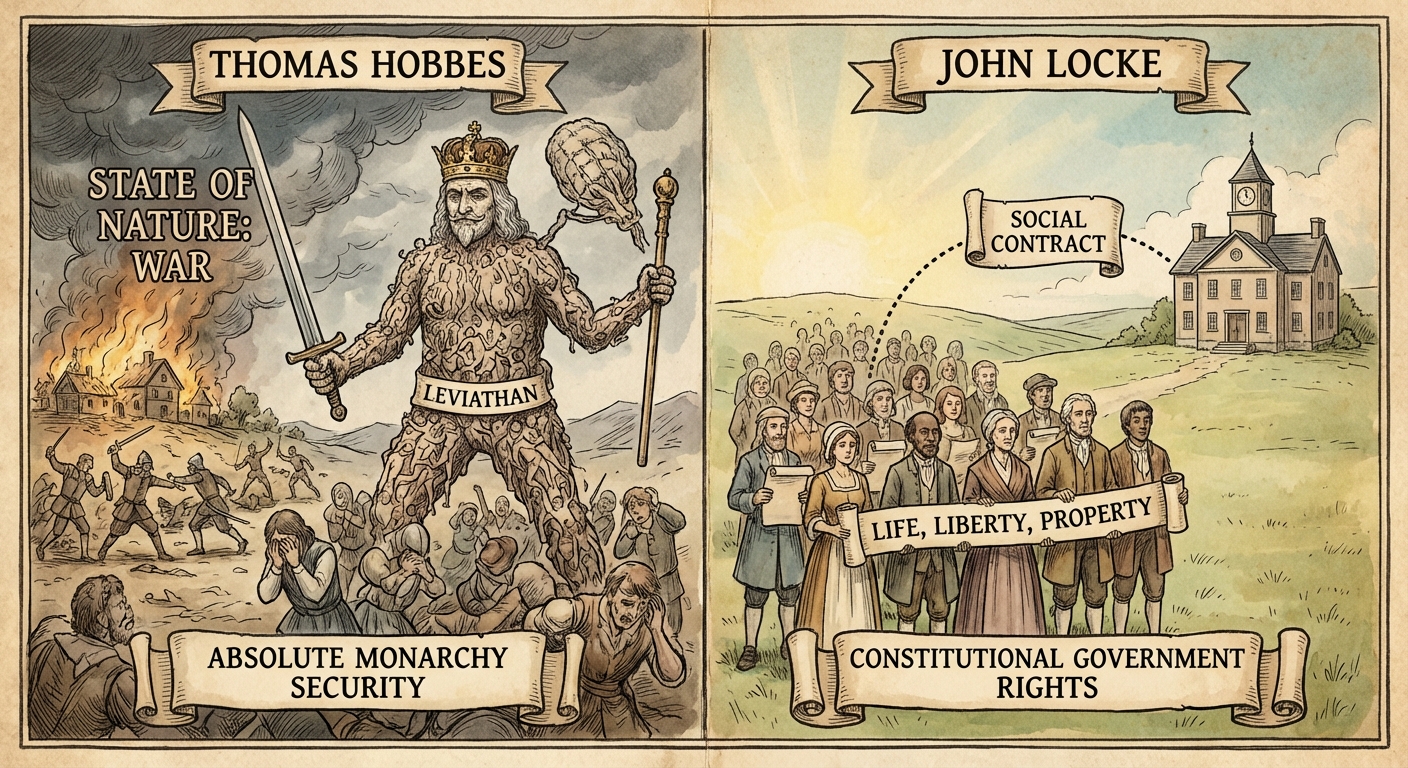
| Feature | Thomas Hobbes (Leviathan) | John Locke (Two Treatises of Government) |
|---|---|---|
| View of Human Nature | Humans are naturally cruel, greedy, and selfish. | Humans are born as a Tabula Rasa (blank slate) and molded by experience. |
| State of Nature | "Solitary, poor, nasty, brutish, and short." War of all against all. | Humans have Natural Rights: Life, Liberty, and Property. |
| Ideal Government | Absolute Monarchy to impose order. | Constitutional government with limited power. |
| Right to Rebel | No. Chaos is worse than tyranny. | Yes. If the government fails to protect rights, people must overthrow it. |
Key Philosophes and Their Ideas
The Baron de Montesquieu
- Work: The Spirit of Laws (1748).
- Concept: Separation of Powers and Checks and Balances.
- Impact: He admired the British political system and heavily influenced the U.S. Constitution and the French Revolution.
Voltaire
- Work: Candide, Letters on the English.
- Concept: Religious toleration and freedom of speech. He famously criticized the French monarchy and the Catholic Church ("Écrasez l'infâme!" — Crush the loathsome thing!).
- Impact: Championed Deism (the belief in a "Clockmaker God" who created the universe but does not intervene).
Denis Diderot
- Work: The Encyclopedia.
- Concept: A compilation of all human knowledge designed to "change the general way of thinking."
- Impact: Spread Enlightenment ideas beyond the elite circle; undermined established authority by emphasizing science and craft over theology.
Jean-Jacques Rousseau
- Work: The Social Contract (1762) and Emile.
- Concept: The General Will. Unlike Locke (who focused on individual rights), Rousseau emphasized that freedom is obeying laws that the community creates for the common good.
- Impact: His ideas on emotion and nature (Romanticism precursor) and his belief that "Man is born free, and everywhere he is in chains" fueled the radical phases of the French Revolution.
Women in the Enlightenment
While many philosophes argued for women's biological inferiority, women played a critical role in spreading ideas through Salons (private gatherings in homes).
- Madame Geoffrin: A famous salonnière who mediated discussions between rival thinkers.
- Mary Wollstonecraft: Wrote A Vindication of the Rights of Woman (1792), defining the feminist argument that women only appeared inferior due to a lack of education.
New Economics: Captialism
Adam Smith, in The Wealth of Nations (1776), attacked Mercantilism (government-controlled trade). He proposed Laissez-Faire economics:
- The "Invisible Hand" of supply and demand should run the market.
- Free trade is superior to tariffs and monopolies.
Enlightened and Other Approaches to Power
Enlightened Absolutism (or Enlightened Despotism) refers to 18th-century monarchs who adopted Enlightenment ideals—rationalism, progress, and tolerance—without giving up their absolute political power.
The Three Major Enlightened Absolutists
1. Frederick II (The Great) of Prussia
- Philosophy: Called himself the "First Servant of the State."
- Reforms: codified laws, abolished torture, promoted religious tolerance, and improved agriculture (potatoes!).
- Limitations: He did not end serfdom because he needed the support of the Junkers (Prussian nobility).
2. Catherine the Great of Russia
- Philosophy: Corresponded with Voltaire and Diderot; wanted to westernize Russia.
- Reforms: Restricted torture, offered limited religious toleration, and expanded education for noble girls.
- Limitations: The Pugachev Rebellion (a massive serf uprising) spooked her. She reacted by giving nobles absolute control over serfs to maintain order, effectively ending her reforms.
3. Joseph II of Austria
- Philosophy: The most radical and sincere of the three.
- Reforms: Abolished serfdom completely (1781), declared full religious toleration (including for Jews), and taxed the nobility.
- Limitations: He changed too much, too fast. The nobles and church rebelled, and after his death, his brother Leopold II undid almost all his reforms to save the empire.
Comparison Table: Success vs. Failure
| Monarch | Religious Tolerance? | Legal Reform? | Serfdom Abolished? | End Result |
|---|---|---|---|---|
| Frederick II | Yes | Yes | No | Successfully strengthened the state using Enlightenment ideas. |
| Catherine II | Limited | Drafted only | No (Worsened) | Expanded Russian territory but failed to liberalize society. |
| Joseph II | Complete | Yes | Yes (Briefly) | Failed due to lack of support; reforms rescinded. |
18th-Century Society and Demographics
While philosophes debated, the average European experienced massive changes in daily life, health, and agriculture.
The Agricultural Revolution
Before the 18th century, the "Open-Field System" (communal farming) limited production. The application of scientific principles to farming changed everything.
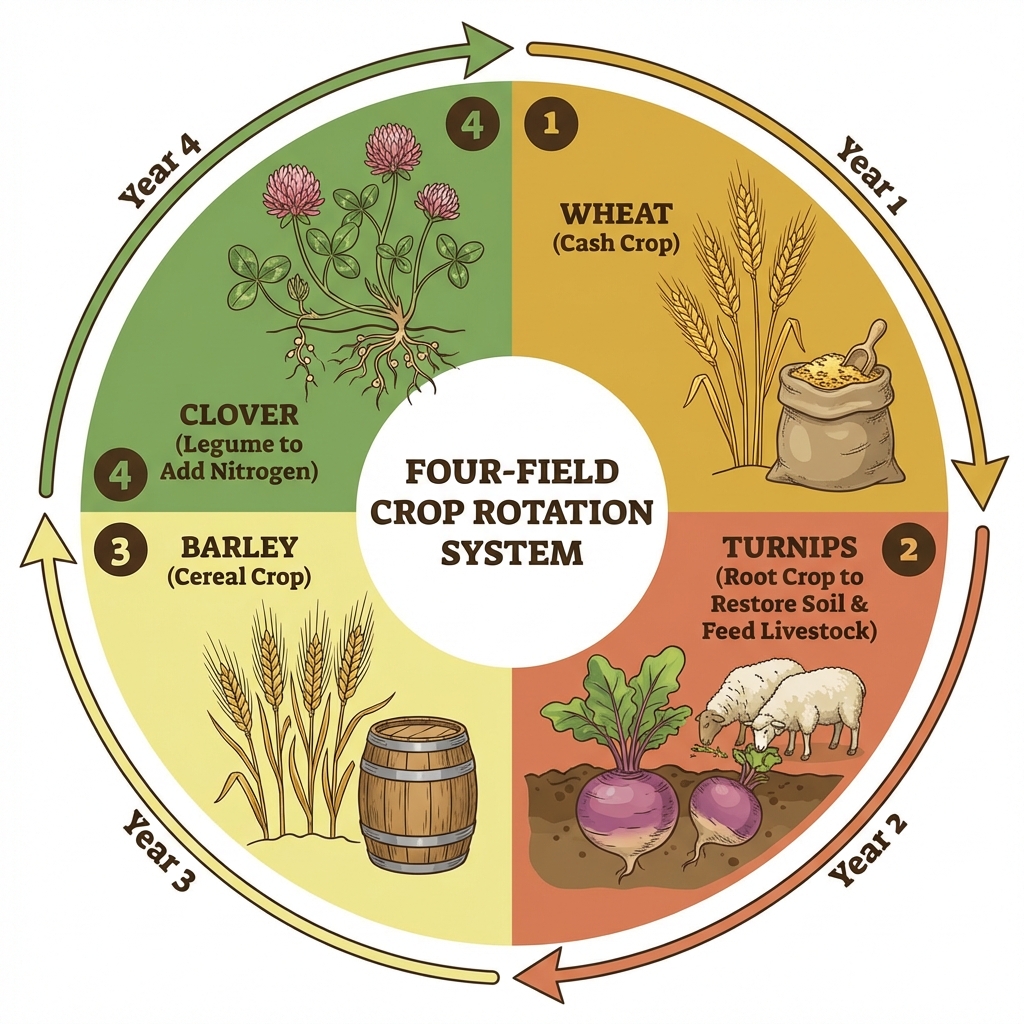
- Crop Rotation: Charles "Turnip" Townshend popularized using nitrogen-restoring crops (turnips, clover) instead of leaving land fallow (empty).
- New Inventions: Jethro Tull’s Seed Drill allowed for precise planting in rows.
- Enclosure Movement: Wealthy landowners fenced off common lands to create commercial farms.
- Result: Increased food production but forced poor peasants off the land, creating a labor pool for the coming Industrial Revolution.
Population Explosion
Around 1750, the European population began to skyrocket.
- Primary Cause: Decline in mortality (death rates).
- The Disappearance of the Plague: Better quarantine measures and the brown rat replacing the black rat.
- Medicine: The inoculation against Smallpox (perfected eventually by Edward Jenner).
- Diet: The Potato became a staple crop for the poor (high calories, easy to grow).
Family Life and Child-Rearing
- Nuclear Family: Couples established their own households later in life (late 20s) to limit family size—a pattern reinforced by economic constraints.
- Illegitimacy Explosion: As community controls broke down in growing villages/cities, premarital sex resulted in more illegitimate births (c. 1750–1850).
- Attitudes Toward Children: Influenced by Rousseau’s Emile, parents began to treat children as innocents rather than "small adults." Swaddling declined, and breastfeeding by mothers (rather than wet nurses) increased among the upper class.
The Consumer Revolution
Europe moved toward a consumer economy. People began buying goods strictly for comfort and display, not just survival.
- Privacy: Homes began having private rooms (the boudoir), moving away from communal living halls.
- Goods: Porcelain dishes, coffee, tea, mirrors, and cotton clothing became accessible to the middle class.
Common Mistakes & Pitfalls
- Confusing Absolutists: Do not confuse Louis XIV (17th Century, "I am the State") with Frederick II (18th Century, "First Servant of the State"). One used religion and divine right; the other used reason and utility.
- Rousseau Misinterpretation: Students often think Rousseau was a straightforward democrat. He wasn't. His concept of "General Will" can be interpreted as democratic, but it was also used by dictators (like Robespierre and later totalitarians) to justify crushing minority opinions.
- Deism is not Atheism: The philosophes did not deny God's existence. They denied organized religion's rituals and the idea of miracles. They viewed God as a rational architect.
- Chronology of Revolutions: The Agricultural Revolution precedes and enables the Industrial Revolution. You cannot have industrialization without the surplus labor and food provided by agricultural changes.
Memory Aids
- "FRED" the Great: First Servant, Religious tolerance, Enlightened, Did not free serfs.
- The "High 5" Philosophes:
- Locke: Rights (Life/Liberty/Property).
- Hobbes: Beast (people are animals needing control).
- Montesquieu: Split (Separation of powers).
- Voltaire: Voice (Freedom of speech).
- Rousseau: Social (The social contract/General Will).