Comprehensive Guide to Biological Psychology and Consciousness
Biological Bases of Behavior
Heredity and Genetics
Biological psychology begins with the understanding of how our genetic makeup influences our behavior (Nature) interacting with our environment (Nurture).
Basics of Genetics
- Chromosomes: Threadlike structures made of DNA molecules that contain genes. Humans normally have 46 chromosomes (23 pairs).
- DNA (Deoxyribonucleic acid): A complex molecule containing the genetic information that makes up the chromosomes.
- Gene: The biochemical units of heredity that make up the chromosomes; segments of DNA capable of synthesizing proteins.
- Genome: The complete instructions for making an organism, consisting of all the genetic material in that organism’s chromosomes.
Genotype vs. Phenotype
- Genotype: The specific genetic makeup of an individual (the "blueprint").
- Phenotype: The observable physical and behavioral characteristics of an individual (the "building"), resulting from the interaction of the genotype with the environment.
- Dominant Gene: The member of a gene pair that controls the appearance of a certain trait.
- Recessive Gene: A gene that is expressed only when it is matched with a similar gene from the other parent.
Twin Studies and Heritability
Behavioral geneticists use twin studies to isolate the effects of nature and nurture.
- Monozygotic (Identical) Twins: Develop from a single fertilized egg that splits in two, creating two genetically identical organisms.
- Dizygotic (Fraternal) Twins: Develop from separate fertilized eggs. They are genetically no closer than ordinary brothers and sisters, but they share a fetal environment.
- Heritability: A statistical estimate of the proportion of the variation among individuals in a group that we can attribute to genes.
- Crucial distinction: Heritability refers to populations, not individuals. If intelligence has 50% heritability, it means 50% of the difference in intelligence between people in a group is due to genetics, not that 50% of your intelligence is genetic.
Key Genetic Conditions
- Down Syndrome: caused by an extra copy of chromosome 21 (Trisomy 21).
- Turner Syndrome: Females with only one X chromosome (XO); often causes physical shortness and infertility.
- Klinefelter’s Syndrome: Males with an extra X chromosome (XXY); often causes minimal sexual development and passivity.
- Phenylketonuria (PKU): Rare genetic condition where the body cannot break down the amino acid phenylalanine. Requires a strict diet to prevent brain damage.
The Neuron: Building Block of the Nervous System
The neuron is the fundamental unit of the nervous system, responsible for receiving, processing, and transmitting electrochemical information.
Neuron Structure
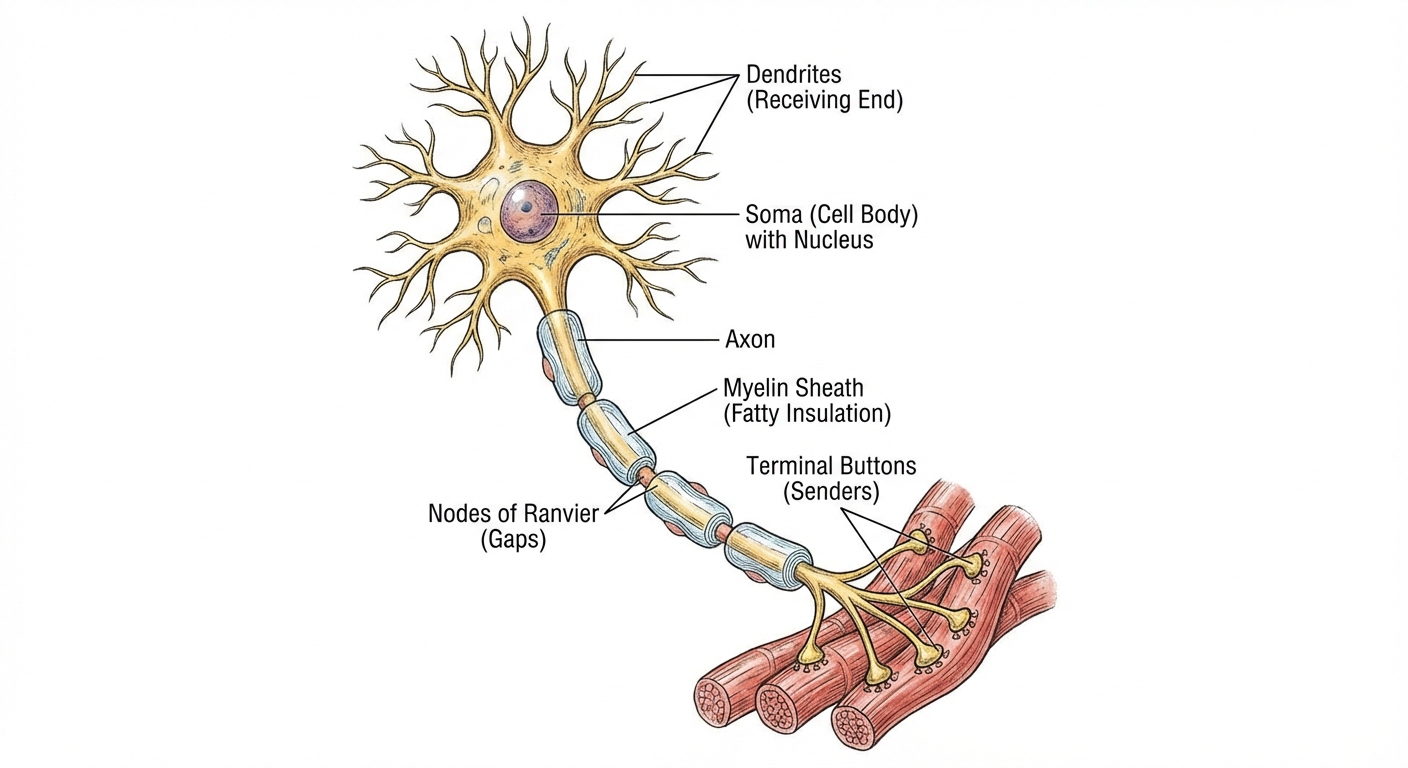
- Dendrites: Branching extensions that receive messages and conduct impulses toward the cell body.
- Soma (Cell Body): Contains the nucleus and maintains the life of the cell.
- Axon: The extension of a neuron through which messages pass to other neurons or to muscles/glands.
- Myelin Sheath: A layer of fatty tissue segmentally encasing the fibers of many neurons; enables vastly greater transmission speed of neural impulses. degeneration of myelin results in Multiple Sclerosis.
- Terminal Buttons: Small knobs at the end of an axon that release chemicals called neurotransmitters.
- Glial Cells: Cells in the nervous system that support, nourish, and protect neurons (the "glue" of the brain).
Neural Transmission: The Action Potential
Neural communication is an electrochemical process.
- Resting Potential: The fluid interior of a resting axon has an excess of negatively charged ions, while the fluid outside the axon membrane has more positively charged sodium ions. The neuron is polarized (approx -70mV).
- Action Potential: A neural impulse; a brief electrical charge that travels down an axon. When the neuron is stimulated to its threshold, the membrane becomes permeable, allowing $Na^+$ ions to rush in (depolarization).
- All-or-None Principle: A neuron either fires completely or does not fire at all. Increasing the stimulus strength does not increase the intensity of the impulse, only the frequency of firing.
- Refractory Period: A period of inactivity after a neuron has fired. The neuron pumps positively charged sodium ions back outside so it can fire again (repolarization).
Synaptic Transmission
The synapse is the junction between the axon tip of the sending neuron and the dendrite or cell body of the receiving neuron.
- Neurotransmitters: Chemical messengers that cross the synaptic gaps between neurons.
- Reuptake: The process by which the sending neuron reabsorbs the excess neurotransmitters from the synapse for later reuse.
Key Neurotransmitters
| Neurotransmitter | Function | Malfunction Examples |
|---|---|---|
| Acetylcholine (ACh) | Muscle action, learning, memory | Deterioration marks Alzheimer's disease. |
| Dopamine | Movement, learning, attention, emotion (reward) | Excess linked to Schizophrenia. Starved of dopamine produces tremors of Parkinson's disease. |
| Serotonin | Mood, hunger, sleep, arousal | Undersupply linked to Depression. |
| Norepinephrine | Alertness, arousal (Fight or Flight) | Undersupply can depress mood. |
| GABA | Major inhibitory neurotransmitter | Undersupply linked to seizures, tremors, and insomnia. |
| Glutamate | Major excitatory neurotransmitter; memory | Oversupply can produce migraines/seizures. |
| Endorphins | Pain control and pleasure | "Runner's high"; artificial opiates cause the brain to stop producing its own endorphins. |
- Agonists: Molecules that mimic a neurotransmitter and bind to its receptor to produce an effect (e.g., Opiates mimic endorphins).
- Antagonists: Molecules that block a neurotransmitter's functioning (e.g., Botulinum toxin blocks ACh).
Organization of the Nervous System
The nervous system is divided into two primary parts:
Central Nervous System (CNS): The brain and spinal cord. The body's decision maker.
- Interneurons: CNS neurons that internally communicate and intervene between the sensory inputs and motor outputs.
Peripheral Nervous System (PNS): The sensory and motor neurons that connect the CNS to the rest of the body.
Subdivisions of the PNS
- Somatic Nervous System: Controls the body’s skeletal muscles (voluntary movements).
- Autonomic Nervous System (ANS): Controls the glands and the muscles of the internal organs (involuntary).
The Dual Nature of the Autonomic System
| Sympathetic Nervous System | Parasympathetic Nervous System |
|---|---|
| "Fight or Flight" | "Rest and Digest" |
| Arouses the body, mobilizing energy. | Calms the body, conserving energy. |
| Dilates pupils | Contracts pupils |
| Accelerates heartbeat | Slows heartbeat |
| Inhibits digestion | Stimulates digestion |
| Stimulates glucose release by liver | Stimulates gallbladder |
| Stimulates secretion of epinephrine | Contracts bladder |
Common Mistake: Students often confuse Afferent and Efferent neurons.
- Afferent neurons (Arrive at brain) = Sensory Neurons.
- Efferent neurons (Exit brain) = Motor Neurons.
- Mnemonic: SAME (Sensory = Afferent, Motor = Efferent).
The Brain
Tools of Discovery
How we know what we know about the brain:
- EEG (Electroencephalogram): Records electrical waves sweeping across the brain's surface. Used for sleep studies.
- CT / CAT Scan: X-ray photographs taken from different angles combined by computer. Shows structure (damage/lesions).
- PET Scan: Visual display of brain activity that detects where a radioactive form of glucose goes while the brain performs a task. Shows activity.
- MRI: Uses magnetic fields and radio waves to produce computer-generated images of soft tissue. Shows structure.
- fMRI (Functional MRI): Reveals blood flow and, therefore, brain activity by comparing successive MRI scans. Shows structure AND function.
Older Brain Structures (The Brainstem)
These structures are evolutionarily oldest and handle basic survival functions.
- Medulla: The base of the brainstem; controls heartbeat and breathing.
- Pons: Sits above the medulla; helps coordinate movement and controls sleep.
- Reticular Formation: A nerve network in the brainstem that plays a vital role in controlling arousal and alertness. Damage here can cause a coma.
- Thalamus: The brain's sensory switchboard (relay station). It directs messages to the sensory receiving areas in the cortex and transmits replies to the cerebellum and medulla. (Processes all senses except smell).
- Cerebellum: The "little brain" at the rear of the brainstem; functions include processing sensory input, coordinating movement output, and balance (implicit memory).
The Limbic System
Located below the cerebral hemispheres; associated with emotions and drives.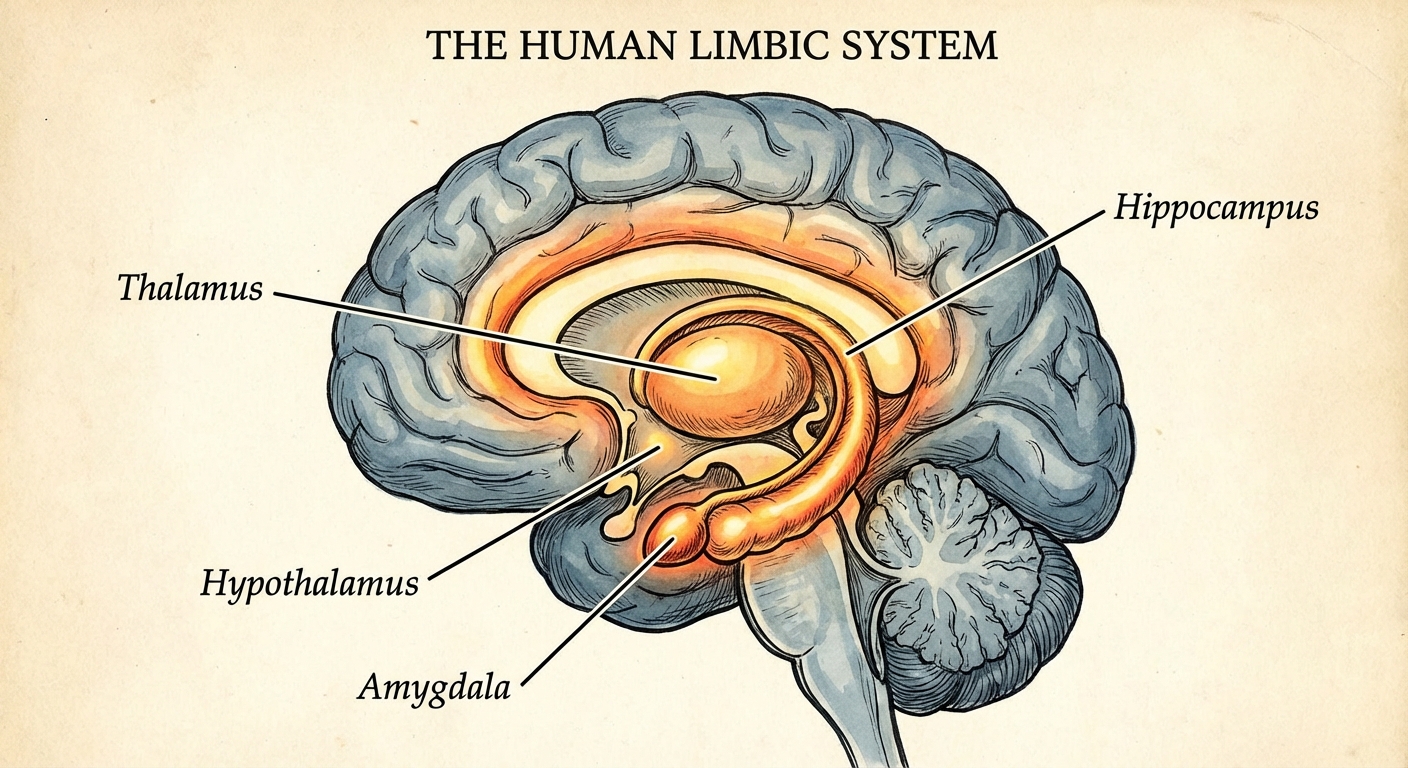
- Amygdala: Two lima-bean-sized neural clusters; linked to emotion, specifically fear and aggression.
- Hypothalamus: Lying below the thalamus; directs several maintenance activities (eating, drinking, body temperature), helps govern the endocrine system via the pituitary gland, and is linked to emotion and reward.
- Hippocampus: Linked to the formation of new explicit memories.
The Cerebral Cortex
The body’s ultimate control and information-processing center. Divided into two hemispheres and four lobes.
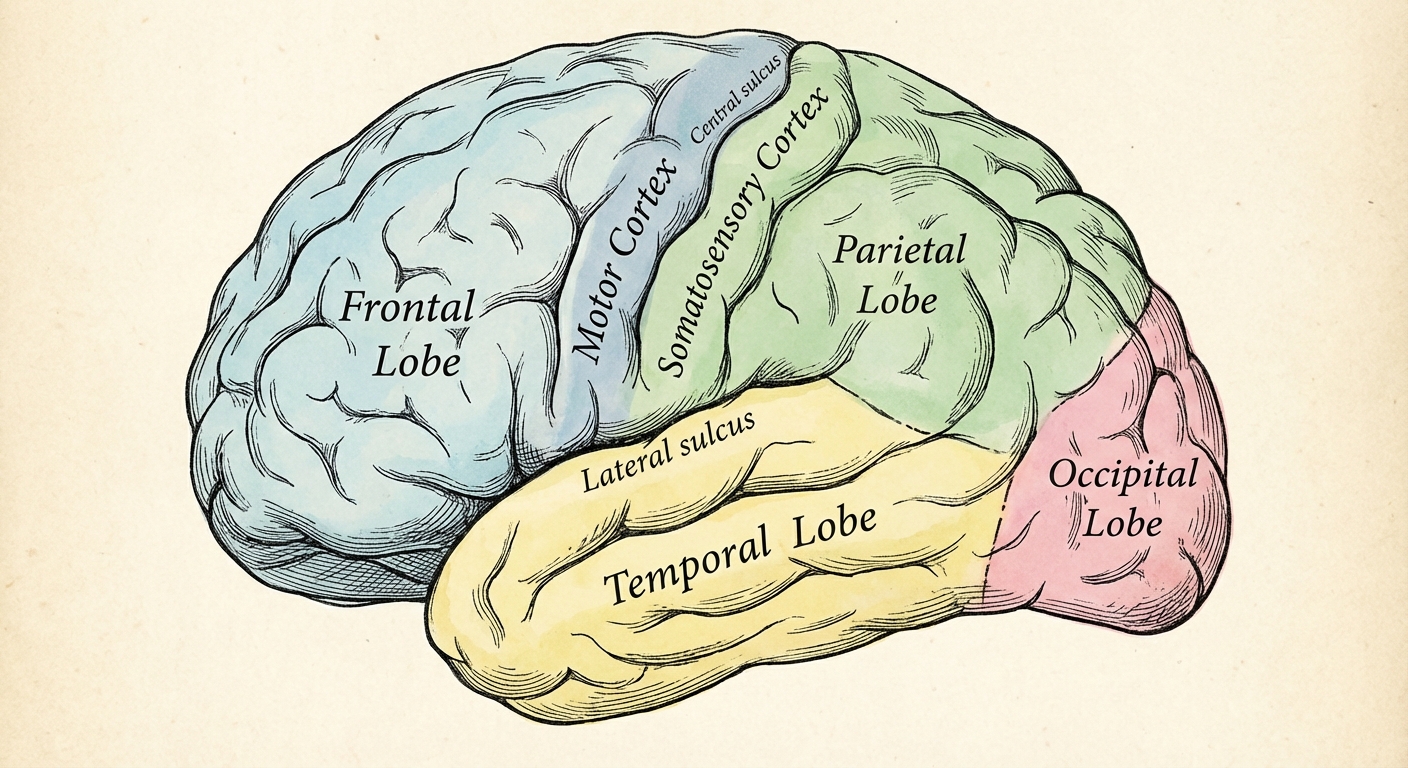
The Four Lobes
- Frontal Lobes: Involved in speaking, muscle movements, and making plans/judgments (Executive function).
- Motor Cortex: Controls voluntary movements.
- Broca's Area: Controls language expression (muscle movement involved in speech). Damage causes Broca's Aphasia (broken speech but comprehension remains).
- Parietal Lobes: Receives sensory input for touch and body position.
- Somatosensory Cortex: Registers and processes body touch and movement sensations.
- Occipital Lobes: Includes areas that receive information from the visual fields.
- Temporal Lobes: Includes the auditory areas.
- Wernicke's Area: Controls language reception (comprehension). Damage causes Wernicke's Aphasia (meaningless speech, poor comprehension).
Brain Plasticity
Plasticity is the brain's ability to change, especially during childhood, by reorganizing after damage or by building new pathways based on experience. While neurons generally do not regenerate (neurogenesis is rare but possible), neural connections do changes.
Hemispheres and Split Brain
- Corpus Callosum: Large band of neural fibers connecting the two brain hemispheres and carrying messages between them.
- Split Brain: A condition resulting from surgery that isolates the brain's two hemispheres by cutting the fibers connecting them (usually to stop seizures).
- Lateralization: The tendency for some neural functions or cognitive processes to be specialized to one side of the brain or the other.
- Left Hemisphere: Logic, language (reading, writing, speaking), calculation, analysis.
- Right Hemisphere: Creativity, imagination, intuition, faces, spatial construction.
- Note: The "creative vs logical" split is often exaggerated in pop culture, but the anatomical separation of sensory/motor inputs (contralateral control) is real.
The Endocrine System
The body's "slow" chemical communication system; a set of glands that secrete hormones into the bloodstream.
- Hormones vs. Neurotransmitters: Neurotransmitters are fast (nervous system); hormones are slow but longer-lasting (bloodstream).
- Pituitary Gland: The "Master Gland." Under the influence of the hypothalamus, the pituitary regulates growth and controls other endocrine glands.
- Adrenal Glands: Sit just above the kidneys. Secrete epinephrine (adrenaline) and norepinephrine, which help arouse the body in times of stress.
States of Consciousness
Sleep and Rhythms
- Circadian Rhythm: The biological clock; regular bodily rhythms (e.g., temperature and wakefulness) that occur on a 24-hour cycle.
- Regulated by the Suprachiasmatic Nucleus (SCN) in the hypothalamus, which causes the pineal gland to adjust melatonin production.
Sleep Stages
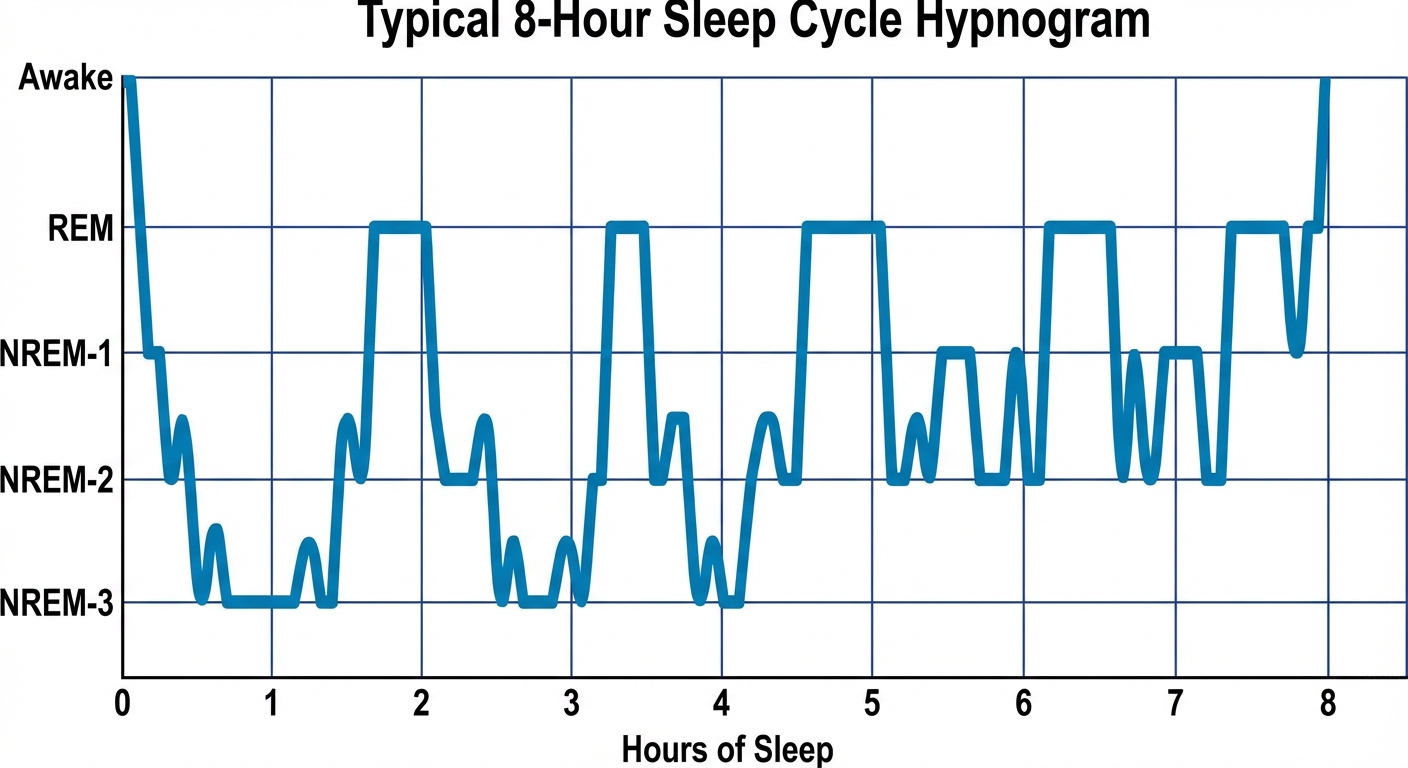
We cycle through roughly 4 stages every 90 minutes.
- NREM-1: Light sleep, theta waves. Hallucinatory sensations (falling/floating) called hypnagogic sensations occur here.
- NREM-2: Sleep Spindles (bursts of rapid brain activity). You spend the most time here.
- NREM-3: Deep sleep, Delta waves. Night terrors and sleepwalking (somnambulism) happen here. Hard to wake up.
- REM (Rapid Eye Movement): Distinct stage where dreams occur. Muscles are relaxed (paralyzed) but other body systems are active (paradoxical sleep).
- REM Rebound: The tendency for REM sleep to increase following REM sleep deprivation.
Sleep Disorders
- Insomnia: Recurring problems in falling or staying asleep.
- Narcolepsy: Uncontrollable sleep attacks. The sufferer may lapse directly into REM sleep.
- Sleep Apnea: Temporary cessations of breathing during sleep and repeated momentary awakenings.
- Night Terrors: High arousal and appearance of being terrified; unlike nightmares, these occur during NREM-3 and are rarely remembered.
Dreams
- Freud’s Wish Fulfillment: Dreams provide a "psychic safety valve." Manifest content (storyline) acts as a censored version of Latent content (underlying meaning/desires).
- Activation-Synthesis: The brain attempts to make sense of random neural activity (activation) coming from the brainstem during REM.
- Information Processing: Dreams help us sort out the day's events and consolidate memories.
Psychoactive Drugs
Chemical substances that alter perceptions and moods.
- Depressants: Reduce neural activity and slow body functions.
- Examples: Alcohol, Barbiturates, Opiates.
- Stimulants: Excite neural activity and speed up body functions.
- Examples: Caffeine, Nicotine, Cocaine, Ecstasy (MDMA), Methamphetamine.
- Hallucinogens: Psychedelic drugs that distort perceptions and evoke sensory images in the absence of sensory input.
- Examples: LSD, THC (Marijuana).
- Tolerance: The diminishing effect with regular use of the same dose of a drug.
- Withdrawal: The discomfort and distress that follow discontinuing the use of an addictive drug.
Common Mistakes & Pitfalls
- NTs vs. Hormones: Remember that some chemicals (like Norepinephrine) can be both. The difference is geography: If it's at a synapse, it's a neurotransmitter. If it's in the blood, it's a hormone.
- Left vs. Right Brain: Don't oversimplify. While language is usually Left, the Right brain handles context and inflection. You are not "Left Brained" or "Right Brained"; the corpus callosum constantly integrates both.
- Sympathetic vs. Parasympathetic: Think "Parachute" for Parasympathetic—it brings you down slowly (calms you).
- Cerebellum vs. Cerebrum: Cerebellum is the "little brain" for balance. Cerebrum is the top part (the cortex) for thinking.
- Hypothalamus vs. Thalamus: The Thalamus is the Relay Station. The Hypothalamus is for Homeostasis (Hunger, Thirst, Temp).