Europe in Transition: The Renaissance and Age of Exploration (c. 1450 – 1648)
1.1 The Italian Renaissance: Rebirth of the Classics
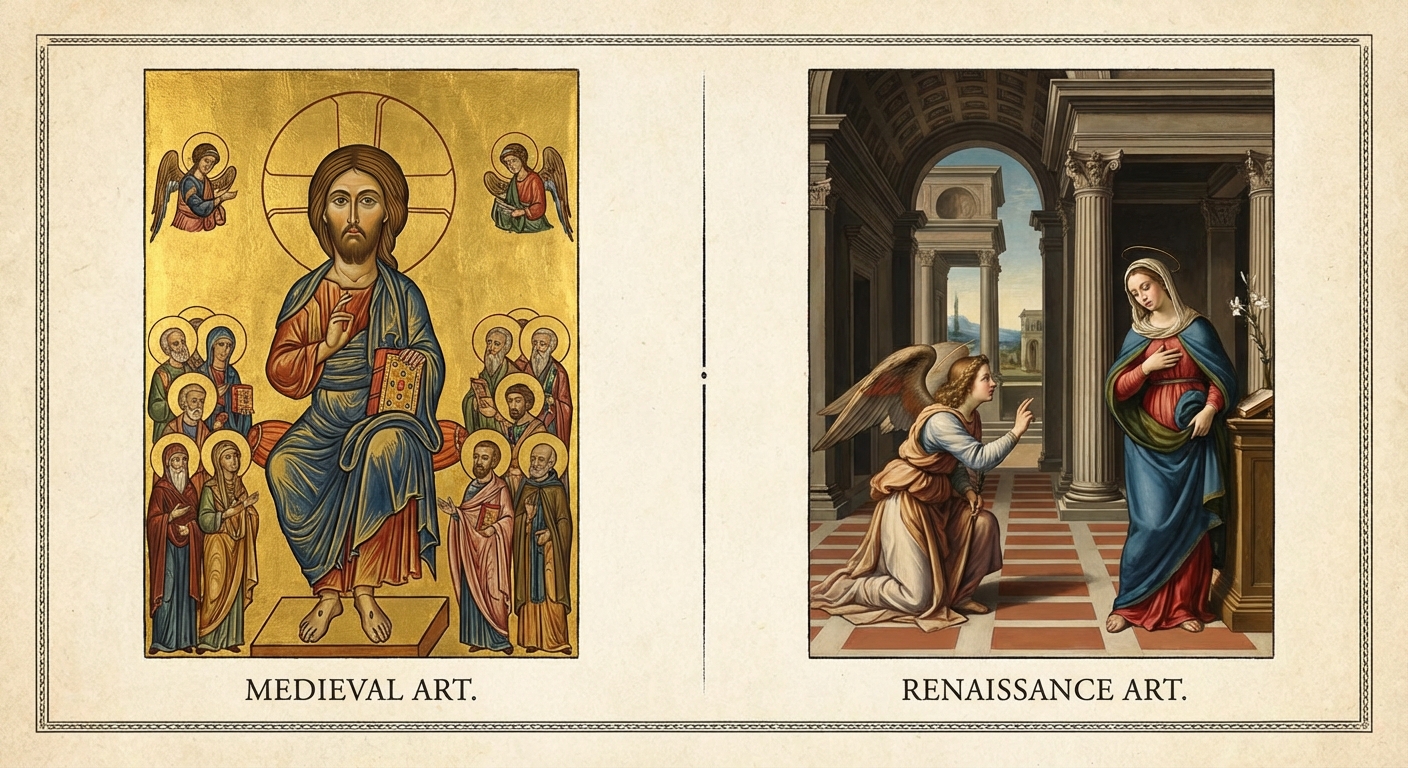
The Renaissance (French for "rebirth") was not a sudden event but a gradual transition from the Middle Ages, marked by a revival of interest in the classical learning of Greece and Rome. It began in the Italian city-states (Florence, Venice, Milan) due to their strategic location for trade and wealth.
Humanism & Philosophy
Humanism was the intellectual engine of the Renaissance. It shifted focus from the theological (God-centered) view of the Middle Ages to an anthropocentric (human-centered) view.
- Classicism (Ad Fontes): The return "to the sources." Humanists studied original Greek and Latin texts (Cicero, Plato) rather than medieval commentaries.
- Secularism: An emphasis on worldly affairs and the present life, rather than solely focusing on the afterlife.
- Individualism: Celebration of individual potential and genius (virtù).
Key Intellectuals:
- Petrarch (1304–1374): The "Father of Humanism." He characterized the Middle Ages as the "Dark Ages" and wrote poetry in the vernacular (Italian) as well as Latin.
- Pico della Mirandola: Wrote Oration on the Dignity of Man, arguing that humans have unlimited potential and can choose their own destiny.
- Niccolò Machiavelli: Wrote The Prince (1513). He introduced Secular Political Science, arguing that a ruler should be pragmatic ("the end justifies the means") rather than morally virtuous. It is better to be feared than loved if one cannot be both.
- Baldassare Castiglione: Wrote The Courtier, defining the "Renaissance Man" as a well-rounded gentleman skilled in arts, arms, and lettuce.
Renaissance Art and Patronage
Art became a status symbol for wealthy merchants (like the Medici in Florence) and the Catholic Church.
Technological Innovations in Art:
- Geometric Perspective: Creating a 3D illusion on a 2D surface (linear perspective).
- Chiaroscuro: Severe contrast between light and dark to create depth.
- Naturalism/Realism: Anatomical accuracy (study of the human body).
| Artist | Major Works | Significance |
|---|---|---|
| Leonardo da Vinci | Mona Lisa, The Last Supper | The ultimate "Renaissance Man" (artist, engineer, scientist). Used sfumato (softening transitions). |
| Michelangelo | David, Sistine Chapel Ceiling | Glorified the human form (Neoplatonic ideal). Commissioned by Pope Julius II. |
| Raphael | School of Athens | Epitomized the High Renaissance ideal of harmony; painted classical philosophers alongside Renaissance contemporaries. |
1.2 The Northern Renaissance
While the Italian Renaissance focused on secularism and individualism, the Northern Renaissance (north of the Alps) retained a more religious tone. It began later (late 15th century) as students traveled to Italy and returned with new ideas.
Christian Humanism
Christian Humanism combined classical learning with the goal of reforming the Catholic Church. They believed in the power of education and early scripture to improve society.
- Desiderius Erasmus (The "Prince of the Humanists"): Wrote In Praise of Folly (1509). He satirized the corruption of the clergy and called for a return to simple Christian piety. (Mnemonic: "Erasmus laid the egg that Luther hatched").
- Thomas More: English humanist who wrote Utopia (1516), describing an ideal society free of private property and greed. He was executed by Henry VIII for refusing to acknowledge the King as head of the church.
Northern Art
Unlike the idealized, muscular figures of Italian art, Northern art focused on:
Minute Detail: Intense realism in everyday objects.
Domestic Interiors: Scenes of daily life.
Oil Painting: Developed by Jan van Eyck for vibrant color.
Jan van Eyck: Arnolfini Portrait (mastery of oil paint and mirror reflection).
Pieter Bruegel the Elder: Painted peasant life and landscapes (e.g., Hunters in the Snow).
Albrecht Dürer: The "Leonardo of the North"; famous for woodcuts and self-portraits.
The Printing Press (c. 1450)
Invented by Johannes Gutenberg (movable type).
- Impact:
- Drastically reduced the cost of books.
- increased literacy across Europe.
- Facilitated the rapid spread of the Protestant Reformation (Luther's 95 Theses).
- Solidified vernacular languages.
1.3 The New Monarchies (c. 1450–1648)
This term refers to rulers who unified their respective nations, creating stable and centralized governments. They reduced the power of the nobility and clergy to establish absolute secular authority.
Tools of Centralization
- Taxation: Monarchs gained control over tax collection (no longer identifying on nobles).
- Military: Creation of professional standing armies (replacing feudal levies).
- Law: Implementing Roman Law (King's will is law) over Common Law.
- Religion: Gaining control over the clergy appointment.
Specific Examples
Spain (The Union of Crowns)
- Isabella of Castile & Ferdinand of Aragon: Their marriage (1469) unified Spain.
- Reconquista (1492): Completed the expulsion of Moors (Muslims) from Granada.
- Spanish Inquisition: Enforced religious uniformity (Catholicism), targeting distinct groups (Jews/Conversos/Muslims).
France (The Valois Dynasty)
- Louis XI ("The Spider King"): Expanded royal territory and curbed feudal nobles.
- Francis I: Signed the Concordat of Bologna (1516) with the Pope, giving the French King the power to appoint bishops (Gallican Church).
England (The Tudor Dynasty)
- Henry VII: Established the Star Chamber, a secret court used to prosecute and break the power of the nobility.
- Henry VIII: Broke from Rome (Act of Supremacy) to control the church and seize monastic lands.
1.4 The Age of Exploration
Also known as the "Age of Discovery," this era saw Europeans circumnavigating the globe, motivated by the "Three Gs": God (spread Christianity), Gold (wealth from spices/minerals), and Glory (personal and national fame).
Technological Causes
Exploration was made possible by improvements in navigation:
- Magnetic Compass & Astrolabe: For direction and latitude.
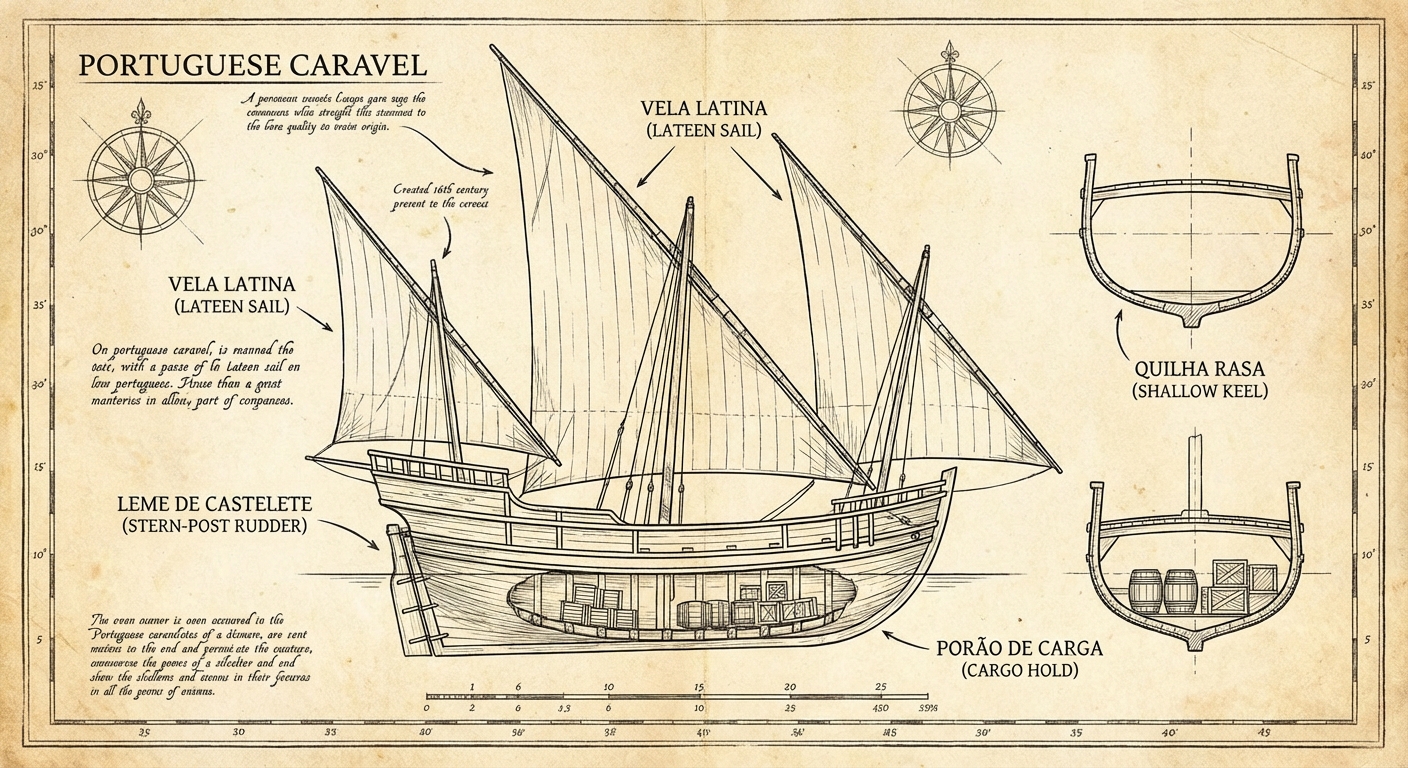
- Caravel: Do-it-all ship with Lateen Sails (triangular sails allowing sailing against the wind) and stern-post rudders.
- Portolani: Detailed navigational charts.
The Portuguese Empire (Trading Post Empire)
Portugal led the way by sailing East around Africa.
- Prince Henry the Navigator: Funded a navigation school.
- Bartholomeu Dias: Rounded the Cape of Good Hope.
- Vasco da Gama: Reached India, establishing a direct spice route and breaking the Ottoman/Venetian monopoly.
The Spanish Empire (Conquest & Colonization)
Spain sailed West to find the East.
- Christopher Columbus (1492): Accidental discovery of the Americas.
- Ferdinand Magellan: His crew was the first to circumnavigate the globe.
- Hernán Cortés: Conquered the Aztec Empire (Mexico).
- Francisco Pizarro: Conquered the Inca Empire (Peru).
Treaty of Tordesillas (1494): The Pope divided the non-European world between Spain (West) and Portugal (East—Brazil and Africa/Asia) to prevent war.
1.5 The Columbian Exchange
The Columbian Exchange was the biological transmission of plants, animals, diseases, and people between the Old World (Europe/Africa/Asia) and the New World (Americas).
Note: This is not the same as trade (Triangular Trade). It encompasses biological transfer.
| Category | From Old World to New World (Europe $\to$ Americas) | From New World to Old World (Americas $\to$ Europe) |
|---|---|---|
| Diseases | Smallpox, Measles, Flu (killed ~90% of natives) | Syphilis |
| Animals | Horses, Cattle, Pigs, Sheep | Turkeys, Llamas |
| Crops | Wheat, Rice, Sugar Cane, Coffee | Potatoes, Maize (Corn), Tomatoes, Tobacco |
Impact
- On Europe: Population BOOM due to high-calorie foods (corn/potato).
- On Americas: Demographic COLLAPSE due to disease; destruction of indigenous empires.
1.6 The Commercial Revolution & Social Change
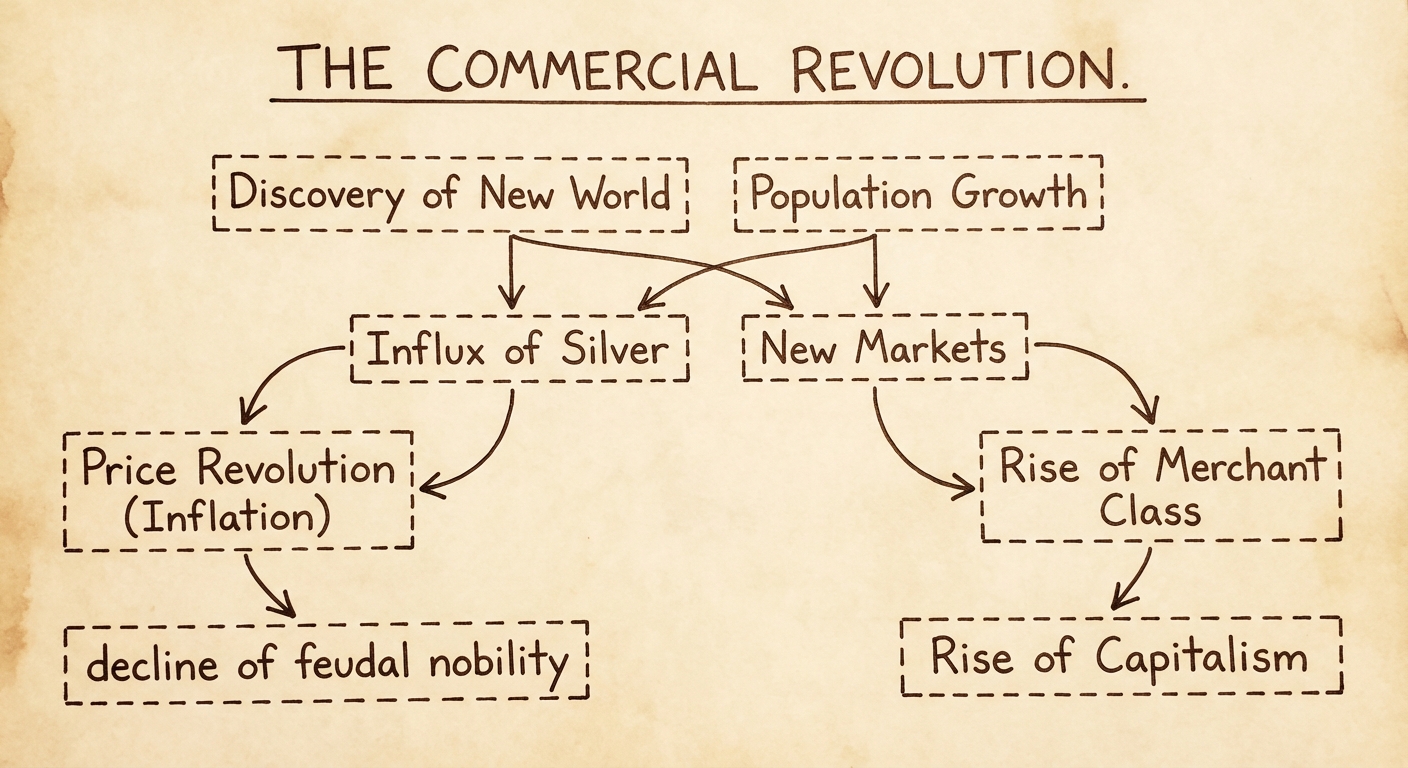
The influx of gold/silver from the Americas and new trade routes triggered a transformation in the European Economy from local/feudal to global/capitalist.
Key Developments
- Price Revolution: A century of high inflation caused by population growth and the influx of Spanish silver. This hurt the land-owning nobles (fixed income) but helped the rising middle class (merchants).
- Mercantilism: The economic theory that a nation's power depends on its wealth (bullion). Governments heavily regulated trade to ensure a favorable balance of trade (exports > imports).
- Joint-Stock Companies: Investors created companies (e.g., Dutch East India Company - VOC) to pool resources and share risk for long-distance trade. Precursor to the stock market.
- Banking: The rise of family banks (e.g., The Fuggers in Germany, Medici in Italy) facilitated international finance.
The Atlantic Slave Trade
As native populations died out from disease, Europeans turned to Africa for labor (specifically for labor-intensive Sugar plantations).
- Triangular Trade: Manufactured goods to Africa $\rightarrow$ Slaves to Americas (Middle Passage) $\rightarrow$ Raw materials (sugar/tobacco) to Europe.
- Asiento System: A license issued by the Spanish crown granting the right to import slaves (later held by the British).
1.7 Common Mistakes & Pitfalls
Confusing Humanism Types:
- Italian Humanism = Secular, focused on individual potential, "virtú".
- Christian (Northern) Humanism = Religious, focused on reforming the church and studying the Bible.
The "Break" from the Middle Ages:
- Mistake: Thinking the Renaissance was a complete restart. Reality: There was significant continuity. The Church remained powerful, and rural peasant life changed very little during the Renaissance.
Portugal vs. Spain:
- Remember: Portugal went around Africa (Trading Posts). Spain went into the Americas (Conquest/Settlement).
Columbian Exchange vs. Triangular Trade:
- Columbian Exchange = Biological (potatoes, smallpox).
- Triangular Trade = Economic system (slaves, guns, sugar).
Mercantilism vs. Capitalism:
- Mercantilism is state-controlled for national power. Capitalism (which was just emerging) implies private ownership and free markets. In this era, they overlapped, but Mercantilism was the dominant state policy.