Study Notes: Conductors and Capacitors
Electrostatics with Conductors
In AP Physics C: Electricity and Magnetism, understanding how conductors behave in electrostatic equilibrium is fundamental. A conductor is a material (typically a metal like copper or aluminum) containing free charge carriers (electrons) that are free to move throughout the atomic lattice.
The Condition of Electrostatic Equilibrium
Electrostatic Equilibrium occurs when all net charge movements have ceased. Even though individual thermal motion continues, there is no net current inside the material. When a conductor reaches this state, four fundamental rules govern its behavior.
1. The Electric Field Inside is Zero
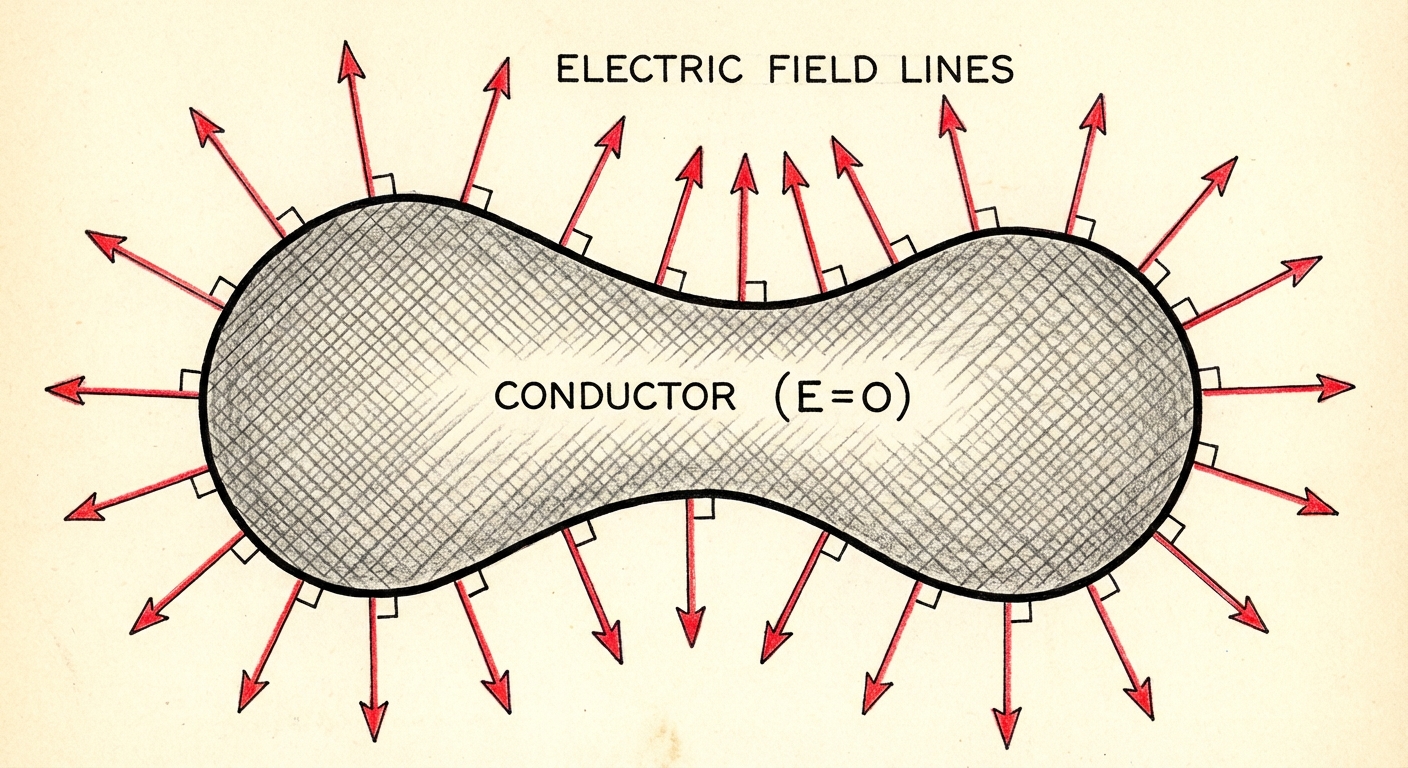
Inside the material of a conductor in electrostatic equilibrium, the net electric field is zero.
- Why? If there were a non-zero electric field inside, it would exert an electric force ($F = qE$) on the free electrons. This force would cause the electrons to accelerate and move, violating the assumption that the conductor is in equilibrium. The charges will shift positions instantaneously until they cancel out any external field within the bulk material.
2. The Conductor is an Equipotential Volume
Since the electric field is zero inside the conductor, the electric potential ($V$) must be constant throughout the entire volume of the conductor, including its surface.
Recall the relationship between potential difference and electric field:
If $E = 0$ everywhere inside, then $\Delta V = 0$ between any two points inside or on the surface.
- Implication: If you connect two conductors with a conducting wire, they become a single equipotential volume. Charge will flow between them until their potentials are equal ($V1 = V2$).
3. Electric Field Just Outside the Surface
The electric field vector just outside a charged conductor is always perpendicular to the surface.
- Why? If the electric field had a component parallel (tangential) to the surface, it would push charges along the surface. Since we are in equilibrium, no surface currents exist, so the tangential component must be zero.
4. Magnitude of Surface Electric Field
Using Gauss's Law, we can determine the magnitude of the electric field just outside the surface. By drawing a small cylindrical Gaussian pillbox extending just outside and just inside the surface:
Where:
- $\sigma$ (sigma) is the local surface charge density ($C/m^2$).
- $\epsilon_0$ is the permittivity of free space.
Note that this is twice the magnitude of the field produced by a non-conducting infinite sheet of charge ($\sigma / 2\epsilon_0$). The conductor effectively prevents field lines from penetrating inwards, "pushing" them all outwards.
Charge Distribution on Conductors
Location of Excess Charge
For a conductor in electrostatic equilibrium, all excess charge resides entirely on the surface.
- Proof via Gauss's Law:
- Imagine a Gaussian surface drawn just inside the actual physical surface of the conductor.
- We know $E = 0$ everywhere on this Gaussian surface (Rule 1).
- Therefore, the flux $\Phi_E = \oint \vec{E} \cdot d\vec{A} = 0$.
- According to Gauss's Law ($ \PhiE = Q{\text{enclosed}} / \epsilon_0 $), the enclosed charge must be zero.
- Any net charge placed on the conductor must therefore be pushed to the exterior boundary.
Curvature and Charge Density ($\sigma$)
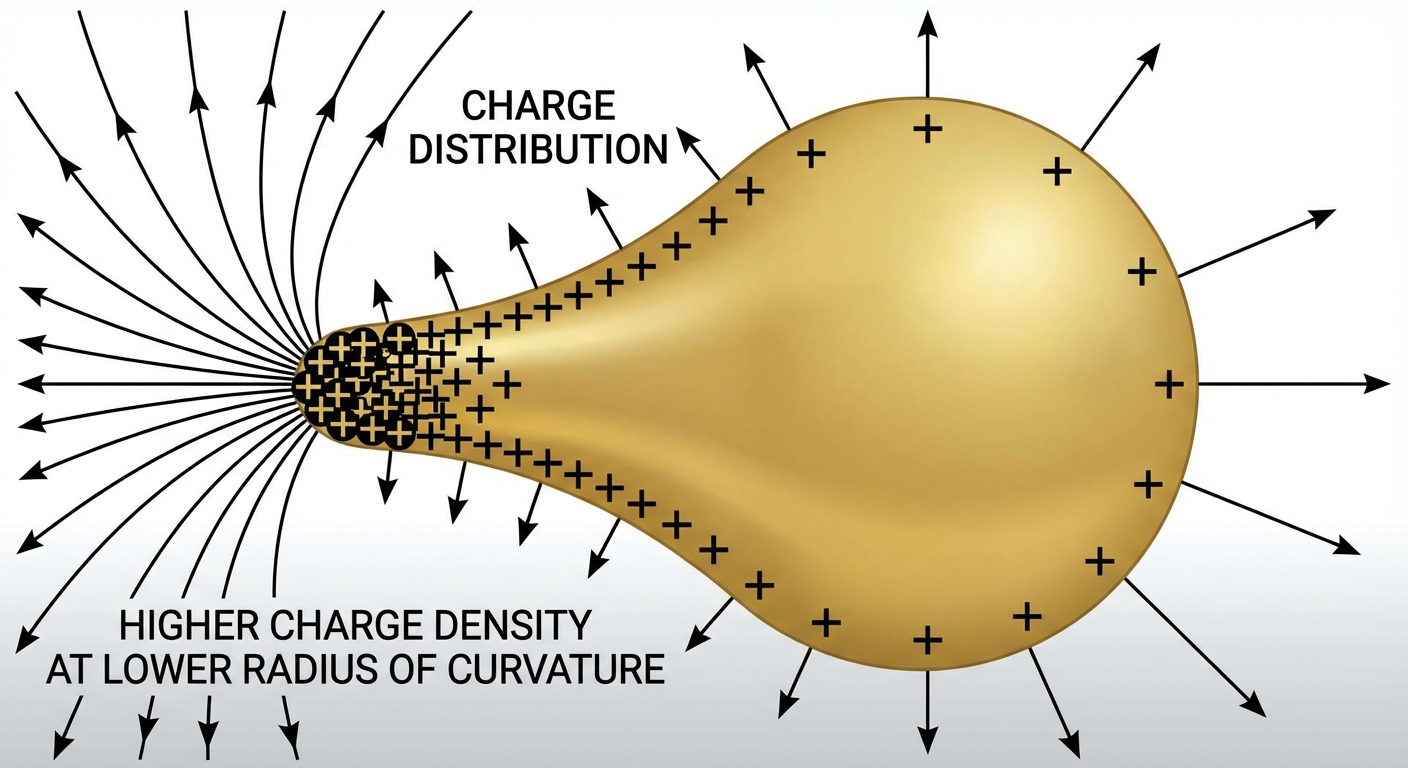
On an irregularly shaped conductor, excess charge is not distributed uniformly. The surface charge density ($\sigma$) is greatest at locations with the smallest radius of curvature (sharpest points).
- Concept Check: Imagine two spheres connected by a long wire. They must have the same potential $V$.
- $V{\text{small}} = k\frac{q1}{r1}$ and $V{\text{large}} = k\frac{q2}{r2}$.
- Equating them: $\frac{q1}{r1} = \frac{q2}{r2}$.
- Since density $\sigma = \frac{q}{4\pi r^2}$, we find that $\sigma{small} > \sigma{large}$.
This explains why lightning rods are sharp; the high charge density creates a strong electric field that ionizes the surrounding air (dielectric breakdown) before a massive strike occurs uncontrolled.
Conductors with Cavities
Problems involving hollow conductors (shells) are very common on the AP exam. We apply Gauss's Law and the properties of conductors to solve them.
Case 1: Empty Cavity
If a conductor has a hollow cavity with no charge inside:
- The electric field inside the cavity is zero.
- There is no charge on the inner surface of the cavity.
- This is the principle of Electrostatic Shielding (Faraday Cage). Electronic components are often encased in metal to protect them from external stray fields.
Case 2: Charge Inside Cavity
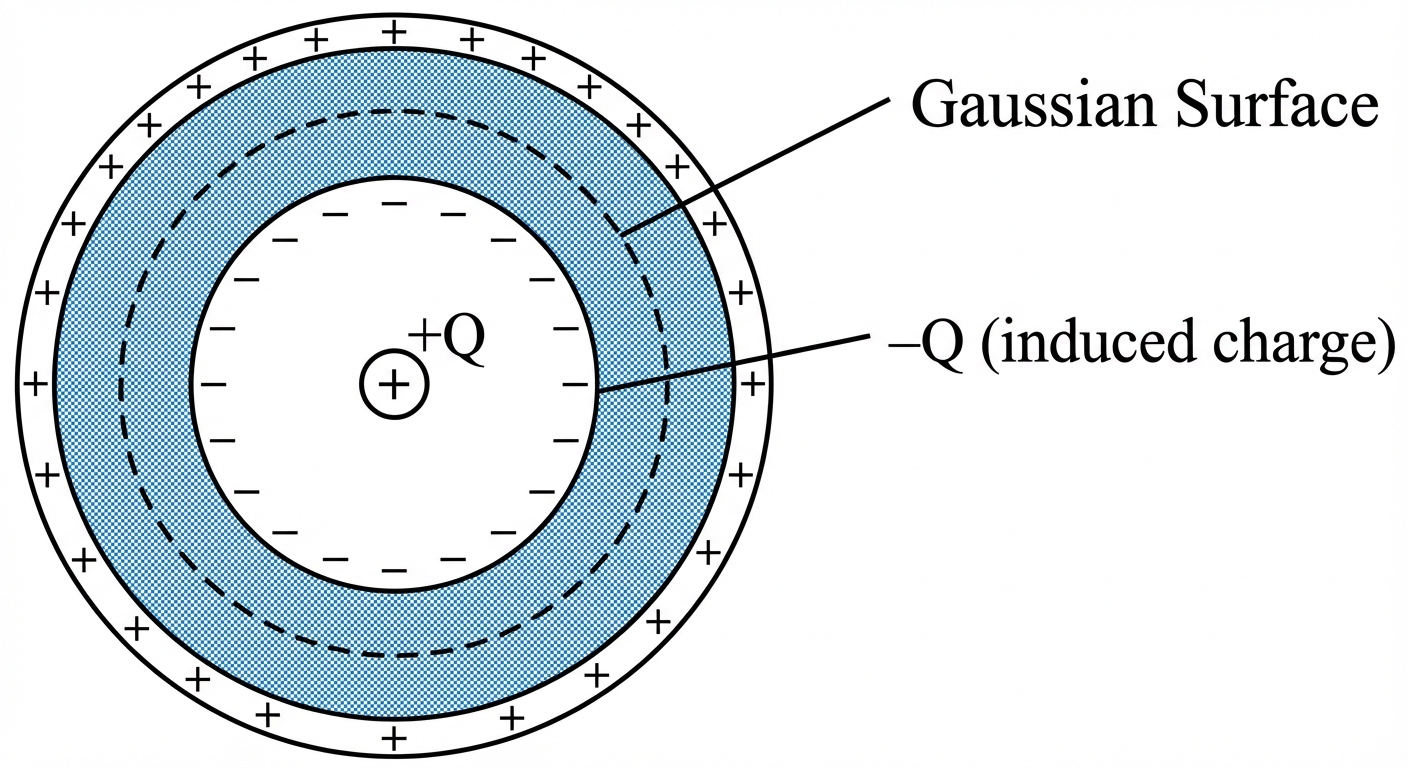
Consider a neutral conducting shell with a point charge $+Q$ floating inside the hollow cavity.
- Gaussian Surface: Draw a surface entirely within the conducting material surrounding the cavity.
- Field Condition: Since it is inside the conductor, $E=0$, so $\Phi_E = 0$.
- Enclosed Charge: For flux to be zero, $Q{\text{enclosed}}$ must be zero. Q{\text{enclosed}} = Q{\text{point}} + Q{\text{inner_surface}} = 0
- Result: The inner surface develops an induced charge of $-Q$ perfectly distributed to cancel the field within the metal.
- Outer Surface: Since the conductor was originally neutral, charge is conserved. If $-Q$ moved to the inner surface, $+Q$ must move to the outer surface.
Summary Table: Conducting Shell with Charge $+q$ inside
| Location | Net Charge | Finding E-Field |
|---|---|---|
| Inside Cavity ($r < R_{in}$) | $+q$ (point charge) | Use Gauss's Law with $+q$. $E = k q / r^2$ |
| Inner Surface ($r = R_{in}$) | $-q$ (induced) | N/A (Boundary) |
| Within Conductor ($R{in} < r < R{out}$) | 0 (bulk) | $E = 0$ (Always in equilibrium) |
| Outer Surface ($r = R_{out}$) | $+q_{\text{total}} - (-q)$ | Determines field outside |
| Outside ($r > R_{out}$) | Depends on shell's net charge | Treat shell as point charge at center |
Common Mistakes & Pitfalls
Confusing Potential ($V$) with Field ($E$) Inside:
- Mistake: Students often think "Since $E=0$ inside, $V$ must also be 0."
- Correction: No! $E$ is the derivative (slope) of $V$. If the slope is zero, the value is constant, not necessarily zero. The conductor is at the same potential as its surface.
Misapplying the Infinite Sheet Formula:
- Mistake: Using $E = \sigma / 2\epsilon_0$ for the field just outside a metal plate.
- Correction: For a conductor, the field is $E = \sigma / \epsilon_0$. The "infinite sheet" formula applies to a non-conducting plane of charge or strictly one layer of charge without the conductor effects.
Touching Conductors:
- Mistake: Thinking touching conductors share charge equally ($Q1 = Q2$).
- Correction: They share charge until Potential is equal ($V1 = V2$). Equal charge only happens if the conductors are identical in size and shape.
Cavity Charges:
- Mistake: Forgetting that a charge inside a cavity induces a physically real charge on the inner wall.
- Correction: Always use a Gaussian surface inside the metal to prove that the inner wall charge must exactly cancel the cavity charge.