APUSH Unit 1: The Contact Period & Columbian Exchange
European Exploration in the Americas
To understand the United States, you must first understand the collision between the Old World (Europe/Africa) and the New World (the Americas) that began in 1492. Period 1 (1491–1607) sets the stage for colonization.
The Motives for Exploration
Why did Europeans suddenly venture across the Atlantic in the late 15th century? Historians generally categorize the motivation using the Three Gs:
- Gold: Wealth accumulation. Under the economic theory of Mercantilism, nations measure power by their wealth (gold and silver). Europe wanted direct access to Asian spice markets to bypass Muslim middlemen in the Middle East, increasing profit.
- Glory: Political power and national status. Emerging nation-states (like Spain, Portugal, France) competed for dominance.
- God: Religious zeal. Following the Protestant Reformation and the Catholic Counter-Reformation, nations sought to convert Indigenous populations to Christianity (specifically Catholicism for the Spanish).
Technological Enablement
Desire wasn't enough; Europeans needed the tools to cross the ocean. Significant innovations, often adapted from Chinese and Islamic technology, made trans-Atlantic travel possible.
- Caravel: A Portuguese ship design using triangular (lateen) sails allowed ships to sail against the wind.
- Astrolabe & Sextant: Instruments used for navigation by measuring the position of stars/sun to calculate latitude.
- Joint-Stock Companies: A business organization where investors pooled capital to fund exploration (managing risk). While more prominent with the English (later), the mechanism of state and private funding was essential.
The Columbian Exchange
The most significant biological event in human history occurred after Christopher Columbus's arrival in 1492.
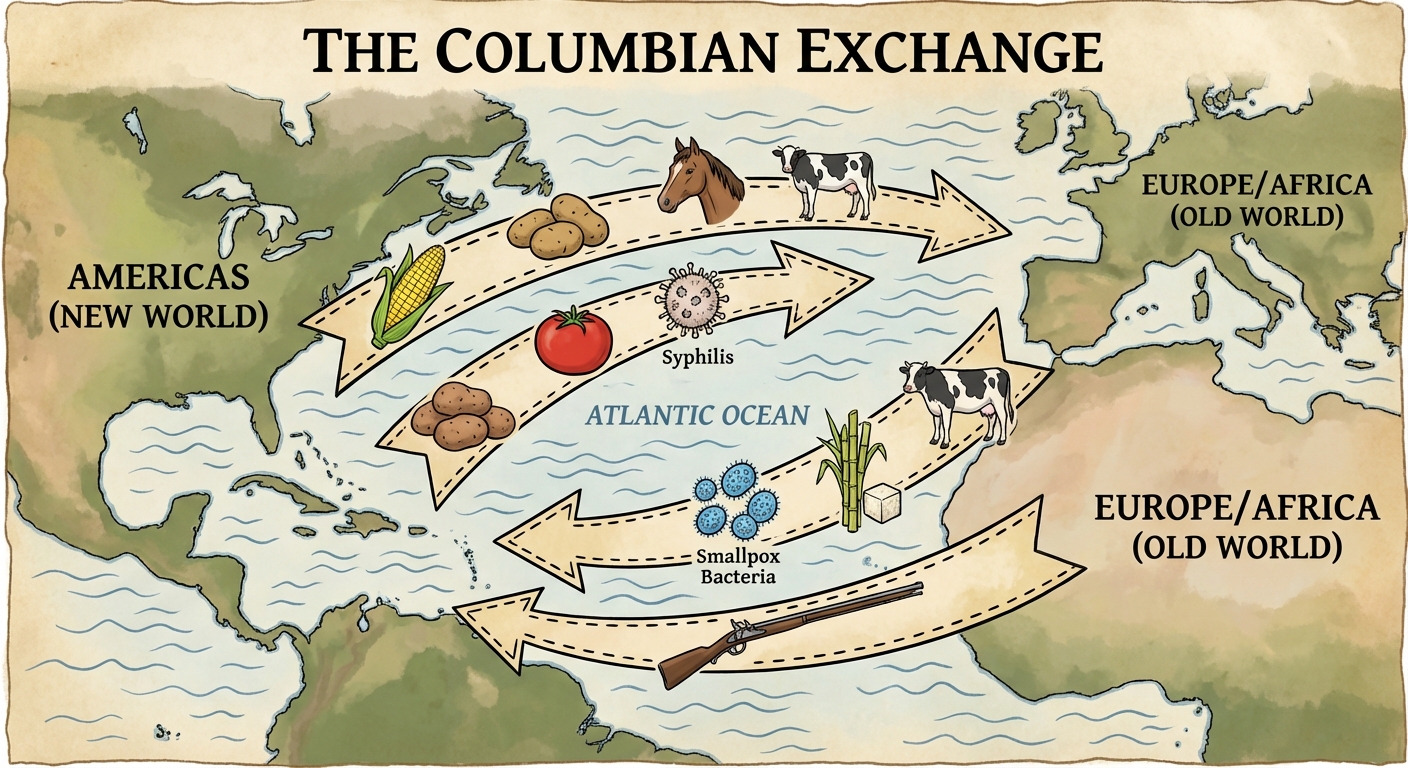
The Columbian Exchange is defined as the transfer of plants, animals, culture, humans, diseases, technology, and ideas between the Americas (New World), West Africa, and the Old World (Europe) in the 15th and 16th centuries.
The Exchange Breakdown
| Category | From Old World (Europe/Africa) to New World | From New World to Old World (Europe) |
|---|---|---|
| Crops/Plants | Wheat, Sugar, Rice, Coffee | Maize (Corn), Potatoes, Tomatoes, Tobacco, Cacao |
| Animals | Horses, Cows, Pigs, Chickens | Turkeys, Llamas, Alpacas |
| Diseases | Smallpox, Measles, Influenza, Bubonic Plague | Syphilis |
| Technology | Guns, Iron tools, the Wheel | Canoe (limited technological transfer) |
Impacts on the Worlds
Impact on the Americas (Demographic Collapse):
- Native Americans had no immunity to European diseases.
- Smallpox was the most devastating, killing an estimated 90% of the Native population in some areas within a century. This is often called the "Great Dying."
- The introduction of the Horse transformed Native cultures, particularly on the Great Plains, facilitating bison hunting and warfare.
Impact on Europe (Population Boom):
- New World crops like maize and potatoes were calorie-dense and easy to grow.
- This nutritional boost led to a massive population spike in Europe, fueling the manpower needed for later colonization and industrialization.
- The influx of gold and silver (specifically from Potosí in present-day Bolivia) shifted Europe from Feudalism to Capitalism.
Spanish Exploration and Conquest
Spain was the dominant power in the Americas during the 1500s. Led by Conquistadors (conquerors), they toppled major empires to extract wealth.
- Hernán Cortés: Conquered the Aztec Empire (Mexico) in 1521 due to advanced weaponry, the help of native allies who hated the Aztecs, and the ravages of smallpox.
- Francisco Pizarro: Conquered the Inca Empire (Peru) in 1532.
The Spanish Colonial Economy
The Spanish economy in the Americas was extraction-based, focused heavily on mining (silver/gold) and plantation agriculture (sugar).
Labor, Slavery, and Caste in the Spanish Colonial System
To extract resources, the Spanish required a massive labor force. Since few Spaniards emigrated, they relied on coerced labor systems.
1. The Encomienda System
The Encomienda System was a labor system instituted by the Spanish crown.
- Definition: Spanish colonists (encomenderos) were granted "protection" of a specific number of Native Americans.
- The Reality: In exchange for "Christianizing" and protecting them, the colonists could demand tribute and forced labor. It was essentially a form of slavery.
2. The Shift to African Slavery
The Encomienda system eventually failed due to:
- The massive death toll of Natives from disease.
- Native familiarity with the land, allowing escapes.
- Moral pressure from religious figures (see Las Casas below).
Consequently, the Spanish introduced the Asiento System, requiring a tax on each enslaved person imported from West Africa. This marked the beginning of the Trans-Atlantic Slave Trade. Africans were immune to European diseases and unfamiliar with the American terrain, making them "ideal" laborers in the eyes of the colonizers.
3. The Casta System
Unlike English colonists who generally segregated themselves from Native populations, the Spanish intermarried (often through coercion) with Native Americans and Africans. To maintain control, they developed a rigid racial hierarchy known as the Casta System.
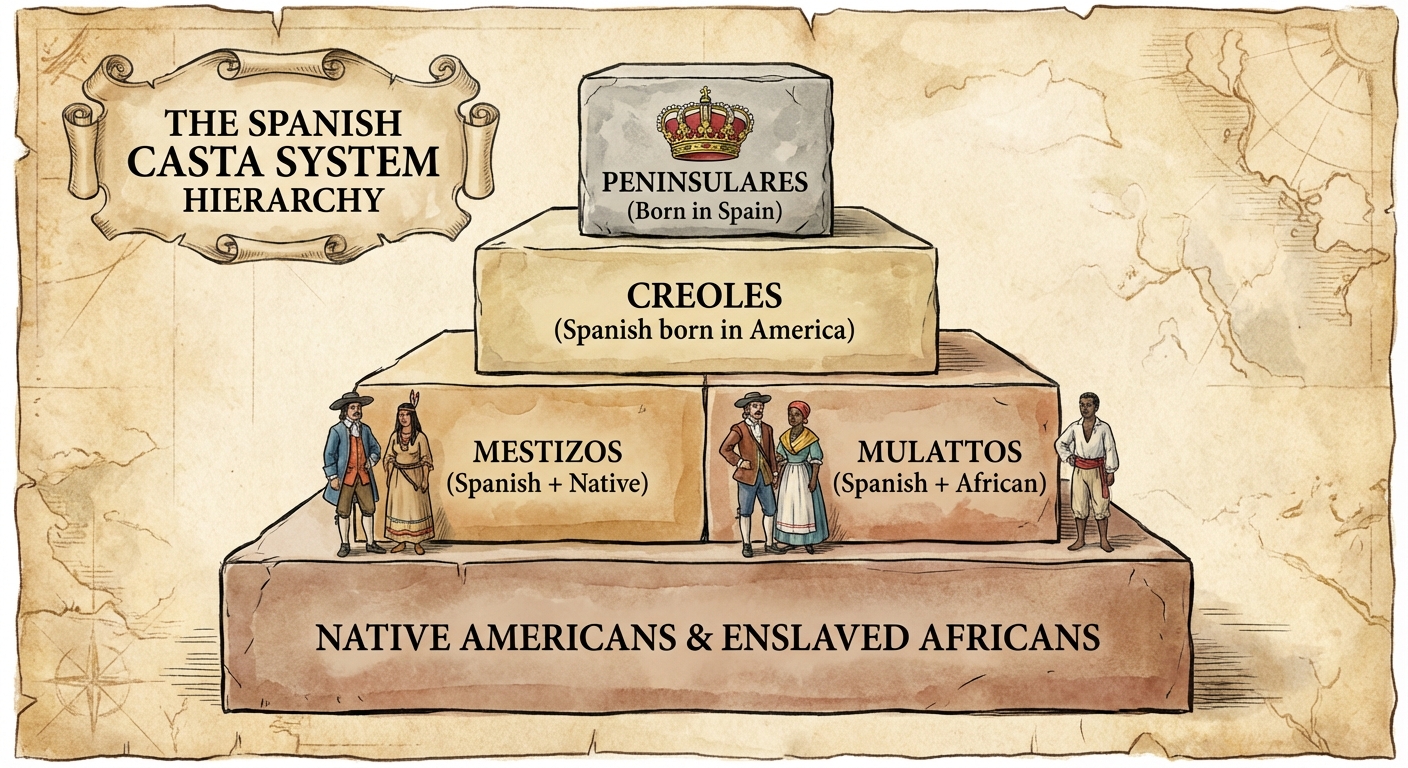
The Hierarchy (from highest to lowest status):
- Peninsulares: Spaniards born in Spain (held the highest government jobs).
- Creoles (Criollos): Spaniards born in the Americas.
- Mestizos: People of mixed Spanish and Native American ancestry.
- Mulattos: People of mixed Spanish and African ancestry.
- Native Americans & Enslaved Africans: The bottom of the social structure.
4. Cultural Interactions and Debate
As the Spanish colonized, debates arose in Europe regarding the morality of their treatment of Native Americans.
The Valladolid Debate (1550–1551)
This was the first moral debate in European history to discuss the rights and treatment of a colonized people.
- Bartolomé de las Casas: A Dominican friar and former encomendero. He wrote A Short Account of the Destruction of the Indies, arguing that Natives were improved by harsh treatment, were rational humans, and deserved protection. He advocated for ending the Encomienda system (though he initially suggested using African slaves instead, a view he later regretted).
- Juan Ginés de Sepúlveda: A Spanish scholar who argued that Natives were "natural slaves" (a concept from Aristotle) and were comprised of barbarians who benefited from being civilized by the Spanish.
Outcome: Technically inconclusive, but Las Casas's arguments led to the "New Laws" of 1542 (which attempted to end the Encomienda system), though these were poorly enforced.
Common Mistakes & Pitfalls
- Chronology Confusion: Do not use "Pilgrims" or "Jamestown" when discussing Period 1 (1491–1607). Period 1 is almost exclusively about Native American complexity and Spanish exploration. The English do not successfully settle until the very end of this period (1607).
- Monolith Myth: Do not assume all Native Americans were the same. They had vastly different environments (Great Plains vs. Southwest vs. Northeast) which dictated their lifestyles (nomadic vs. sedentary). Similarly, not all Europeans treated Natives the same (Spanish subjugated; French later intermarried for trade).
- Misunderstanding the Columbian Exchange: Students often forget that the population grew in Europe (potatoes/corn) while it shrank in the Americas (disease). It is a demographic trade-off.
- Encomienda vs. Slavery: While Encomienda functioned like slavery, technically the Spanish Crown granted the labor, not the person. Chattel slavery (owning a person as property) became more prominent with the shift to African labor.
- The "Black Legend": Be careful not to characterize the Spanish as cartoonishly evil compared to the English. While the Spanish were brutal, the English later pushed Natives off land entirely. The "Black Legend" was anti-Spanish propaganda used by Protestant rivals (England) to justify their own colonization.