Unit 5: Long-Run Consequences of Stabilization Policies
Government Deficits and the National Debt
To understand long-run policy consequences, we must first distinguish between annual budget outcomes and the accumulation of those outcomes over time.
Budget Balance vs. Debt
- Budget Deficit: A flow variable representing the difference when government spending ($G$) exceeds tax revenue ($T$) in a single fiscal year.
- Formula: $\text{Deficit} = G - T$ (where $G > T$).
- Budget Surplus: Occurs when tax revenue exceeds government spending in a single year ($T > G$).
- National Debt: A stock variable representing the total accumulation of past deficits minus past surpluses. It is the total amount of money the federal government owes to bondholders.
Memory Aid: Think of a bathtub. The water flowing in from the tap is the deficit (flow). The total water sitting in the tub is the debt (stock).
Financing the Debt
When the government runs a deficit, it must finance the difference. It does not simply "print money" (which causes hyperinflation). Instead, the U.S. Treasury issues bonds (securities). These bonds are sold to various entities, including private citizens, foreign governments, and the Federal Reserve.
The Crowding Out Effect
One of the most frequent AP Exam topics is Crowding Out. This phenomenon explains the potential negative consequence of expansionary fiscal policy (specifically deficit spending) on private sector investment.
The Mechanism
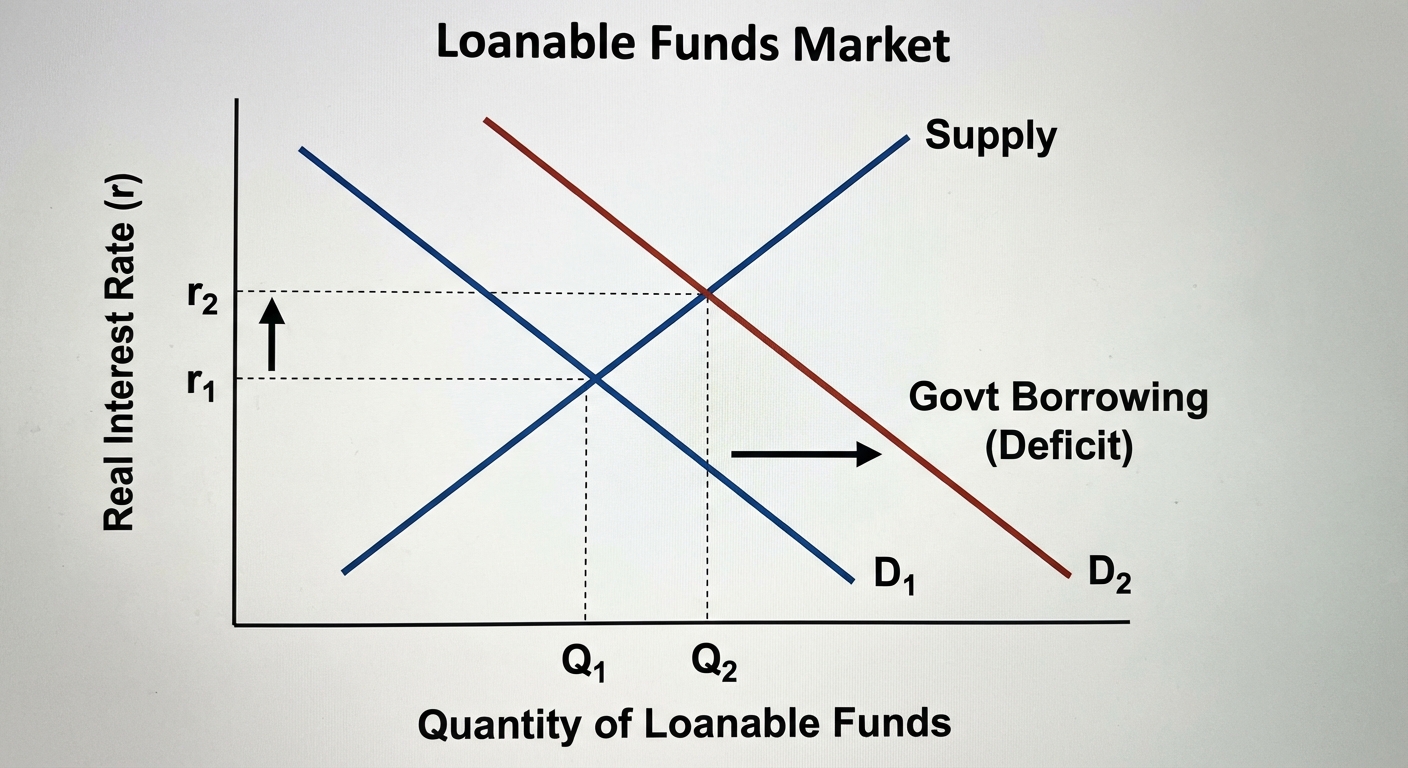
Crowding out occurs through the Loanable Funds Market. When the government acts as a borrower, it competes with private borrowers for available funds.
- Government Borrowing: To fund a deficit, the government borrows from the Loanable Funds Market.
- Demand Shift: This increases the Demand for Loanable Funds (or decreases supply, though AP Macro prefers showing it as a Demand shift).
- Interest Rates Rise: The increased demand drives up the equilibrium Real Interest Rate ($r$).
- Investment Falls: Private businesses borrow less because loans are more expensive. Consequently, Gross Private Investment ($I_g$) decreases.
Impact on Capital Stock
Because Investment ($I_g$) is the purchase of physical capital (machinery, factories, tools), a decrease in investment slows the accumulation of capital.
- Short-Run: Aggregate Demand may still increase due to government spending ($G > I_g$ decrease).
- Long-Run: With less physical capital, the rate of capital stock formation slows down. This hinders future economic growth.
Economic Growth
Economic growth is defined as a sustained increase in Real GDP per Capita over time. While Real GDP measures total output, Real GDP per capita measures the standard of living.
The Rule of 70
To estimate how long it takes for a variable (like GDP) to double, economists use the Rule of 70.
- Example: If an economy grows at 2% per year, it will take $70/2 = 35$ years to double its standard of living.
Visualizing Growth
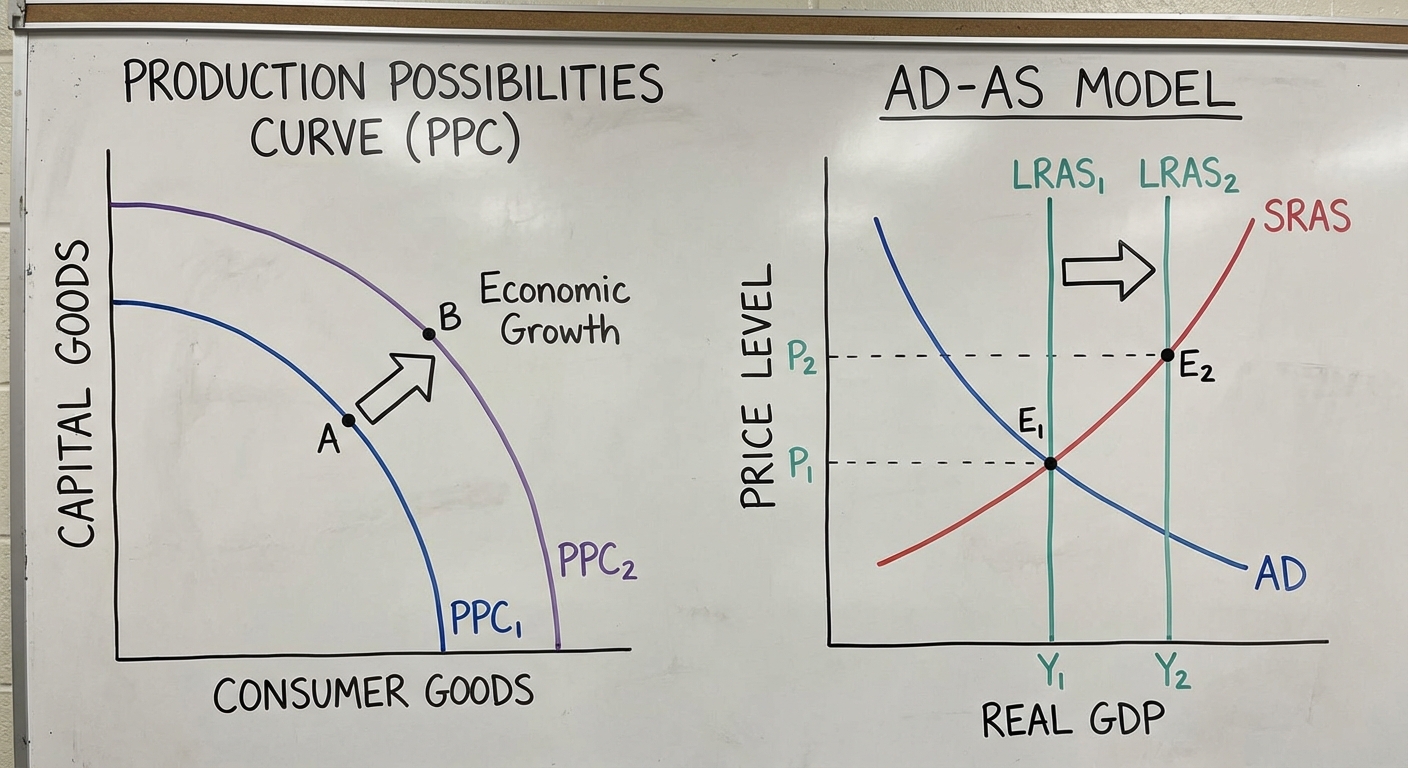
Economic growth is represented graphically in two ways:
- Production Possibilities Curve (PPC): An outward shift of the curve.
- AD-AS Model: A rightward shift of the Long-Run Aggregate Supply (LRAS) curve.
Determinants of Growth
Growth is not caused by using existing resources more efficiently (which is just moving to the PPC curve). It is caused by an increase in the economy's potential capacity. The key determinants are:
- Physical Capital: Tools, machinery, and structures used to produce goods.
- Human Capital: The knowledge, skills, and education of the workforce.
- Technology: The technical means for the production of goods and services (efficiency of combining inputs).
- Natural Resources: Land, minerals, and weather conditions.
Aggregate Production Function
The relationship between inputs and output is described by the Aggregate Production Function. It typically maps Real GDP per worker against Physical Capital per worker.
Diminishing Returns
The function exhibits diminishing marginal returns to capital.
- When a worker typically has very few tools, giving them one new machine massively boosts productivity.
- When a worker already has ten machines, giving them an 11th machine adds very little to productivity.

As you move right along the curve (adding capital), you get more output, but at a decreasing rate. To shift the entire curve upward, you need Technological Advancement.
Public Policy and Economic Growth
Governments can implement supply-side policies to foster long-run growth by targeting the determinants listed above.
Key Policy Interventions
| Determinant | Public Policy Example |
|---|---|
| Physical Capital | Investment Tax Credits: Lowering taxes for businesses that invest in new equipment increases the incentive to build capital stock. |
| Human Capital | Education & Training: Subsidizing college (e.g., Pell Grants) or vocational training increases the skill level of the workforce. |
| Technology | Research & Development (R&D) Grants: Tax breaks or direct funding for scientific research promote innovation. |
| Institutions | Property Rights & Political Stability: Enforcing contracts and patent laws encourages entrepreneurs to innovate without fear of theft. |
Infrastructure
Government spending on infrastructure (roads, bridges, ports, internet grids) creates positive externalities that lower the cost of doing business and increase overall productivity ($Y/L$).
Common Mistakes & Pitfalls
- Debt vs. Deficit: Do not use these interchangeably. Deficit is the yearly shortfall; Debt is the total accumulation.
- Crowding Out Mechanism: Students often forget the middle step. Government borrowing does not directly lower investment; it raises interest rates first, which then lowers investment.
- Investment Definition: In Economics, "Investment" means buying physical capital (machines, factories). Buying stocks or bonds is saving, not investment.
- Growth vs. Recovery: Moving from a recession gap back to full employment (moving a point inside the PPC to the curve) is recovery, not economic growth. Growth requires the curve itself to shift outward.
- Nominal vs. Real: Always define growth in terms of Real GDP per capita, not Nominal GDP, to account for inflation and population changes.