AP French Unit 6 Study Guide: Global Challenges (Les défis mondiaux)
Unit Overview: Defining Global Challenges
Unit 6, Les défis mondiaux (Global Challenges), is often considered the most rigorous unit in the AP French curriculum. It moves beyond daily life and culture into complex, abstract, and often controversial topics affecting the planet and humanity. Mastery of this unit requires not just vocabulary, but an understanding of the intersection between economics, politics, and environmental ethics within the Francophone world.
Essential Questions
When studying this unit, you should constantly reflect on these core inquiries:
- How do environmental, political, and societal challenges positively and negatively impact communities? (En quoi les défis environnementaux, politiques et sociaux ont-ils un impact positif et négatif sur les communautés ?)
- What role do individuals play in identifying and potentially solving complex societal issues? (Quel rôle l’individu joue-t-il en identifiant et éventuellement en résolvant des problèmes complexes de société ?)
- How do challenging issues affect a society’s culture? (En quoi les enjeux difficiles affectent-ils la culture d’une société ?)
Environmental Challenges (L'environnement)
This section focuses on the relationship between humans and the natural world. In France and the Francophone world, environmental protection is often viewed as a state responsibility as well as an individual duty.
Key Vocabulary and Concepts
To discuss these topics effectively, you must distinguish between causes, effects, and solutions.
- Le réchauffement climatique / planétaire: Global warming.
- L’effet de serre (m): The greenhouse effect. (Caused by les émissions de gaz à effet de serre).
- L'épuisement des ressources (m): Resource depletion.
- Les énergies renouvelables (f): Renewable energies (solaire, éolienne, hydraulique).
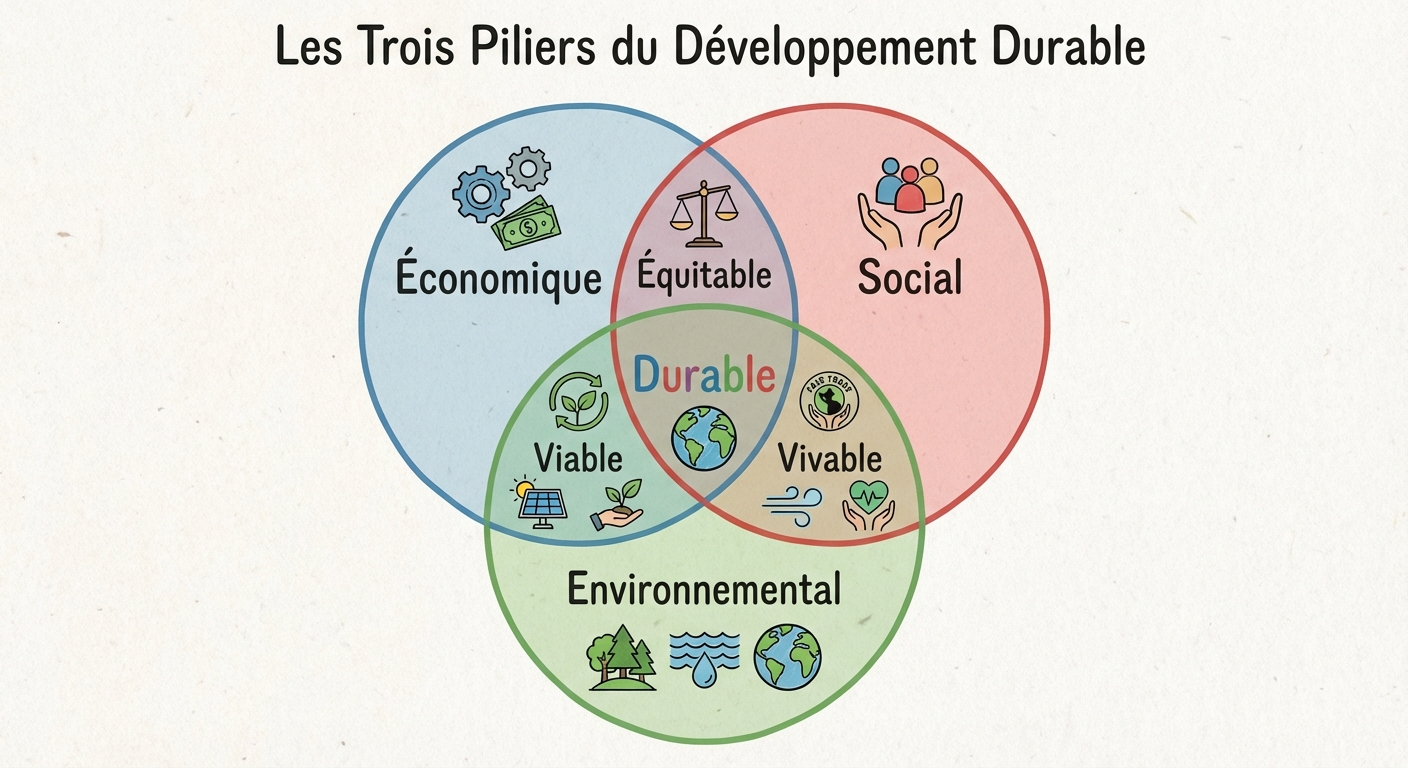
- Le développement durable: Sustainable development. This concept rests on three pillars: economic, social, and environmental.
- L'empreinte carbone (f): Carbon footprint.
Cultural Contexts and Examples
1. France: Nuclear Power vs. Green Transition
Unlike many neighbors, France relies heavily on l'énergie nucléaire (nuclear energy) for electricity (~70%), which produces low carbon emissions but generates radioactive waste (les déchets radioactifs). The Loi de transition énergétique aims to reduce this reliance and increase renewables.
2. The Paris Agreement (L'Accord de Paris)
Signed in 2015, this is a pivotal international treaty on climate change. Mentioning this in an essay demonstrates strong cultural knowledge. France views itself as a leader in la diplomatie climatique.
3. Francophone Africa: Desertification and Deforestation
- The Sahel: Countries like Senegal and Mali face la désertification, where fertile land becomes desert due to drought and climate change. The "Great Green Wall" (la Grande Muraille Verte) is a major initiative to plant trees across Africa to stop this.
- Central Africa: La déforestation in the Congo Basin (often for timber or agriculture) threatens global biodiversity.
Economic and Social Challenges (L'économie et le bien-être social)
This theme covers the stability of society, wealth distribution, and the social safety net.
Key Vocabulary
- Le chômage: Unemployment. (Specific term: un chômeur is an unemployed person).
- La précarité: Job/financial insecurity or instability.
- Le seuil de pauvreté: The poverty line.
- Les Sans-Domicile-Fixe (SDF): The homeless. (Note: use SDF rather than clochard, which is pejorative).
- L'aide sociale (f): Social welfare/aid.
Social Safety Nets vs. Liberalism
France is known for its robust État-providence (welfare state), contrasting with the more market-driven approach of the US.
- La Sécurité Sociale (La Sécu): Universal healthcare coverage and family benefits.
- Le RSA (Revenu de Solidarité Active): A minimum income guaranteed for people without jobs or resources.
- Les HLM (Habitations à Loyer Modéré): Social housing projects. While intended to help, they are often located in les banlieues (suburbs) and can be associated with social isolation.
The Role of Strikes (Les Grèves)
In France, striking is a constitutionally protected right and a primary method of political expression. The Gilets Jaunes (Yellow Vests) movement began as a protest against high fuel taxes (an economic burden) but evolved into a broader cry against social inequality (inégalité sociale) and the cost of living (le coût de la vie).
Political and Societal Challenges (La politique et la société)
This section addresses how diverse populations live together (le vivre-ensemble) and how rights are protected.
Definitions & Concepts
- La Laïcité: Secularism. This is a uniquely French concept. It strictly separates Church and State. Unlike the US, where religious expression is protected in public institutions, in French public schools (l'école publique), conspicuous religious symbols (veils, large crosses, kippahs) are banned to ensure neutrality.
- Les Droits de l'Homme: Human rights. France is historically known as the "Patrie des Droits de l'Homme" (Homeland of Human Rights).
- L'immigration et l'intégration: The challenge of integrating immigrants, particularly from former colonies in the Maghreb and West Africa, is a constant political debate.
Tolerance and Discrimination
- La xénophobie: Fear/hatred of foreigners.
- Le plafond de verre: The "glass ceiling" (faced by women or minorities in the workplace).
- Lois anti-discrimination: France has strict laws punishing hate speech and discrimination in hiring.
Example for Comparison:
In Canada (Quebec), the approach is often le multiculturalisme (coexistence of distinct cultures), whereas France aims for l'assimilation or l'universalisme (everyone becomes "French" first, leaving particular differences in the private sphere).
Grammar Focus: The Subjunctive & Connectors
To score high on the Argumentative Essay (Free Response Question 2), you must use advanced grammar. Global challenges almost always require the Subjunctive because they deal with necessity, doubt, emotion, and possibility.
The Subjunctive Formula
Crucial Triggers for this Unit:
- Necessity: Il est impératif que le gouvernement prenne des mesures. (It is imperative that the government take measures.)
- Doubt: Je ne pense pas que la situation s'améliore rapidement. (I don't think the situation is improving quickly.)
- Emotion: Il est triste que tant d'espèces disparaissent. (It is sad that so many species are disappearing.)
- Conjunctions: Bien que (although), à condition que (provided that), pour que (so that).
- Example: Nous devons agir pour que les générations futures puissent vivre en paix. (We must act so that future generations can live in peace.)
Logical Connectors (Les Mots Charnières)
Never start sentences with "Et" or "Mais" in an essay. Use these instead:
- To Add: De plus (moreover), Par ailleurs (furthermore).
- To Contrast: Cependant (however), Néanmoins (nevertheless), Toutefois (however), Au contraire (on the contrary).
- To Conclude: En somme (in sum), Toutes choses considérées (all things considered).
Exam Focus: The Argumentative Essay
This unit heavily supports the Argumentative Essay. You will be given three sources: an article, a table/chart, and an audio clip. You must defend a viewpoint using all three.
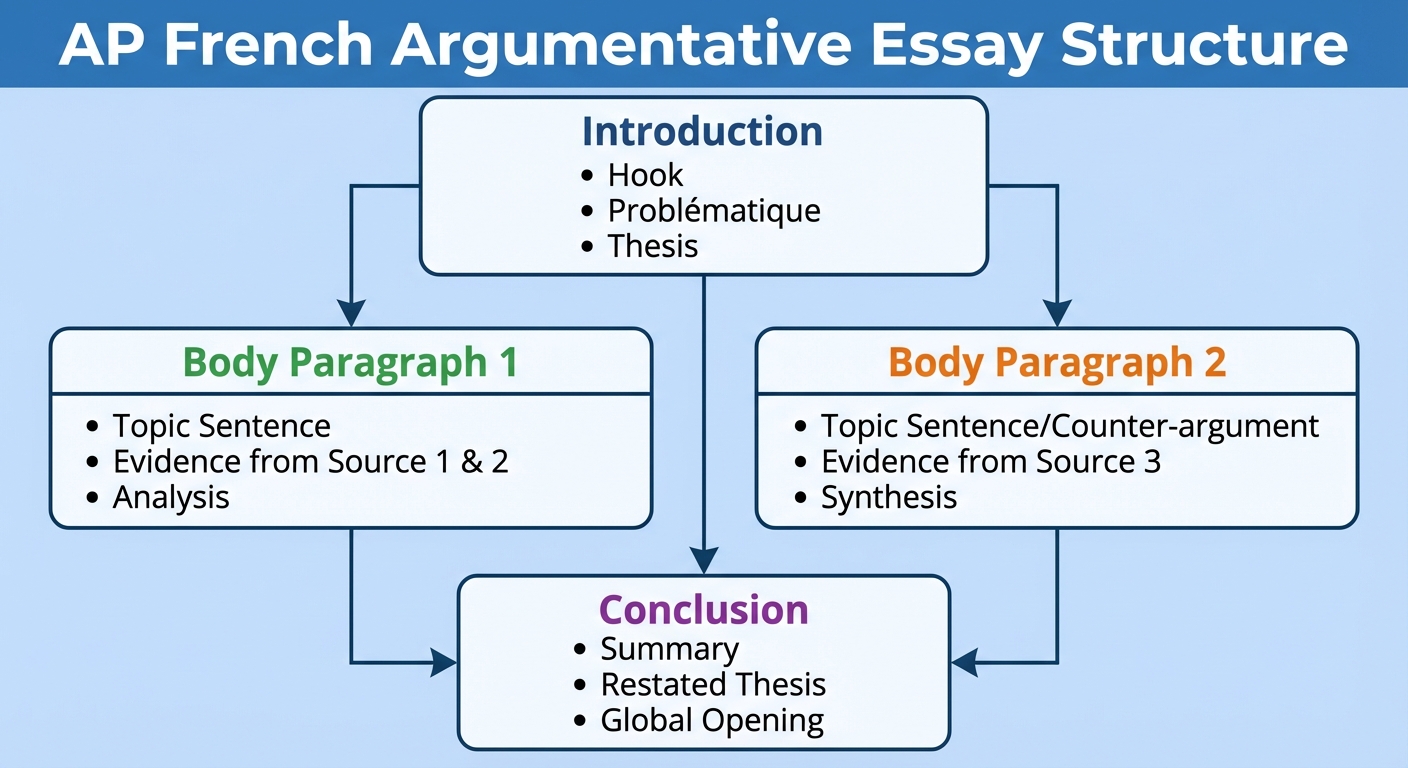
Structure of a High-Scoring Essay
Introduction:
- Hook (general statement on the theme).
- Presentation of the issue (la problématique).
- Thesis Statement: Clear opinion using a subjunctive phrase (Il est essentiel de défendre…).
Body Paragraph 1:
- Argument A.
- Citation of Source 1 (text) and Source 2 (chart).
- Analysis (Why does this matter?).
Body Paragraph 2:
- Argument B (or Counter-argument/Rebuttal).
- Citation of Source 3 (audio).
- Synthesis (How does the audio connect to the chart?).
Conclusion:
- Restate thesis (using different words).
- Summarize main points.
- Opening (ouverture) to a broader global context.
Tip: Do not quote long passages. Summarize the evidence: "D'après l'article…" or "Comme l'indique le graphique…".
Common Mistakes & Pitfalls
False Cognates:
- La misère usually means extreme poverty, not just "misery" (unhappiness).
- L'éducation refers to upbringing/manners; strictly school-related instruction is often l'enseignement or la scolarité (though éducation naitonale relates to the school system).
- Supporter means to tolerate/stand something. To support an idea or person, use soutenir.
Overusing "Les gens": It is vague. Use les citoyens (citizens), la population, les individus, or le public.
Confusing "Politique":
- La politique = Politics / Policy (la politique étrangère).
- Le politique = The politician (less common).
- Un politicien / une femme politique = A politician.
Subject-Verb Agreement with "Tout le monde":
- Mistake: Tout le monde ont…
- Correction: Tout le monde a… (Everyone is singular in French).
Forgetting the Article with Countries:
- In English: "Unemployment in France."
- In French: "Le chômage en France" (preposition) or "La France a des problèmes" (subject).
- Do not say en le or en la.