AP Physics C: Unit 3 — Circuit Fundamentals
Electric Current and Current Density
Defining Electric Current
Electric Current ($I$) is defined as the rate at which charge flows through a cross-sectional area of a conductor. In AP Physics C, because charge flow is not always constant, we define instantaneous current using calculus.
Consequently, the total charge $Q$ passing a point over a time interval can be found by integrating the current:
- Unit: Ampere (A), where $1 \text{ A} = 1 \text{ C/s}$.
- Direction: By convention, current flows in the direction positive charge carriers would move (high potential to low potential). In metals, electrons (negative) move opposite to the current direction.
The Microscopic View: Drift Velocity
While electric signals travel near the speed of light, individual electrons actually move quite slowly. This average velocity is called the Drift Velocity ($v_d$).
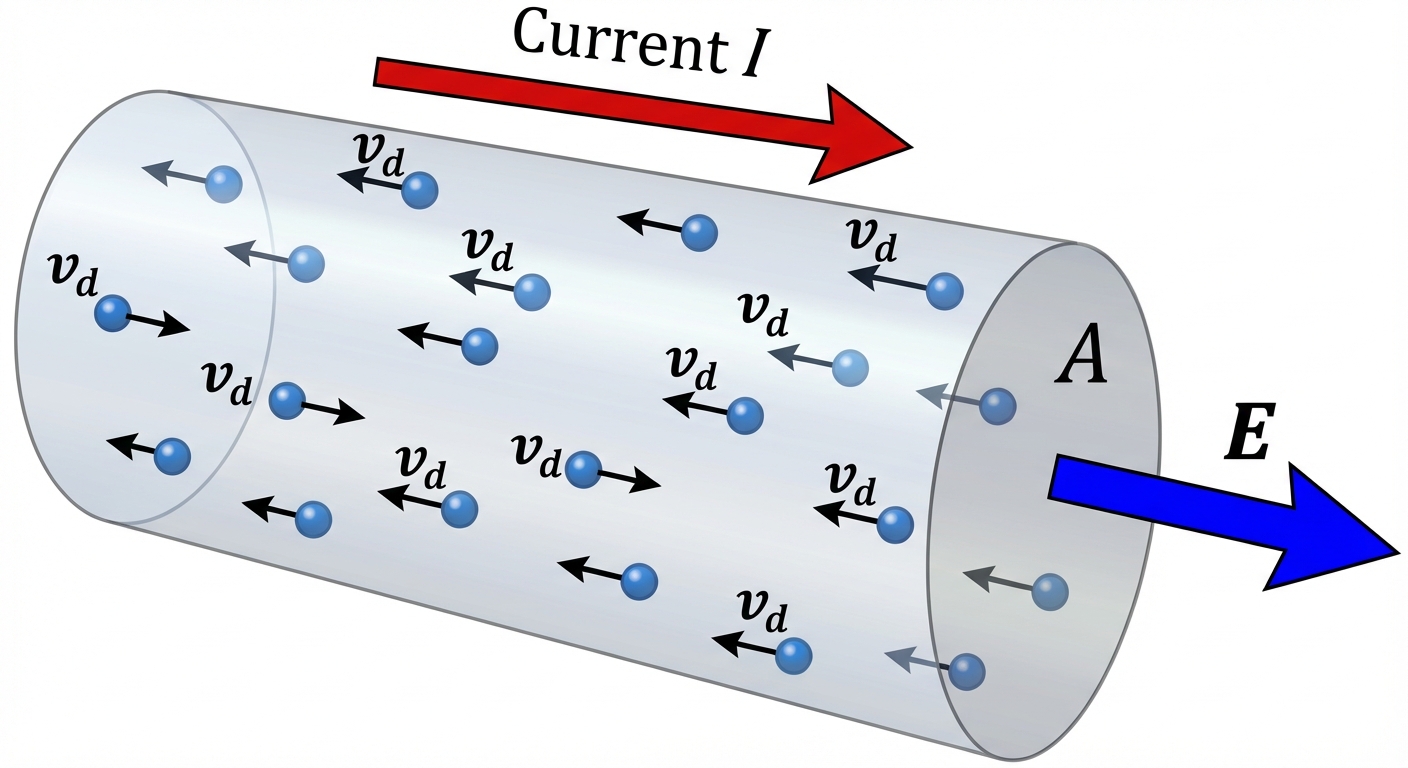
Consider a conductor with cross-sectional area $A$ and charge carrier density $n$ (number of charges per unit volume).
Where:
- $n =$ charge carrier density (carriers/$m^3$)
- $q =$ charge of a single carrier ($1.6 \times 10^{-19} \text{ C}$ for electrons)
- $v_d =$ drift velocity (m/s)
- $A =$ cross-sectional area ($m^2$)
Current Density ($J$)
Current Density is a vector quantity describing the flow of charge per unit area at a specific point. It aligns with the direction of the electric field $\vec{E}$.
(Assuming uniform flow perpendicular to area $A$).
Resistivity and Resistance
Resistivity vs. Resistance
It is crucial to distinguish between the intrinsic property of a material and the geometric property of a specific object.
Resistivity ($\rho$): A material property that quantifies how strongly a material opposes the flow of electric current. It depends on the atomic structure and temperature.
- Unit: Ohm-meter ($\Omega \cdot m$)
- Conductivity ($\sigma$) is the reciprocal of resistivity: $\sigma = 1/\rho$.
Resistance ($R$): A measure of how difficult it is for current to pass through a specific component. It depends on resistivity and geometry.
- $L =$ Length of the conductor (current travels further, more collisions $\rightarrow$ higher $R$)
- $A =$ Cross-sectional area (wider path, easier flow $\rightarrow$ lower $R$)
Ohm’s Law and Microscopic Form
Ohm's Law is not a fundamental law of nature; it is an empirical relationship for specific materials (called Ohmic materials).
Macroscopic Form:
Microscopic (Vector) Form:
The electric field within a conductor drives the current density. For isotropic materials:
Temperature Dependence
Resistivity usually increases with temperature in metals because increased atomic vibration leads to more collisions with charge carriers.
Since $R \propto \rho$, resistance follows the same pattern:
- $\alpha$ is the temperature coefficient of resistivity.
Worked Example: The Stretching Wire
Problem: A cylindrical copper wire has resistance $R$. If the wire is stretched so that its length doubles while its volume remains constant, what is the new resistance $R'$?
Solution:
- Analyze Geometry: Volume $V = L \cdot A$. Since volume is constant, if $L$ doubles ($L' = 2L$), then $A$ must halve ($A' = A/2$).
- Apply Formula:
- Substitute:
- Result: $R' = 4R$. The resistance quadruples.
Electromotive Force (EMF)
Definition and Concept
Despite the name, Electromotive Force ($\mathcal{E}$) is not a force. It is the maximum potential difference (energy per unit charge) supplied by a source (like a battery or generator) when no current is flowing.
- $\mathcal{E}$ represents the work done by non-electrostatic forces to move charge from low to high potential inside the source.
- Unit: Volts (V).
Internal Resistance and Terminal Voltage
Real batteries are not ideal. They have internal resistance ($r$) caused by the chemicals and materials inside them. We model a real battery as an ideal source $\mathcal{E}$ in series with a resistor $r$.
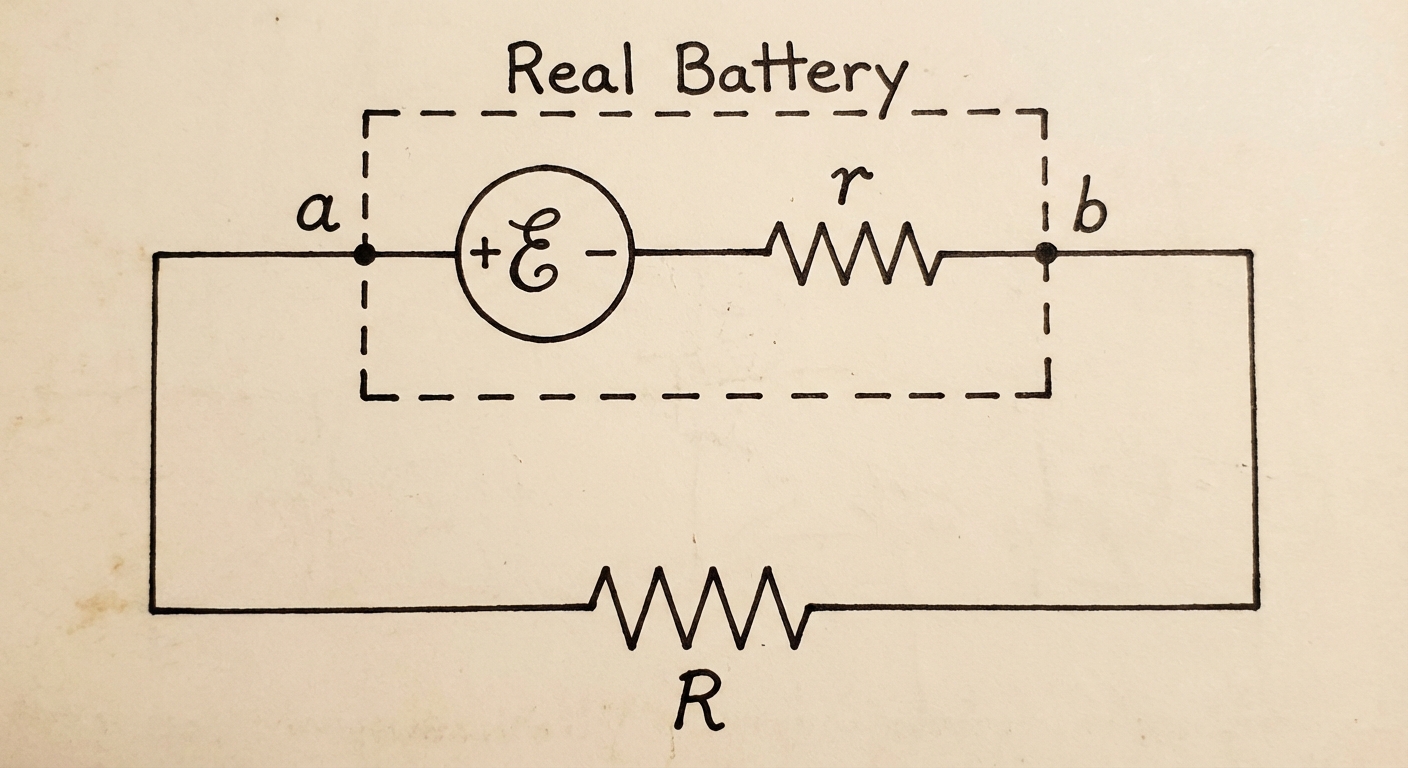
Terminal Voltage ($V_{ab}$) is the actual voltage measured across the battery terminals when current $I$ flows.
- If the circuit is open ($I=0$), then $V_{ab} = \mathcal{E}$.
- If the battery is discharging (supplying current), $V_{ab} < \mathcal{E}$.
- If the battery is being charged (current forced backward into positive terminal), $V_{ab} = \mathcal{E} + Ir$.
Power Relationships
The total power generated by the source vs. power delivered to the external circuit:
Common Mistakes & Pitfalls
- Current Consumption: A very common misconception is that current gets "used up" as it goes through a resistor. Current is conserved. The current entering a resistor equals the current leaving it. It is energy (voltage) that drops.
- Drift Velocity Speed: Students often think electrons move at the speed of light. They don't; they move at millimeters per second. The electric field signal propagates near the speed of light.
- Resistivity vs. Resistance: Don't confuse $\rho$ (material constant) with $R$ (object property). Changing the length of a wire changes $R$, but $\rho$ stays the same.
- The meaning of EMF: Remember that EMF is work per unit charge (Volts), not Newtons. It is the "push" that gives charges potential energy.
- Graphing Ohm's Law: If you graph $V$ (y-axis) vs $I$ (x-axis), the slope is $R$. If you graph $I$ (y-axis) vs $V$ (x-axis), the slope is $1/R$ (Conductance). Always check your axes!