Mastering Energy Conservation Mechanisms and Efficiency
Introduction: Conservation vs. Efficiency
Before diving into specific technologies, you must distinguish between two fundamental concepts in Unit 6. While often used interchangeably in casual conversation, they have distinct meanings in AP Environmental Science.
- Energy Conservation: Finding and implementing ways to use less energy. This typically involves a lifestyle change or a reduction in service.
- Example: Turning off the lights when leaving a room, biking instead of driving, or lowering the thermostat in winter.
- Energy Efficiency: Getting the same result from a smaller amount of energy. This involves technology rather than behavior changes.
- Example: Using an LED lightbulb (uses 10 watts to produce the same light as a 60-watt incandescent) or driving a car with high MPG.
The ultimate goal of both is to reduce the demand on energy resources, particularly non-renewable fossil fuels, thereby decreasing environmental impacts like habitat destruction and greenhouse gas emissions.
Sustainable Architecture and Building Design
Buildings consume a massive percentage of global energy—for heating, cooling, and electricity. Sustainable design incorporates both passive and active strategies.
Passive Solar Design
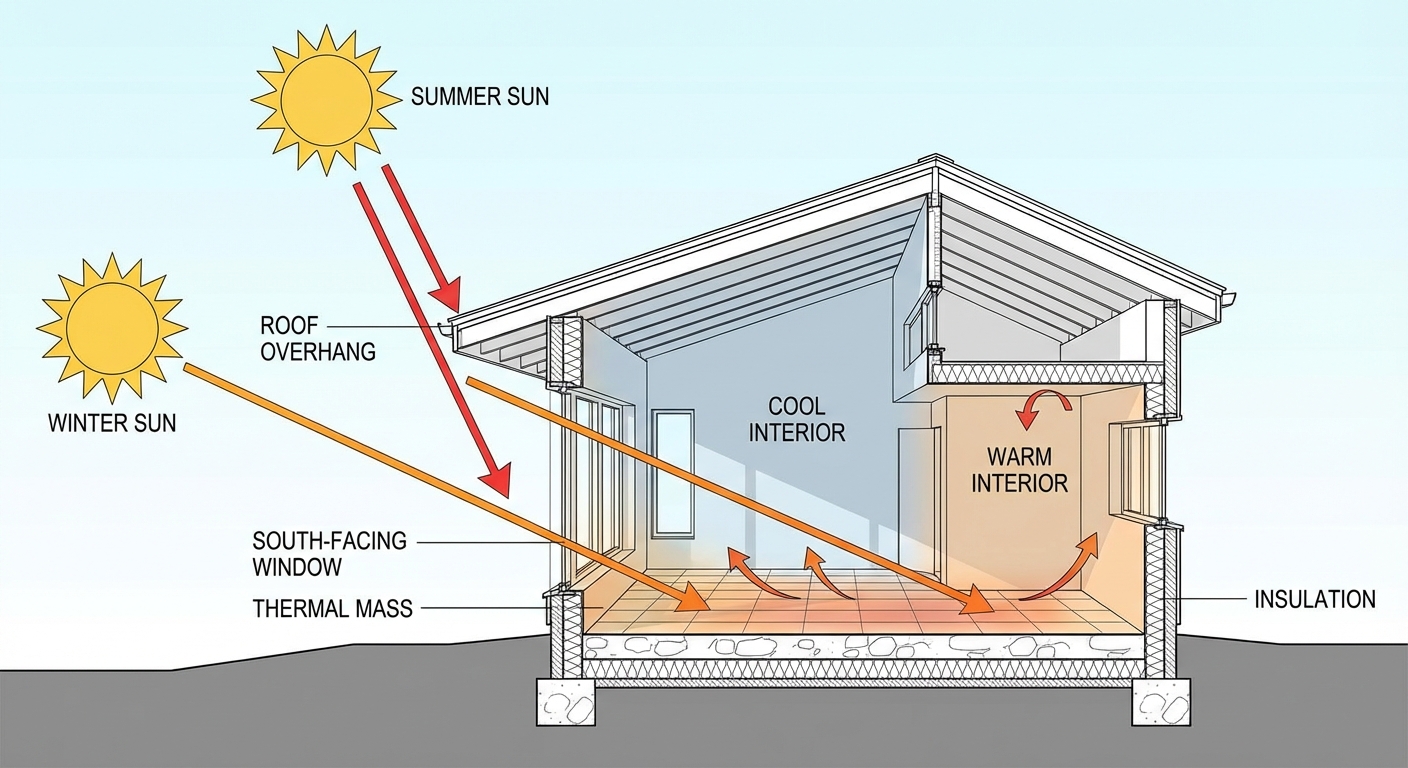
Passive Solar Design refers to construction techniques that utilize solar energy to maintain thermal comfort without the use of mechanical or electrical devices (like pumps or fans).
Key principles for the Northern Hemisphere include:
- Orientation: Large windows should face South. This maximizes heat gain during winter when the sun is low in the southern sky.
- Overhangs/Awnings: Roof overhangs are calculated to shade the South-facing windows during summer (when the sun is high) to prevent overheating, while allowing sunlight in during winter.
- Thermal Mass: Materials with high heat-absorbing capacity (stone, concrete, tile) are placed inside the home (floors/walls) to absorb heat during the day and release it slowly at night.
- Insulation: High efficiency heavily relies on preventing heat transfer through walls and roofs.
Insulation and R-Value
Insulation works by trapping air bubbles to slow down the transfer of heat (conduction and convection).
- R-Value: The measure of thermal resistance. The higher the R-value, the greater the insulating power.
- Double-Paned Windows: Two layers of glass with a vacuum or inert gas between them significantly reduce heat loss compared to single-pane windows.
- Green Roofs: Planting vegetation on roofs provides extra insulation, absorbs rainwater (reducing runoff), and mitigates the Urban Heat Island effect.
Transportation Efficiency
Transportation is a primary consumer of liquid fossil fuels (petroleum). Conservation here relies on government policy and technological innovation.
CAFE Standards
The Corporate Average Fuel Economy (CAFE) standards are regulations in the United States intended to improve the average fuel economy of cars and light trucks.
- Mechanism: If the average MPG (miles per gallon) of a manufacturer's fleet falls below the standard, they pay a penalty.
- Impact: These standards force manufacturers to innovate (lighter materials, better engines) to make vehicles more efficient, reducing national oil consumption.
Hybrid and Electric Vehicles (EVs)
- Hybrid Electric Vehicles (HEVs): Combine a gasoline combustion engine with an electric motor. They capture energy usually lost during braking to charge the battery.
- Regenerative Braking: When you brake, the electric motor acts as a generator, converting the vehicle's Kinetic Energy back into stored chemical energy in the battery.
- Battery Electric Vehicles (BEVs): Run purely on electricity. They produce zero tailpipe emissions, though the environmental impact depends on how the electricity grid they charge from is powered (coal vs. wind).
| Vehicle Type | Power Source | Key Efficiency Feature | Emissions |
|---|---|---|---|
| ICE (Internal Combustion) | Gasoline/Diesel | Low efficiency (~20%) | High CO₂, NOₓ |
| Hybrid (HEV) | Gas + Electric | Regenerative Braking | Moderate |
| Electric (BEV) | Electricity (Grid) | No thermal loss from combustion | Zero (Tailpipe) |
Industrial and Grid-Scale Conservation
Cogeneration (CHP)
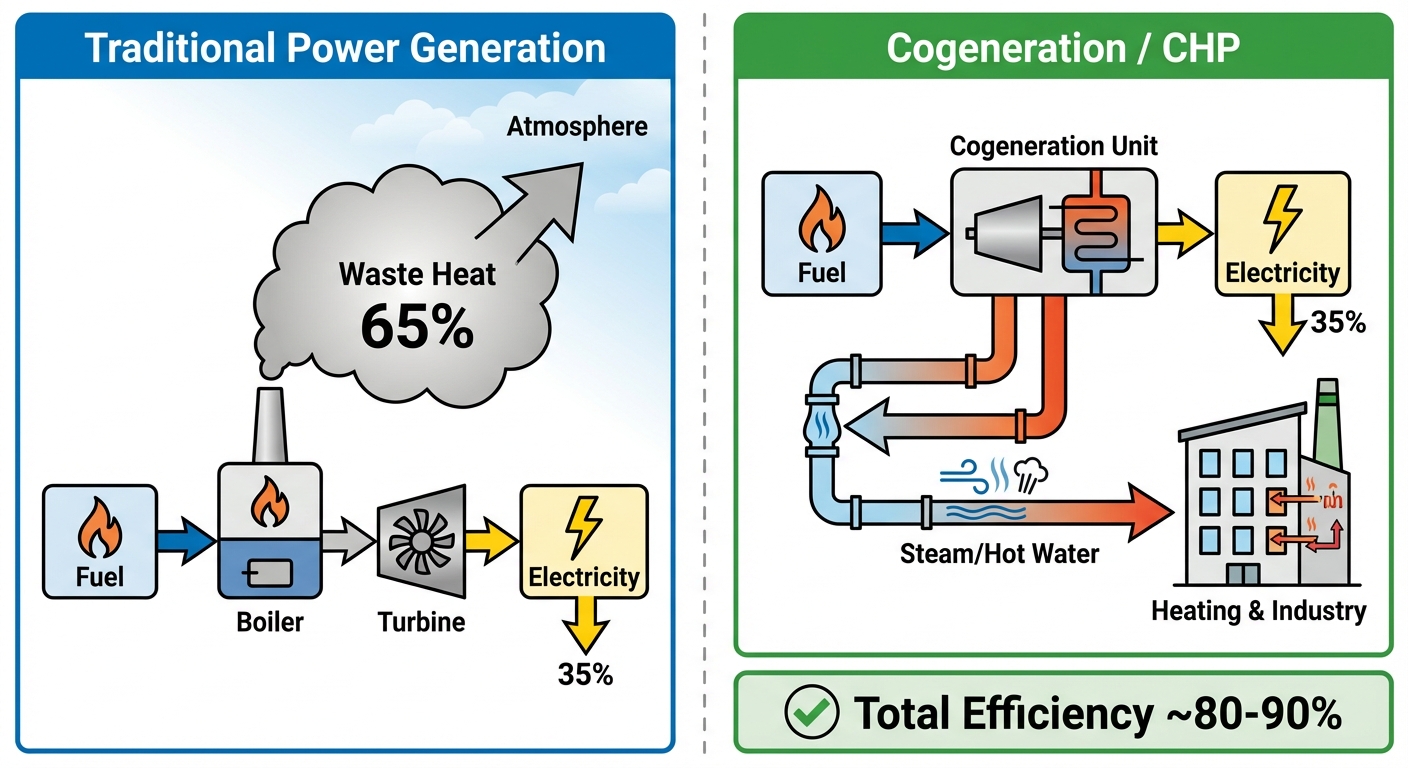
One of the most efficient industrial technologies is Cogeneration, also known as Combined Heat and Power (CHP).
- The Problem: Traditional coal-fired power plants are only about 30-35% efficient. Most of the energy in the coal is lost as waste heat (steam/hot water) released into the environment.
- The Solution: In a CHP system, the facility generates electricity and captures the waste heat to heat buildings or power industrial processes.
- Efficiency: CHP systems can achieve efficiencies closer to 80–90%.
The Smart Grid
The current electrical grid is outdated and inefficient. A Smart Grid uses digital technology to detect and react to local changes in usage.
- Peak Demand: Energy use is not constant; it peaks on hot summer afternoons (AC usage). Utility companies must build backup power plants (often dirty "peaker plants") just to meet this momentary demand.
- Variable Pricing: Smart meters allow utilities to charge more for electricity during peak hours, incentivizing consumers to run appliances (dishwashers/dryers) at night (off-peak).
Home Energy Calculations
On the AP exam, you may be asked to calculate energy savings. The most critical formula is the relationship between power and energy.
Worked Example
A school replaces 100 incandescent bulbs (60 Watts each) with LED bulbs (10 Watts each). The lights are on for 10 hours a day, 200 days a year. Electricity costs $0.10 per kWh. Calculate the annual savings in dollars.
Step 1: Calculate Power Difference per bulb.
Step 2: Total Power Saved.
Step 3: Total Energy Saved.
Step 4: Calculate Cost Savings.
Common Mistakes & Pitfalls
- Passive vs. Active Solar: Students frequently confuse these.
- If it has a pump, a fan, or a photovoltaic panel, it is ACTIVE.
- If it relies solely on building orientation, windows, and heavy materials, it is PASSIVE.
- Hemisphere Confusion: Remember that in the Northern Hemisphere, the sun is in the South. In the Southern Hemisphere, the sun is in the North. Windows must face the equator to capture sun.
- Vampire Energy: Don't forget that plugged-in electronics draw power even when turned off (standby mode). This is called "phantom load" or "vampire energy." Unplugging devices conserves energy.
- Efficiency Limits: No system is 100% efficient due to the Second Law of Thermodynamics (some energy is always lost as lower-quality heat). Do not suggest a machine creates energy.
Mnemonic: S.O.U.T.H.
For Passive Solar in the US/Europe (Northern Hemisphere):
- South-facing windows
- Overhangs block summer sun
- Utilize
- Thermal mass (floors)
- Heat naturally