Unit 9: Post-WWII European Dynamics (1945–Present)
The Cold War and European Division
The Cold War was a prolonged period of geopolitical tension between the Soviet Union (and its satellite states) and the United States (and its Western European allies). For AP European History, it is crucial to understand that while direct military conflict between superpowers never occurred on European soil, Europe was the primary theater for ideological, economic, and diplomatic warfare.
Origins of the Division (1945–1949)
Following the defeat of Nazi Germany, the fragile alliance between the Western Allies and the USSR fractured over the future of Eastern Europe.
- Yalta & Potsdam Conferences: Stalin promised free elections in Eastern Europe but installed puppet communist regimes to create a Buffer Zone against future invasions.
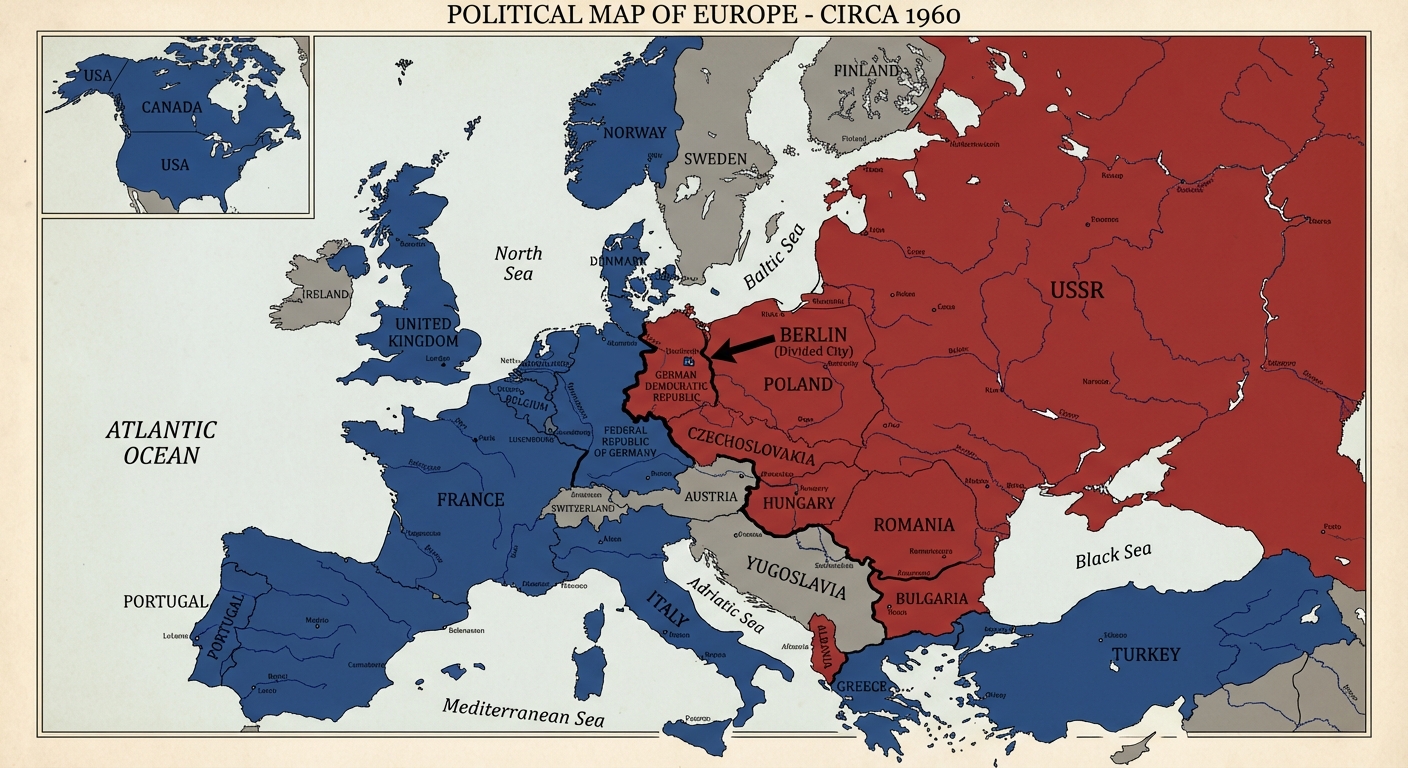
- The Iron Curtain: Coined by Winston Churchill in 1946, this metaphor described the ideological and physical boundary dividing Europe into two separate areas.
Containment and Collective Defense
The U.S. adopted the policy of Containment—preventing the spread of communism without actively rolling it back in areas where it was already established.
- Truman Doctrine (1947): The U.S. pledged military and economic financing to countries resisting communist subjugation, specifically aimed at saving Greece and Turkey.
- The Marshall Plan (1948): Officially the European Recovery Program. The U.S. funneled over $13 billion into Western Europe.
- Goal: Rebuild economies to remove the poverty that fueled communist appeal.
- Result: Triggered an economic boom in the West; Stalin forbade Eastern Bloc nations from accepting the aid.
- NATO vs. Warsaw Pact:
- NATO (1949): A collective security alliance (anti-Soviet). An attack on one is an attack on all.
- Warsaw Pact (1955): The Soviet military response, integrating the armed forces of the Eastern Bloc.
Germany: The Focal Point of Tension
Germany was the physical manifestation of the Cold War division.
- Berlin Blockade & Airlift (1948–49): Stalin blocked access to West Berlin (located deep inside East Germany). The Allies flew in supplies for 11 months until Stalin backed down. This solidified the division into West Germany (FRG) and East Germany (GDR).
- The Berlin Wall (1961): Built by the GDR to stop the "brain drain" of skilled workers fleeing to the West. It became the ultimate symbol of communist repression.
Thaw and Freeze: The Soviet Sphere
Within the Eastern Bloc, the USSR struggled to maintain control against rising nationalism and desires for reform.
- De-Stalinization (1956): Nikita Khrushchev's "Secret Speech" denounced Stalin’s crimes, creating a brief "thaw" in censorship.
- Hungarian Revolution (1956): Encouraged by the thaw, Hungarians demanded democracy and withdrawal from the Warsaw Pact. Soviet tanks crushed the rebellion, proving the USSR would not allow political divergence.
- Prague Spring (1968): Alexander Dubček attempted "Socialism with a human face" in Czechoslovakia. Brezhnev crushed it and issued the Brezhnev Doctrine: The USSR claimed the right to intervene in any socialist country to preserve socialism.
Decolonization and Its Effects on Europe
Decolonization is the process by which European powers lost their overseas empires. This occurred simultaneously with the Cold War, often turning colonies into proxy battlegrounds.
Causes of Imperial Collapse
- WWII Exhaustion: European powers (Britain, France) were economically devastated and could not afford the military cost of holding empires.
- Ideological Hypocrisy: Fighting Hitler for "freedom" made denying freedom to colonies difficult to justify. The UN Charter emphasized self-determination.
- Superpower Pressure: Both the U.S. (anti-colonial history) and USSR (ideologically anti-imperialist) pressured Europe to dismantle empires.
Two Paths to Independence
| Feature | Negotiated Independence | Violent Conflict |
|---|---|---|
| Description | Peaceful power transfer to local elites. | Long wars of attrition due to settlers or strategic value. |
| Key Example | India (1947): Britain withdrew after Gandhi’s non-violent campaigns. | Algeria (1954–1962): France considered Algeria part of France. A brutal civil war ensued, leading to the collapse of the French Fourth Republic. |
| Key Example | Sub-Saharan Africa: (mostly) peaceful transition in British/French zones by 1960. | Vietnam (1946–1954): France fought Ho Chi Minh forces to keep Indochina, leading to French defeat at Dien Bien Phu. |
Geopolitical Consequences
- Suez Crisis (1956): Egypt nationalized the Suez Canal. Britain and France invaded to retake it but were forced to withdraw by US/Soviet pressure.
- Significance: Proved that European powers were no longer superpowers; they could not act without US consent.
Domestic Effects in Europe
Decolonization brought the empire "home."
- Migration: Former subjects moved to metropoles (e.g., Algerians to France, Indians/Pakistanis to the UK) seeking work.
- Racial Tensions: The influx of non-white immigrants challenged homogeneous European national identities, giving rise to right-wing anti-immigrant parties (e.g., Jean-Marie Le Pen’s National Front in France).
Postwar Recovery and Economic Miracles
While the East stagnated under command economies, Western Europe experienced an "Economic Miracle" (Wirtschaftswunder in Germany) characterized by high growth, low unemployment, and mass consumerism.
The Move Toward Unity
To prevent future wars, European leaders (like Monnet and Schuman) sought to integrate economies so closely that war would be materially impossible.
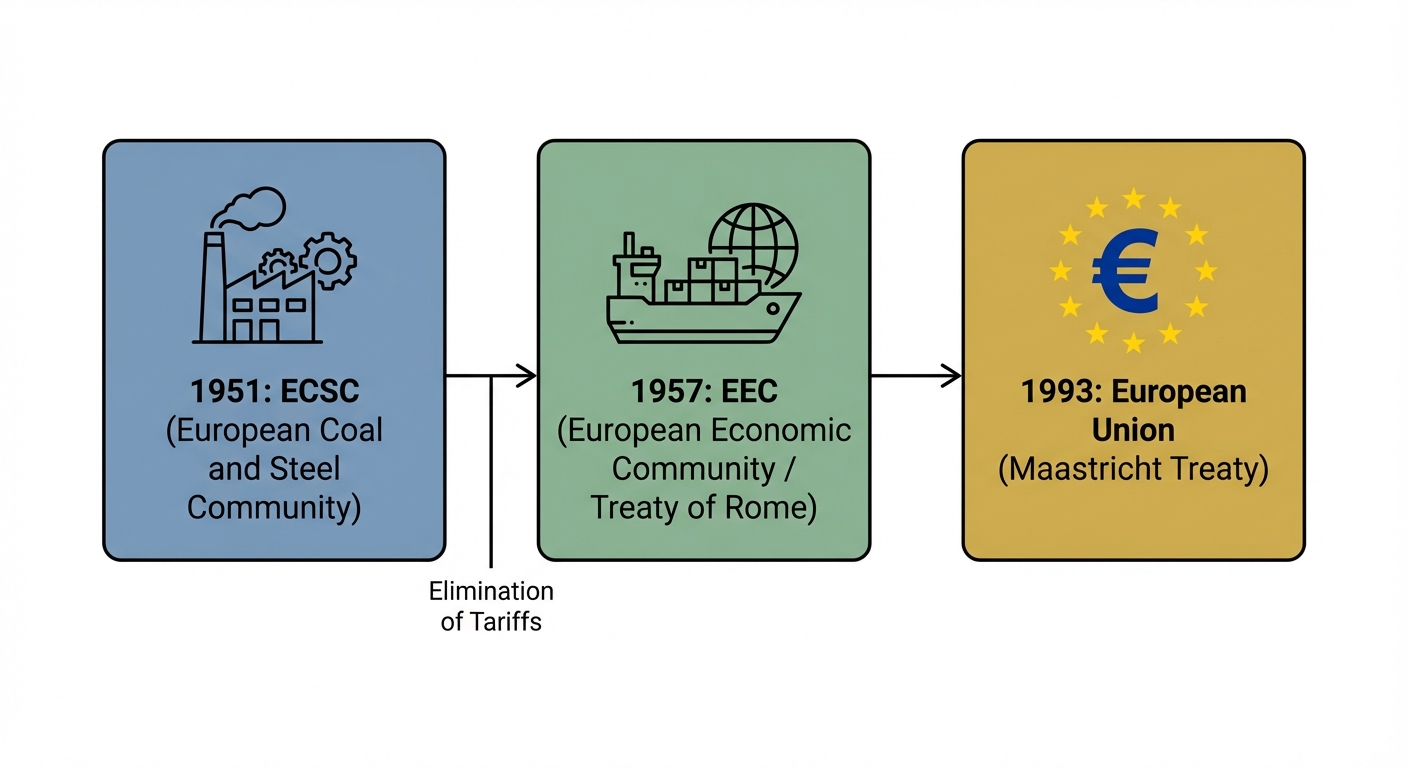
- European Coal and Steel Community (ECSC, 1951): Six nations (France, West Germany, Italy, Benelux) pooled coal and steel resources. This was the seed of the modern EU.
- Treaty of Rome (1957): Created the European Economic Community (EEC), or "Common Market." It eliminated tariffs between members, fueling massive trade growth.
The Welfare State
Postwar governments (both Christian Democrats and Socialists) agreed that the state had a duty to protect citizens.
- Consensus: To prevent the desperation that led to fascism, governments provided universal healthcare, pensions, and unemployment insurance.
- Example: Under Clement Attlee (Labour Party), Britain established the National Health Service (NHS), the first universal, tax-funded health system.
- Christian Democrats: Center-right parties (e.g., in Germany and Italy) that combined traditional values with support for democracy and social welfare programs, playing a key role in stability.
Society and Rebellion (1968)
Despite economic success, the "baby boom" generation grew disillusioned with consumerism, authoritarian universities, and the Vietnam War.
- May 1968 (France): Student protests joined with worker strikes nearly toppled Charles de Gaulle’s government. While the revolution failed politically, it successfully liberalized social morals regarding sexuality and authority.
Common Mistakes & Pitfalls
- Mistake: Thinking the "Iron Curtain" and the "Berlin Wall" are the same thing.
- Correction: The Iron Curtain (1946) was a metaphorical ideological border across the entire continent. The Berlin Wall (1961) was a physical concrete wall surrounding West Berlin.
- Mistake: Assuming all Eastern Bloc countries were exactly the same.
- Correction: While all were Soviet satellites, Poland and Hungary constantly pushed for reforms, whereas East Germany and Romania remained rigidly Stalinist.
- Mistake: Confusing NATO with the United Nations.
- Correction: The UN is a global diplomatic body formed to keep peace (1945). NATO is a specific military alliance of Western nations formed to counter the USSR (1949).
- Mistake: Believing the Marshall Plan helped Eastern Europe.
- Correction: The US offered aid to the East, but Stalin forced Poland, Czechoslovakia, and others to reject it, creating a massive economic disparity between West and East.