Unit 8: The Great War and the Transformation of Europe
The Causes of World War I
The outbreak of the "Great War" in 1914 was not an isolated accident but the culmination of long-term diplomatic, military, and social tensions in Europe.
The Long-Term Causes: M.A.I.N.
To remember the structural causes of WWI, use the classic acronym MAIN:
Militarism: The aggressive build-up of armed forces and the influence of military leaders on government policy.
- Anglo-German Naval Race: Germany attempted to build a navy to rival Britain's, threatening British naval supremacy and pushing Britain closer to France.
- Schlieffen Plan: Germany's military strategy to avoid a two-front war by quickly knocking out France through neutral Belgium before turning to Russia.
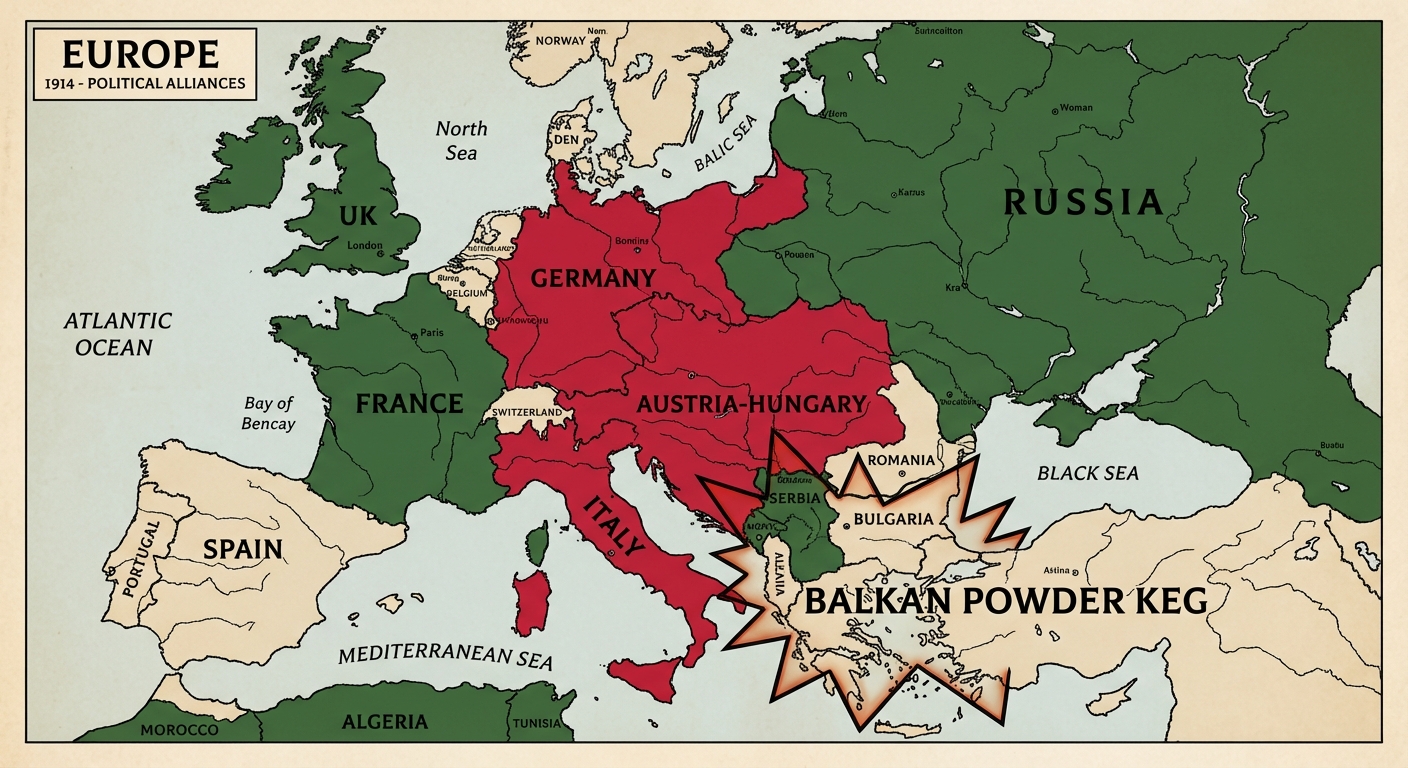
Alliances: A tangled web of secret and public agreements that turned a regional conflict into a continental war.
- Triple Alliance (1882): Germany, Austria-Hungary, Italy.
- Triple Entente (1907): France, Great Britain, Russia.
- Note: When the war started, these evolved. The Triple Alliance became the Central Powers (minus Italy, plus Ottoman Empire). The Triple Entente became the Allied Powers.
Imperialism: Competition for colonies caused diplomatic friction.
- Moroccan Crises (1905, 1911): Germany challenged French control in Morocco to test the Anglo-French alliance; it only strengthened the bond between Britain and France.
Nationalism: The belief that each nation (people with shared culture/language) should have its own state.
- Pan-Slavism: Russia viewed itself as the protector of all Slavic peoples, specifically supporting Serbia against Austria-Hungary.
- The Balkans: Known as the "Powder Keg of Europe" due to overlapping claims by the Ottoman Empire, Austria-Hungary, and local nationalists.
The Immediate Cause: The Assassination
- June 28, 1914: Archduke Franz Ferdinand (heir to the Austro-Hungarian throne) was assassinated in Sarajevo.
- The Assassin: Gavrilo Princip, a member of the Black Hand, a Serbian nationalist terrorist group.
- The Reaction (July Crisis): Austria issued an ultimatum to Serbia. Germany issued the "Blank Check" (unconditional support) to Austria. Russia mobilized to support Serbia. Alliances kicked in like dominoes.
World War I: A Total War
Total War is a conflict in which the contenders are willing to make any sacrifice in lives and other resources to obtain a complete victory. It blurs the line between combatants and civilians.
Trench Warfare and Stalemate
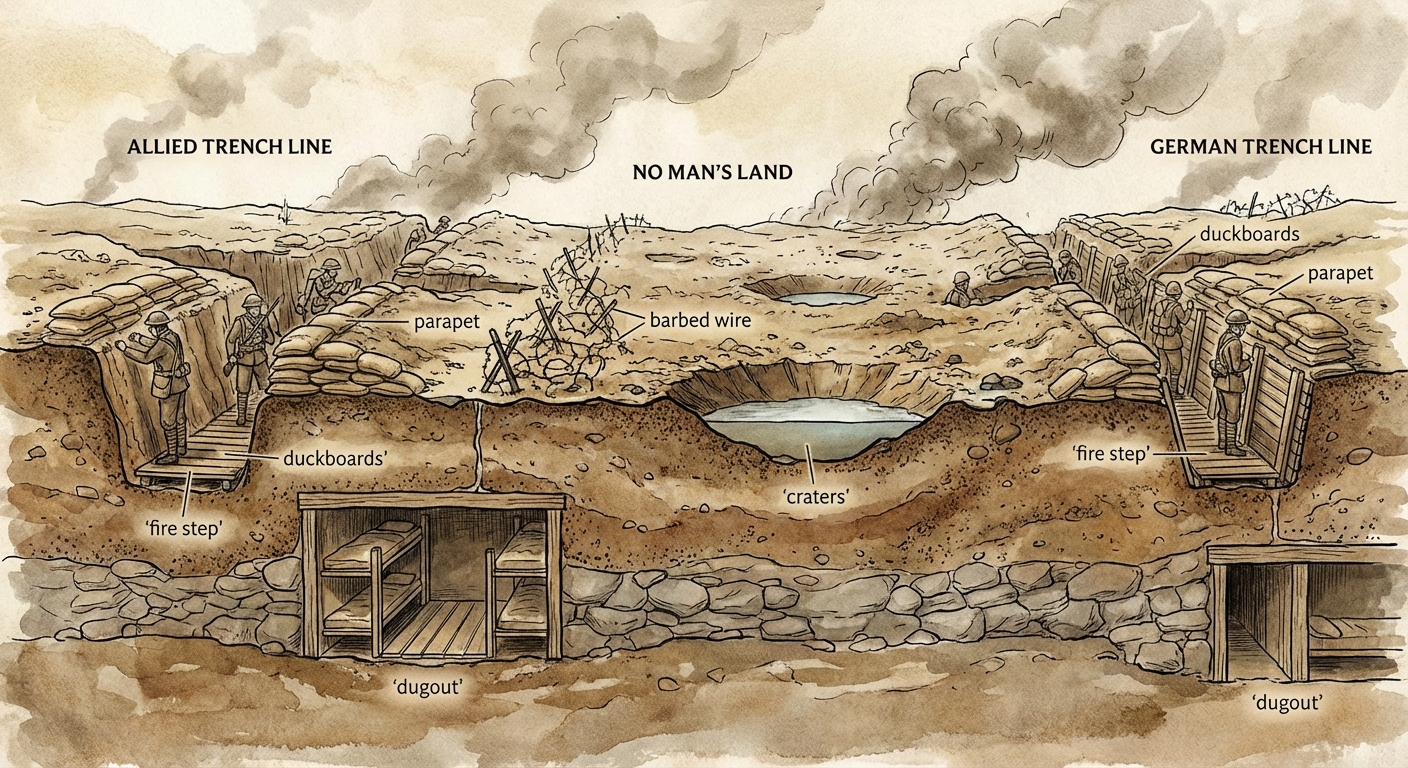
The war on the Western Front quickly stagnated into a stalemate due to new military technologies favoring defense over offense.
- Trench Warfare: Soldiers dug thousands of miles of trenches stretching from Switzerland to the North Sea.
- Key Technologies:
- Machine Guns: Made charging across "No Man's Land" suicidal.
- Poison Gas: Introduced by Germany (chlorine/mustard gas) to break stalemates; caused psychological terror.
- Tanks: Introduced by the British to cross trenches (initially ineffective, crucial by 1918).
- U-Boats (Submarines): Used by Germany to disrupt supply lines.
The Home Front
Governments mobilized every aspect of society to sustain the war effort.
- Planned Economies: Governments abandoned free-market capitalism for state control.
- Example: The War Raw Materials Board in Germany rationed and distributed resources.
- Example: The British Ministry of Munitions organized private industry to produce shells.
- Social Roles: With men at the front, women moved into heavy industry, transport, and clerical jobs. This contribution was a primary catalyst for women gaining suffrage (the right to vote) in Britain, Germany, and the US immediately after the war.
- Propaganda and Censorship: Governments used posters and media to vilify the enemy (e.g., Germans as "Huns") to maintain civilian morale and sell war bonds.
Global Conflict and Effects
Though centered in Europe, the war involved colonial resources and peoples.
- Colonial Troops: Britain and France drafted soldiers and laborers from India, Africa, and Indochina.
- Armenian Genocide: Under the cover of war, the Ottoman government executed a systematic ethnic cleansing of Armenians (claimed to be collaborating with Russians), resulting in over 1 million deaths.
The Russian Revolution
The immense strain of Total War caused the collapse of the Tsarist regime in Russia, leading to the first communist state.
The February Revolution (1917)
- Causes: Military incompetence (Nicholas II took personal command), massive casualties, food shortages in Petrograd, and the influence of Rasputin.
- Event: Unplanned uprisings in Petrograd. The army joined the protesters. Nicholas II abdicated.
- Result: A Provisional Government was established.
- The Fatal Mistake: The Provisional Government (led by Alexander Kerensky) decided to stay in the war. This alienated the soldiers and the peasantry.
The October Revolution (1917)
- The Bolsheviks: A radical socialist faction led by Vladimir Lenin.
- April Theses: Lenin returned from exile (aided by Germany) and promised "Peace, Land, and Bread."
- Peace: End the war with Germany.
- Land: Redistribute land to peasants.
- Bread: Feed the starving cities.
- The Coup: The Bolsheviks seize power from the Provisional Government. This was a planned coup, not a spontaneous uprising like February.
Consolidation of Power
- Treaty of Brest-Litovsk (1918): Lenin fulfilled his promise of peace but at a high cost, ceding 1/3 of Russia's population (Poland, Ukraine, Baltics) to Germany. Russia exits WWI.
- Russian Civil War (1917–1922): The Reds (Bolsheviks/Trotsky's Red Army) vs. the Whites (monarchists, liberals, anti-communists). The Reds won due to internal unity and "War Communism" (seizing grain/nationalizing industry).
Versailles Settlement and Its Effects
The peace settlement of 1919 redrew the map of Europe but failed to establish lasting stability, paving the way for WWII.
The Big Four
The conference was dominated by conflicting goals:
- Woodrow Wilson (USA): Idealist. Proposed the 14 Points (open diplomacy, self-determination, League of Nations). Wanted "Peace without victory."
- Georges Clemenceau (France): Realist/Vengeful. Wanted to punish Germany and ensure French security (creating a buffer zone).
- David Lloyd George (Great Britain): Mediator. Wanted mild punishment but promised British voters he would "make Germany pay."
- Vittorio Orlando (Italy): Wanted territory promised in 1915; largely ignored (leading to Italian resentment).
The Treaty of Versailles (Germany)
- Article 231 (War Guilt Clause): Germany was forced to accept sole responsibility for the war.
- Reparations: Germany forced to pay roughly $33 billion (crippled the Weimar economy).
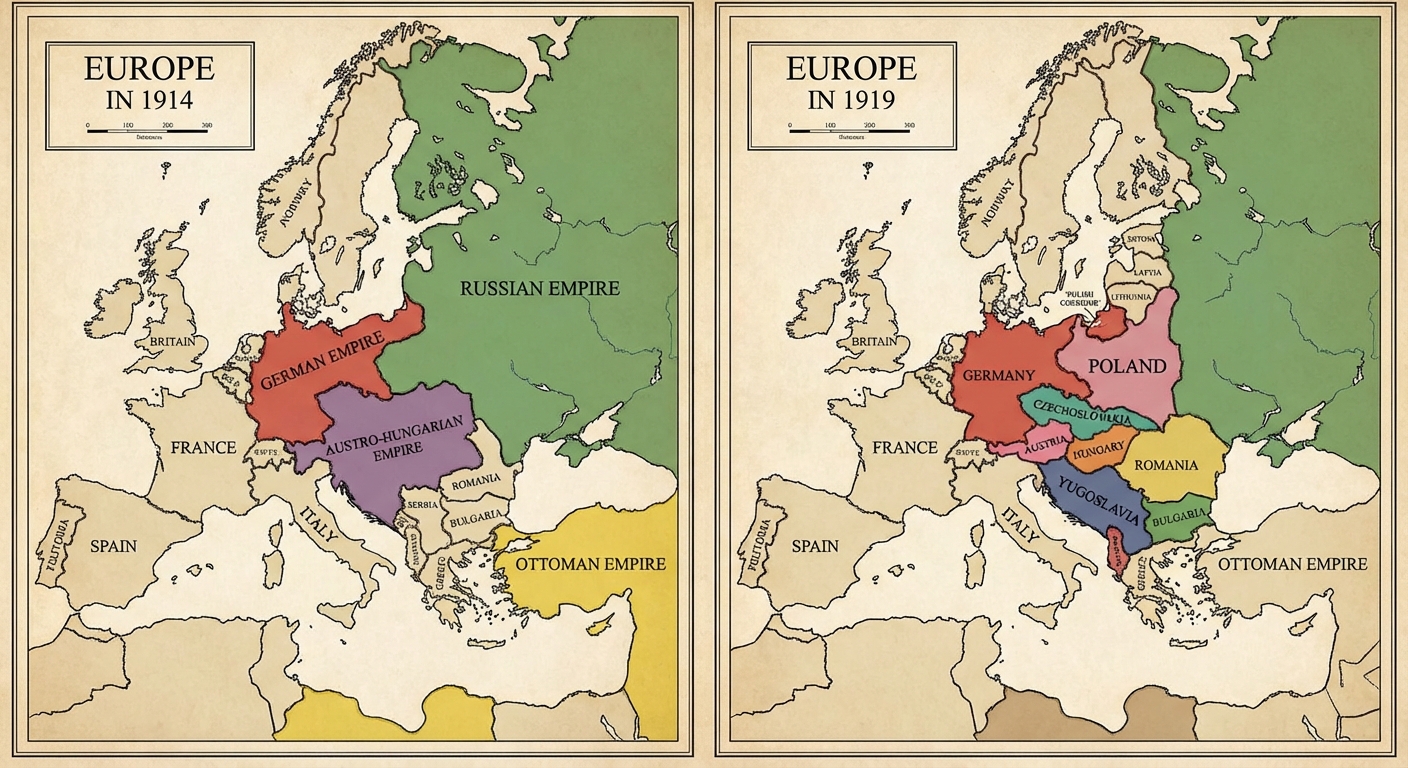
- Territorial Losses: Alsace-Lorraine returned to France; Poland recreated (Polish Corridor separates East Prussia).
- Demilitarization: The Rhineland was occupied; the German army limited to 100,000 men; no air force.
The Map of Europe and Middle East
- Fall of Empires: The German, Austro-Hungarian, Ottoman, and Russian empires ceased to exist.
- New Nations: Poland, Czechoslovakia, Hungary, Yugoslavia, Finland, Estonia, Latvia, Lithuania.
- Mandate System: Instead of granting independence, Ottoman territories were placed under British and French control as "mandates" (e.g., Britain got Palestine/Iraq; France got Syria).
Common Mistakes & Pitfalls
- Confusing the Alliance Timelines: Students often confuse the Triple Alliance (Germany, Austria, Italy) with the Central Powers (Germany, Austria, Ottomans). Remember: Italy switched sides in 1915.
- The Reason for US Entry: Do not say the US entered solely because of the sinking of the Lusitania (1915). The US did not enter until 1917. The actual triggers were the resumption of unrestricted submarine warfare and the Zimmermann Telegram.
- Russian Revolution Chronology: Do not mix up February and October. February = Tsar out, Provisional Govt in. October = Provisional Govt out, Bolsheviks in.
- Self-Determination Limitations: While Wilson preached self-determination, it was only applied to Eastern Europe. Colonies in Africa and Asia were ignored or turned into Mandates, which fueled anti-colonial movements later.