Unit 8: Interwar Instability and the Second World War
The Rise of Fascism and Totalitarianism
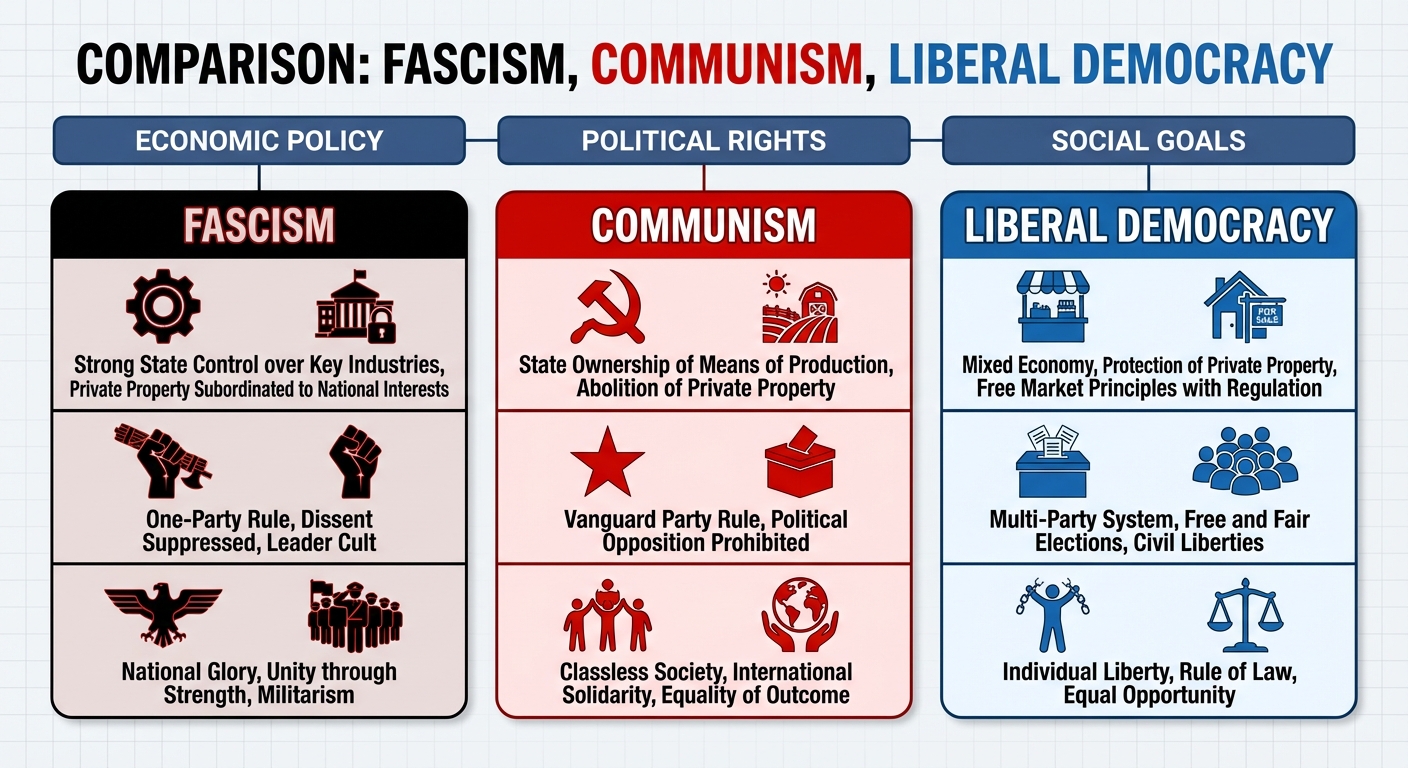
Following World War I, the fragility of new democracies, economic instability, and national resentment created a vacuum filled by aggressive authoritarian regimes. This period marked the emergence of Totalitarianism, a form of government where the state exercises absolute control over every aspect of public and private life.
Defining the Ideologies
To understand this era, you must distinguish between traditional authoritarianism (like absolute monarchies) and totalitarianism. Totalitarian regimes use modern technology (radio, film) and bureaucracy to mobilize the entire population toward state goals.
- Fascism: An ultranationalist, antidemocratic, anti-Marxist, and antiparliamentary ideology. It often emphasizes the glorification of the state, a single charismatic leader (Il Duce, Der Führer), and the use of violence.
- Communism (Stalinist): While ideologically opposite to fascism regarding class (communism seeks a classless society; fascism preserves class structure if it serves the state), Stalin's USSR shared structural similarities: a one-party state, secret police, and state control of the economy.
Fascist Italy (Mussolini)
Benito Mussolini capitalized on Italian dissatisfaction with the Treaty of Versailles (Italy felt cheated out of territory) and fear of rising communism.
- Black Shirts: Mussolini's paramilitary militia used violence to intimidate opponents.
- March on Rome (1922): Mussolini demanded the government dissolve. King Victor Emmanuel III, fearing civil war, appointed Mussolini prime minister. This was a legal transfer of power under threat of force.
- Lateran Agreement (1929): Mussolini recognized the Vatican as an independent state, gaining support from the Catholic Church.
Nazi Germany (Hitler)
The Weimar Republic (Germany's post-WWI democracy) was plagued by the humiliation of the "War Guilt Clause," hyperinflation (1923), and the Great Depression.
- Beer Hall Putsch (1923): Hitler's failed coup attempt. While in prison, he wrote Mein Kampf, outlining his theories of Lebensraum (living space) and antisemitism.
- Legal Rise to Power: Unlike a violent revolution, the Nazis gained seats in the Reichstag democratically. In 1933, President Hindenburg appointed Hitler Chancellor.
- Enabling Act (1933): Passed by the Reichstag, this gave Hitler absolute dictatorial power for four years, effectively killing the Weimar Republic.
The Great Depression in Europe
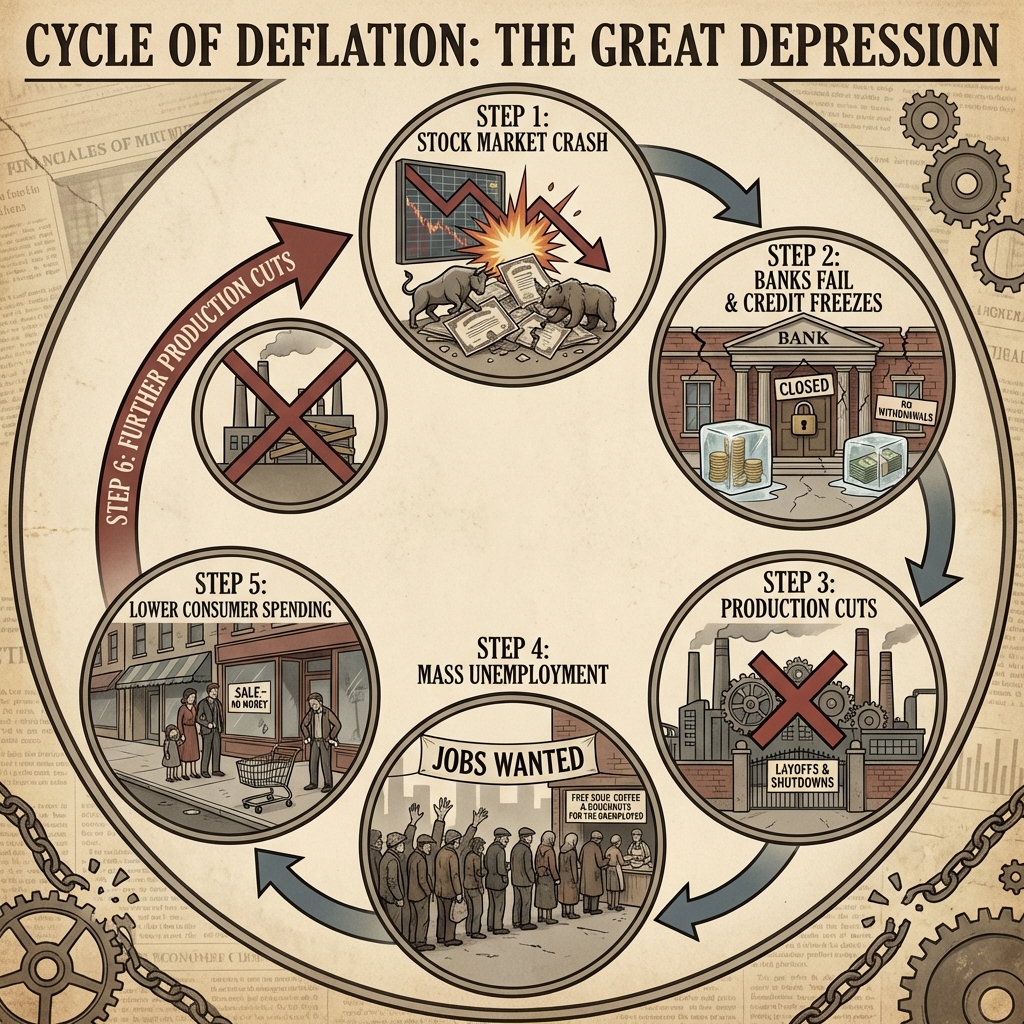
The economic collapse was the catalyst that turned fringe radical parties into mainstream political forces. The Depression demonstrated the interconnected nature of the global economy.
Causes and The American Connection
Europe's recovery relied heavily on the Dawes Plan (1924), a circular flow of money where US loans helped Germany pay reparations to France/Britain, who then repaid war loans to the US.
- Stock Market Crash (1929): US capital flow stopped; American banks recalled loans.
- Financial Panic: Austrian and German banks collapsed.
- Production Crisis: Global trade dropped, leading to massive industrial decline.
Responses to the Depression
Different nations adopted radically different strategies to cope with mass unemployment and deflation.
| Region/Country | Response Type | Details |
|---|---|---|
| Scandinavia | Middle Way | Cooperative social action. State-funded public works and social welfare programs helped maintain production and employment. |
| Great Britain | Orthodox | Balanced budgets and controlled spending. Recovery was slow but steady; focused on the domestic market rather than exports. |
| France | Popular Front | A coalition of Communists, Socialists, and Radicals. Attempted social reform (vacations, 40-hour weeks) but was hampered by high inflation and political instability. |
| Germany | Totalitarian | Hitler launched massive public works (Autobahn) and rapid rearmament (violating Versailles), achieving near-full employment by 1936. |
World War II
The war in Europe was a conflict between the Axis Powers (Germany, Italy, Japan) and the Grand Alliance (Britain, USA, USSR). It was characterized by Total War, where the distinction between combatants and civilians was erased.
Road to War: Appeasement
Western democracies primarily adopted a policy of Appeasement—granting concessions to an aggressor to avoid war.
- Remilitarization of the Rhineland (1936): Hitler violated Versailles; Britain and France did nothing.
- Anschluss (1938): Annexation of Austria.
- Munich Conference (1938): Neville Chamberlain famously declared "peace for our time" after giving the Sudetenland (part of Czechoslovakia) to Germany.
- Nazi-Soviet Non-Aggression Pact (1939): A shock to the world. Hitler and Stalin agreed not to fight and to divide Poland. This paved the way for the invasion of Poland on September 1, 1939, starting the war.
Course of the War (European Theater)
- Blitzkrieg (Lightning War): Germany used coordinated tank and air power to crush Poland, Denmark, Norway, Belgium, the Netherlands, and France (1940).
- Battle of Britain (1940): An air war. Britain (led by Winston Churchill) used radar to repel the Luftwaffe. It was the first check on German expansion.
- Operation Barbarossa (1941): Hitler betrayed Stalin and invaded the Soviet Union. The "War of Annihilation" began.
Turning Points
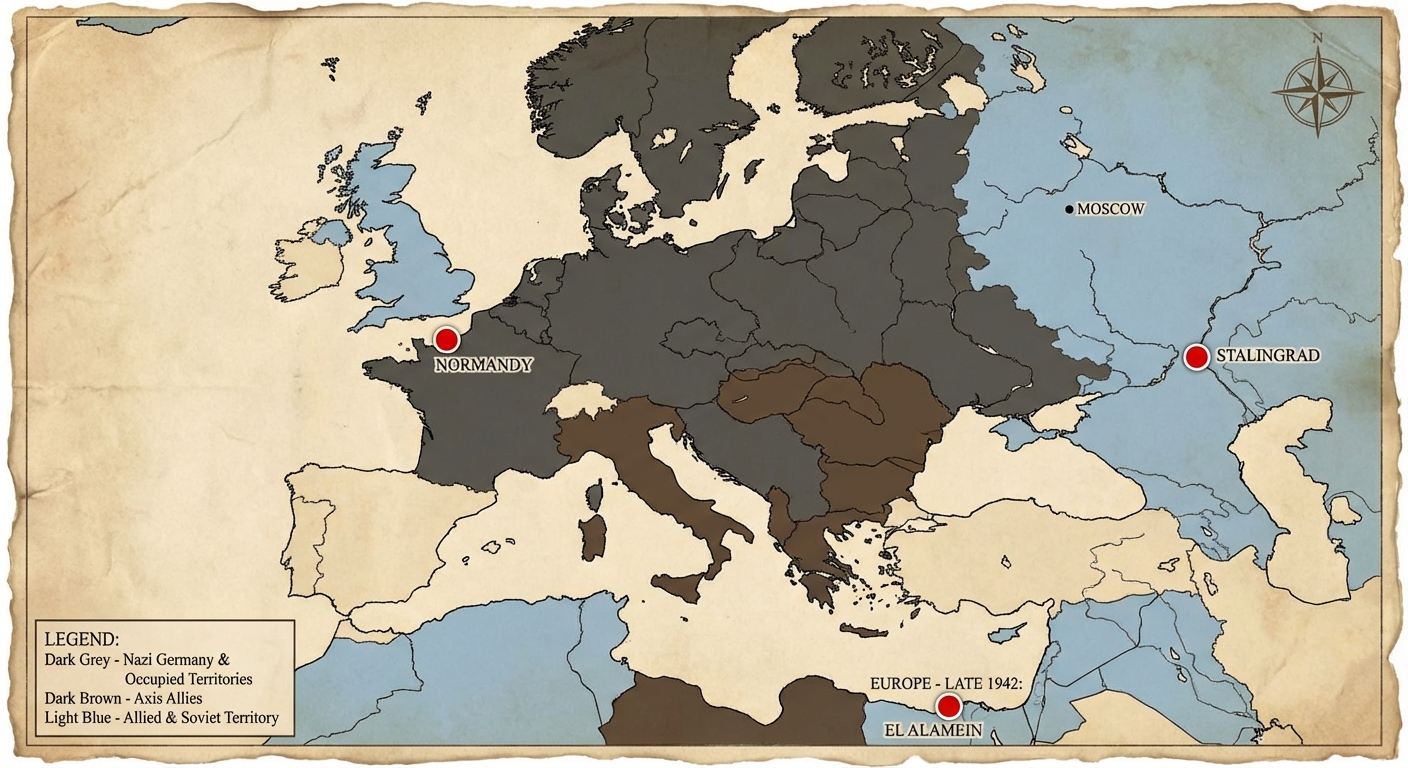
- Battle of El Alamein (1942): British halted Axis forces in North Africa.
- Battle of Stalingrad (1942–1943): The bloodiest battle. Soviet victory marked the beginning of the German retreat on the Eastern Front.
- D-Day (June 6, 1944): Allied amphibious invasion of Normandy, France, opening a designated "Second Front" in the West.
The Holocaust
The systematic, state-sponsored persecution and murder of six million Jews and millions of others (Roma, disabled, LGBTQ+ individuals, Jehovah's Witnesses) by the Nazi regime and its collaborators.
The Escalation of Persecution
The Holocaust was not a sudden event but a gradual process of dehumanization.
- Nuremberg Laws (1935): Stripped Jews of German citizenship and prohibited marriage between Jews and non-Jews.
- Kristallnacht (1938): "Night of Broken Glass." State-organized pogrom destroying Jewish businesses and synagogues.
- Ghettos: Jews were forced into overcrowded, sealed districts in occupied territories (e.g., Warsaw).
- The Final Solution (1942): Formalized at the Wannsee Conference. Shifted from mobile killing squads (Einsatzgruppen) to industrial extermination camps (Auschwitz-Birkenau, Treblinka) utilizing gas chambers.
Historical Perspective: The Holocaust was made possible not just by Nazi leadership, but by the collaboration of local populations across occupied Europe and the indifference of bystanders.
Common Mistakes & Pitfalls
- Confusing WWI and WWII Alliances: Italy was with the Allies in WWI but an Axis power (with Germany) in WWII. The USSR started with a pact with Germany but finished the war as a key Ally.
- Misunderstanding Appeasement: Students often judge Chamberlain as merely weak. Historically, many Europeans remembered the slaughter of WWI and believed the Treaty of Versailles was too harsh on Germany, making concessions seem reasonable at the time.
- Hyperinflation vs. Depression: Do not confuse the German Hyperinflation (1923, wheelbarrows of cash) with the Great Depression (1929, mass unemployment). They are two separate economic crises in the Weimar timeline.
- Totalitarianism Definition: Not all dictatorships are totalitarian. Franco (Spain) is often considered authoritarian rather than totalitarian because he sought to maintain the status quo (conservative traditionalism) rather than mobilize society for a revolutionary new order.