Unit 5: AP Physics 2 study notes - Optic Fundamentals
Reflection and Fundamentals of Geometric Optics
In Geometric Optics, we model light as rays—straight lines that represent the path of light energy. This section focuses on how light serves as a wave front interacting with boundaries to produce reflection, and how mirrors manipulate these rays to form images.
The Law of Reflection
When a light ray encounters a boundary between two media, a portion (or all) of the light bounces back into the original medium. This is reflection.
Types of Reflection
There are two primary modes of reflection:
- Specular Reflection: Reflection off a smooth, polished surface (like a mirror or calm water). All parallel incident rays are reflected parallel to one another, preserving the image.
- Diffuse Reflection: Reflection off a rough surface (like paper or a wall). Parallel incident rays are scattered in many directions. This is how we see most non-luminous objects.
The Law
Regardless of the surface type, individual rays follow a specific rule.
The Law of Reflection states that the angle of incidence equals the angle of reflection.
Critical Notation Note: In physics, angles in optics are ALWAYS measured with respect to the Normal (a dashed line perpendicular to the surface at the point of contact), not the surface itself.
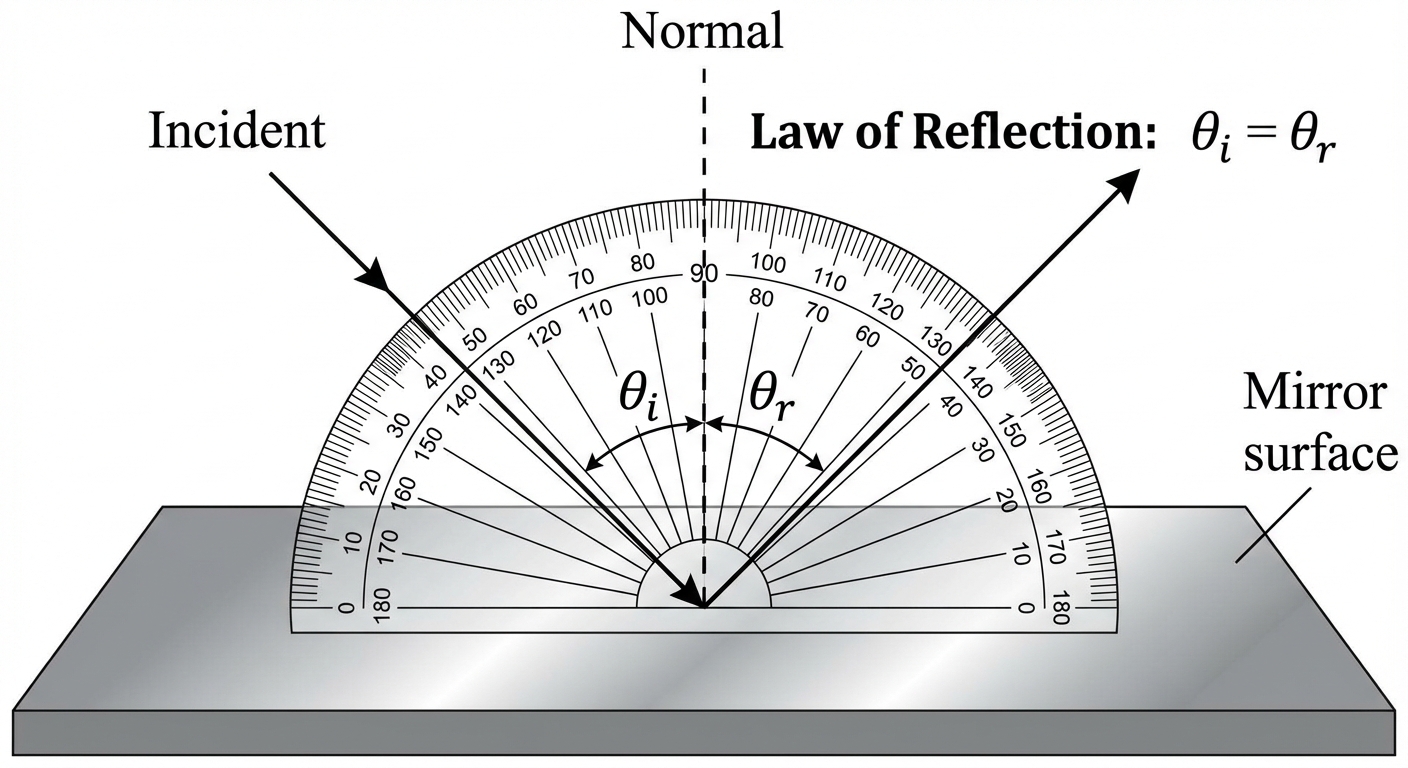
Plane Mirrors
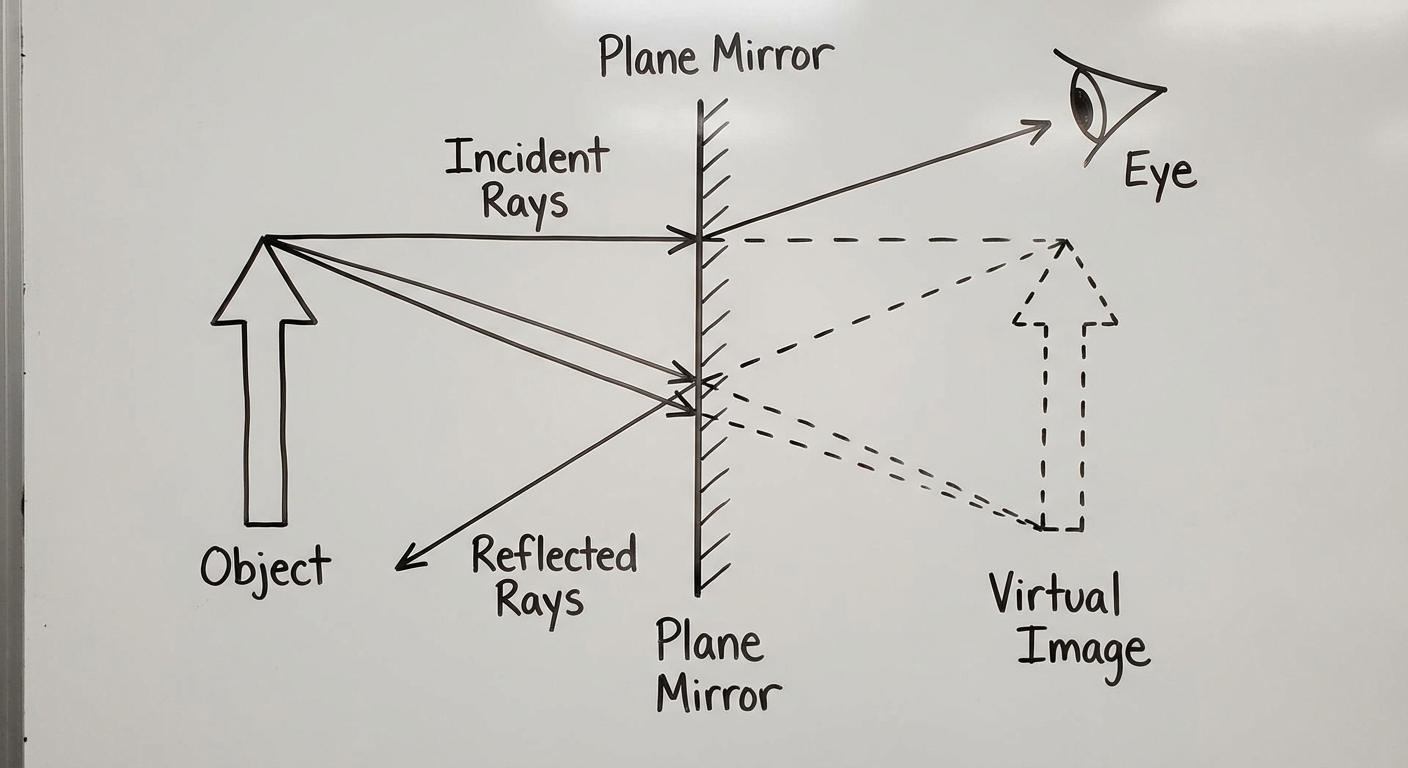
A Plane Mirror is a flat reflecting surface. Image formation here is the simplest case in optics, yet it establishes rules used for curved mirrors.
Characteristics of Plane Mirror Images
When you look into a flat mirror, the image formed is:
- Virtual: The light rays do not actually pass through the image location; they only appear to originate from there. Virtual images cannot be projected onto a screen.
- Upright: The image has the same vertical orientation as the object.
- Same Size: The magnification is 1 ($hi = ho$).
- Equidistant: The image distance ($di$) behind the mirror equals the object distance ($do$) in front of it.
- Laterally Inverted: Left and right are reversed.
Spherical Mirrors
Spherical mirrors are sections of a sphere. They are classified by which side of the curve is reflective.
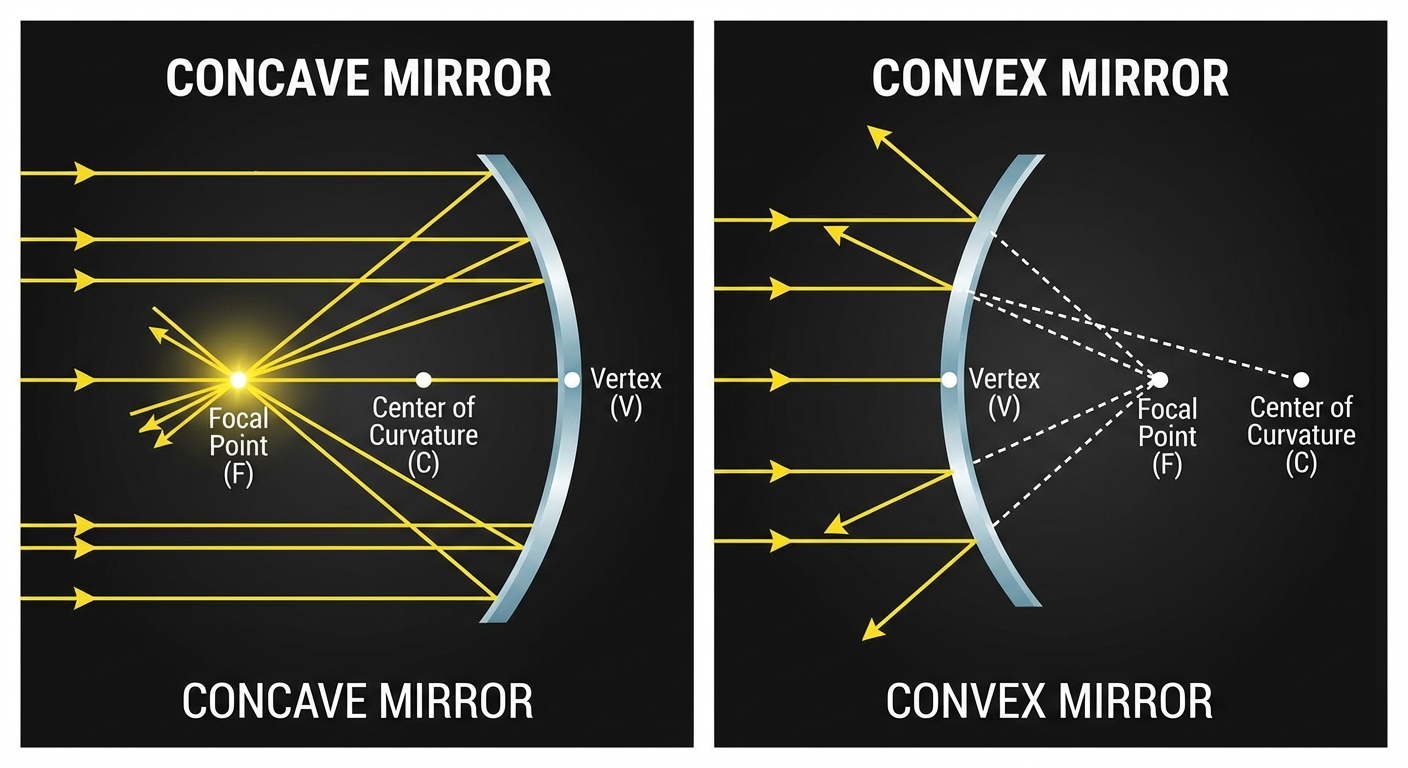
1. Concave (Converging) Mirrors
- Definition: The inner surface of the sphere is reflective (like the inside of a spoon).
- Function: Incoming parallel rays reflect and converge (meet) at a single point called the Focal Point ($F$).
- Applications: Makeup mirrors, telescope primary mirrors, solar cookers.
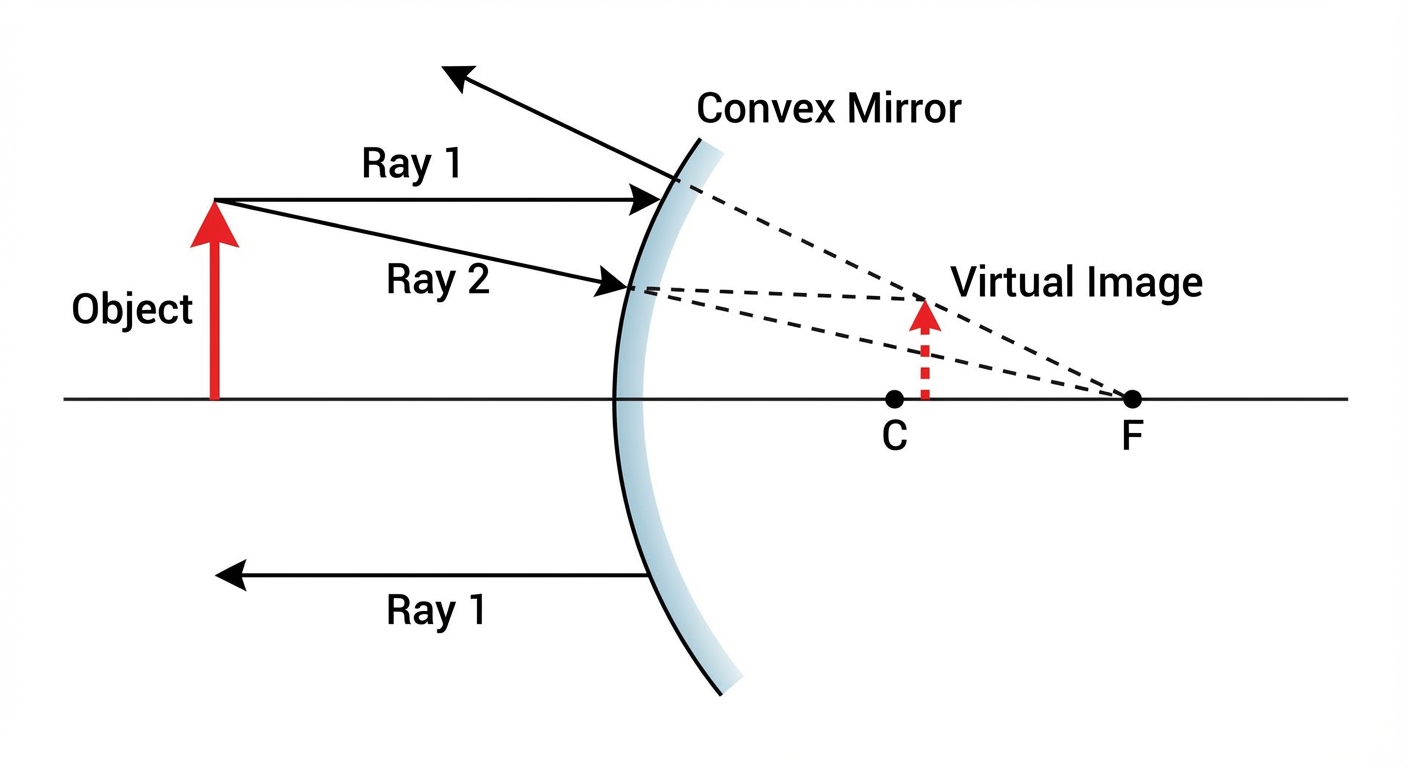
2. Convex (Diverging) Mirrors
- Definition: The outer surface is reflective (like the back of a spoon).
- Function: Incoming parallel rays reflect and diverge (spread out). If you trace the reflected rays backward behind the mirror, they appear to originate from a virtual focal point.
- Applications: Security mirrors in stores, side-view car mirrors ("Objects in mirror are closer than they appear").
Key Parameters
- Center of Curvature ($C$): The geometry center of the sphere the mirror was cut from.
- Radius of Curvature ($R$): Distance from the mirror surface to $C$.
- Vertex ($V$): The geometric center of the mirror surface itself.
- Principal Axis: A line passing through $C$, $F$, and $V$.
- Focal Length ($f$): Distance from the mirror to the focal point.
For spherical mirrors with small curvature (paraxial approximation):
Geometric Ray Tracing
To determine where an image forms without doing math, we use Ray Diagrams. You only need to draw two of the three "Principal Rays" to find the intersection point.
The Three Principal Rays
- Parallel Ray: Draws parallel to the principal axis $\rightarrow$ reflects through the Focal Point ($F$). (For convex: reflects away from $F$).
- Focal Ray: Draws through the Focal Point $\rightarrow$ reflects parallel to the principal axis.
- Central Ray: Draws through the Center of Curvature ($C$) $\rightarrow$ reflects back on itself (along the normal).
Image Cases for Concave Mirrors
The image depends heavily on the object's position relative to $f$ and $C$:
| Object Position | Image Type | Orientation | Size | Location |
|---|---|---|---|---|
| Beyond $C$ | Real | Inverted | Reduced | Between $C$ and $F$ |
| At $C$ | Real | Inverted | Same Size | At $C$ |
| Between $C$ and $F$ | Real | Inverted | Magnified | Beyond $C$ |
| At $F$ | No Image | N/A | N/A | Rays are parallel |
| Inside $F$ | Virtual | Upright | Magnified | Behind Mirror |
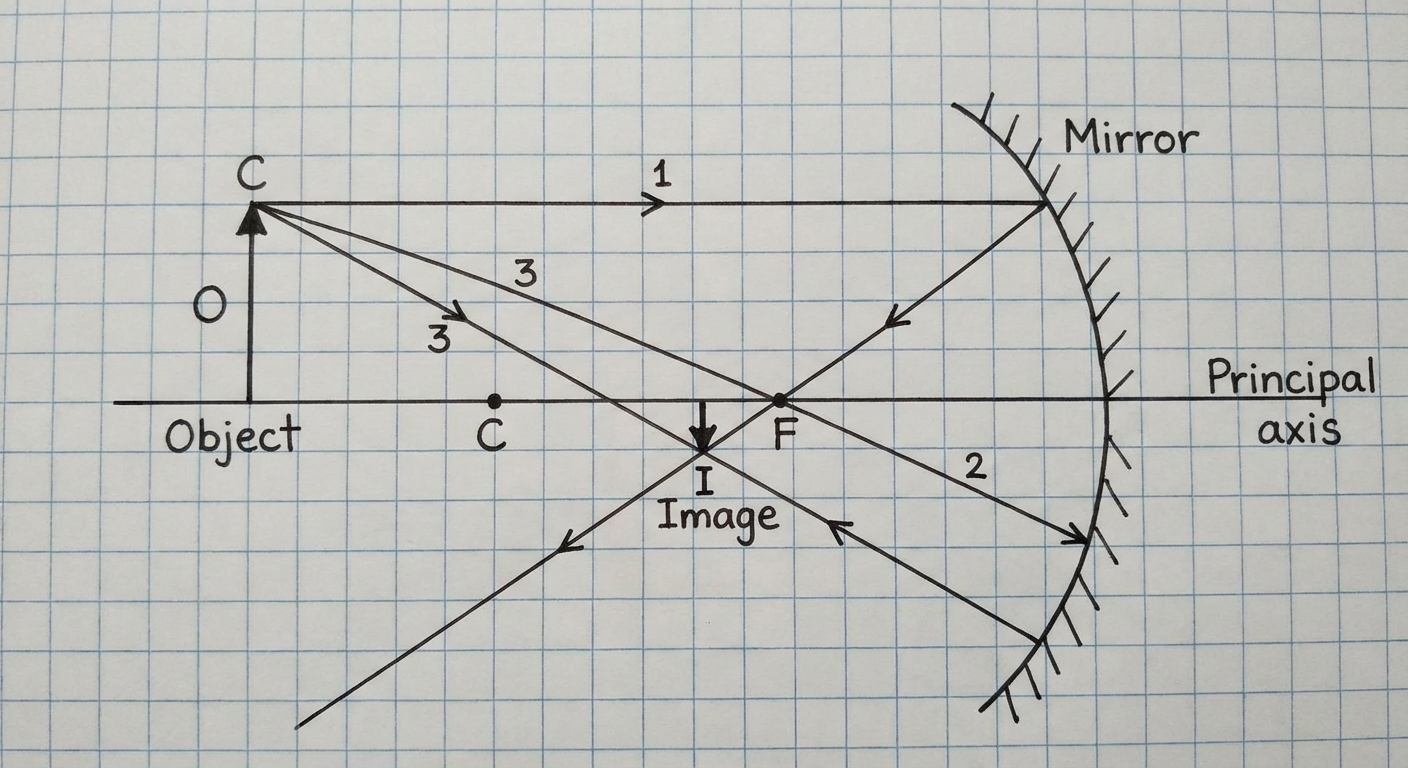
Image Case for Convex Mirrors
Convex mirrors are simple. Regardless of object location:
- The image is ALWAYS Virtual, Upright, and Reduced.
Quantitative Analysis: The Mirror Equations
To solve for exact distances and sizes, we use two fundamental equations.
1. The Mirror Equation
Relates the focal length to object and image distances.
2. The Magnification Equation
Relates the height of the image ($hi$) and object ($ho$) to their distances.
Sign Conventions (The "Table of Truth")
This is the most common source of error on AP Exams. Memorize this convention:
| Variable | Positive (+) Sign | Negative (-) Sign |
|---|---|---|
| Focal Length ($f$) | Concave (Converging) | Convex (Diverging) |
| Object Distance ($d_o$) | Real Object (in front) | Virtual Object (very rare in AP 2) |
| Image Distance ($d_i$) | Real Image (in front) | Virtual Image (behind mirror) |
| Magnification ($M$) | Upright Image | Inverted Image |
Note on $M$: If $|M| > 1$, the image is magnified. If $|M| < 1$, the image is reduced.
Worked Example: Concave Mirror
Problem: A 4.0 cm tall candle is placed 15.0 cm in front of a concave mirror with a radius of curvature of 20.0 cm. Determine the position, size, and characteristics of the image.
Solution:
Find Focal Length:
(Positive because it is concave).Solve for Image Distance ($di$):
Solve for Size/Magnification:
Interpretation:
Since $d_i$ is positive, the image is Real. Since $M$ is negative, the image is Inverted. Since $|M| > 1$, the image is Magnified (twice as tall).
Common Mistakes & Examination Pitfalls
- Angle Measurement: Students frequently measure the angle of incidence from the mirror surface to the ray. Correction: Always measure from the Average Normal to the ray.
- Sign Errors: Forgetting that convex mirrors have negative focal lengths, or that virtual images (behind the mirror) have negative image distances.
- Real vs. Virtual Identification:
- Start with the math: $+di$ is Real; $-di$ is Virtual.
- Visual check: If rays actually cross, it's real. If you have to trace dotted lines back, it's virtual.
- The "Half-Covered Mirror" Trick: An exam question might ask what happens to an image if you cover the top half of the mirror.
- Wrong Answer: You see half the image.
- Right Answer: You see the entire image, but it is dimmer. Every point on the mirror reflects rays from every point on the object; covering half just reduces the number of rays available to form the image.
- Inside the Focal Point: When an object is inside $f$ of a concave mirror, the math will yield a negative $d_i$. Don't panic; this just means the image has become virtual and magnified (like a makeup mirror).