Unit 3: Cultural Patterns and Processes — Identity and Belief Systems
Language: The Geography of Speech
Language is the central element of culture; it is how culture is transmitted, preserved, and expressed. In AP Human Geography, you are not learning how to speak languages, but rather where they are spoken, why they are spoken there, and how they diffuse.
Language Classification Hierarchy
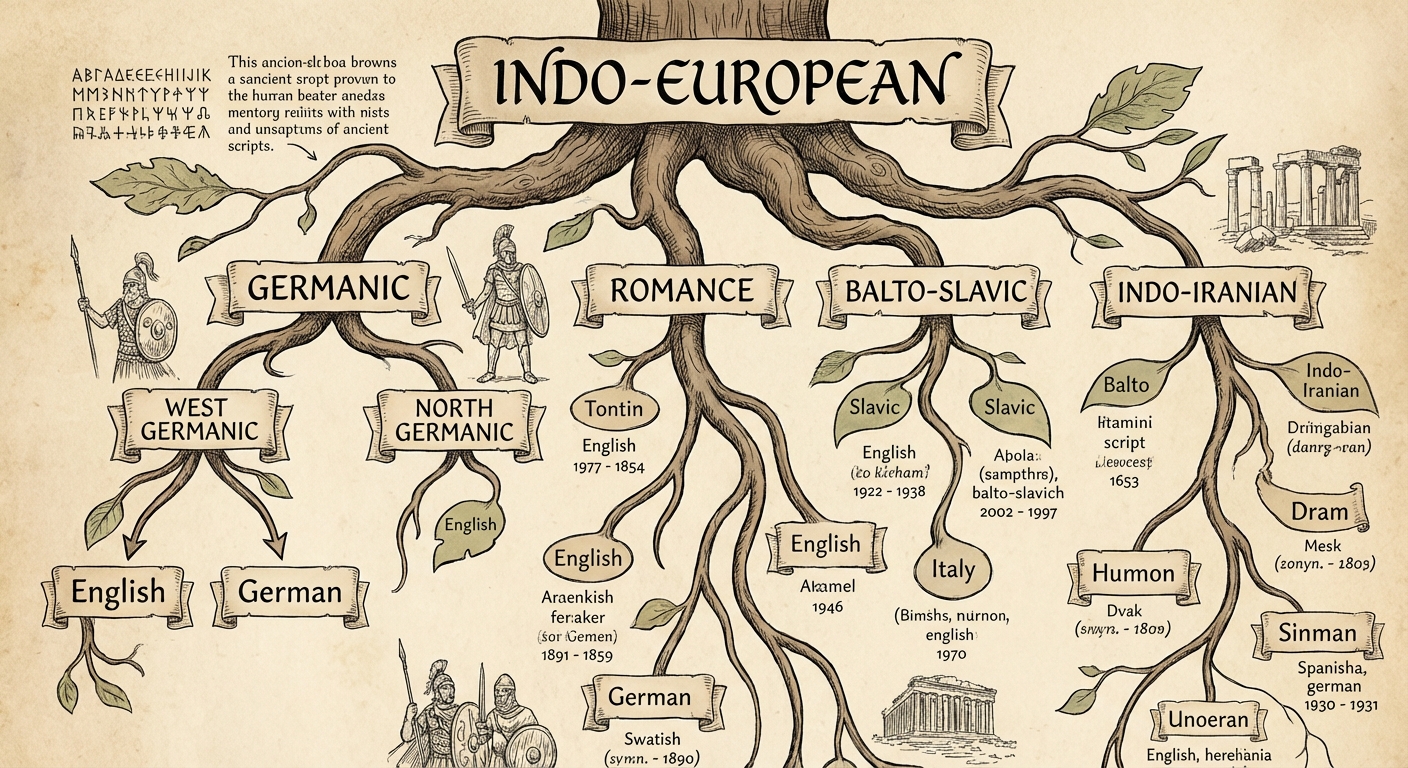
To understand global linguistic patterns, geographers classify languages like a family tree. You must memorize this hierarchy from largest to smallest:
- Language Family: A collection of languages related through a shared ancestral language that existed long before recorded history (e.g., Indo-European, Sino-Tibetan).
- Language Branch: A collection of languages within a family related through a common ancestor several thousand years ago (e.g., Germanic, Romance).
- Language Group: Languages within a branch showing similar grammar and vocabulary, originating in the recent past (e.g., West Germanic).
- Language: The specific system of communication (e.g., English).
Dialects and Isoglosses
When a language is spoken across a large area, regional variations emerge.
- Dialect: A regional variation of a language distinguished by distinctive vocabulary, spelling, and pronunciation. (e.g., British English vs. American English).
- Isogloss: A boundary line on a map that marks the limit of an area where a specific linguistic feature (like a word or pronunciation) is prevalent. For example, the line dividing where people say "pop" vs. "soda" in the United States.
Lingua Franca, Pidgins, and Creoles
As globalization increases, the need for a common language grows.
- Lingua Franca: A language mutually understood and commonly used in trade by people who have different native languages. English is the current global lingua franca; Swahili is a major lingua franca in East Africa.
- Pidgin Language: A simplified form of speech with limited vocabulary and grammar, used for communication between speakers of two different languages. Crucially, a pidgin has NO native speakers.
- Creole Language: A language that results from the mixing of a colonizer's language with the indigenous language. It becomes a Creole when it evolves from a pidgin to become the mother tongue of a people, acquiring complex grammar and vocabulary (e.g., Haitian Creole).
Religion: Universalizing vs. Ethnic
Geographers distinguish between religions based on who follows them and how they spread. This is a binary classification system you typically see on the exam.
Comparison Table
| Feature | Universalizing Religions | Ethnic Religions |
|---|---|---|
| Goal | Attempt to appeal to all people, regardless of location or culture. | Appeal primarily to one group of people living in one place. |
| Conversion | Aggressively seek converts (proselytizing). | Do not seek converts; born into the faith. |
| Examples | Christianity, Islam, Buddhism, Sikhism. | Hinduism, Judaism, Shintoism, Indigenous animism. |
| Calendar | Holidays relate to life events of the founder (e.g., Christmas). | Holidays relate to the local agricultural cycle or seasons. |
| Diffusion | Widespread diffusion (Relocation and Expansion). | Limited diffusion (mostly Relocation). |
Major Religions and Hearths
- Christianity: Largest universalizing religion. Hearth in the West Bank (Middle East). Diffused via hierarchical diffusion (Roman Emperor Constantine) and relocation diffusion (colonization/missionaries).
- Islam: Second largest universalizing. Hearth in Mecca/Medina (Saudi Arabia). Diffused via contagious diffusion (trade/conquest) across North Africa and Southeast Asia.
- Buddhism: Universalizing. Hearth in Northern India/Nepal. Diffused East/Southeast via missionaries (Emperor Ashoka) and trade routes. Note: Buddhism died out significantly in its hearth (India) and was replaced by Hinduism.
- Hinduism: Largest ethnic religion. Hearth in the Indus River Valley (Pakistan/India). Concentrated heavily in India and Nepal.
- Judaism: Ethnic. Hearth in the Eastern Mediterranean. Unusually widely scattered due to the Diaspora (forced dispersion by Romans).
The Religious Cultural Landscape
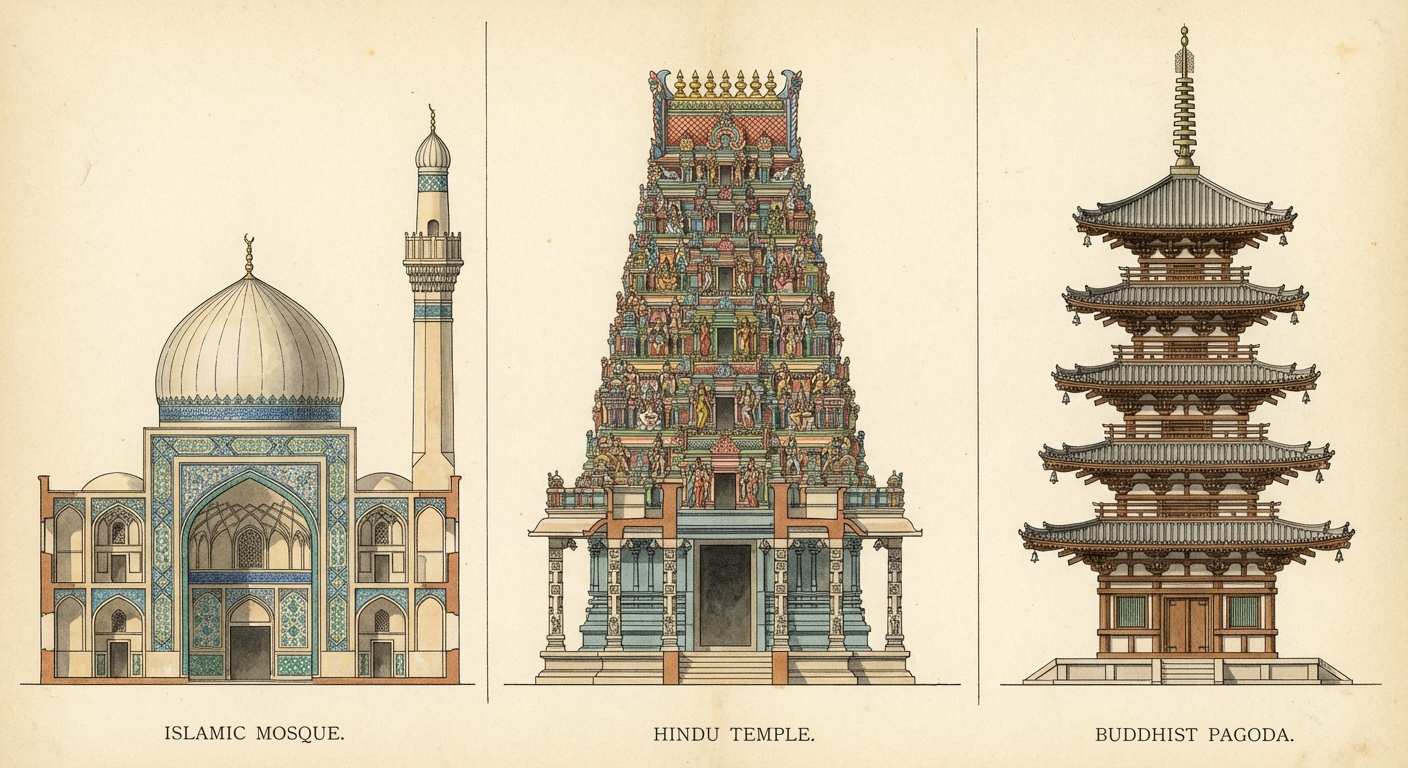
Religion physically alters the landscape. You need to identify religions by their architecture and land use.
- Christianity: High density of churches; burial of the dead in cemeteries (consumes land).
- Islam: Mosques with Minarets; call to prayer; prohibition of pork/alcohol affects agriculture; orientation of prayer toward Mecca.
- Hinduism: Temples/Shrines often near river banks; cremation of the dead (strain on wood supply); ritual bathing in the Ganges.
- Buddhism: Pagodas (contain relics, not always for congregational worship); stupas.
Ethnicity and Nationalism
While race is often described as a social construct based on physical characteristics, ethnicity is identity with a group of people who share the cultural traditions of a particular homeland or hearth.
Nationality and Political Geography
- Nationality: Identity with a group of people who share legal attachment and personal allegiance to a particular country.
- Nation-State: A state whose territory corresponds to that occupied by a particular ethnicity that has been transformed into a nationality (e.g., Japan, Iceland).
- Multinational State: A state that contains two or more ethnic groups with traditions of self-determination (e.g., United Kingdom, Russia).
Centripetal vs. Centrifugal Forces
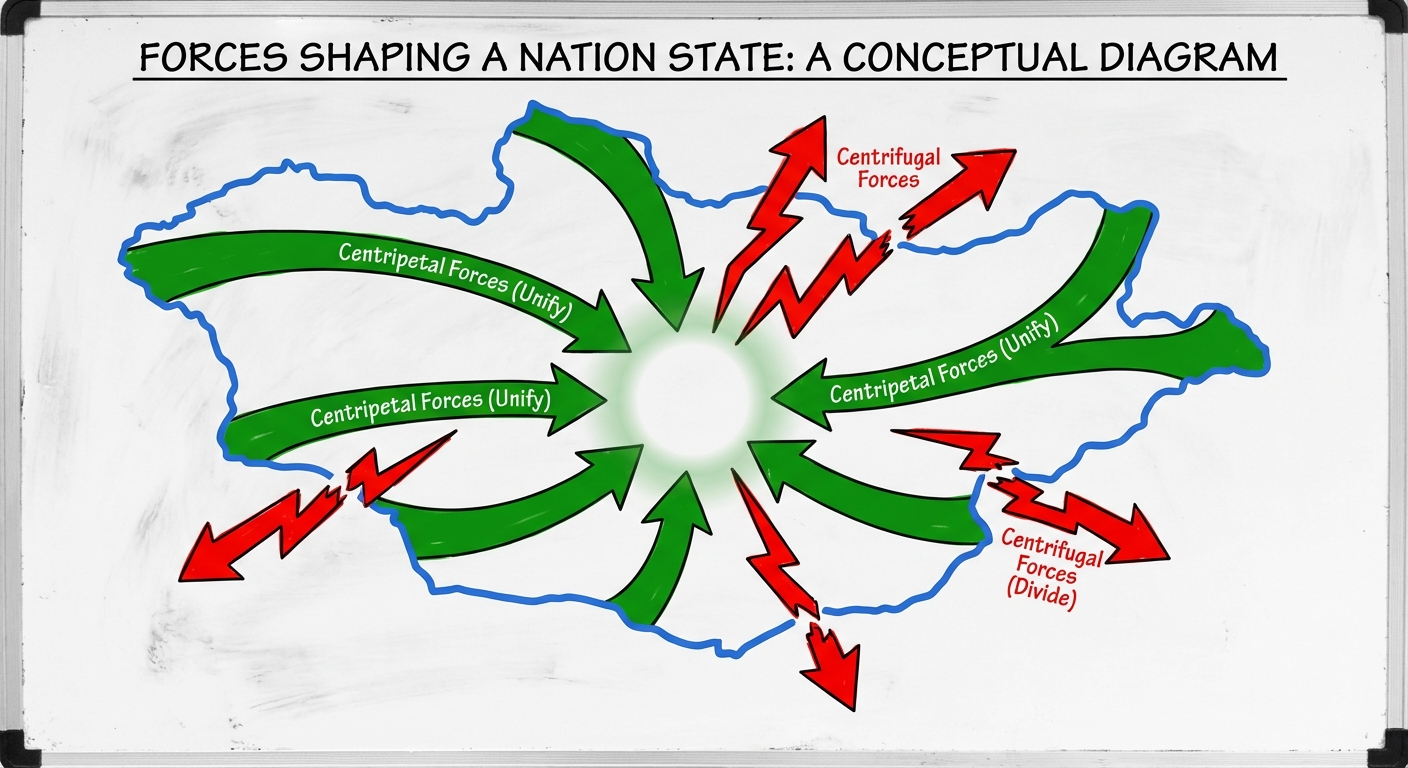
These forces determine the stability of a state.
| Force | Definition | Examples |
|---|---|---|
| Centripetal | Forces that unify people and enhance support for a state. | National anthem, shared language, strong infrastructure, charismatic leader, external threat. |
| Centrifugal | Forces that divide a state. | Multiple languages, religious conflict, uneven economic development, physical geography barriers. |
Ethnic Conflict and Balkanization
When centrifugal forces overwhelm a state, it may fragment.
- Balkanization: The process by which a state breaks down through conflicts among its ethnicities (named after the Balkan Peninsula/Yugoslavia).
- Ethnic Cleansing: A purposeful policy designed by one ethnic or religious group to remove by violent and terror-inspiring means the civilian population of another ethnic or religious group.
Effects of Cultural Diffusion
How do language, religion, and ethnicity interact when they move?
Acculturation vs. Assimilation
- Acculturation: When an ethnic group adopts enough of the host society's ways to be able to function economically and socially, but retains their own cultural distinctions (e.g., speaking a new language at work, but native language at home).
- Assimilation: The complete loss of unique cultural traits as a group blends indistinguishably into the dominant culture.
Syncretism
Syncretism is the blending of traits from two different cultures to form a new trait. This is very common in religion.
- Example: Santería in the Caribbean (blends African traditional spirit worship with Roman Catholic saints).
- Example: Sikhism (contains elements of both Islam and Hinduism).
Common Mistakes & Pitfalls
- Confusing Race, Ethnicity, and Nationality: Identify the root: Race (biological/physical perception), Ethnicity (cultural heritage/hearth), Nationality (legal relationship to a State). a person can be Ethnically Kurdish, Nationally Iraqi, and Racially White.
- Pidgin vs. Creole: Remember the timeline. If you learn it as a second language to do business, it's a pidgin. If you are a baby born learning it as your first language, it's a Creole.
- Ethnic Religion ≠ Ethnic Group: While ethnic religions are tied to specific ethnic groups, not all members of an ethnic group follow that religion. Also, don't confuse "Ethnic Religion" with "Tribal Religion"—Hinduism is an Ethnic religion with over a billion followers.
- Language Hierarchy: Students often flip "Family" and "Group". Remember the mnemonic: Fat Boys Get Lunch (Family -> Branch -> Group -> Language).
- Official Language: The USA does not have an official language at the federal level. English is the de facto language, but not de jure (by law).