AP Physics C: E&M — Comprehensive Guide to Electric Potential
Electric Potential Energy
Before diving into Electric Potential (Voltage), we must first understand the concept of Electric Potential Energy ($U_E$). Just as a mass has gravitational potential energy due to its position in a gravitational field, a charge has electric potential energy due to its position in an electric field.
Definitions and The Work-Energy Relationship
Electric Potential Energy is the energy stored in a system of charged particles. It is a scalar quantity (no direction, just magnitude and sign).
Key relationships regarding Work ($W$) and Potential Energy ($U_E$):
- Work done by the Electric Field ($WE$): The field is a conservative force. The work done by the field equals the negative change in potential energy.
- Work done by an External Agent ($W{ext}$): To move a charge against the electric field at a constant speed, an external force must do work equal to the change in potential energy.
Point Charge Systems
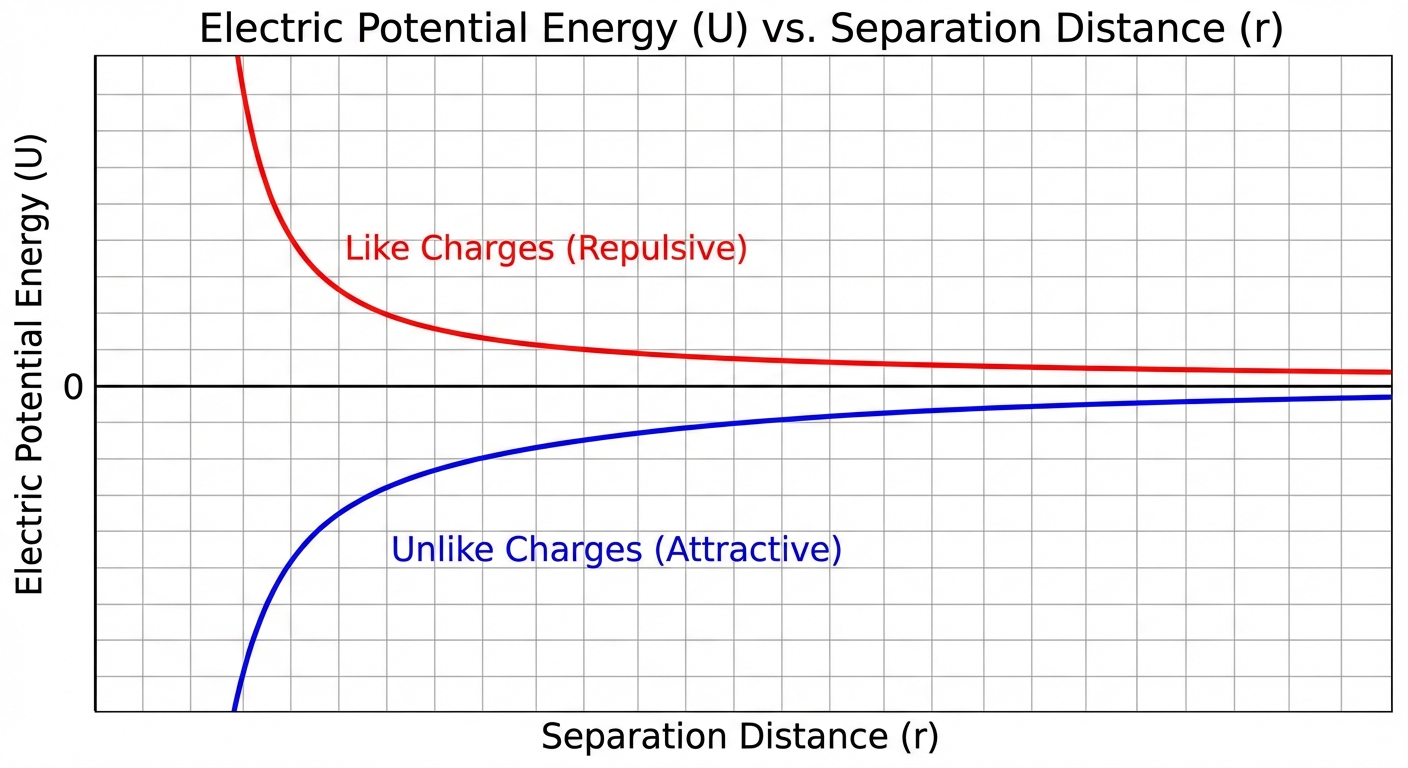
The potential energy of a system consisting of two point charges, $q1$ and $q2$, separated by a distance $r$ is given by:
Where:
- $k$ is Coulomb's constant ($8.99 \times 10^9 \, \text{N}\cdot\text{m}^2/\text{C}^2$)
- The sign of $U_E$ matters!
- Like charges (+/+ or -/-): $U_E > 0$. You must do positive work to push them together (repulsion).
- Opposite charges (+/-): $U_E < 0$. You must do negative work to bring them together (attraction), or positive work to pull them apart.
- At infinity: $U_E = 0$ as $r \rightarrow \infty$.
Systems of Multiple Charges
Because energy is a scalar, finding the total energy of a system of multiple charges is simple algebraic addition. You must sum the potential energy of every unique pair of charges in the system.
Electric Potential
While potential energy is a property of a system of charges, Electric Potential ($V$) is a property of a specific point in space created by source charges.
Definition and Formula
Electric Potential is defined as the electric potential energy per unit charge. It tells you how much energy a hypothetical +1 C charge would have if placed at that location.
For a single point charge $Q$, the potential $V$ at a distance $r$ is:
- Unit: Volt (V), where $1 \, \text{V} = 1 \, \text{Joule/Coulomb} (J/C)$.
- Scalar Quantity: Unlike Electric Field ($E$), $V$ has no direction. This makes calculating potential much easier than calculating fields because you do not need to decompose vectors into components.
Superposition Principle
To find the total potential at a point $P$ due to several source charges, you simply sum the individual potentials algebraically:
Equipotential Surfaces
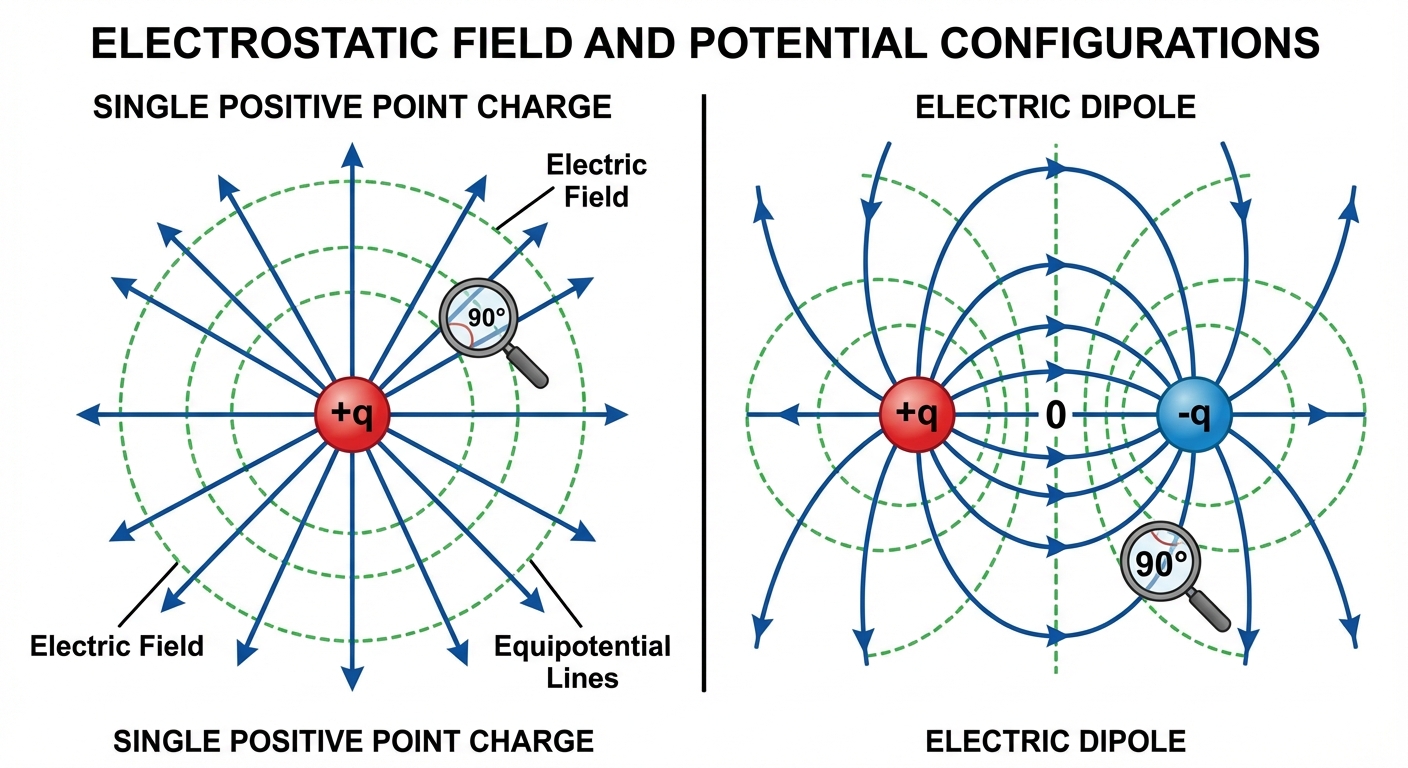
An Equipotential Surface is a region where the potential is constant ($V$ is the same everywhere).
- No work is done moving a charge along an equipotential surface ($W = q\Delta V = 0$).
- Equipotential lines are always perpendicular to Electric Field lines.
- Conductors in electrostatic equilibrium are equipotential volumes (surface and interior).
Relationship Between Electric Field and Potential
The connection between Electric Field ($\, vec{E}$) and Potential ($V$) is a fundamental calculus concept in AP Physics C. We can view this relationship in two ways: Integral form and Differential form.
1. Finding Potential from Field (Integration)
If you know the electric field, you can calculate the potential difference between two points, $a$ and $b$:
- The negative sign indicates that moving with the E-field decreases potential (moving "downhill").
- If the field is uniform (constant $E$), this simplifies to $\Delta V = -Ed \cos\theta$.
2. Finding Field from Potential (Differentiation)
If you have a function for the potential $V(r)$, the electric field is the negative gradient (slope) of the potential.
For a radial field (like a point charge):
The Hill Analogy: Think of Potential ($V$) as altitude (height) and Electric Field ($E$) as the slope of the hill. Positive charges roll "downhill" (from high $V$ to low $V$). Negative charges roll "uphill" (from low $V$ to high $V$).
Potential Due to Charge Distributions
For continuous objects (rods, rings, disks, spheres), we cannot use the summation $\sum$. Instead, we treat the object as a collection of infinitesimal point charges $dq$. Using the principle of superposition, we integrate:
Integration Strategy:
- Define a small charge element $dq$ (using $\lambda dl$, $\sigma dA$, or $\rho dV$).
- Expression the distance $r$ from $dq$ to the point of interest in terms of coordinates.
- Set up limits of integration and solve.
Example 1: Comparing Ring and Disk
A. Charged Ring (Axis of Symmetry)
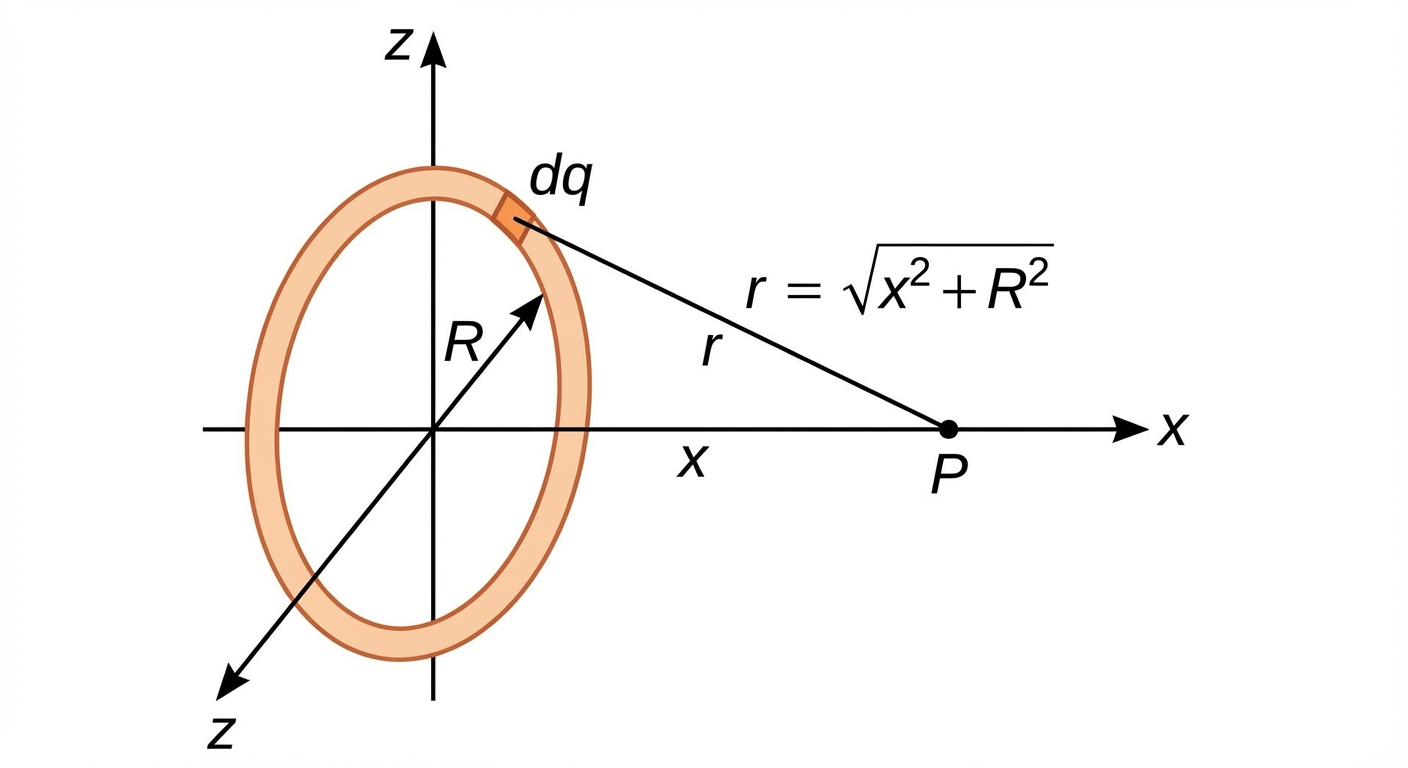
Consider a ring of radius $R$ and total charge $Q$. Finds $V$ at a point $x$ on the central axis.
- Because every slice $dq$ on the ring is equidistant from point $P$, $r = \sqrt{x^2 + R^2}$ is a constant for the integration.
B. Charged Disk (Axis of Symmetry)
To obtain the potential of a disk, you integrate a series of concentric rings from radius $0$ to $R$. (This derivation often appears on FRQs).
Conductors and Potential
A critical concept for AP Physics C is the behavior of conductors in electrostatic equilibrium:
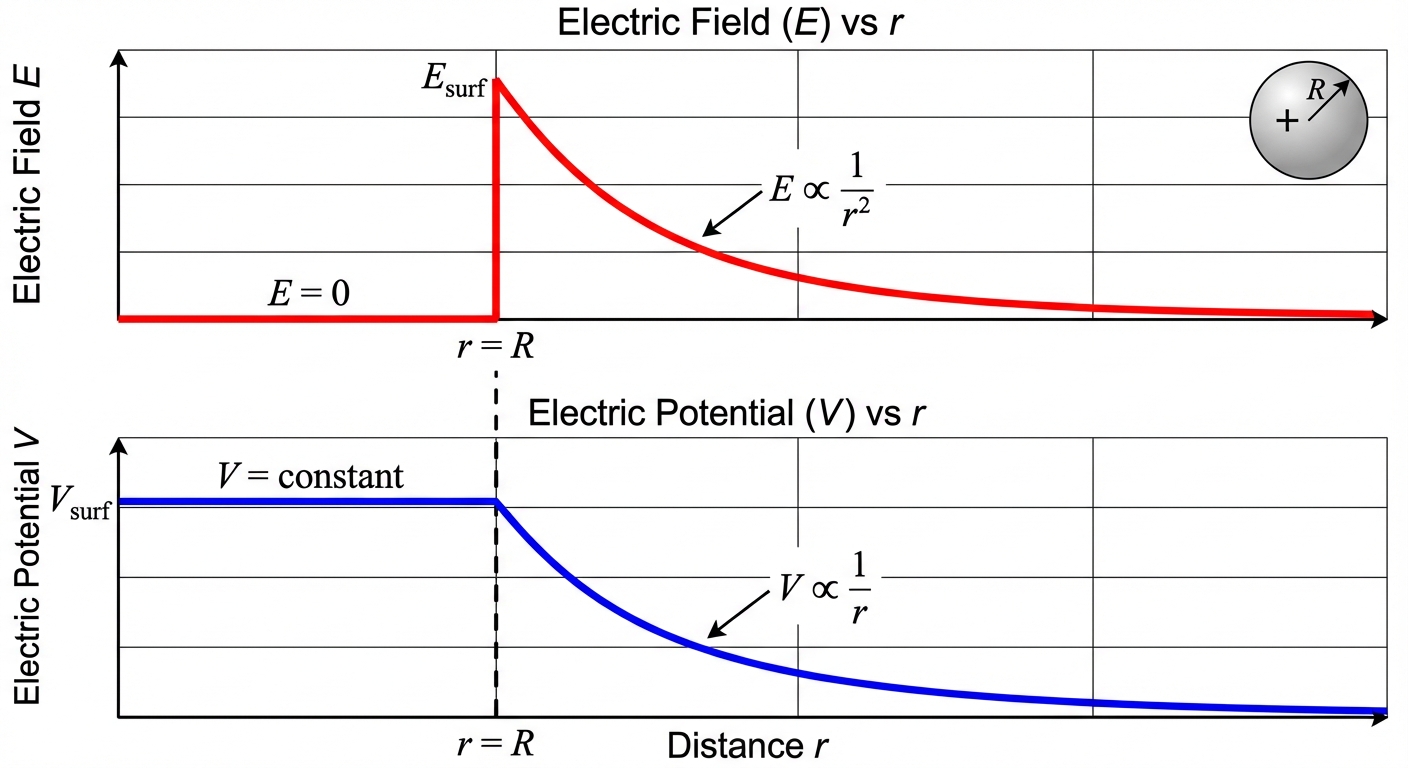
- Electric Field inside is zero ($E=0$).
- Since $E = -dV/dr$, if $E=0$, the derivative of potential is zero.
- Therefore, Potential $V$ is constant everywhere inside a conductor.
- The potential at the center of a solid metal sphere is the same as the potential at the surface.
Common Mistakes & Pitfalls
Confusing Vectors and Scalars:
- Mistake: Trying to use sine/cosine components when adding Electric Potentials.
- Correction: $V$ is a scalar. Simply add the numbers: $V{net} = V1 + V_2$. Never use components for Potential.
The $1/r$ vs $1/r^2$ Problem:
- Mistake: Using $V = kQ/r^2$ or $E = kQ/r$.
- Correction: Remember the hierarchy. Forces and Fields fall off fast ($1/r^2$). Energy and Potential fall off slower ($1/r$).
- Force/Field: $\propto 1/r^2$
- Energy/Potential: $\propto 1/r$
Signs in Work Calculations:
- Mistake: Forgetting the negative sign in $W = -q\Delta V$.
- Correction: Always identify who is doing the work. The field does work to lower potential energy. An external agent does work against the field to raise potential energy.
Integration Limits:
- Mistake: Integrating from $0$ to $r$ when the reference point is infinity.
- Correction: The definition of absolute potential assumes $V(\infty) = 0$. When deriving formulas, ensure your limits match this convention or use definite integrals for potential differences.