Comprehensive Guide to Cultural Patterns and Processes
1. Fundamentals of Culture
Culture is the sum total of knowledge, attitudes, and habitual behavior patterns shared and transmitted by the members of a society. It is the "way of life" of a group of people.
Components of Culture
Culture is divided into two primary categories:
- Material Culture: The physical, tangible objects made and used by members of a cultural group. Examples include clothing, building architecture, food, artwork, musical instruments, and technology.
- Non-Material Culture: The abstract concepts of values, beliefs, and behaviors. Examples include language, religion, folklore, social norms, and political organization.
Cultural Hierarchy
To understand how culture is organized, geographers use a hierarchy of terms:
- Cultural Trait: The smallest unit of culture; a single attribute of a culture (e.g., eating with chopsticks, wearing a turban).
- Cultural Complex: A distinct combination of cultural traits (e.g., the Maasai cattle complex involves food, status, and rites of passage related to cattle).
- Cultural System: A collection of interacting cultural traits and complexes shared by a group within a particular territory.
- Cultural Region: An area wherein a group of people or a certain activity prevails (e.g., the "Bible Belt" in the US).
Folk vs. Popular Culture
The AP Human Geography curriculum heavily emphasizes the distinction between these two:
| Feature | Folk Culture | Popular Culture |
|---|---|---|
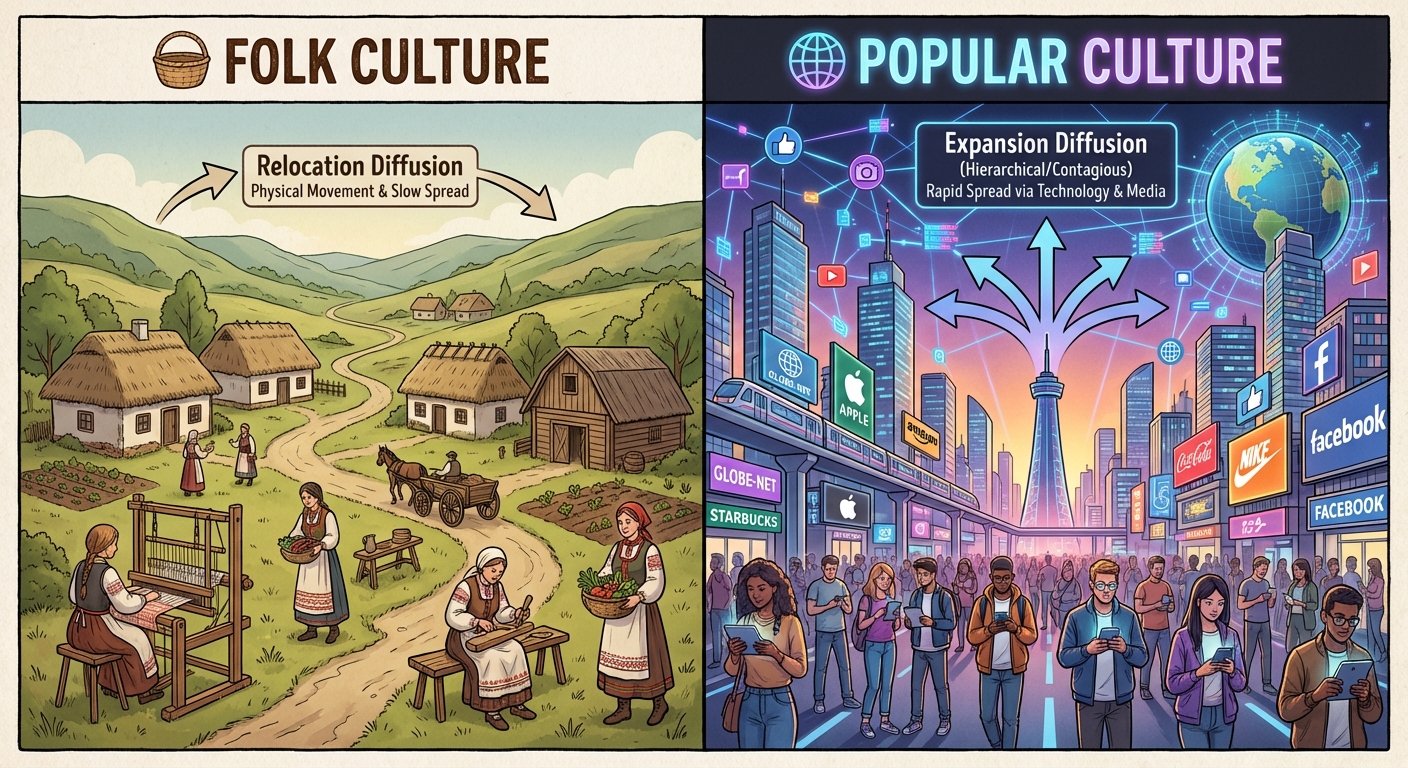
| Origins (Hearth) | Anonymous, often unknown dates/originators. Rooted in tradition. | Traceable to a specific person or corporation. Often urban hearths (e.g., NYC, LA, London). |
| Diffusion | Transmitted slowly via Relocation Diffusion (migration). | Spreads rapidly via Hierarchical or Contagious Diffusion (media/internet). |
| Distribution | Isolated; limited interactions; influenced by physical geography (environmental determinism). | Widespread; distributed wherever technology/income allows; ignores physical barriers. |
| Change | Changes very little over time. | Changes rapidly over time (trends and fads). |
| Examples | The Amish, traditional Navajo weaving, Bluegrass music (originally). | K-Pop, McDonald's, Jeans, TikTok trends. |
2. Cultural Landscapes and Architecture
The Cultural Landscape is a concept defined by geographer Carl Sauer. It is the "built environment"—the visible imprint of human activity on the landscape. As Sauer stated, "Culture is the agent, the natural area is the medium, the cultural landscape is the result."
Sequent Occupance
This refers to the notion that successive societies leave their cultural imprints on a place, each contributing to the cumulative cultural landscape.
- Example: In New Orleans, you can see layers of French, Spanish, African, and American cultural influences in the architecture and street names.
- Example: The Hagia Sophia in Istanbul, Turkey, started as a Christian view, became a Muslim mosque with added minarets, and is now a museum (and active mosque again), showing layers of history.
Architecture and the Built Environment
Architecture is a key marker of cultural identity.
1. Traditional/Folk Housing (USA)
Folk housing styles spread from three main US hearths:
- New England (Northern): The "Saltbox" house (long pitched roof in front, low angle in back) and the "Cape Cod" (small, one-story, steep roof for snow).
- Middle Atlantic: The "I-House" (two full stories, one room deep, gables to the side). This is the most ubiquitous folk style in the US, spreading westward via the Ohio Valley.
- Lower Chesapeake (Southern): Often one-story raised on piers (to prevent flooding) with porches.
2. Modern and Contemporary Architecture
- Modern Architecture (Mid-20th Century): Defined by efficiency, geometric forms, and function over form. Uses steel and glass (e.g., rectangular skyscrapers of the 1960s-80s).
- Postmodern Architecture: A reaction against the rigidity of modernism. It uses curvature, decoration, color, and historical references. It is often unique and focuses on aesthetics.
- Example: The Guggenheim Museum in Bilbao (wavy titanium) or the Burj Khalifa.
3. Cultural Diffusion
Diffusion is the spread of people, things, ideas, cultural practices, disease, technology, weather, and more from place to place. The starting point is called the Hearth.
Types of Diffusion
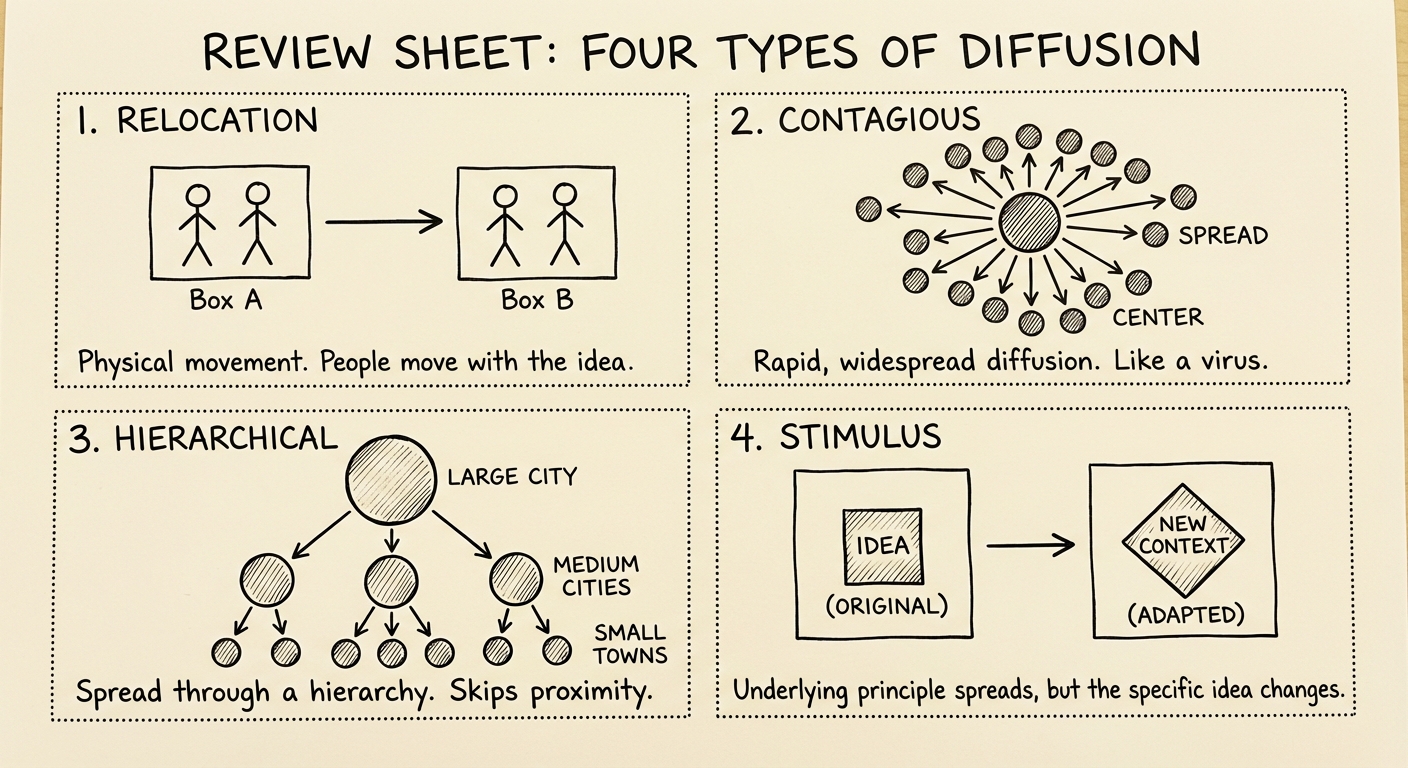
A. Relocation Diffusion
The spread of an idea through physical movement of people from one place to another. Key Concept: The people move and take the culture with them.
- Example: Pizza brought to the US by Italian immigrants.
B. Expansion Diffusion
The spread of a feature from one place to another in a snowballing process. The idea moves; the people don't necessarily have to migrate.
- Contagious Diffusion: Rapid, widespread diffusion of a characteristic throughout the population like a viral disease or a viral video. No hierarchy; affects everyone adjacent.
- Example: The spread of COVID-19 or a meme.
- Hierarchical Diffusion: Spread from a person/node of authority or power to other persons/places. It "jumps" between major cities before hitting rural areas.
- Example: High fashion (Milan → NYC → Local suburban mall) or slang words from celebrities.
- Stimulus Diffusion: The underlying principle of a characteristic spreads, but a specific trait is rejected or modified due to cultural barriers.
- Example: McDonald's in India serves veggie burgers (Maharaja Mac) because the Hindu population generally does not eat beef. The idea (fast food) diffused, but the product changed.
4. Language Patterns
Language is often the most important component of culture because it allows for the transmission of culture.
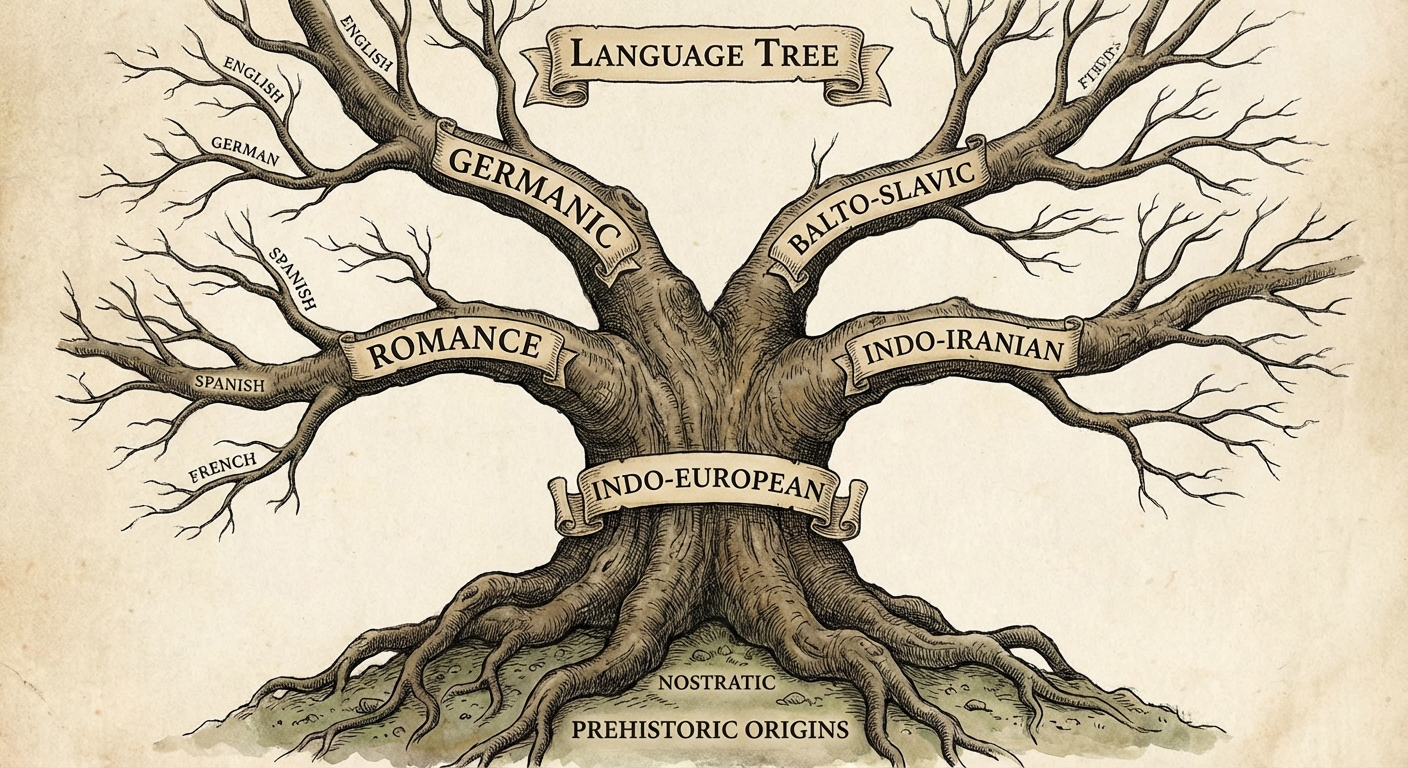
Language Structure (The Tree Analogy)
- Language Family: A collection of languages related through a common ancestral language mostly from before recorded history. (The Trunk)
- Indo-European is the largest family (~50% of the world).
- Sino-Tibetan is the second largest (includes Mandarin).
- Language Branch: A collection of languages within a family related through a common ancestral language strictly from recorded history. (The Branches)
- Example: Germanic, Romance, Balto-Slavic, Indo-Iranian.
- Language Group: A collection of languages within a branch that share a common origin in the relatively recent past. (The Twigs aka the individual languages)
- Example: West Germanic group includes English, German, and Dutch.
Theories of Indo-European Origins
- Nomadic Warrior Theory (Kurgan Hypothesis): Proposed by Marija Gimbutas. Specific Kurgan people from the steppes (border of Russia/Kazakhstan) were nomadic herders who conquered Europe and South Asia, spreading their language via horseback warfare.
- Sedentary Farmer Theory (Anatolian Hypothesis): Proposed by Colin Renfrew. The language spread peacefully along with agricultural innovations from Anatolia (modern Turkey) into Europe and Asia.
Dialects and Isoglosses
- Dialect: A regional variation of a language distinguished by vocabulary, spelling, and pronunciation.
- Isogloss: A boundary line on a map that marks the limit of a linguistic feature (e.g., the line on a US map dividing where people say "Soda" vs. "Pop").
Language Dynamics
- Lingua Franca: A language mutually understood and commonly used in trade by people who have different native languages. English is the current global lingua franca. Others include Swahili (East Africa), Hindi (India), and Russian (former Soviet states).
- Pidgin Language: A simplified form of speech with limited vocabulary and grammar, used for communication between speakers of two different languages. It has no native speakers.
- Creole Language: A pidgin language that evolves to become the primary language of a people, developing more complex grammar and vocabulary. (e.g., Haitian Creole, Gullah).
5. Religion Patterns
Religions are classified into two categories based on their recruitment of followers.
A. Universalizing Religions
Attempt to appeal to all people, regardless of location or culture. They usually have a precise founder and specific hearth, and spread via expansion and relocation diffusion.
- Christianity:
- Hearth: Judea (Middle East/Jerusalem).
- Diffusion: Relocation (missionaries), Hierarchical (emperor Constantine), Contagious (colonization).
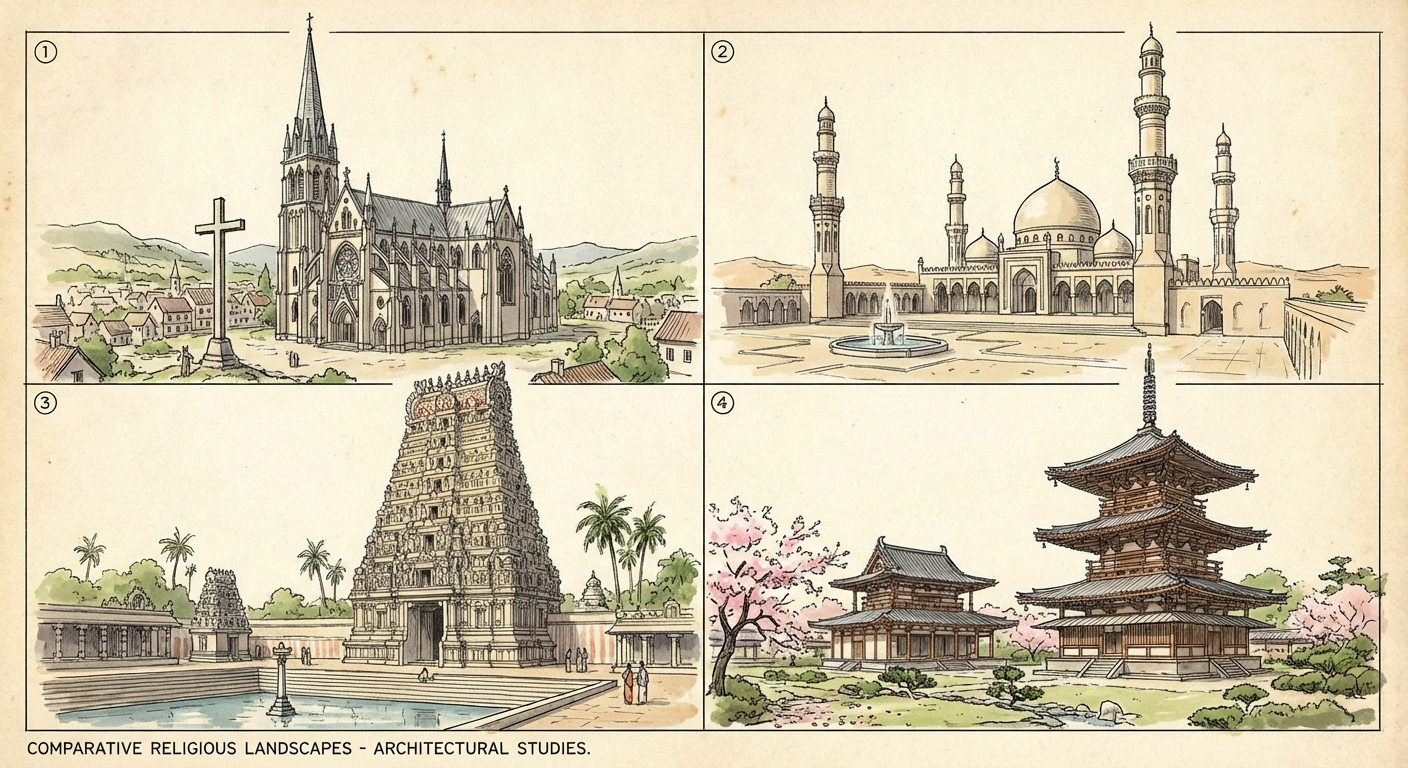
- Landscape: Churches (steeple/cross). Burial of the dead (cemeteries take up land).
- Islam:
- Hearth: Mecca/Medina (Arabian Peninsula). Founder: Muhammad.
- Branches: Sunni (majority) vs. Shiite (mostly Iran/Iraq).
- Landscape: Mosques (domes, minarets for call to prayer). Hajj (pilgrimage) creates massive movement patterns. Orientation toward Mecca (Black Stone/Kaaba).
- Buddhism:
- Hearth: Northern India/Nepal. Founder: Siddhartha Gautama.
- Diffusion: Slow diffusion via Magadha Empire and Silk Road to East/Southeast Asia.
- Landscape: Pagodas (store relics, not always for congregation), Stupas.
- Sikhism:
- Hearth: Punjab region (India/Pakistan). Syncretic religion (blends Islam and Hinduism).
- Landscape: Golden Temple at Amritsar.
B. Ethnic Religions
Appeal primarily to one group of people living in one place. They generally do not seek converts. Born into the faith.
- Hinduism:
- Hearth: Indus River Valley (India). Oldest major religion. No single founder.
- Beliefs: Karma, Reincarnation, Caste System.
- Landscape: Temples (shrines for specific gods), Cremation (burning dead near rivers, distinct from burial). Ganges River is sacred.
- Judaism:
- Hearth: Eastern Mediterranean (Canaan/Israel).
- History: Diaspora (forced scattering by Romans) spread Jews into Europe and North Africa.
- Landscape: Synagogues, Western Wall.
- Animism:
- Belief that inanimate objects (plants, stones, natural events) have discrete spirits and conscious life. Common in traditional African and Native American cultures.
6. Ethnicity, Race, and Identity
It is crucial to distinguish these terms for AP Human Geography.
- Ethnicity: Identity with a group of people who share the cultural traditions of a particular homeland or hearth (Language, Religion, Customs). Cultural.
- Race: Identity with a group of people who are perceived to share a physiological trait (e.g., skin color). Biological/Social Construct.
- Nationality: Identity with a group of people who share legal attachment and personal allegiance to a particular country. Political.
Ethnic Distribution in the US
- Hispanics: Clustered in the Southwest.
- African Americans: Clustered in the Southeast and in urban centers of the North (due to the Great Migration).
- Asian Americans: Clustered in the West (California/Hawaii).
- Indigenous: Clustered in the Southwest and Plains, and Alaska.
Conflict and Segregation
- Ethnic Enclave: A place with a high concentration of an ethnic group that is distinct from those in the surrounding area (e.g., Chinatown, Little Italy). Often a result of chain migration.
- Centripetal Forces: Attitudes that unify people and enhance support for a state (e.g., National anthem, common language).
- Centrifugal Forces: Attitudes that divide a state (e.g., varying languages, religious conflict).
- Ethnic Cleansing: A process in which a more powerful ethnic group forcibly removes a less powerful one to create an ethnically homogeneous region (e.g., Yugoslavia in the 90s).
- Genocide: The mass killing of a group of people in an attempt to eliminate the entire group from existence (e.g., Rwanda, Holocaust).
7. Contemporary Cultural Issues
Syncretism
The blending of traits from two different cultures to form a new trait.
- Religious Syncretism: Santeria (Catholicism + African spirit worship), Sikhism (Hinduism + Islam).
- Cultural Syncretism: Tex-Mex food, K-Pop (Western pop structure + Korean lyrics/style).
Globalization vs. Cultural Preservation
- Cultural Imperialism: The dominance of one culture over another (usually Western/American culture spreading globally).
- Time-Space Compression: Through technology (internet, planes), distant places seem closer, accelerating diffusion of pop culture.
- Acculturation: When a minority group adopts aspects of the dominant culture but retains its distinct heritage.
- Assimilation: When a minority group completely adopts the dominant culture and ceases to be distinct.
- Multiculturalism: Policy of maintaining a diversity of ethnic cultures within a community.
Common Mistakes & Pitfalls
- Confusing Race and Ethnicity: Remember, race is often defined by physical characteristics (socially constructed), while ethnicity is defined by shared culture and heritage. Tip: You can change your cultural traits (language/religion), but not your race.
- Mixing up Expansion Diffusion Types:
- If the leader does it first: Hierarchical.
- If it spreads like a wave evenly: Contagious.
- If the idea spreads but the specific trait is modified: Stimulus.
- Misunderstanding "Sequent Occupance": It is not just about old buildings; it's about the layers of history visible on the landscape. It implies a timeline of different groups inhabiting the same space.
- Environmental Determinism vs. Possibilism: Do not confuse these. Determinism (old, mostly rejected) says the environment causes culture. Possibilism (modern) says the environment limits availability, but people adapt and modify the environment.
- Syncretism vs. Assimilation: Syncretism is a blend (A+B=C). Assimilation is a dominance/erasure (A+B=A).