Comprehensive Guide to AP Psychology Unit 3: Developmental & Learning Sciences
Major Themes in Developmental Psychology
Developmental Theories & Debates
Developmental Psychology examines physiological, cognitive, and social changes across the lifespan. It is framed by three major continuously debated issues:
Nature vs. Nurture: How does our genetic inheritance (nature) interact with our experiences (nurture) to feel our development?
- Current View: Interactionist—genes predispose us to certain traits, but the environment determines how they are expressed (epigenetics).
Continuity vs. Stages (Discontinuity):
- Continuity: Development is a gradual, continuous process (like riding an escalator). Researchers who emphasize learning and experience often see development this way.
- Stages: Development occurs in distinct steps or stages (like climbing a ladder). Theories by Piaget (cognitive), Kohlberg (moral), and Erikson (psychosocial) are stage theories.
Stability vs. Change: Do our early personality traits persist through life, or do we become different persons as we age?
- Findings: Temperament tends to be stable; social attitudes are more likely to change.
Research Methods in Development
| Method | Definition | Pros | Cons |
|---|---|---|---|
| Cross-Sectional Study | Participants of different ages are studied at the same time. | Fast, cheaper, less dropout. | Cohort effects (differences due to cultural generation gaps, not age). |
| Longitudinal Study | The same people are restudied and retested over a long period. | Tracks accurate developmental changes. | Expensive, time-consuming, participant attrition (dropouts). |
Physical Development Across the Lifespan
Prenatal Development
Development begins at conception and progresses through three clear stages:
- Zygote (0–2 weeks): Fertilized egg; rapid cell division; enters a 2-week period of rapid cell division and develops into an embryo.
- Embryo (2–8 weeks): The developing human organism from about 2 weeks after fertilization through the second month. Organs begin to form.
- Fetus (9 weeks–birth): The developing human organism from 9 weeks after conception to birth.
Teratogens are agents (chemicals, viruses) that can reach the embryo or fetus during prenatal development and cause harm.
- Fetal Alcohol Syndrome (FAS): Physical and cognitive abnormalities in children caused by a pregnant woman's heavy drinking.
Infant & Child Development
Reflexes: Infants are born with innate, survival-based reflexes.
- Rooting: Turning head when cheek is touched to find a nipple.
- Moro (Startle): Throwing arms out when startled.
- Babinski: Fanning toes when the sole of the foot is stroked.
Brain Development:
- Maturation: Biological growth processes that enable orderly changes in behavior, relatively uninfluenced by experience.
- Pruning: The process where unused neural connections decay and disappear, while used connections are strengthened ("use it or lose it").
- Critical Period: An optimal period early in the life of an organism when exposure to certain stimuli or experiences produces normal development (e.g., for language or vision).
Adolescence
- Puberty: The period of sexual maturation, during which a person becomes capable of reproducing.
- Primary Sex Characteristics: Body structures (ovaries, testes, and external genitalia) that make sexual reproduction possible.
- Secondary Sex Characteristics: Non-reproductive sexual traits (breasts, hips, male voice quality, body hair).
- Brain Development: The Limbic System (emotions) develops faster than the Frontal Lobes (judgment/control), often explaining risky adolescent behavior.
Adulthood & Aging
- Early Adulthood: Peak physical performance.
- Middle Adulthood:
- Menopause: Cessation of menstruation in women.
- Late Adulthood:
- Sensory abilities (vision, smell, hearing) decline.
- Telomeres (tips of chromosomes) wear down, accelerating aging.
Cognitive Development
Jean Piaget’s Stage Theory
Piaget believed children actively construct their understanding of the world through:
- Schemas: Concepts or frameworks that organize and interpret information.
- Assimilation: Interpreting new experiences in terms of existing schemas (e.g., calling a zebra a "horse").
- Accommodation: Adapting current schemas to incorporate new information (e.g., realizing a zebra is different from a horse).
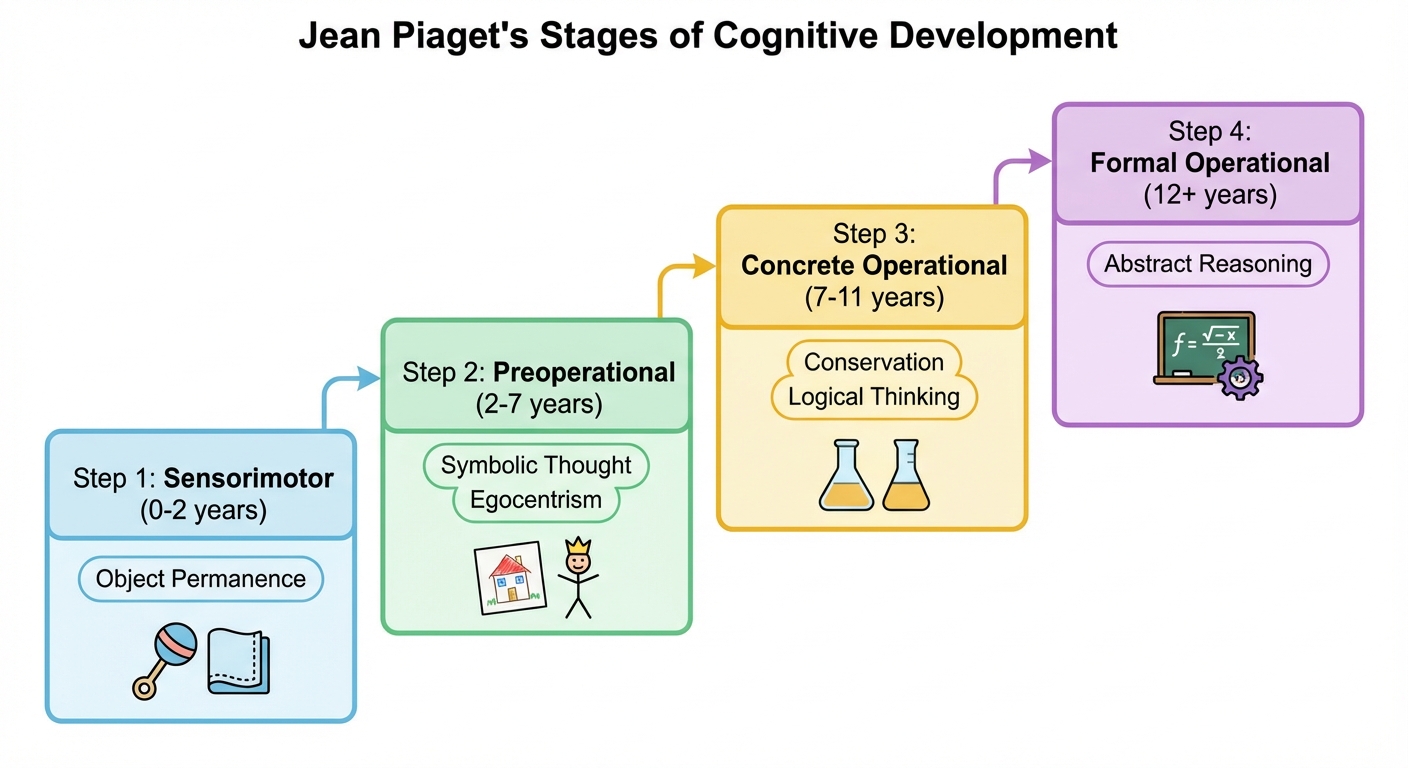
1. Sensorimotor Stage (Birth–2 Years)
- Experiencing the world through senses and actions.
- Key Milestone: Object Permanence (awareness that things continue to exist even when not perceived), typically develops around 8 months.
2. Preoperational Stage (2–7 Years)
- Representing things with words and images (symbolic thinking) but lacking logical reasoning.
- Egocentrism: Difficulty taking another’s point of view.
- Animism: Belief that inanimate objects have feelings.
- Theory of Mind: People's ideas about their own and others' mental states (starts developing here).
3. Concrete Operational Stage (7–11 Years)
- Thinking logically about concrete events.
- Conservation: Understanding that mass, volume, and number remain the same despite changes in forms (e.g., pouring liquid into a tall, thin glass does not change the amount).
- Reversibility: The ability to mentally reverse an operation.
4. Formal Operational Stage (12+ Years)
- Abstract reasoning and hypothetical thinking.
Vygotsky’s Sociocultural Theory
Unlike Piaget, Lev Vygotsky emphasized how culture and social interaction guide cognitive development.
- Zone of Proximal Development (ZPD): The gap between what a child can do alone and what they can do with help.
- Scaffolding: Temporary support that is tailored to a learner’s needs and abilities and aimed at helping the learner master the next task in a given learning process.
Cognitive Changes in Adulthood
- Fluid Intelligence: Our ability to reason speedily and abstractly; tends to decrease during late adulthood.
- Crystallized Intelligence: Our accumulated knowledge and verbal skills; tends to increase with age.
Social & Emotional Development
Attachment Theory
Attachment is an emotional tie with another person.
Harry Harlow’s Monkeys: Demonstrated that attachment is based on contact comfort (warmth/softness) rather than nourishment. Infant monkeys preferred the cloth mother over the wire mother with food.
Konrad Lorenz & Imprinting: The process by which certain animals form strong attachments during an early-life critical period (e.g., ducks following the first moving object).
Mary Ainsworth’s Strange Situation: A procedure to study attachment styles by observing infants' reactions to the mother leaving and returning.
- Secure Attachment: Distress when mother leaves, seeking contact when she returns. Associated with sensitive, responsive parenting.
- Insecure-Avoidant: Little distress when mom leaves, ignores her upon return.
- Insecure-Anxious/Ambivalent: Intense distress when leaving, resists contact or is angry upon return.
Parenting Styles (Diana Baumrind)
| Style | Description | Typical Outcome in Children |
|---|---|---|
| Authoritarian | Impose rules and expect obedience ("Because I said so"). Low warmth, High control. | Less social skill, lower self-esteem. |
| Permissive | Submit to children’s desires; make few demands and use little punishment. High warmth, Low control. | More aggressive, immature. |
| Authoritative | Both demanding and responsive. Set rules but explain reasons and encourage discussion. | High self-esteem, self-reliance, and social competence. (Ideal) |
| Negligent | Uninvolved; neither demanding nor responsive. | Poor academic and social outcomes. |
Erikson’s Psychosocial Stages
Erik Erikson proposed that each stage of life has its own psychosocial task, a crisis that needs resolution.
- Trust vs. Mistrust (Infancy): Needs met comfortably = trust.
- Autonomy vs. Shame/Doubt (Toddler): Exercise will/do things for self.
- Initiative vs. Guilt (Preschool): Initiate tasks and carry out plans.
- Industry vs. Inferiority (School Age): Joy in applying oneself to tasks.
- Identity vs. Role Confusion (Adolescence): Refining a sense of self. Key crisis for teenagers.
- Intimacy vs. Isolation (Young Adult): Forming close relationships.
- Generativity vs. Stagnation (Middle Adult): Contributing to the world/family.
- Integrity vs. Despair (Late Adult): Reflection on life.
Moral Development
Lawrence Kohlberg’s Levels of Moral Thinking
Kohlberg assessed moral reasoning by posing hypothetical moral dilemmas (e.g., the Heinz Dilemma).
- Preconventional Morality (Before age 9): Self-interest; obey rules to avoid punishment or gain concrete rewards.
- Conventional Morality (Early adolescence): Uphold laws and rules to gain social approval or maintain social order.
- Postconventional Morality (Adolescence and beyond): Actions reflect belief in basic rights and self-defined ethical principles.
Carol Gilligan’s Critique: Criticized Kohlberg for studying only boys. She argued women focus more on caring and relationships ethics rather than abstract justice.
Learning Theories: Classical Conditioning
Learning is a relatively permanent change in an organism's behavior due to experience.
Pavlov & The Basics
Classical Conditioning is a type of learning where an organism comes to associate stimuli. (Ivan Pavlov).
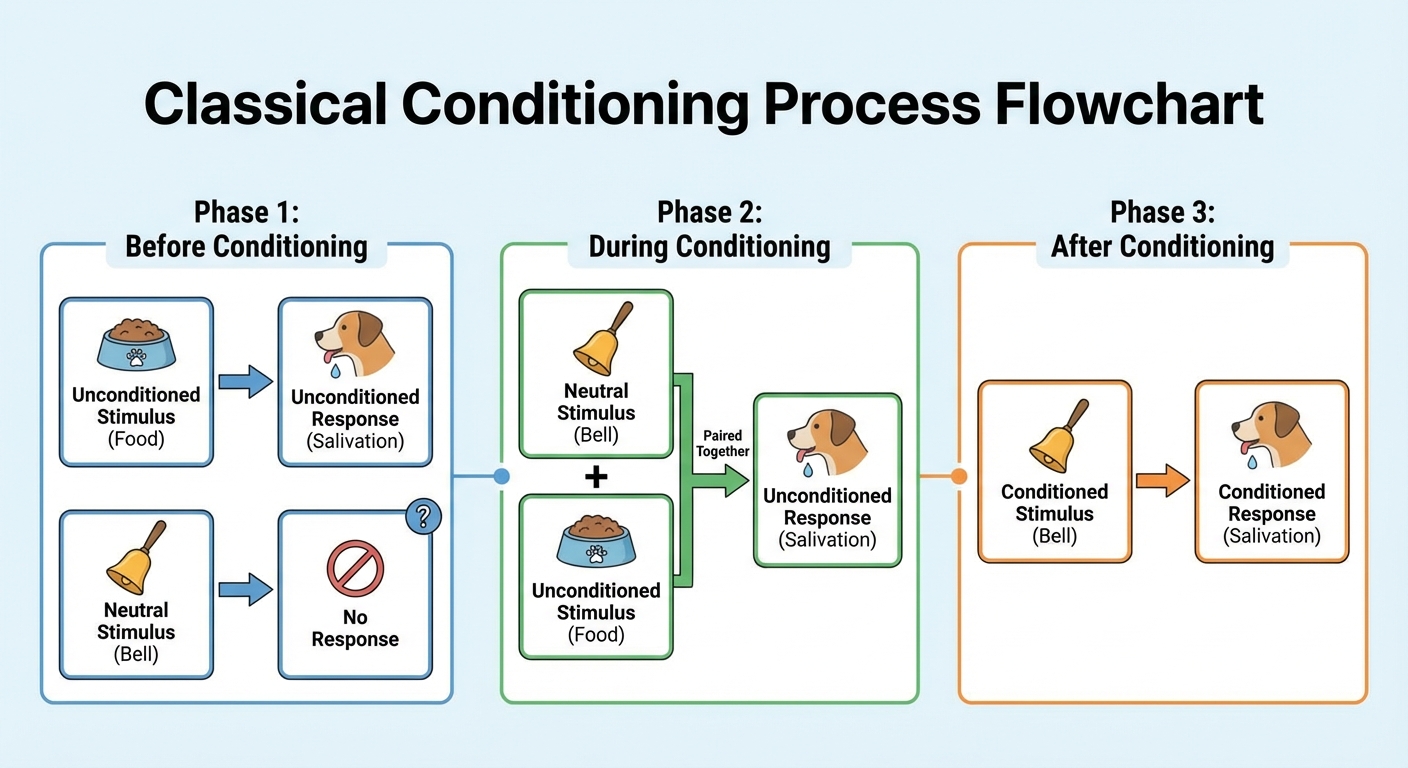
- Unconditioned Stimulus (US): A stimulus that naturally triggers a response (e.g., Food).
- Unconditioned Response (UR): An unlearned, natural response to the US (e.g., Salivation).
- Neutral Stimulus (NS): A stimulus that elicits no response before conditioning (e.g., Bell).
- Conditioned Stimulus (CS): An originally neutral stimulus that, after association with a US, triggers a response (e.g., Bell becomes CS).
- Conditioned Response (CR): The learned response to a previously neutral CS (e.g., Salivation to the bell).
Key Principles
- Acquisition: The initial stage where the link is established (NS + US).
- Extinction: The diminishing of a CR; occurs when the US does not follow the CS.
- Spontaneous Recovery: The reappearance, after a pause, of an extinguished CR.
- Generalization: The tendency to respond to stimuli similar to the CS (e.g., fearing all furry white objects, not just the rat—seen in the Little Albert Experiment by Watson).
- Discrimination: The learned ability to distinguish between a CS and other irrelevant stimuli.
Biological Constraints
- Taste Aversion (Garcia Effect): John Garcia showed that rats could learn to avoid a taste (CS) if it induced nausea (UR) hours later. This defies the idea that conditioning requires immediate timing, showing biological predisposition to associate taste with sickness for survival.
Learning Theories: Operant Conditioning
Operant Conditioning creates an association between behavior and consequence (reward or punishment). Associated with B.F. Skinner and Edward Thorndike (Law of Effect).
Reinforcement vs. Punishment
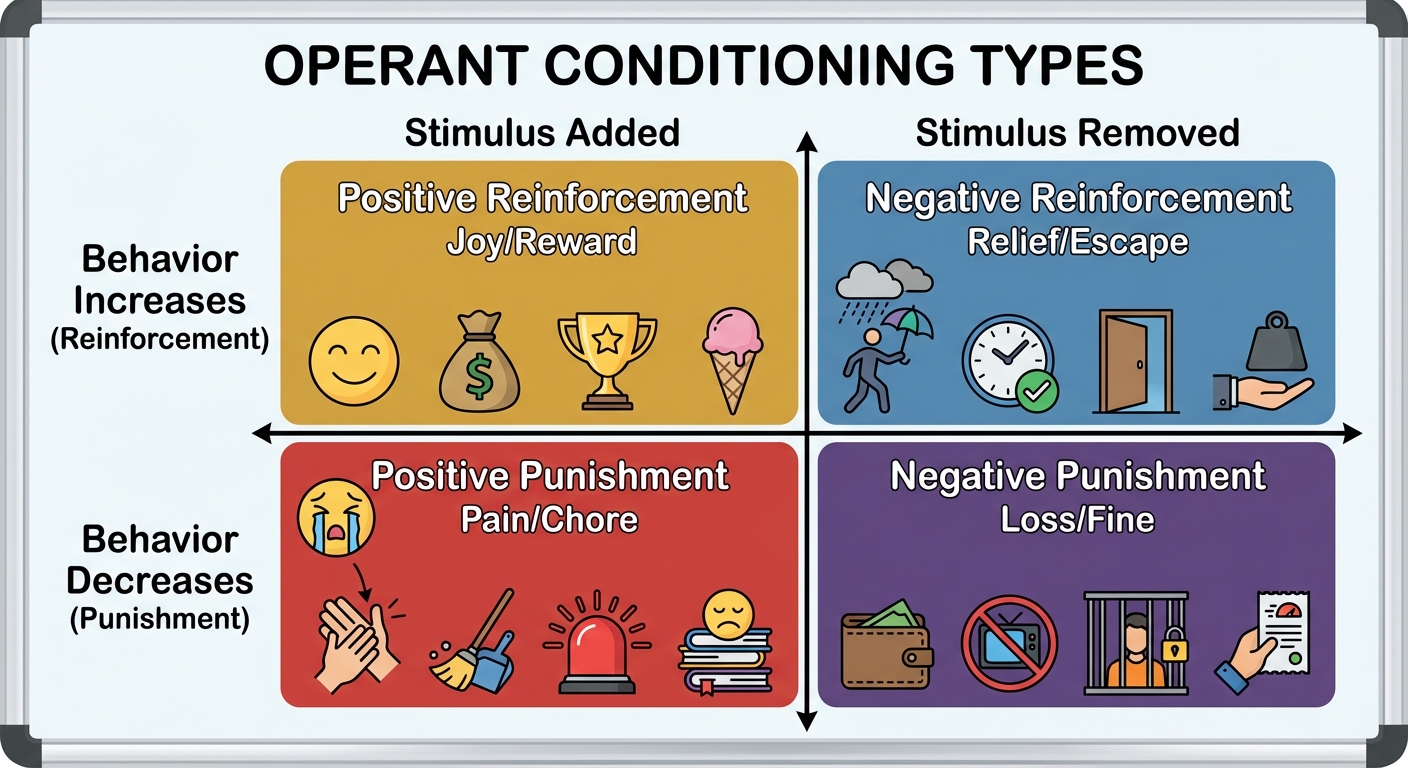
Reinforcement INCREASES behavior.
- Positive Reinforcement: Adding a desirable stimulus (e.g., giving a dog a treat).
- Negative Reinforcement: Removing an aversive stimulus (e.g., fastening a seatbelt to stop the annoying beeping).
Punishment DECREASES behavior.
- Positive Punishment: Adding an aversive stimulus (e.g., spanking, giving a speeding ticket).
- Negative Punishment: Removing a desirable stimulus (e.g., taking away the phone, time-out).
Schedules of Reinforcement
How often is the behavior reinforced? This affects how fast learning happens and how resistant it is to extinction.
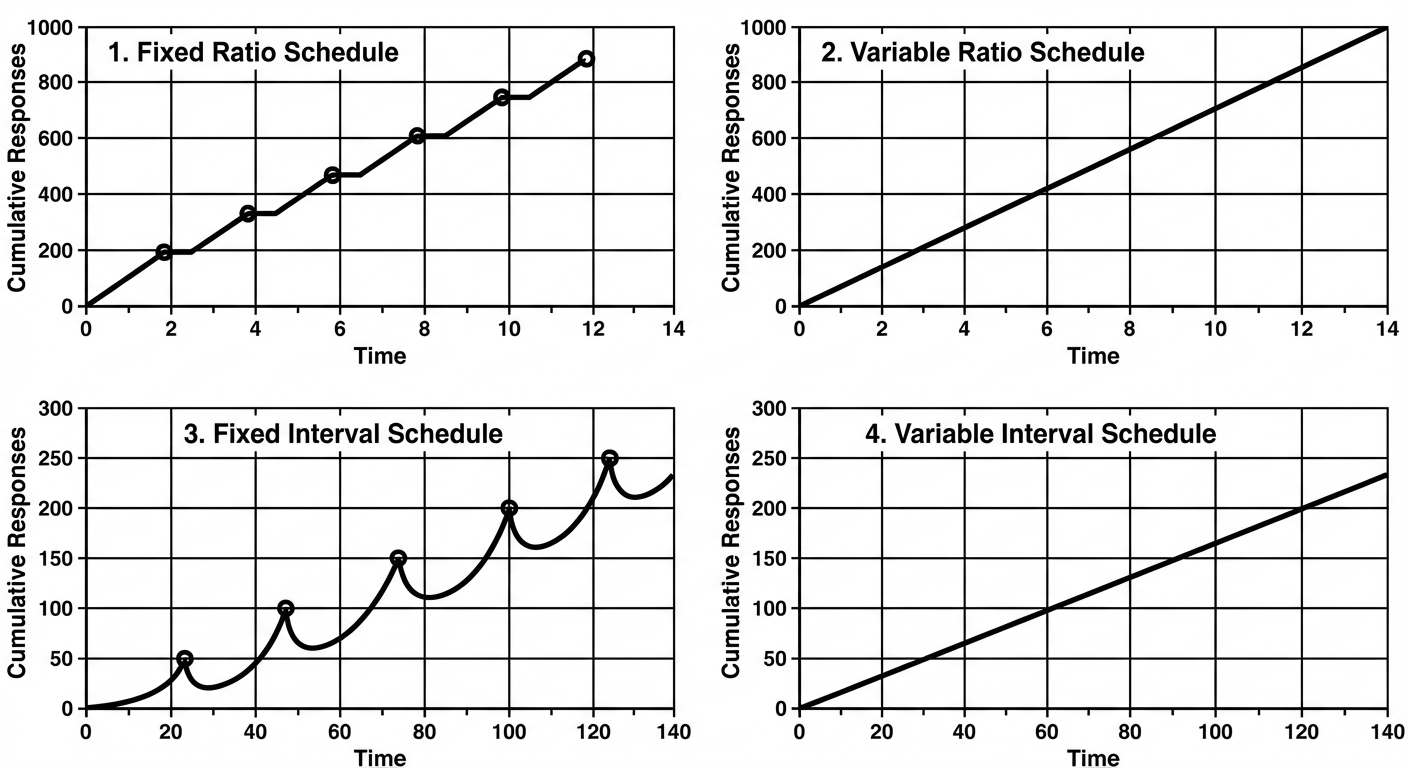
- Fixed-Ratio (FR): Reinforces a response only after a specified number of responses (e.g., Buy 10 coffees, get 1 free). High response rate.
- Variable-Ratio (VR): Reinforces a response after an unpredictable number of responses (e.g., Slot machines). Most resistant to extinction.
- Fixed-Interval (FI): Reinforces a response only after a specified time has elapsed (e.g., Paycheck every 2 weeks). Choppy response pattern (scalloped).
- Variable-Interval (VI): Reinforces a response at unpredictable time intervals (e.g., Fishing, checking email). Slow, steady responding.
Social & Cognitive Factors in Learning
Observational Learning
Learning by observing others (Social Learning Theory).
- Albert Bandura & The Bobo Doll Experiment: Children observed adults hitting a doll and mimicked the aggression.
- Modeling: The process of observing and imitating a specific behavior.
- Mirror Neurons: Frontal lobe neurons that fire when performing certain actions or when observing another doing so. The brain's mirroring of another's action may enable imitation and empathy.
- Prosocial Behavior: Positive, constructive, helpful behavior (opposite of antisocial behavior).
Cognitive Learning
- Latent Learning (Tolman): Learning that occurs but is not apparent until there is an incentive to demonstrate it (e.g., rats creating a "cognitive map" of a maze without reward).
- Insight Learning (Köhler): A sudden realization of a problem's solution (the "Aha!" moment), practiced by chimps reaching for bananas.
- Learned Helplessness (Seligman): The hopelessness and passive resignation an animal or human learns when unable to avoid repeated aversive events.
- Locus of Control (Rotter):
- Internal: You control your own fate.
- External: Chance or outside forces determine your fate.
Common Mistakes & Pitfalls
- Negative Reinforcement vs. Punishment: This is the #1 mistake. Remember: Reinforcement always makes a behavior happen MORE. Punishment makes it happen LESS. Negative Reinforcement is "relief" (taking away pain), not inflicting pain.
- Imprinting vs. Attachment: Imprinting happens mainly in birds and is irreversible during a critical period. Humans form attachment, which is flexible and develops over months.
- Fluid vs. Crystallized Intelligence: Don't swap them. Fluid flows (speed, abstract) and dries up with age. Crystallized is like a crystal (solid, accumulated knowledge) that grows.
- Authoritative vs. Authoritarian: "Authoritarian" is like a libraryan (quiet, strict, rules). "Authoritative" is supportive (give and take).
- Role Confusion: Often confused with "Identity Crisis". In Erikson's stage, if you don't find your Identity, you fall into Role Confusion (not knowing where you fit in society).
- Ratio vs. Interval: Ratio = Number (counting responses). Interval = Time (watching the clock). If the reward depends on you doing it a bunch of times, it's Ratio. If it depends on waiting five minutes, it's Interval.