AP Statistics Unit 4: Mastering Probability Rules
Estimating Probabilities Using Simulation
Before diving into theoretical formulas, it is crucial to understand that probability describes the long-term relative frequency of an event. When theoretical probability is difficult to calculate, we estimate it using simulation.
The Law of Large Numbers
This law states that as the number of repetitions of a chance process increases, the proportion of times that a specific outcome occurs approaches its true probability.
- Short-run: Random and unpredictable.
- Long-run: Predictable patterns emerge.
Steps for a Simulation (The 4-Step Process)
To receive full credit on AP Exam FRQs regarding simulation, you must explicitly describe the correspondence between random numbers and outcomes.
- State (the question): Ask a question about the probability of a chance process.
- Plan: Describe how to use a chance device (random number generator, table of random digits) to imitate one repetition of the process.
- Assign: Explicitly state which numbers represent a "Success" and which represent a "Failure." Mention if repeats are ignored (sampling without replacement).
- Stop: State when a single trial ends.
- Do: Perform many repetitions of the simulation.
- Conclude: Use the results of your simulation to estimate the probability.
Example: The Cereal Box Problem
Suppose a toy is inside 20% of cereal boxes. You want to know the probability of finding a toy within the first 3 boxes.
- Digits 0-1: Toy found.
- Digits 2-9: No toy.
- Trial: Look at 3 distinct two-digit numbers (or single digits if independent).
- Success: Reading a 0 or 1 in the sequence.
Mutually Exclusive Events and the Addition Rule
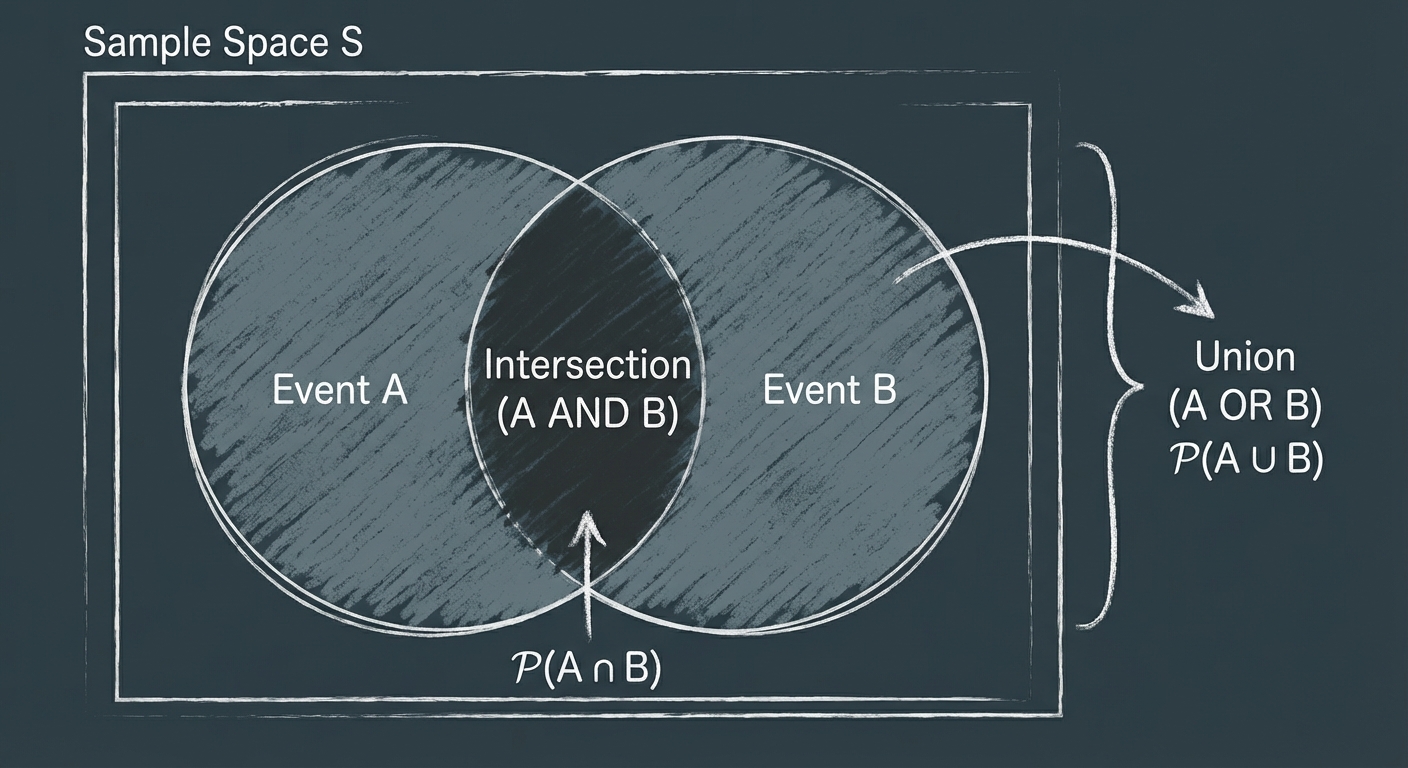
When dealing with the probability of Event A OR Event B, we look at the union of events.
Mutually Exclusive (Disjoint) Events
Two events are mutually exclusive (or disjoint) if they represent outcomes that cannot occur at the same time. They have no common outcomes.
- Notation: $P(A \cap B) = 0$
- Visual: Two circles in a Venn Diagram that do not touch or overlap.
The General Addition Rule
To find the probability that at least one of two events occurs, use the General Addition Rule. This works for both disjoint and non-disjoint events.
- $P(A \cup B)$: Probability of A OR B (Union).
- $P(A \cap B)$: Probability of A AND B (Intersection).
Why subtract the intersection?
When you add $P(A)$ and $P(B)$, you count the outcomes where both happen twice (the overlap). You must subtract the intersection once to fix this double-counting.
Example
In a class, 40% of students take Calculus ($C$), 30% take Physics ($P$), and 10% take both.
So, 60% of students take Calculus or Physics.
Conditional Probability and Independence
Conditional probability restricts the sample space to a specific subset of outcomes.
Determining Conditional Probability
We denote "Probability of A given B" as $P(A|B)$.
The Formula:
- Numerator: The probability that both happen.
- Denominator: The probability of the condition (the "given" event).
Independent Events
Two events are independent if the occurrence of one event does not change the probability that the other event will happen. This is a binary properties concept: events are either independent or dependent.
Test for Independence
To check if events A and B are independent, verify if either of these equations is true (if one is true, both are true):
- $P(A|B) = P(A)$
- $P(B|A) = P(B)$
Translated: "Knowing B happened didn't change the likelihood of A happening."
Crucial Concept: Disjoint $\neq$ Independent
This is a major conceptual trap.
- Disjoint Events are ALWAYS Dependent. If Event A happens, Event B cannot happen. Knowing A occurred gives you perfect information about B (probability becomes 0).
- Independent Events can generally occur together (unless one has 0 probability).
The Multiplication Rule
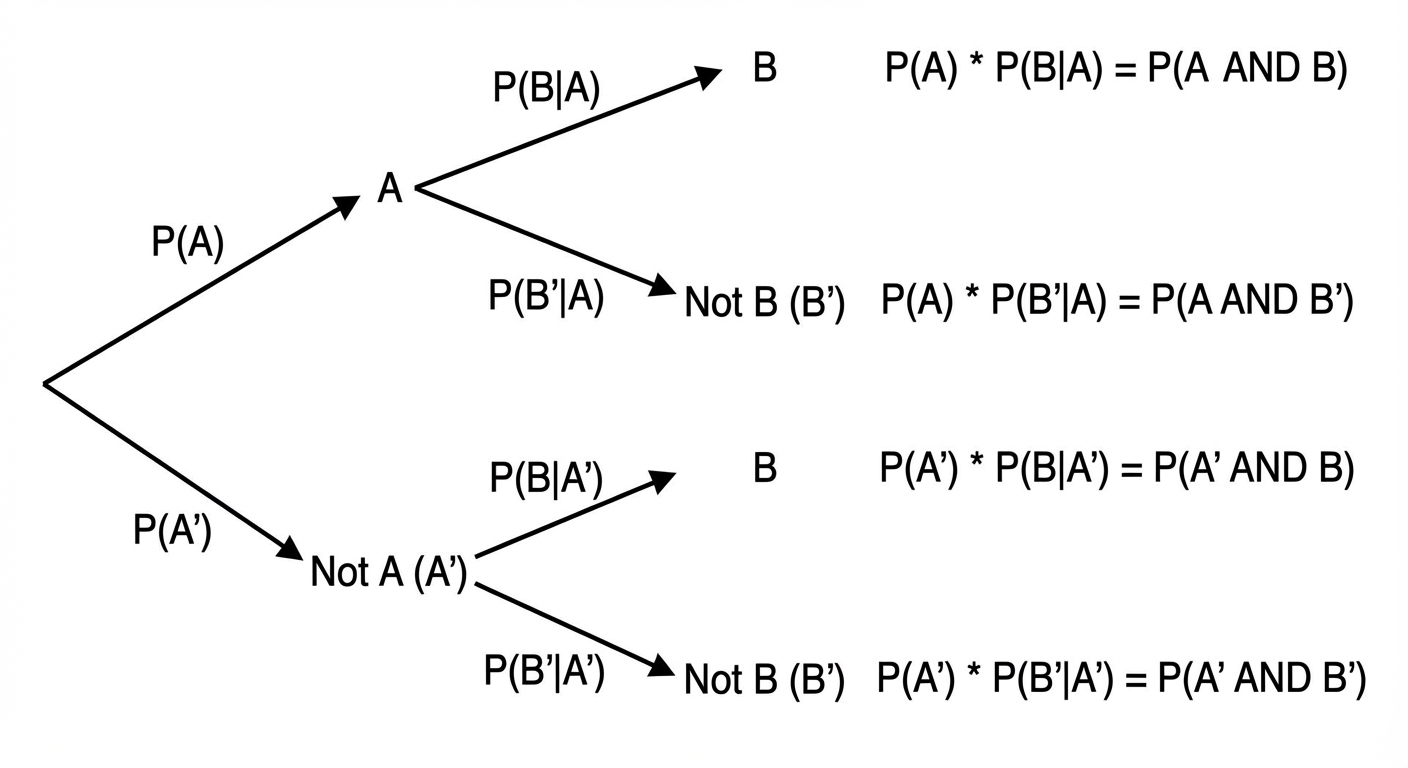
When dealing with the probability of Event A AND Event B occurring in sequence, we use the multiplication rule.
The General Multiplication Rule
Derived from the conditional probability formula, this applies to all events:
- Use this when selection is done without replacement (the second probability changes based on the first outcome).
Multiplication Rule for Independent Events
If (and only if) A and B are independent, $P(B|A) = P(B)$, so the formula simplifies to:
Tree Diagrams
Tree diagrams are excellent tools for visualizing the multiplication rule, especially for multi-stage experiments.
- Branches emanating from the same node must sum to 1.
- Multiply probabilities along the branches to find the probability of the final intersection.
The "At Least One" Rule
Calculating the probability of "at least one success" directly can be tedious (calculating 1 success + 2 successes + 3 successes…). Instead, use the complement.
Example
A basketball player makes 80% of their free throws. What is the probability they make at least one of their next 3 shots? (Assume independence).
- $P(\text{Miss}) = 1 - 0.80 = 0.20$
- $P(\text{Miss All 3}) = 0.20 \cdot 0.20 \cdot 0.20 = 0.008$
- $P(\text{At least one Make}) = 1 - 0.008 = 0.992$
Summary of Notation
| Notation | Meaning | Keyword | Formula Rule |
|---|---|---|---|
| $P(A \cup B)$ | Union | OR | Addition Rule |
| $P(A \cap B)$ | Intersection | AND | Multiplication Rule |
| $P(A | B)$ | Conditional | GIVEN |
| $A^C$ | Complement | NOT | $1 - P(A)$ |
Common Mistakes & Pitfalls
- Adding Probabilities for Non-Disjoint Events: Students often calculate $P(A \cup B) = P(A) + P(B)$ without subtracting the overlap. Unless the text says "mutually exclusive," always assume there is an intersection.
- Confusing Mutually Exclusive with Independence:
- Mutually Exclusive: They cannot happen at the same time. (Picture: Separate circles).
- Independent: One doesn't affect the other. (Picture: Knowing A happened doesn't help you predict B).
- The "Given" Denominator: In conditional probability problems, the denominator is always the probability of the subgroup you are restricting to. If checking $P( ext{Red}|\text{Ace})$, the denominator is the total number of Aces, not the total deck.
- Misinterpreting "At Least One": Students sometimes think the opposite of "at least one" is "at least one failure." The complement of "at least one" is strictly "none."