Navigating the Fin de Siècle: Society, Culture, and Politics (1850–1914)
19th-Century Culture and Arts
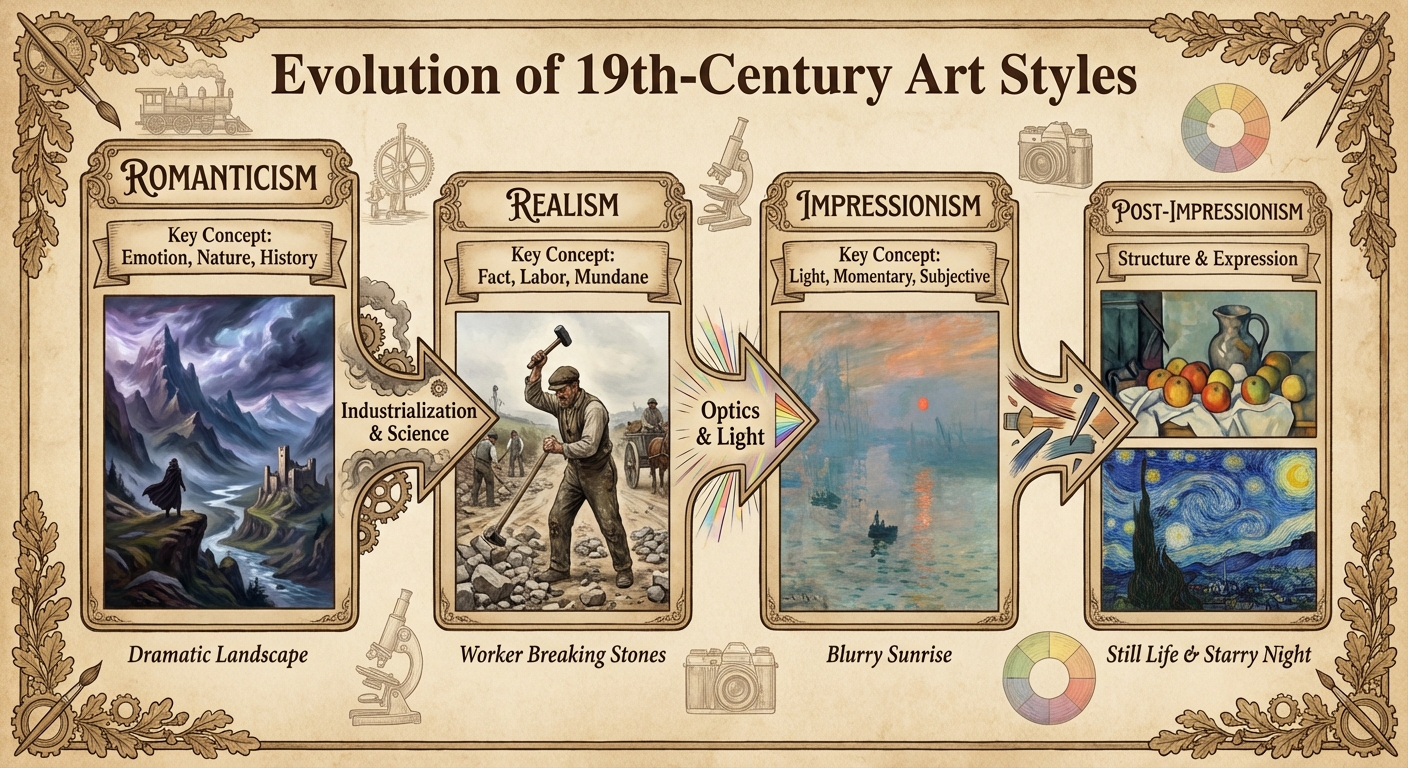
The cultural landscape of Europe shifted dramatically in the second half of the 19th century. As the Industrial Revolution matured and scientific rationalism took hold, the emotionalism of Romanticism gave way to movements that sought to depict the world as it truly was, and later, to movements that questioned the nature of reality itself.
The Shift to Realism
Realism was an artistic and literary movement that emerged in the 1850s, rejecting the idealization of Romanticism. It focused on the precise, objective depiction of the physical world and social problems.
- Influencing Factors: The rise of photography, the spread of industrialization, and the philosophy of Positivism (Auguste Comte), which argued that science and objective observation were the highest forms of knowledge.
- Key Characteristics:
- Depiction of ordinary people (peasants, workers) rather than heroes.
- Focus on the harsh realities of urban life and labor.
- Rejection of mythological or religious themes in favor of contemporary secular subjects.
Key Figures in Realism
| Field | Figure | Representative Work | Significance |
|---|---|---|---|
| Literature | Émile Zola | Germinal | Applied scientific determinism to characters; depicted the misery of coal miners. |
| Literature | Leo Tolstoy | War and Peace | Fatalistic view of history; realistic depiction of Russian society. |
| Art | Gustave Courbet | The Stone Breakers | Famous quote: "Show me an angel and I will paint one." Depicted mundane physical labor without glamour. |
| Art | Jean-François Millet | The Gleaners | Highlighted the poverty of rural life. |
Impressionism and Post-Impressionism
By the 1870s, artists began to move away from precise realism toward capturing the subjective experience of light and color.
Impressionism (c. 1870s–1880s):
- Focused on capturing a fleeing moment (impression) rather than a detailed study.
- Emphasis on light, visible brushstrokes, and painting outdoors (en plein air).
- Claude Monet (Impression, Sunrise) and Pierre-Auguste Renoir depicted middle-class leisure and urban scenes.
Post-Impressionism (c. 1880s–1890s):
- Retained the Impressionist emphasis on light but emphasized form, structure, and emotional content.
- Vincent van Gogh used color to express emotion (Starry Night).
- Paul Cézanne broke objects into geometric shapes, paving the way for Cubism (Picasso) and modern art.
New Scientific Perspectives
Science in this era undermined the certainty of the Newtonian universe and challenged traditional religious views.
- Charles Darwin & Evolution: In On the Origin of Species (1859), Darwin proposed Natural Selection. This theory was controversial as it challenged the biblical account of creation.
- Social Darwinism: Thinkers like Herbert Spencer (not Darwin himself) applied ideas of "survival of the fittest" to human society, justifying imperialism, racism, and economic inequality.
- Modern Physics: Marie Curie (radiation), Max Planck (Quantum Theory), and Albert Einstein (Theory of Relativity) shattered the belief that the universe was mechanically predictable.
- Sigmund Freud: Founded Psychoanalysis, suggesting human behavior is driven by the irrational unconscious (Id, Ego, Superego), challenging the Enlightenment view of humans as purely rational actors.
Social Reform and Urban Life
The second half of the 19th century saw governments and reformers attempting to address the chaos caused by rapid urbanization.
The Bacterial Revolution and Sanitation
Prior to the 1850s, the Miasmatic Theory (disease caused by bad odors) prevailed. The acceptance of the Germ Theory of Disease revolutionized public health.
- Louis Pasteur: Discovered bacteria caused disease; developed pasteurization.
- Joseph Lister: Developed the "antiseptic principle," sterilizing wounds and instruments, drastically reducing surgery mortality.
- Edwin Chadwick: British reformer who linked disease to filth; his report led to the Public Health Act of 1848, creating modern sewer and water systems.
Urban Planning: Redesigning Paris
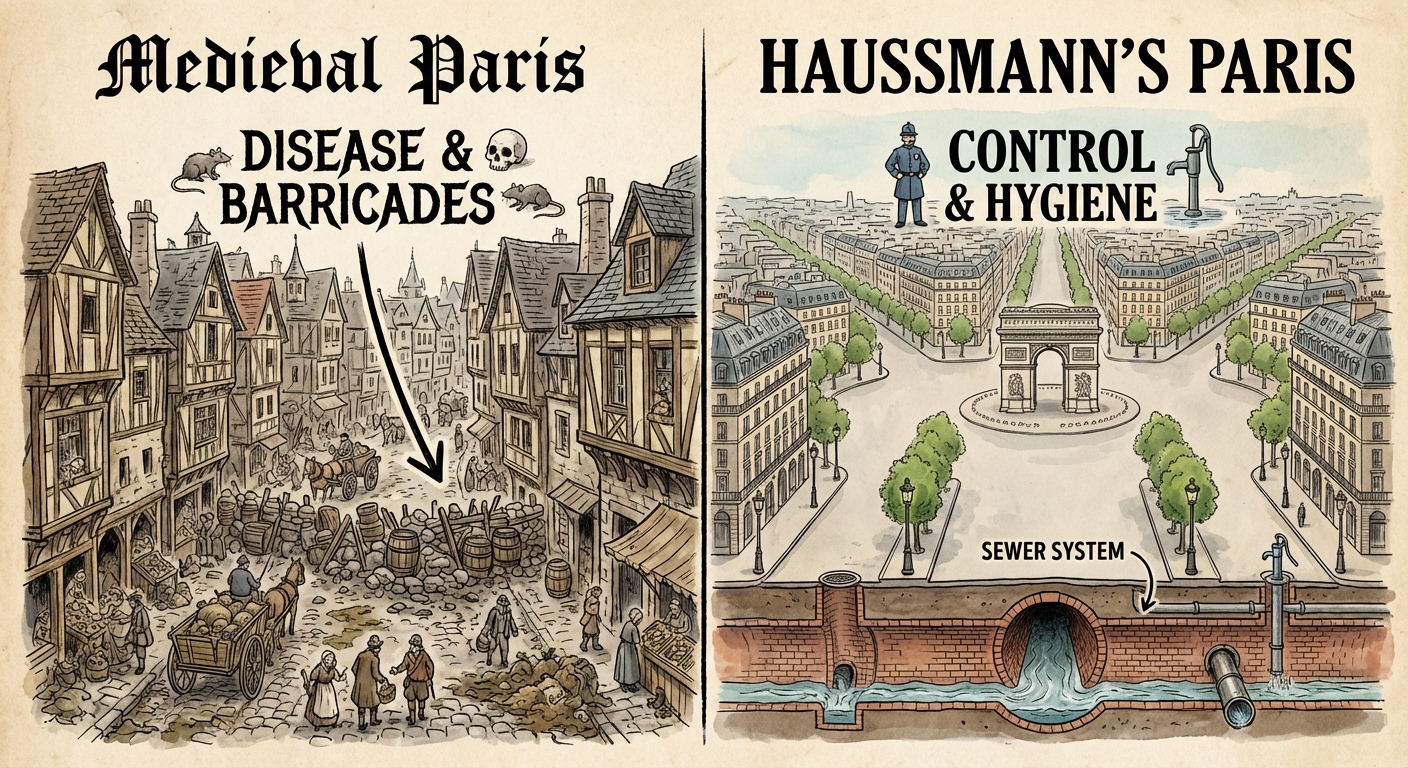
Napoleon III and his prefect Georges Haussmann undertook a massive rebuilding of Paris (1850s–1860s), setting the standard for modern urban planning.
- Objectives: Improve sanitation, ease traffic flow, and prevent street barricades (making revolutions harder).
- Features: Wide boulevards, public parks, demolition of slums, and construction of aqueducts/sewers.
The Feminist Movement
Women remained second-class citizens legally but began to mobilize for rights, particularly the right to vote (Suffrage).
- Legal Status: Married women gained property rights (e.g., Britain's 1882 law), but were largely excluded from higher education and politics.
- Suffragists: Middle-class women led by Millicent Fawcett who advocated for peaceable, constitutional change.
- Suffragettes: Led by Emmeline Pankhurst and the WSPU (Women's Social and Political Union). They used militant tactics (hunger strikes, arson, egging officials) under the motto "Deeds, not words."
Mass Politics and Political Parties
Between 1871 and 1914, the political landscape transformed into Mass Politics: universal male suffrage, mass political parties, and state-sponsored welfare.
Characteristics of Mass Politics
- Expanded Suffrage: By 1914, most Western European nations had universal manhood suffrage.
- Mass Media: Cheap newspapers and literacy spread political ideas rapidly.
- Government Responsiveness: Governments (even conservative ones) had to appeal to the masses to maintain legitimacy.
Political Parties and Ideologies
1. Liberalism (Review)
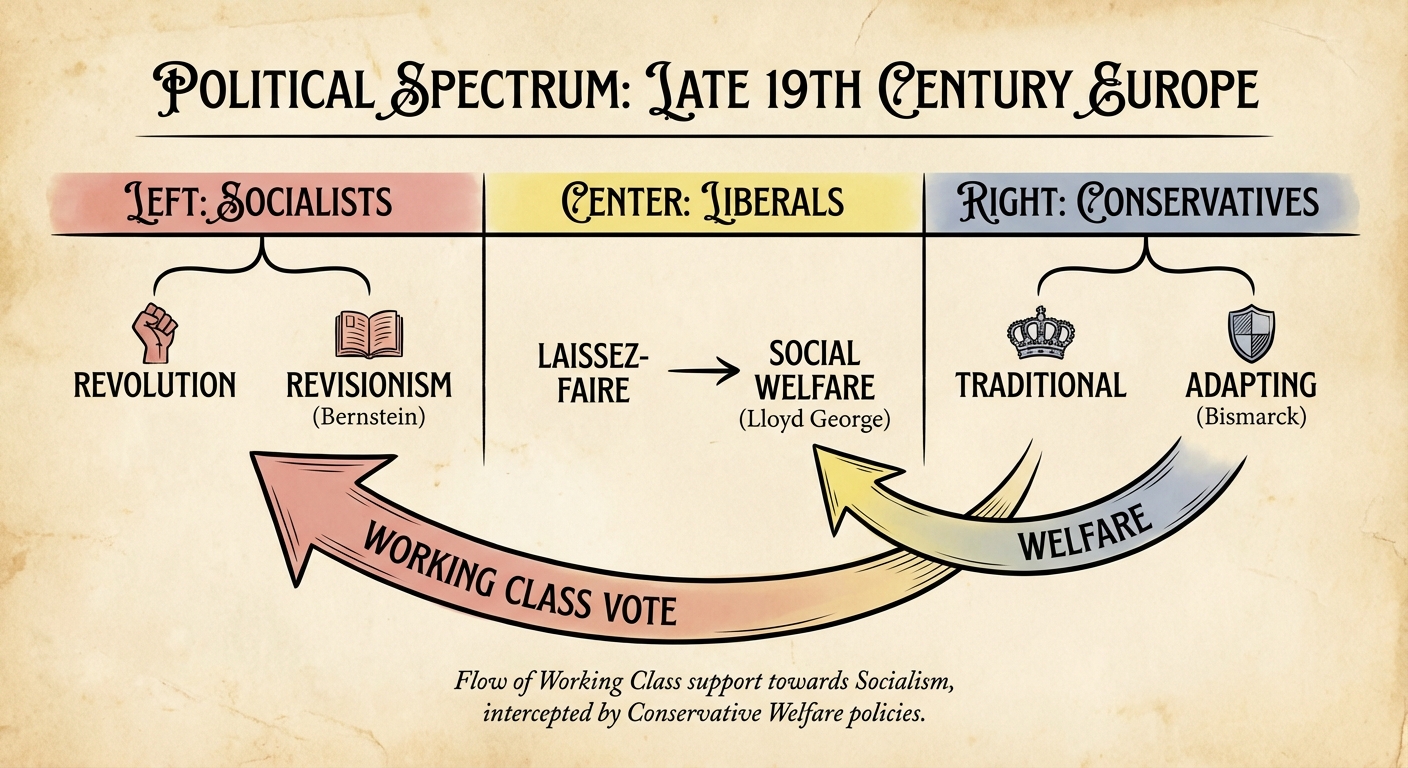
Originally favored laissez-faire economics. In Britain, the Liberal Party (under David Lloyd George) shifted toward the "People's Budget" (1909), raising taxes on the rich to fund social welfare programs (National Insurance Act of 1911).
2. Conservatism (Review)
Conservatives adapted to survive. They often co-opted nationalist or socialist ideas.
- Example: Otto von Bismarck (Germany) attacked the Catholic Church (Kulturkampf) but then switched focus to attacking Socialists. To wean workers away from socialism, he enacted the first social welfare state (State socialism), providing old-age pensions and accident insurance.
3. Socialism and Labor Unions
Socialist parties grew rapidly. The German Social Democratic Party (SPD) became the largest party in the Reichstag by 1912.
- The Revisionist Debate:
- Classic Marxism: Revolution is inevitable and necessary.
- Revisionism (Eduard Bernstein): Argued in Evolutionary Socialism that Marx's predictions of capitalist collapse were wrong. Workers should use democratic means (voting/unions) to achieve gradual gains.
Case Study: The Dreyfus Affair (France)
A Jewish captain, Alfred Dreyfus, was falsely accused of treason. The affair divided the Third Republic:
- Anti-Dreyfusards: The Army, Catholic Church, and Conservatives (anti-Semitic, nationalist).
- Dreyfusards: Liberals, Socialists, Republicans (defenders of justice and secularism).
- Result: Dreyfus was exonerated. The result was a victory for the Republic and led to the strict separation of Church and State in France (1905).
Memory Aids & Mnemonics
- "REAL people do REAL work": Helps remember Realism focused on the working class (Courbet/Millet), unlike the heroes of Romanticism.
- "Pasteur Puts Pests to Pasture": Louis Pasteur discovered the Germ Theory (bacteria/pests).
- "Bismarck's Carrot and Stick": The Stick was the Anti-Socialist Laws; the Carrot was state-sponsored social welfare to keep workers happy.
Common Mistakes & Pitfalls
- Confusing Social Darwinism with Darwin:
Darwin was a biologist; he did not apply his theories to sociology. Herbert Spencer is the father of Social Darwinism. Do not attribute racist/imperialist ideology to Darwin himself on an exam. - Universal Suffrage Misconception:
When texts say "Universal Suffrage" in the late 19th century, they almost always mean Universal Male Suffrage. Women generally did not get the vote until after WWI (1918/1920) in most countries. - The Nature of Impressionism:
Students often think Impressionism was just "messy painting." It was actually a highly technical study of the physics of light and optics. It was scientific in its own way! - Conservative vs. Liberal Roles:
Don't assume Conservatives always cut spending. In the late 19th Century, Conservatives (like Bismarck) often expanded government spending on welfare to stop the spread of revolutionary Socialism.