Industrialization and Global Economic Development
Unit 7: Industrial and Economic Development Patterns and Processes
7.1 The Industrial Revolution
The Industrial Revolution was not a single event, but a series of improvements in industrial technology that transformed the process of manufacturing goods. It represents a fundamental shift from cottage industries (home-based manufacturing) to factories.
Origins and Diffusion
- Hearth: Began in Great Britain in the mid-to-late 18th century (approx. 1750s).
- Why Britain?
- Availability of natural resources (Coal for energy, Iron Ore for machinery).
- Water power (rivers) for early textile mills.
- Ports and waterways for transportation.
- A stable government and banking system ready to invest.
- Key Inventions:
- Steam Engine (James Watt): Allowed factories to move away from riverbanks and locate near coal fields; revolutionized transportation (trains/ships).
- Textiles: The first industry to industrialize (Spinning Jenny, Power Loom).
- Diffusion: Spread from Britain to Western Europe (Rhine-Ruhr Valley), then to North America (New England), and later to Eastern Europe and Asia (Japan, Russia).
Social and Economic Impacts
- Urbanization: Mass migration from rural farms to factory cities (enclosure movement).
- Class Structure: Emergence of the industrial working class (proletariat) and the bourgeoisie (owners).
- Standard of Living: Increased availability of goods and food (Second Agricultural Revolution occurred concurrently), population variation (Stage 2 of DTM), but initially poor working conditions.
- Colonialism: European powers needed raw materials and markets, fueling the "New Imperialism" of the late 19th century.
7.2 Economic Sectors and Patterns
Economies are classified by the dominant activity of their workforce. As countries develop, the workforce shifts from primary to tertiary+ activities.
The Five Sectors
- Primary Sector (Extraction): extracting materials from the earth.
- Examples: Agriculture, mining, fishing, forestry.
- Dominance: LDCs (Least Developed Countries) and Periphery nations.
- Secondary Sector (Processing): turning raw materials into finished products.
- Examples: Manufacturing, assembly, construction, energy production.
- Dominance: NICs (Newly Industrialized Countries) and Semi-Periphery nations (e.g., Vietnam, Mexico, China).
- Tertiary Sector (Services): providing goods and services to people in exchange for payment.
- Examples: Retail, transportation, restaurants, tourism, basic clerical work.
- Dominance: MDCs (More Developed Countries) and Core nations.
- Quaternary Sector (Knowledge): research, information processing, and management of information.
- Examples: Finance, insurance, real estate (FIRE), software development, consultancy.
- Quinary Sector (Decision Making): highest-level decision making and specialized services.
- Examples: Top government officials, CEOs, research scientists, healthcare executives.
Labor Trends
- Deindustrialization: MDCs have seen a decline in secondary sector jobs due to automation and outsourcing, causing a shift to a service-based economy.
- Women in Development: In LDCs, women are heavily involved in agriculture. In NICs, women are often the primary labor force in textile factories (maquiladoras). In MDCs, women are increasingly entering the technical and professional workforce, though the Gender Pay Gap persists.
7.3 Theories of Industrial Location
Companies choose locations to maximize profit by minimizing costs. The two main costs are Site Factors (land, labor, capital) and Situation Factors (transportation).
Weber’s Least Cost Theory
Alfred Weber (1909) developed a model to predict the location of a manufacturing plant based on three factors, ranked by importance:
- Transportation Costs (Most important)
- Labor Costs
- Agglomeration (Clustering benefits)
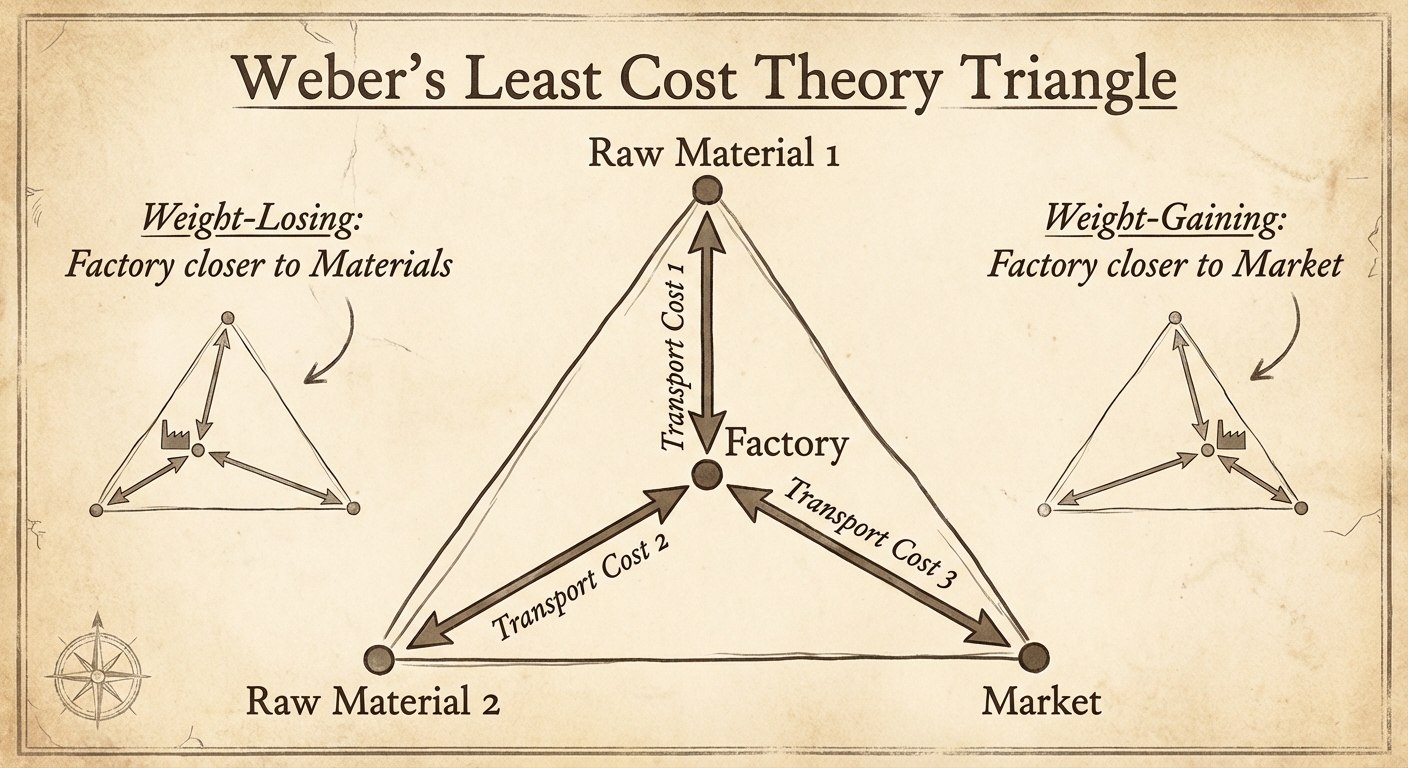
Situation Factors: Bulk-Gaining vs. Bulk-Reducing
- Bulk-Reducing Industry (Weight-Losing): The inputs weigh more than the final product.
- Location: Near the source of raw materials.
- Example: Copper smelting, ethanol production, lumber mills.
- Bulk-Gaining Industry (Weight-Gaining): The product gains volume, weight, or fragility during production.
- Location: Near the market.
- Example: Soft drink bottling (adding water), auto assembly, bakeries.
Other Location Concepts
- Break-of-Bulk Point: A location where transfer is possible from one mode of transportation to another (e.g., a port where cargo moves from ship to truck). Manufacturing often clusters here to save costs.
- Footloose Industry: An industry where the cost of transporting both raw materials and finished product is negligible (e.g., diamonds, computer chips). These firms can locate anywhere, usually focusing on labor or tax incentives.
- Agglomeration: The clustering of similar industries to share resources, talent, and infrastructure (e.g., Silicon Valley for tech, Dalton, GA for carpets).
- Deglomeration: Occurs when a cluster becomes too crowded/expensive, pushing firms to leave.
7.4 Measures of Development
Development is uneven. Geographers use various metrics to compare standards of living and economic health.
Economic Indicators
- GDP (Gross Domestic Product): Total value of goods/services produced within a country.
- GNI (Gross National Income): GDP + income earned by citizens working abroad.
- Per Capita: Dividing these values by the total population reveals the average wealth per person, though it hides inequality.
- Sectoral Structure: The percentage of the workforce in primary/secondary/tertiary sectors.
- Use of Fossil Fuels: Higher development usually correlates with higher energy consumption per capita.
Social and Demographic Indicators
- HDI (Human Development Index): Created by the UN. A score from 0.0 to 1.0 based on:
- Decent Standard of Living (GNI per capita)
- Long and Healthy Life (Life expectancy)
- Access to Knowledge (Mean and expected years of schooling)
- GII (Gender Inequality Index): Measures the gender gap. 0 = equality, 1 = high inequality. Based on reproductive health, empowerment (seats in gov), and labor market participation.
- Gini Coefficient: Measures income distribution (inequality). 0 = perfect equality, 100 = perfect inequality.
7.5 Theories of Development
Rostow’s Stages of Economic Growth (Modernization Model)
Walt Rostow (1960s) proposed that all countries pass through five linear stages of development. It is a capitalist, Western-centric model.
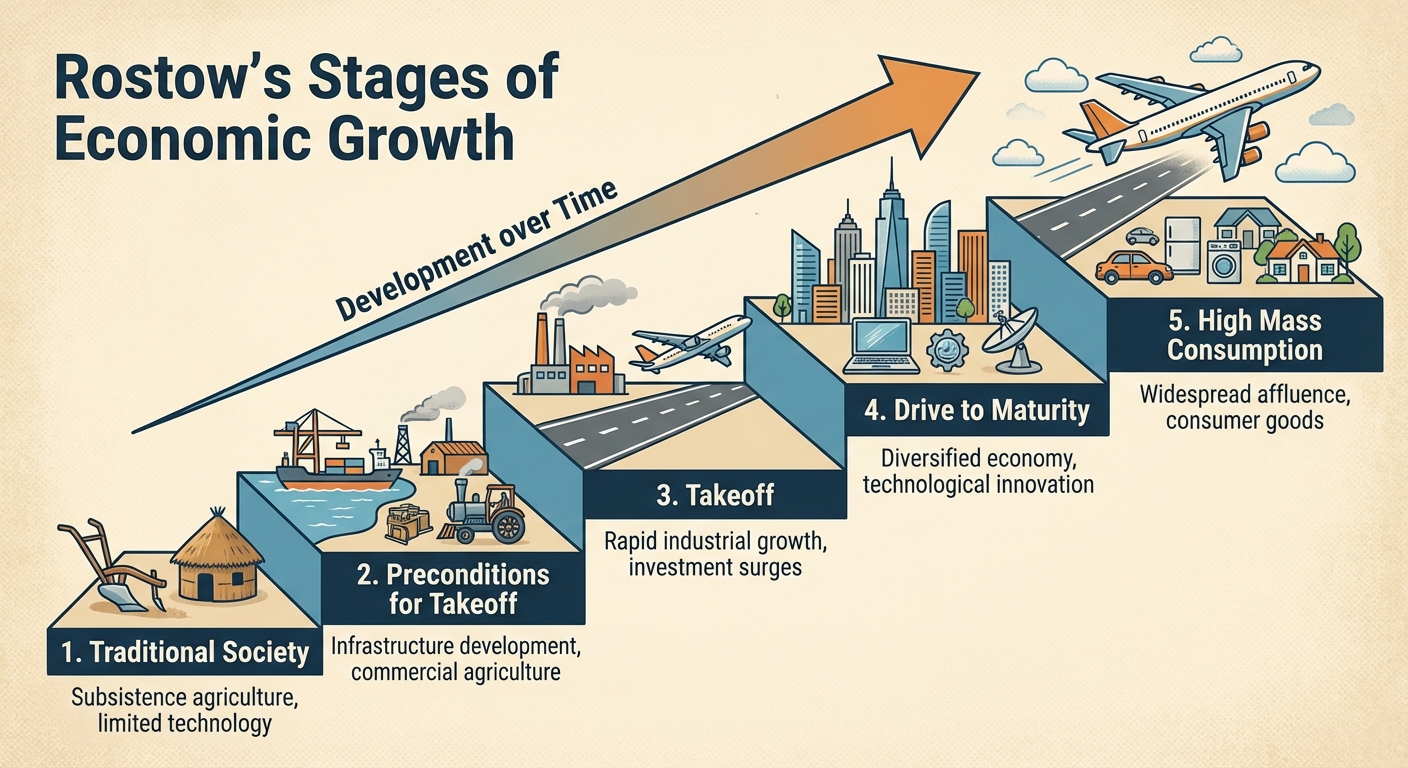
- Traditional Society: Subsistence farming, rigid social structure, limited tech.
- Preconditions for Takeoff: Elite group initiates investment in infrastructure (roads, water) and new technology.
- Takeoff: Rapid growth in a limited number of industrial sectors (textiles/food). Industrialization begins.
- Drive to Maturity: Modern technology diffuses to a wide variety of industries; workers become skilled.
- High Mass Consumption: Economy shifts to consumer goods (cars, electronics) and services.
Wallerstein’s World Systems Theory (Core-Periphery)
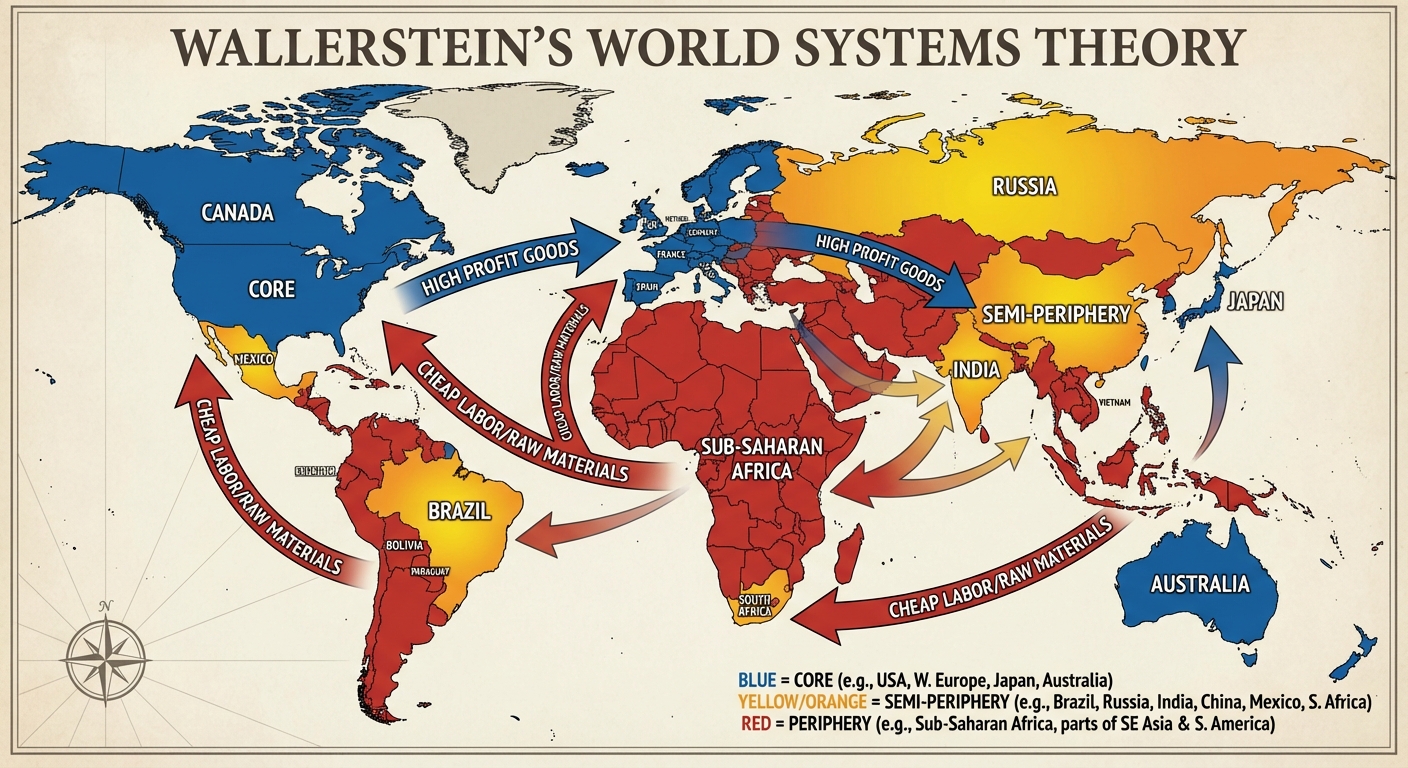
Immanuel Wallerstein (1970s) argued development is spatial and structural. The world is one interconnected capitalist economy with a three-tier structure.
- Core: High wages, high tech, high consumption. Exploit the periphery for cheap labor/materials. (e.g., USA, Japan, Germany).
- Periphery: Low wages, low education, extraction of raw materials. Dependent on the core. (e.g., DRC, Peru, Cambodia).
- Semi-Periphery: Manufacturing centers. Take from periphery, exploited by core. (e.g., Brazil, India, China, Mexico).
Dependency Theory
Argues that LDCs are poor because MDCs are rich. The colonial era established a system where colonies were dependent on the colonizer. Even after independence, Neocolonialism exists through corporate control and debt.
7.6 Trade and the Global Economy
Global Trade Agreements/Organizations
- Neoliberalism: Policies favoring free markets, privatization, and reduction of government control (tariffs).
- Supranational Organizations:
- WTO (World Trade Organization): Regulates international trade.
- EU (European Union): Free trade zone in Europe.
- USMCA (formerly NAFTA): Free trade between US, Mexico, and Canada.
- Mercosur: South American trading bloc.
- Tariffs: Taxes on imports. Free trade agreements aim to remove these to lower prices and increase efficiency.
Global Financial Crises
Interdependence means a crash in one region affects others.
- Asian Economic Crisis (1997): Started in Thailand, spread to the "Asian Tigers" (South Korea, Hong Kong, Taiwan, Singapore), causing devaluing of currencies.
- 2008 Recession: A US housing collapse impacted global banking systems.
Outsourcing and Economic Zones
- Outsourcing: Turning over production responsibilities to independent third-party suppliers (often abroad).
- Offshoring: Moving a company's own physical operations overseas.
- New International Division of Labor: The spatial shift of manufacturing industries from MDCs to LDCs/NICs.
- EPZ (Export Processing Zone): specific areas in LDCs offering tax breaks and weak labor laws to attract foreign investment.
- Maquiladoras: EPZs in Mexico near the US border. Foreign companies import parts duty-free, assemble them, and export back to the US.
- SEZ (Special Economic Zones): Specific areas in China (like Shenzhen) where capitalism was allowed to encourage FDI (Foreign Direct Investment), driving China's rapid manufacturing growth.
7.7 Changes in Industrial Production
Fordism vs. Post-Fordism
- Fordism: Mass production. One factory does everything (vertical integration). Assembly line. Low-skill, repetitive tasks. Inventory held in massive warehouses.
- Post-Fordism: Flexible production. Specialized teams, high-tech, and automation.
Just-in-Time Delivery
Instead of storing massive inventory (which costs money and space), parts arrive at the factory moments before they are needed.
- Risk: Supply chain disruptions (e.g., a strike, natural disaster, or pandemic) can shut down the entire production line instantly.
The Shift from Rust Belt to Sun Belt
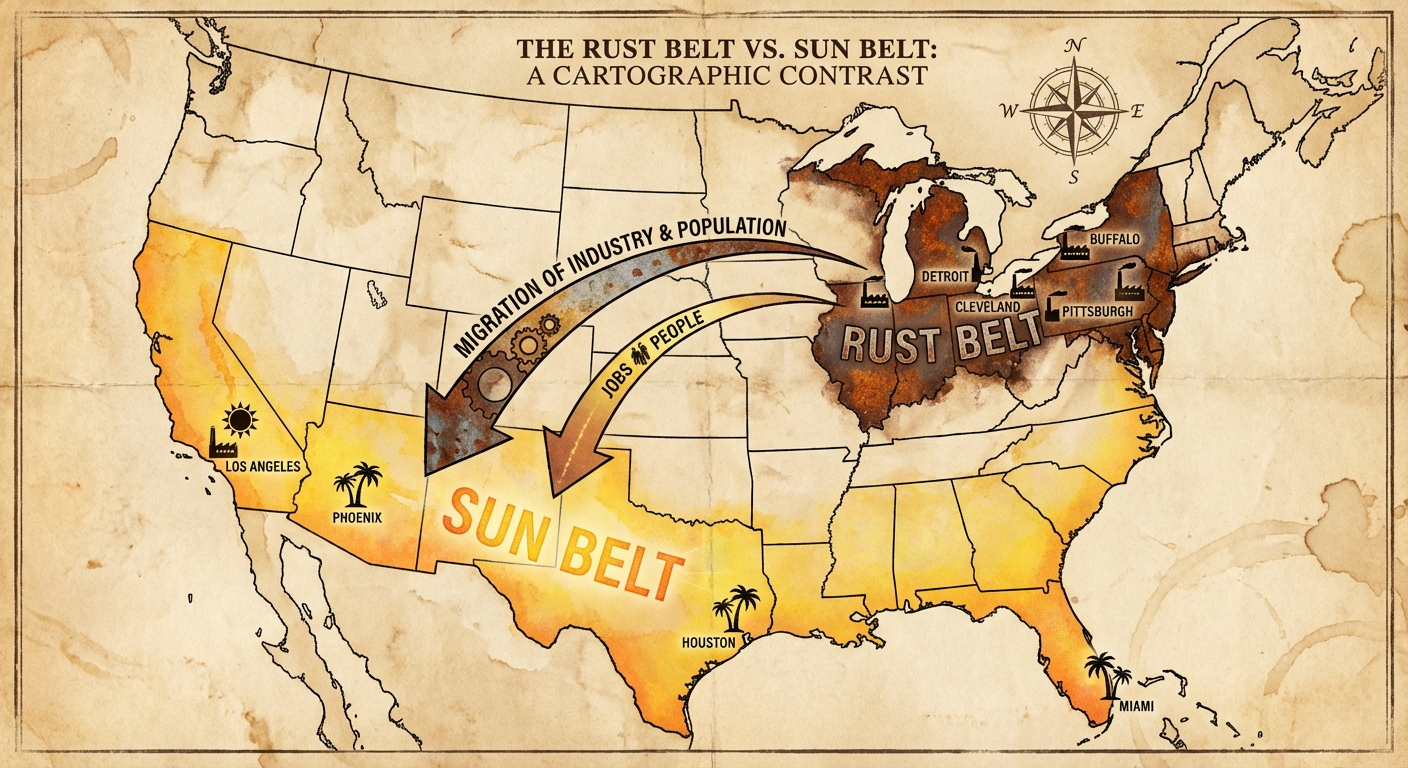
In the US, manufacturing has moved from the Rust Belt (Northeast/Midwest) to the Sun Belt (South).
- Why? The South consists of Right-to-Work states where labor unions are weaker, making labor cheaper for companies.
7.8 Sustainable Development
Industrialization places stress on the environment (climate change, depletion of resources).
Sustainable Development Goals (SDGs)
Adopted by the UN in 2015 to be achieved by 2030. There are 17 goals, including:
- No Poverty
- Gender Equality
- Clean Water and Sanitation
- Climate Action
Ecotourism
Tourism based on enjoyment of scenic areas or natural wonders that aims to provide an experience of nature or culture in an environmentally sustainable way.
- Example: Costa Rica protects rainforests because tourists pay to see them, effectively making the forest more valuable standing than cut down.
Microloans / Microfinance
Providing small loans ($10-$500) to individuals and small businesses in LDCs who cannot access traditional banking.
- Grameen Bank (Bangladesh): Pioneered by Muhammad Yunus.
- Impact: Remarkably high repayment rates; largely focused on women. Empowering women financially leads to lower birth rates and better child nutrition.
Common Mistakes & Pitfalls
- GNI vs GDP: Remember, GNI implies "National" (citizens, wherever they are). GDP implies "Domestic" (inside the borders, whoever is doing the work).
- Rostow vs. Wallerstein: Rostow says any country can develop if they follow the steps (optimistic). Wallerstein says the system is rigged; the Core stays rich by exploiting the Periphery (pessimistic/structural).
- High Tech implies Wealth: Not always. India has a massive high-tech sector (Bangalore), but the country as a whole is still a NIC with significant poverty. Do not confuse a sector with the whole economy.
- Weather/Climate vs. Location: Students often think factories locate in the Sun Belt for better weather. It is primarily for Right-to-Work laws and lower wages.
- Bulk-Gaining Definition: It is not just about weight! If a product becomes harder to transport (more fragile, or perishable like bread), it is treated as bulk-gaining and typically locates near the market.