Mastering Implicit Differentiation Strategies
Explicit vs. Implicit Functions
In Calculus, functions are traditionally presented in explicit form, where the dependent variable $y$ is isolated on one side of the equation. This expresses $y$ directly in terms of $x$.
- Explicit: $y = x^2 - 4x + 7$ or $y = \sqrt{25 - x^2}$
However, many interesting relationships in geometry and physics form curves that are not functions (they fail the vertical line test) or are algebraically difficult to solve for $y$. These are defined by implicit equations, where $x$ and $y$ are intermixed.
- Implicit: $x^2 + y^2 = 25$ (Circle)
- Implicit: $y^3 + x^3 = 6xy$ (Folium of Descartes)
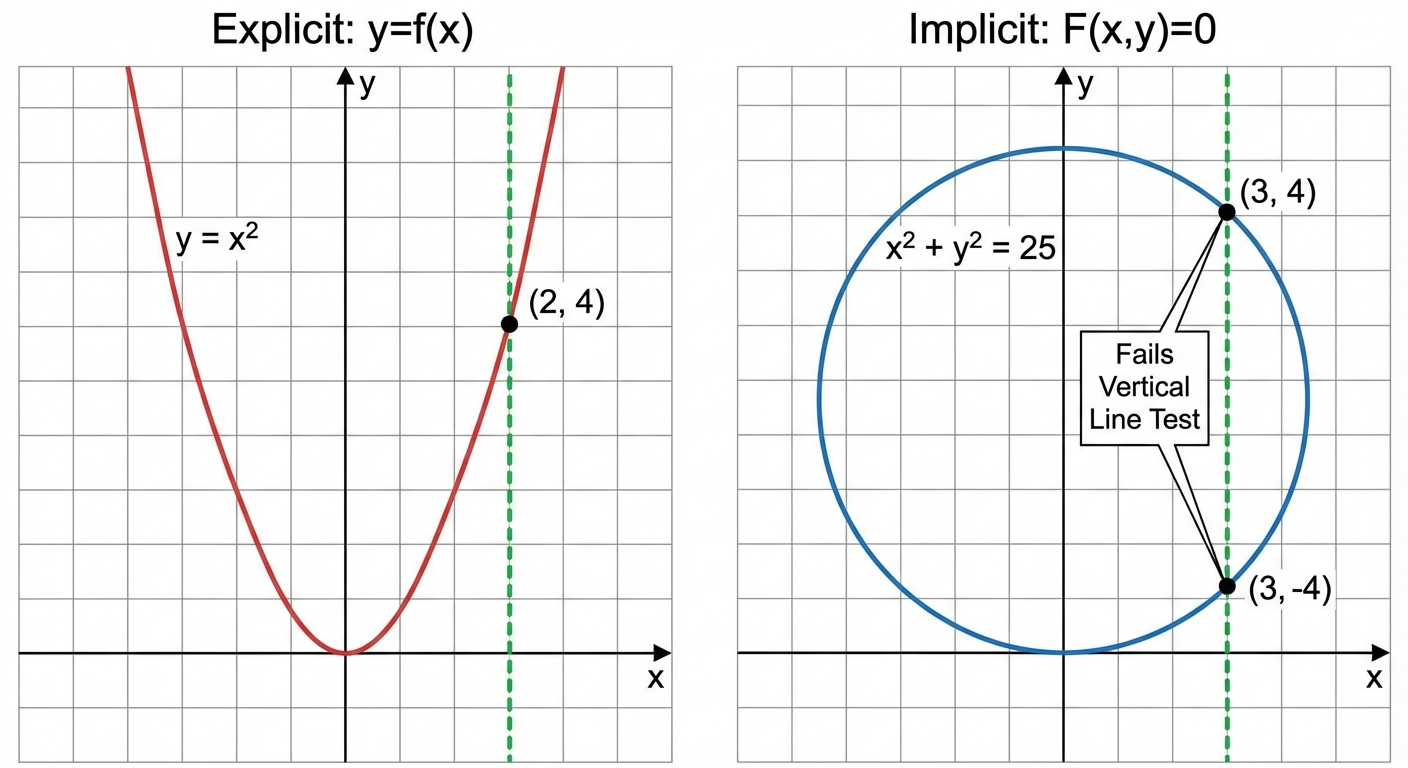
Implicit Differentiation is the technique used to find the derivative $\frac{dy}{dx}$ (the slope of the tangent line) without having to isolate $y$ first.
The Chain Rule Connection
The most critical concept in implicit differentiation is remembering that $y$ is a function of $x$ ($y = f(x)$), even if we don't know exactly what that function holds.
When you differentiate an expression involving $x$ with respect to $x$, standard rules apply. However, when you differentiate an expression involving $y$ with respect to $x$, you must apply the Chain Rule.
The Rule of Thumb
| Expression | Derivative with respect to $x$ | Explanation |
|---|---|---|
| $x^3$ | $3x^2$ | Standard Power Rule. |
| $y^3$ | $3y^2 \cdot \frac{dy}{dx}$ | Power Rule (outer) $\times$ Derivative of $y$ (inner). |
| $x + y$ | $1 + \frac{dy}{dx}$ | Sum rule. |
| $xy$ | $1 \cdot y + x \cdot \frac{dy}{dx}$ | Product Rule. This is a common trap! |
Procedure for Implicit Differentiation
To find $\frac{dy}{dx}$ for an implicit equation, follow these four steps:
- Differentiate both sides of the equation with respect to $x$.
- Apply the Chain Rule whenever you differentiate a term containing $y$ (multiply by $\frac{dy}{dx}$).
- Isolate all terms containing $\frac{dy}{dx}$ on one side of the equation.
- Factor out $\frac{dy}{dx}$ and divide to solve for it.
Worked Example 1: The Circle
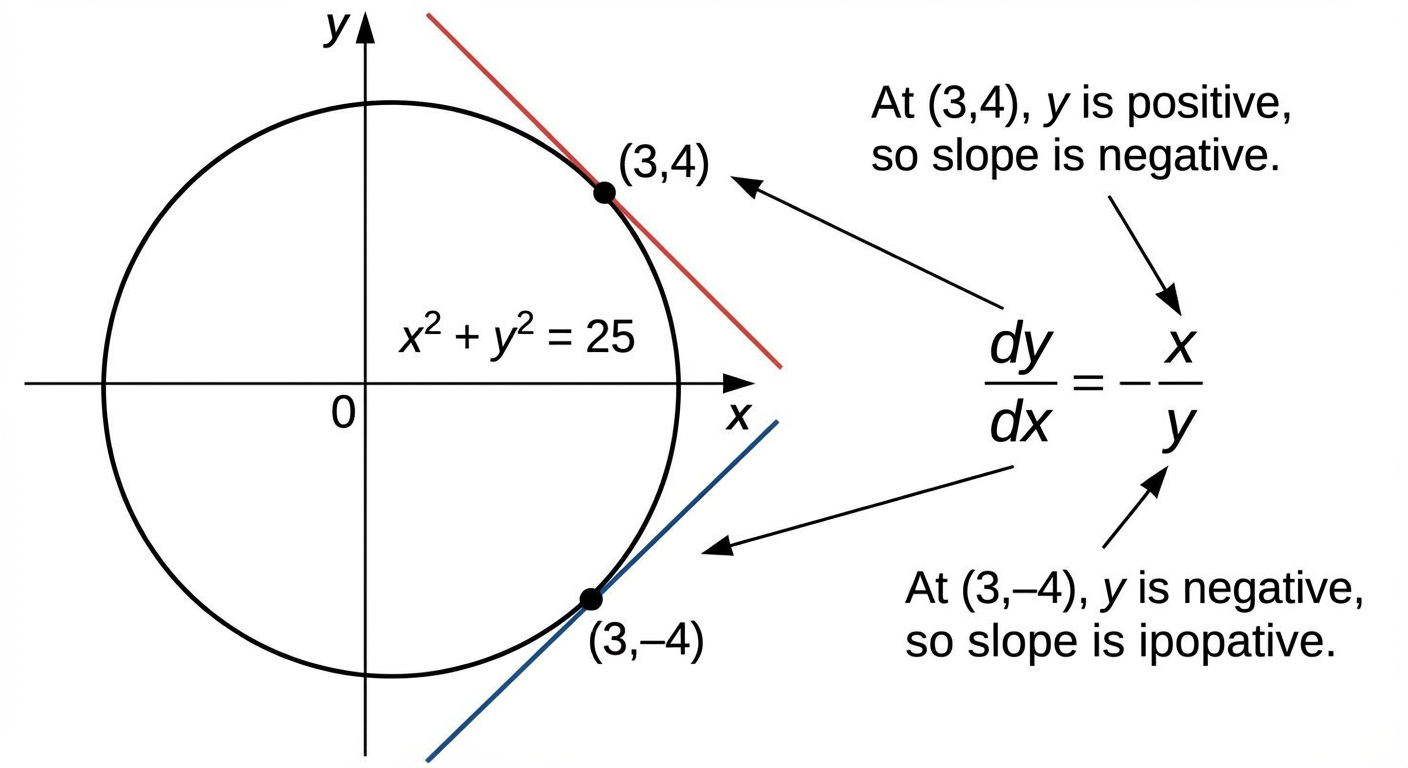
Find $\frac{dy}{dx}$ for the circle $x^2 + y^2 = 25$.
Step 1 & 2: Differentiate both sides.
Step 3: Isolate $\frac{dy}{dx}$ terms.
Step 4: Solve.
Notice that the derivative depends on both $x$ and $y$. This makes sense because a circle has two different tangent slopes for a single $x$-value (one on the top semicircle, one on the bottom).
Worked Example 2: The Product Rule Trap
Find the slope of the curve $x^3 + y^3 = 4xy$ at definition $(2, 2)$.
1. Differentiate:
Note the term $4xy$. Treat $4x$ as the first function and $y$ as the second function. Use the Product Rule ($uv' + vu'$).
2. Expand:
3. Group $\frac{dy}{dx}$ terms:
4. Factor and Solve:
5. Evaluate at $(2,2)$:
Horizontal and Vertical Tangents
In implicit differentiation exams, you are often asked to find coordinates where the tangent line is horizontal or vertical.
Given a derivative $\frac{dy}{dx} = \frac{\text{Numerator}}{\text{Denominator}}$:
- Horizontal Tangent: Slope $= 0$. Set the Numerator $= 0$ (and ensure denominator $\neq 0$).
- Vertical Tangent: Slope is undefined. Set the Denominator $= 0$ (and ensure numerator $\neq 0$).
Note: After finding relationships between $x$ and $y$ from the numerator or denominator, you usually have to substitute them back into the original implicit equation to find the specific coordinate points.
Higher-Order Derivatives
Finding the second derivative ($\frac{d^2y}{dx^2}$) implicitly is a classic AP Calculus Short Answer (FRQ) topic. The process follows a specific workflow:
- Find the first derivative $\frac{dy}{dx}$ as usual.
- Differentiate $\frac{dy}{dx}$ again with respect to $x$ using the Quotient Rule (usually required).
- Crucial Step: The result will contain a $\frac{dy}{dx}$ term. You must substitute the expression found in Step 1 into this term.
- Simplify algebraically.
Worked Example: Second Derivative
Find $\frac{d^2y}{dx^2}$ for $x^2 + y^2 = 25$.
Part 1: First Derivative
We already found: $\frac{dy}{dx} = -\frac{x}{y}$.
Part 2: Second Derivative (Quotient Rule)
Use Quotient Rule: $\frac{Low \cdot dHigh - High \cdot dLow}{Low^2}$. Recall $dHigh$ (derivative of $x$) is 1, and $dLow$ (derivative of $y$) is $\frac{dy}{dx}$.
Part 3: Substitution
Replace $\frac{dy}{dx}$ with $-\frac{x}{y}$.
Part 4: Simplification
Multiply numerator and denominator by $y$ to clear the complex fraction:
Look back at the original equation! We know $x^2 + y^2 = 25$.
Common Mistakes & Pitfalls
- Forgetting the Chain Rule ($y'$): The most frequent error is differentiating $y^3$ as just $3y^2$ instead of $3y^2 \frac{dy}{dx}$. If you are differentiating a $y$-variable with respect to $x$, you must attach the derivative.
- Product Rule Negligence: In terms like $xy$ or $x^2y$, students often write the derivative as $1 \cdot \frac{dy}{dx}$. You must use the Product Rule: $y + x\frac{dy}{dx}$.
- Sign Errors in Quotient Rule: When finding the second derivative, parentheses are your best friend. Distribute negatives carefully.
- Stopping Too Early on Second Derivatives: On Free Response Questions, if asked for $\frac{d^2y}{dx^2}$ in terms of $x$ and $y$, you must substitute the original $\frac{dy}{dx}$ back in. Leaving $\frac{dy}{dx}$ in the final answer is usually incorrect.