AP Physics 1: Unit 4 Guide - Momentum, Impulse, and Collisions
1. Introduction to Linear Momentum
Defining Momentum
Linear Momentum is a vector quantity that represents the "quantity of motion" an object possesses. It describes how difficult it is to stop a moving object. In the AP Physics 1 curriculum, understanding the vector nature of momentum is crucial for solving collision and explosion problems correctly.
The mathematical definition is:
Where:
- $\vec{p}$ is the momentum in kilogram-meters per second ($kg\cdot m/s$)
- $m$ is the mass in kilograms ($kg$)
- $\vec{v}$ is the velocity in meters per second ($m/s$)
Key Properties
- Vector Quantity: Momentum has both magnitude and direction. The direction of the momentum vector is always the same as the direction of the velocity vector.
- Linearity: If you double the mass or double the velocity, you double the momentum.
- Inertia vs. Momentum: Inertia (mass) is the resistance to a change in motion (acceleration). Momentum is a measure of the motion itself. A semi-truck at rest has huge inertia but zero momentum.
Newton’s Original Second Law
While students often memorize $F=ma$, Isaac Newton originally formulated his Second Law in terms of momentum. He stated that the net force acting on an object is equal to the rate of change of its momentum:
This form is more general than $F=ma$ because it accounts for situations where mass might change (like a rocket burning fuel), though in AP Physics 1, mass is usually constant.
2. Impulse and Momentum Change
The Impulse-Momentum Theorem
If we rearrange Newton's Second Law form shown above, we get definitions for Impulse:
This relationship is known as the Impulse-Momentum Theorem. It states that an Impulse ($\vec{J}$) applied to an object equates to exactly the change in that object's momentum.
Components of Impulse
- Impulse ($\vec{J}$): The product of the average force applied and the time interval over which it acts. Units: $N\cdot s$ (which is equivalent to $kg\cdot m/s$).
- Change in Momentum ($\Delta \vec{p}$): Calculated as $\vec{p}f - \vec{p}i = m(\vec{v}f - \vec{v}i)$.
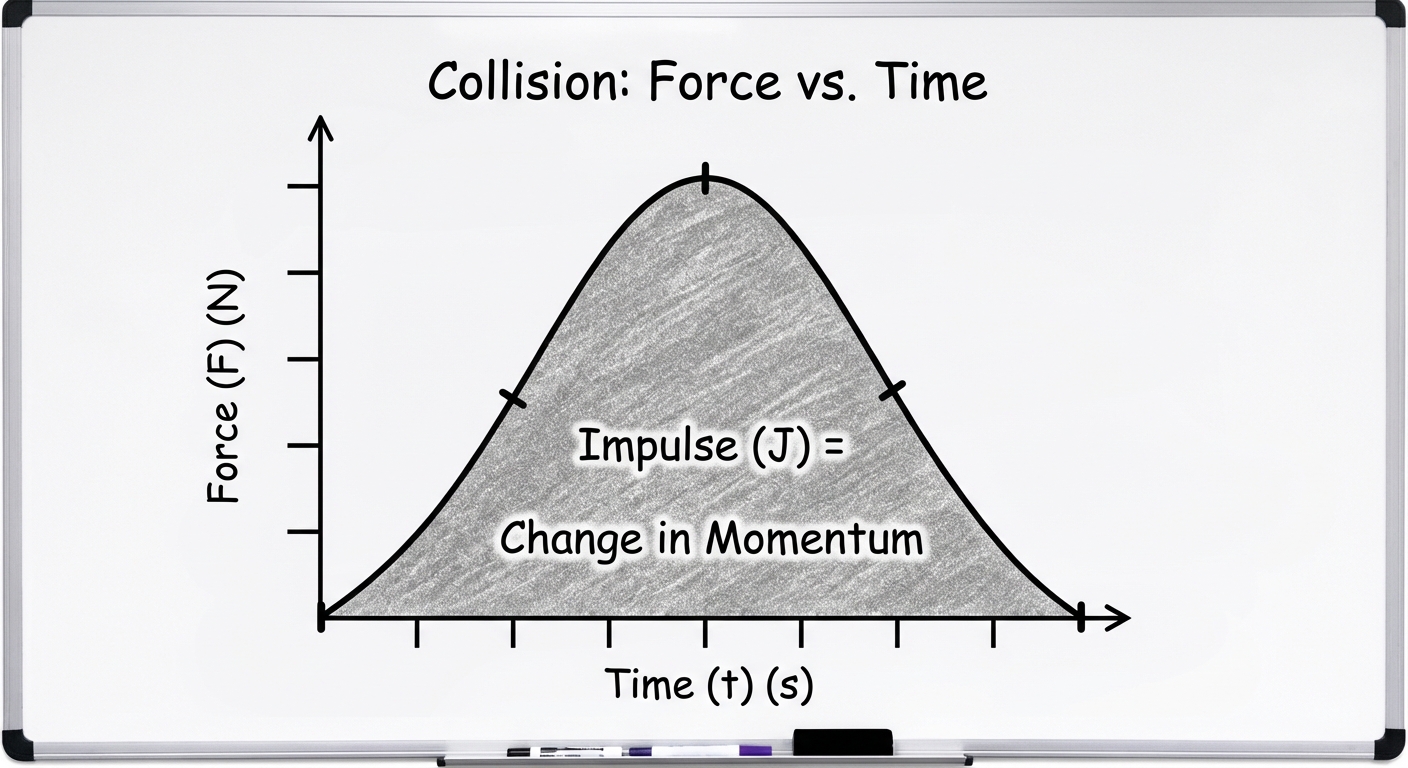
Analyzing Force vs. Time Graphs
A frequent exam question involves analyzing a graph with Force on the y-axis and Time on the x-axis.
- The Rule: The area under the curve of a Force vs. Time graph represents the Impulse (and therefore the change in momentum).
- If the graph is a rectangle ($F$ is constant), Area = $F \times \Delta t$.
- If the graph is a triangle (varying force), Area = $\frac{1}{2}bh$.
Real-World Application: Safety Engineering
Why do airbags exist?
Using the theorem $\vec{F}_{avg} = \frac{\Delta \vec{p}}{\Delta t}$:
- In a crash, the passenger must come to a stop ($\Delta \vec{p}$ is fixed/predetermined by the speed of the car).
- An airbag increases the time of impact ($\Delta t$).
- Because $\Delta t$ is in the denominator, increasing time decreases the Average Force ($\vec{F}_{avg}$) exerted on the passenger, reducing injury.
Common Mistakes: Impulse
- Confusing Total Momentum with Change: Impulse is equal to the change ($ {final} - {initial}$), not just the final momentum.
- Bouncing Objects: When an object bounces, the change in velocity is large because the direction swaps symbols (e.g., from $+v$ to $-v$).
- $\Delta v = (-v) - (+v) = -2v$.
- Bouncing imparts a greater impulse than simply sticking.
3. Conservation of Linear Momentum
The Principle of Conservation
The Law of Conservation of Momentum is the cornerstone of Unit 4. It states:
In a closed, isolated system, the total linear momentum remains constant.
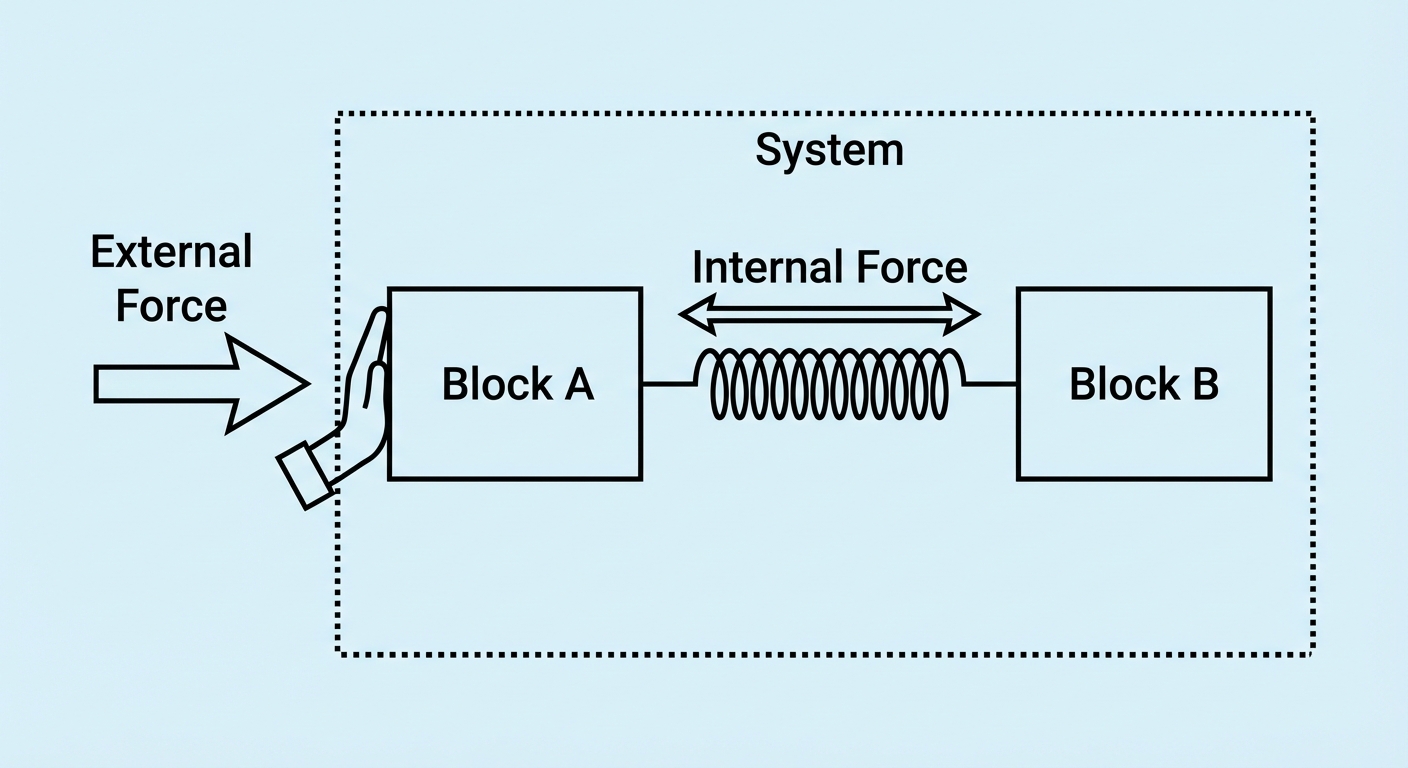
Defining the System
To use this law correctly, you must define your system boundaries.
- Closed: No mass enters or leaves the system.
- Isolated: No net external forces act on the system (e.g., friction from the floor, gravity from outside) or the external forces assume zero summation or negligible impact during the collision interval.
If the system is valid:
Internal vs. External Forces
- Internal Forces: Forces between objects inside the system (e.g., Car A hits Car B). These forces occur in action-reaction pairs ($F{AB} = -F{BA}$) and cancel out, so they do not combine to change the total momentum.
- External Forces: Forces from outside (e.g., friction stopping the cars after they crash). These do change the total momentum.
4. Types of Collisions
While momentum is conserved in all isolated collisions, Kinetic Energy (K) is not always conserved. This distinction defines the collision type.
| Collision Type | Momentum Conserved? | Kinetic Energy (K) Conserved? | Description | Example |
|---|---|---|---|---|
| Elastic | YES | YES | Objects bounce off perfectly; no energy lost to heat/sound. | Ideal gas molecules, magnets repelling, hard steel balls. |
| Inelastic | YES | NO | Objects bounce/separate, but some K is lost to heat/deformation. | Car crash (bumper bounce), tennis ball hitting court. |
| Perfectly Inelastic | YES | NO (Max Loss) | Objects stick together and move with a common final velocity. | Clay hitting floor, tackling a football player, bullet in block. |
Solving Perfectly Inelastic Collisions
Since the objects stick together, they act as one single mass ($m1 + m2$) with one final velocity ($v_f$):
Explosions (Reverse Inelastic)
An explosion is mathematically treated as a perfectly inelastic collision in reverse. An object starts as one mass and separates into pieces.
- Initial Momentum is often zero (if at rest).
- $0 = m1v{1f} + m2v{2f}$.
- This implies the pieces must move in opposite directions.
5. Reviewing 2D Momentum and Center of Mass
Center of Mass (COM)
The Center of Mass is a geometric point that represents the average position of all the mass in the system.
The Velocity of the Center of Mass ($v_{cm}$)
Crucial AP Concept: For an isolated system (no external forces), the velocity of the center of mass remains constant, regardless of collisions or explosions happening internally.
Even if two cars crash and spin off wildly, the invisible point representing their COM continues moving in a straight line at a constant speed (until friction slows them down).
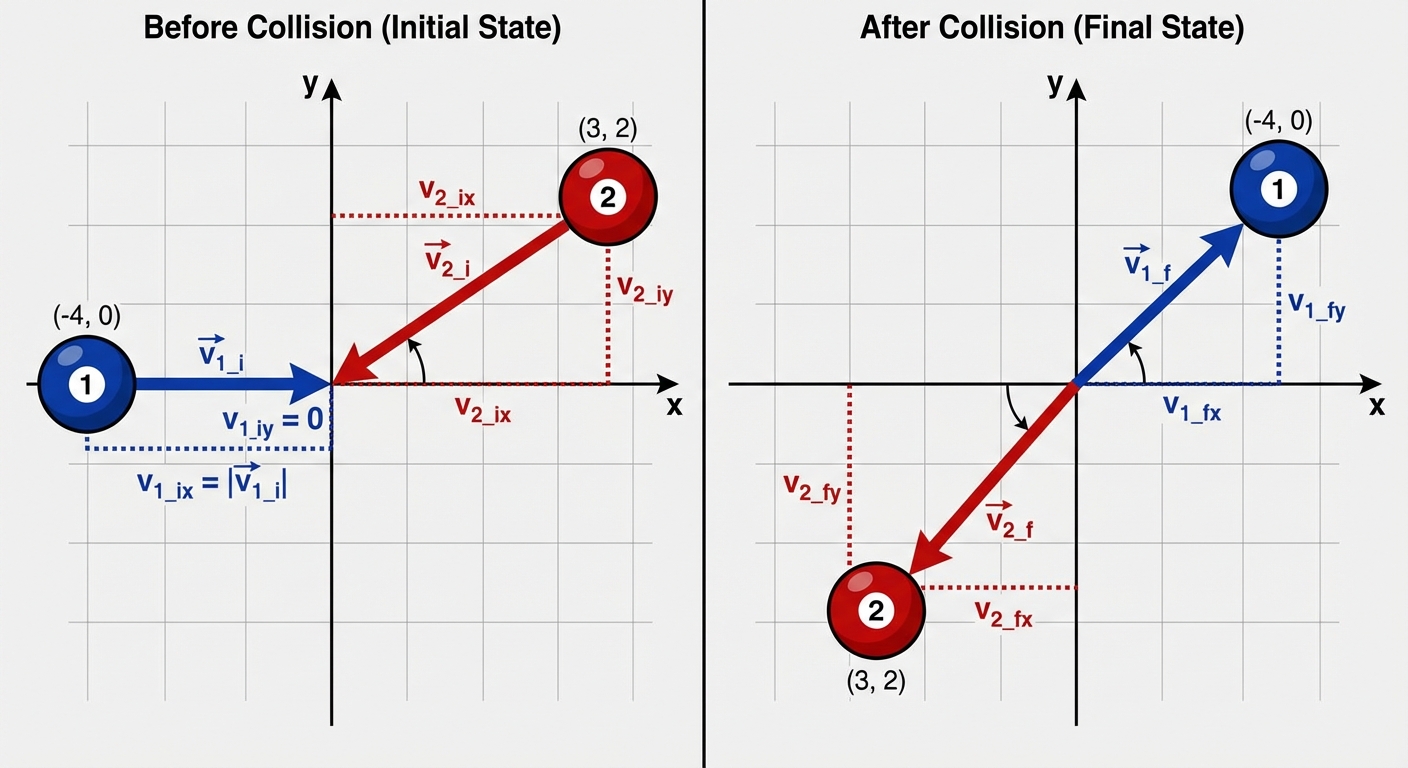
2D Collisions
When objects collide at angles (not head-on), momentum is conserved independently in the X and Y directions.
- X-Axis Conservation: $\sum p{ix} = \sum p{fx}$
- Y-Axis Conservation: $\sum p{iy} = \sum p{fy}$
Strategy: Resolve all initial velocity vectors into x and y components using sine and cosine. Solve the conservation equations separately for x and y, then recombine components if asked for the final speed and angle.
6. Common Mistakes & Exam Pitfalls
1. The Sign Error
Mistake: Treating momentum as a scalar implies ignoring direction.
Correction: Define a positive direction (e.g., Right is +). If a ball hits a wall moving right at $5 m/s$ ($pi = +5m$) and bounces back left at $5 m/s$, the final momentum is $pf = -5m$. The change is $-10m$, not $0$.
2. Elastic vs. Inelastic Confusion
Mistake: Assuming $p$ is only conserved in elastic collisions, or that $K$ is conserved in all collisions.
Correction: Momentum is conserved in ALL isolated collisions. Kinetic Energy is ONLY conserved in Elastic collisions.
3. F vs. t Graph Axes
Mistake: Confusing a Force vs. Time graph (Area = Impulse/$\Delta p$) with a Force vs. Position graph (Area = Work/$\Delta E$).
Correction: Check the units of the x-axis immediately.
4. Center of Mass Logic
Mistake: Thinking the Center of Mass stops during a collision.
Correction: If the net external force is zero, $a{cm} = 0$, meaning $v{cm}$ is constant. It does not accelerate, turn, or stop unless an external force acts on it.
5. Open vs. Closed Systems
Mistake: Trying to use conservation of momentum when an external force (like gravity on a falling ball) is acting.
Correction: If a ball is dropped, Earth's gravity acts on it. Momentum of the ball is not conserved (it speeds up). Momentum of the Ball + Earth system IS conserved (Earth moves up infinitesimally). Always match your equation to your system choice.
7. Summary Table / Cheat Sheet
| Concept | Formula / Property | Restriction |
|---|---|---|
| Linear Momentum | $\vec{p} = m\vec{v}$ | Vector quantity |
| Impulse (Calculus/Nav) | $\vec{J} = \int F dt = \Delta \vec{p}$ | Area under F-t graph |
| Impulse (Algebra) | $F{avg}\Delta t = m(vf - v_i)$ | Constant or Avg Force |
| Conservation | $\sum \vec{p}i = \sum \vec{p}f$ | Closed, Isolated System |
| Perfectly Inelastic | $vf = \frac{m1v{1i} + m2v{2i}}{m1+m_2}$ | Objects stick together |
| Center of Mass Velocity | $v{cm} = \frac{m1v1 + m2v2 + …}{m{total}}$ | Constants if $F_{net,ext} = 0$ |