Unit 1: The Rise of Centralized Power and Global Interaction
Unit 1: The Rise of Centralized Power and Global Interaction
New Monarchies (c. 1450–1550)
Concept Definition
The term New Monarchies refers to the rulers of England, France, and Spain in the late 15th and early 16th centuries who successfully centralized power at the expense of the landed nobility and the clergy. While they were not yet "absolute" monarchs (a concept for the 17th century), they laid the foundation for the modern nation-state.
These monarchs focused on three main pillars:
- Monopoly on Tax Collection: Establishing consistent revenue streams independent of noble consent.
- Control over Military Force: Creating professional armies (paid by the state) rather than relying on feudal levies.
- Religious Control: Gaining authority over the clergy to ensure national unity.
Regional Examples
1. Spain: The Union of Crowns
Spain was created through the dynastic marriage of Isabella I of Castile and Ferdinand II of Aragon in 1469.
- Religious Uniformity: They pursued a policy of religious strictness to unify their distinct kingdoms. This included the Reconquista (completed in 1492 with the fall of Granada) and the expulsion of Jews and Muslims.
- The Inquisition: Established to enforce Catholic orthodoxy, specifically targeting conversos (Jewish converts suspected of secretly practicing Judaism). This served as a political tool to create a unified national identity: "One King, One Law, One Faith."
- Exploration Sponsorship: Funded Christopher Columbus, initiating Spain’s Golden Age.
2. France: The Valois Dynasty
France consolidated power after the Hundred Years' War.
- Louis XI (The Spider King): Ruthlessly suppressed nobles and expanded royal territory. He established a permanent tax (the taille) and created a professional army.
- Francis I: A pivotal move for French power was the Concordat of Bologna (1516). This agreement with Pope Leo X allowed the French King to appoint bishops and abbots. This gave the monarchy control over church resources and prevented the Reformation from taking deep root in France initially, as the King already controlled the church.
3. England: The Tudor Dynasty
- Henry VII: The first Tudor king, he ended the War of the Roses. He focused on curbing the power of the nobility using the Star Chamber. This was a royal court operating without a jury, used to prosecute unruly nobles—effectively bypassing the noble-controlled common law courts.
- Henry VIII: While famous for his wives, his political centralization was massive. By declaring himself Head of the Church of England (Act of Supremacy, 1534), he seized monastic lands and wealth, redistributing them to gentry to secure loyalty.
Comparison Table: Methods of Centralization
| Feature | Medieval Monarchy | New Monarchy |
|---|---|---|
| Army | Feudal levies (loyal to nobles) | Professional mercenaries (loyal to King) |
| Law | Regional/Local systems | Roman Law (Centralized/Royal Courts) |
| Finances | Land income only | Sales taxes, property taxes, loans |
| Religion | Subordinate to the Pope | Negotiated power (e.g., Concordat of Bologna) |
European Exploration and Expansion
Motivations: The Three Gs
The primary drivers for exploration were God, Gold, and Glory.
- Gold (Economics): The Ottoman conquest of Constantinople (1453) blocked traditional trade routes to the East. Europeans desperately needed a new route to Asian spice markets to bypass Muslim intermediaries and Italian monopolies.
- God (Religion): The desire to spread Christianity (missionary zeal) and the hope of finding Christian allies against Islam (the legend of Prester John).
- Glory (Politics): Individual fame for explorers and geopolitical dominance for the sponsoring monarchy.
Technological Enablement
Expansion was impossible without specific technological advancements, largely adapted from Chinese and Arab origins.
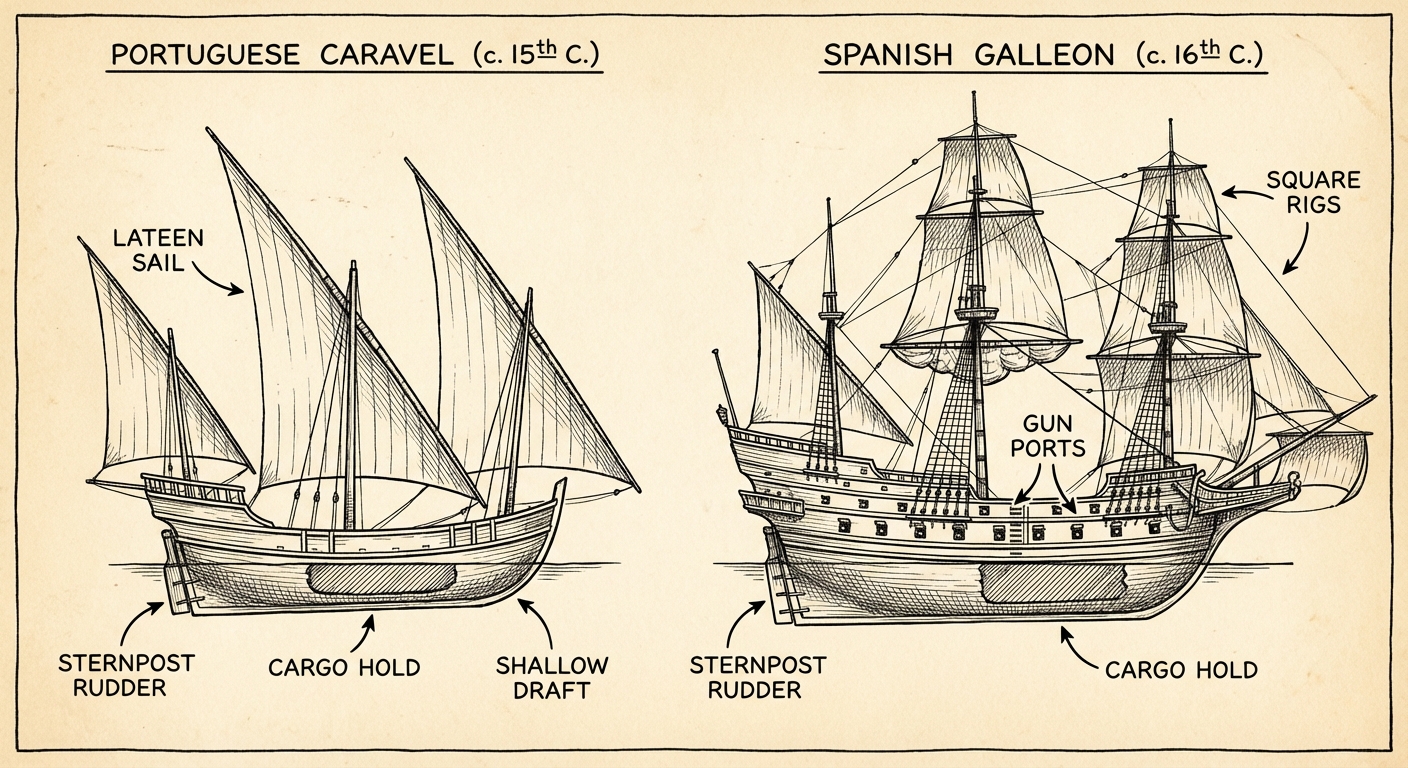
- Caravel: A small, highly maneuverable ship developed by the Portuguese. It used the Lateen Sail (triangular) which allowed ships to tack against the wind, combined with square sails for speed.
- Sternpost Rudder: Allowed for more precise steering.
- Navigational Tools:
- Magnetic Compass: For direction.
- Astrolabe: For determining latitude by measuring the altitude of celestial bodies.
The Portuguese Trading Post Empire
Portugal, led by Prince Henry the Navigator (who funded the navigation schools), chose the Eastern route around Africa.
- Bartholomew Diaz: Rounded the Cape of Good Hope (1488).
- Vasco da Gama: Reached India (1498), returning with spices worth 60x the cost of the voyage.
- Strategy: Portugal did not conquer large landmasses initially. Instead, they built a Trading Post Empire—fortified bases at key ports (like Goa and Malacca) to force merchant ships to pay duties.
The Spanish Empire of Conquest
Spain looked West. inadvertently discovering the Americas.
- Christopher Columbus (1492): Arrived in the Caribbean, initiating permanent European contact.
- Ferdinand Magellan (1519): His crew circumnavigated the globe, proving the scale of the Pacific Ocean.
- Hernán Cortés: Conquered the Aztec Empire (1521).
- Francisco Pizarro: Conquered the Inca Empire (1532).
Key Treaty: The Treaty of Tordesillas (1494), brokered by the Pope, divided the non-European world between Spain (West) and Portugal (East/Brazil). This explains why Brazil speaks Portuguese while the rest of Latin America speaks Spanish.
The Columbian Exchange and Its Effects
Definition
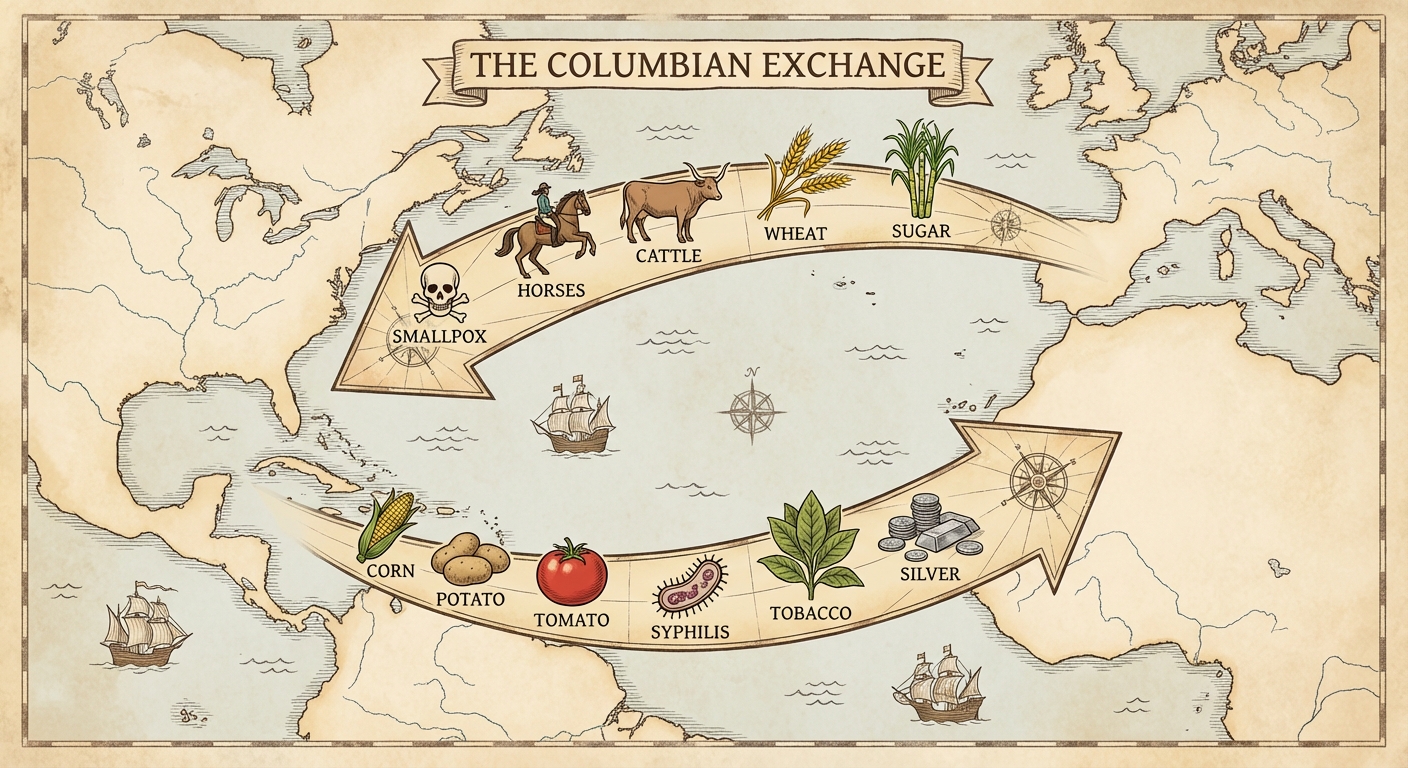
The Columbian Exchange was the widespread transfer of plants, animals, culture, human populations, technology, and diseases between the Americas (New World) and the Old World (Europe, Africa, and Asia) in the 15th and 16th centuries. It is a biological exchange, not just a trade network.
The Exchange Matrix
| Category | From Old World (Europe/Africa) to New World | From New World (Americas) to Old World |
|---|---|---|
| Diseases | Smallpox, Measles, Influenza, Typhus | Syphilis |
| Crops | Wheat, Rice, Sugarcane, Coffee | Potato, Maize (Corn), Tomato, Tobacco, Cacao |
| Animals | Horses, Cattle, Pigs, Sheep | Turkeys, Llamas |
Major Effects
1. Demographic Catastrophe in the Americas
Indigenous populations had no immunity to Afro-Eurasian diseases. Smallpox was the most devastating, killing an estimated 90% of the native population within a century of contact. This population collapse facilitated Spanish conquest and created a labor shortage that fueled the Atlantic Slave Trade.
2. Population Growth in Europe
While the Americas were depopulated, Europe experienced a population boom. New World crops, specifically the Potato and Maize, were high in calories and easy to grow. This stabilized the food supply and reduced the frequency of famines.
3. Economic Shifts
- Shift to the Atlantic: The economic center of Europe shifted from the Mediterranean (Italy) to the Atlantic states (Spain, Portugal, France, England/Netherlands). Italian city-states began a slow decline.
- The Price Revolution: The influx of silver (specifically from the Potosí mines) combined with population growth caused steady inflation across Europe. This hurt the nobility (who lived on fixed incomes) but helped the rising merchant class (bourgeoisie).
4. Social Structures in the New World
Spain imposed the Encomienda System, a labor system where valid conquerors were granted indigenous people to work the land in exchange for Christianizing them. It was essentially a disguised form of slavery. Following the advocacy of Bartolomé de Las Casas, who criticized the brutality against natives, the system was gradually replaced, but it led to the importation of African slaves via the Asiento system (license to trade slaves).
Common Mistakes & Pitfalls
Confusing "New Monarchs" with "Absolutists":
- Mistake: Calling Henry VII or Ferdinand "Absolute Monarchs."
- Correction: They were centralizing monarchs. Absolutism (total unchecked power, Divine Right broadly applied) is a 17th-century concept (think Louis XIV). New Monarchs still had to negotiate with nobles and towns, though they were gaining the upper hand.
Misunderstanding the Columbian Exchange:
- Mistake: Describing the Columbian Exchange solely as "trade."
- Correction: It was unintentional biological transfer. If a merchant buys silk from China, that is trade. If a merchant brings a pig to America and that pig brings influenza, that is the Columbian Exchange.
The Cause of Inflation:
- Mistake: Thinking silver was the only cause of the Price Revolution.
- Correction: A recovering population after the Black Death increased demand for food and goods, which drove prices up. The silver influx exacerbated this existing inflation.
Portuguese vs. Spanish Models:
- Mistake: Thinking all explorers conquered land immediately.
- Correction: Remember Portugal created a Trading Post Empire (coastal forts) due to lack of manpower, while Spain created a Colonial Empire (settlement and conquest).