Europe in the Global Age: Cold War to Present
Unit 9: Cold War and Contemporary Europe
9.1 Context and Origins of the Cold War
Defining the Conflict
The Cold War (c. 1947–1991) was a prolonged state of ideological, geopolitical, and military tension between the two superpowers that emerged from World War II: the United States (capitalism/democracy) and the Soviet Union (communism/authoritarianism). It is termed "cold" because there was no large-scale direct fighting between the two superpowers, though they engaged in major regional proxy wars.
The Post-War Settlement
Following the unconditional surrender of Germany (May 1945) and Japan (September 1945), the Grand Alliance (USA, UK, USSR) dissolved into rivalry.
- Yalta Conference (Feb 1945): Stalin pledged free elections in Eastern Europe but later reneged, installing puppet communist regimes.
- Potsdam Conference (July 1945): Highlighted deep mistrust; Truman hinted at the atomic bomb, and disagreements over German reparations solidified the East-West divide.
- Division of Germany: Germany was divided into four occupation zones (US, UK, French, Soviet). Berlin, located deep within the Soviet zone, was also divided into four sectors.
The Iron Curtain
In 1946, Winston Churchill delivered his famous speech in Fulton, Missouri, declaring:
"From Stettin in the Baltic to Trieste in the Adriatic, an Iron Curtain has descended across the Continent."
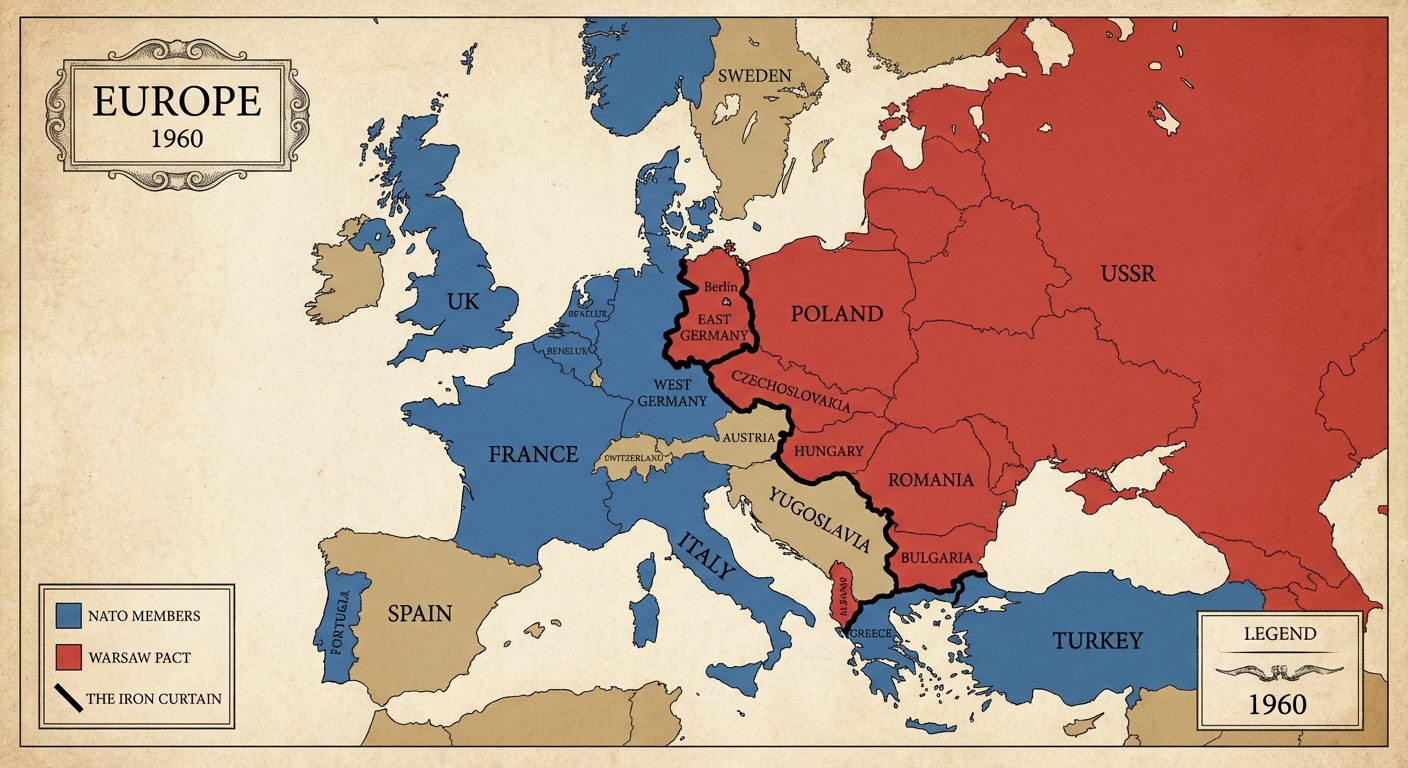
This metaphor described the physical and ideological border separating the Soviet-dominated Eastern Bloc from the US-aligned Western Europe.
Containment Policy
The US adopted the policy of Containment (formulated by George Kennan), aiming to stop the spread of communism without initiating direct conflict.
- Truman Doctrine (1947): The US pledged military and economic aid to countries threatened by communism, specifically Greece and Turkey.
- The Marshall Plan (1948): Officially the European Recovery Program (ERP). The US provided over $13 billion in economic aid to help rebuild Western Europe. The goal was to stabilize economies to prevent the appeal of communism.
- Result: The "Economic Miracle" in Western Europe; Stalin rejected aid for the Eastern Bloc.
9.2 Rebuilding Europe: Economic Miracles and Systems
Economic Systems Comparison
| Feature | Western Europe (Capitalist/Mixed) | Eastern Bloc (Command Economy) |
|---|---|---|
| Ownership | Private property with state intervention | State ownership of industry/agriculture |
| Market | Supply and demand determine prices | Central planning determines quotas/prices |
| Focus | Consumer goods and services | Heavy industry (steel, military) |
| Trade | Global trade (GATT/EEC) | COMECON (closed trading block) |
The Welfare State
Post-war Western European governments (both Christian Democrats and Social Democrats) pioneered the Welfare State. This "Cradle to Grave" social security system was designed to ensure exact standards of living and prevent the desperation that led to fascism.
Key Formula concept (Keynesian Economics):
Governments utilized Keynesian spending to manage the economy. The multiplier effect suggests that government spending boosts aggregate demand:
(Where $k$ is the multiplier and $MPC$ is the Marginal Propensity to Consume).
- Examples: Universal healthcare (British NHS), state pensions, unemployment benefits, and family allowances.
9.3 The Cold War: Major Events and Alliances
Military Alliances
- NATO (North Atlantic Treaty Organization, 1949): A collective defense alliance among Western democracies (an attack on one is an attack on all).
- Warsaw Pact (1955): The Soviet response; a military alliance of the USSR and its Eastern European satellite states.
Key Flashpoints in Europe
- Berlin Blockade & Airlift (1948–1949): Stalin blocked land access to West Berlin. The Allies responded with an 11-month airlift of supplies. Result: creation of West Germany (FRG) and East Germany (GDR).
- Berlin Wall (1961): Constructed by the GDR to stop the "Brain Drain" of intellectuals fleeing East to West. It became the ultimate symbol of oppression.
- Cuban Missile Crisis (1962): Though outside Europe, this was the peak of nuclear tension. Khrushchev placed missiles in Cuba; JFK blockaded. Result: Missiles removed, hotline established, beginning of Détente (relaxation of tensions).
Soviet Repression in the East
The USSR crushed attempts at liberalization within the Eastern Bloc:
- Hungarian Uprising (1956): Led by Imre Nagy; crushed by Soviet tanks.
- Prague Spring (1968): Led by Alexander Dubček in Czechoslovakia looking for "Socialism with a human face." Crushed by the Warsaw Pact invasion.
- Brezhnev Doctrine: Proclaimed the USSR had the right to intervene in any socialist country to "save" socialism.
9.4 Post-War Nationalism and Decolonization
The End of Empires
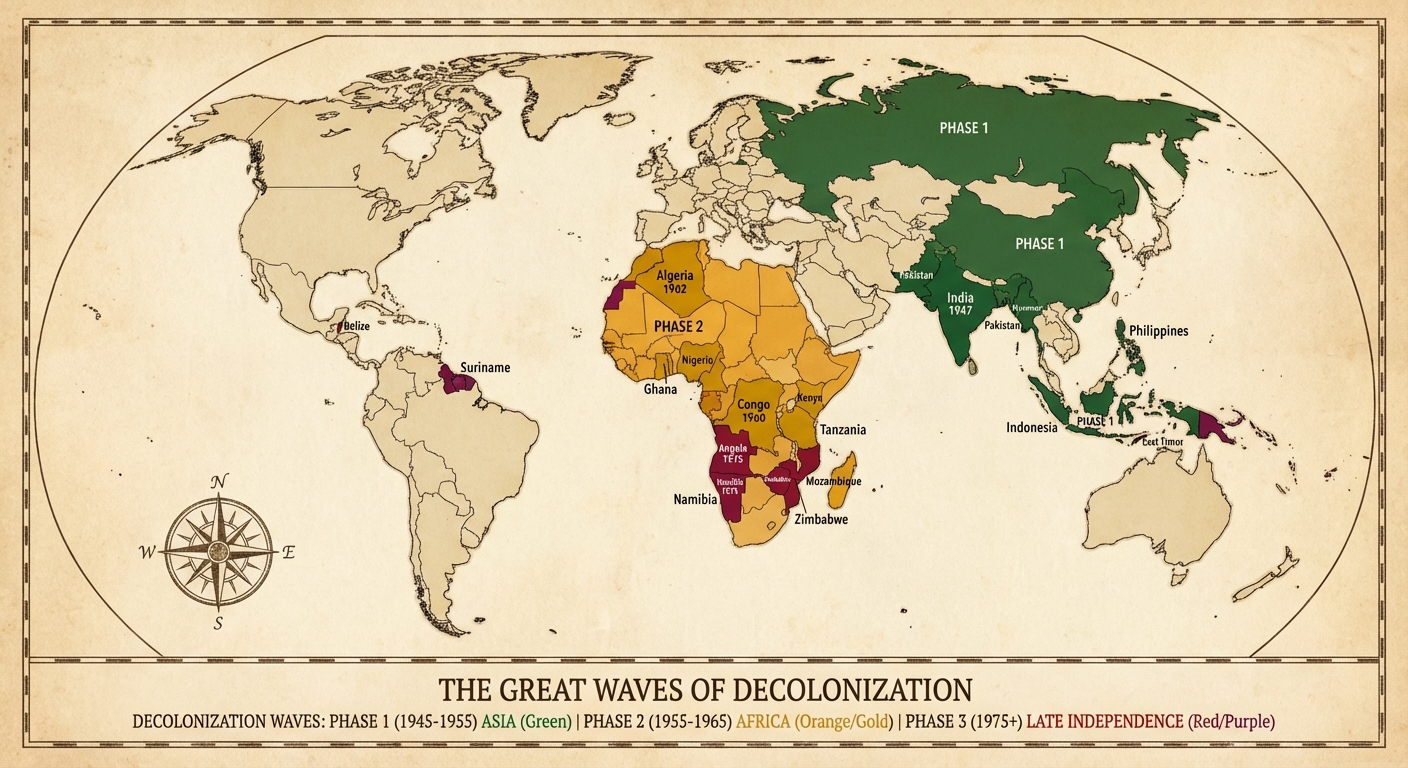
World War II exhausted European powers economically and militarily, making colonial rule unsustainable. Furthermore, the ideological hypocrisy of fighting for freedom against Hitler while holding colonies spurred independence movements.
Models of Decolonization
- Negotiated Independence:
- India (1947): Britain withdrew, partitioning the subcontinent into India and Pakistan.
- Sub-Saharan Africa (1950s-60s): Ghana and Nigeria gained independence from Britain relatively peacefully.
- Violent Conflict:
- Vietnam (1946–1954): France fought to hold Indochina but was defeated at Dien Bien Phu.
- Algeria (1954–1962): A brutal war between French forces and the FLN (National Liberation Front). The conflict caused the collapse of the French Fourth Republic and the return of Charles de Gaulle.
Impacts on Europe
- Reverse Migration: Immigrants from former colonies moved to Europe (e.g., North Africans to France, Caribbean/South Asians to the UK).
- Loss of Prestige: European powers could no longer act as global superpowers on their own (evidenced by the Suez Crisis of 1956).
9.5 The Fall of Communism (1989-1991)
Causes of Collapse
- Economic Stagnation: The command economy could not produce consumer goods or compete with the computer age.
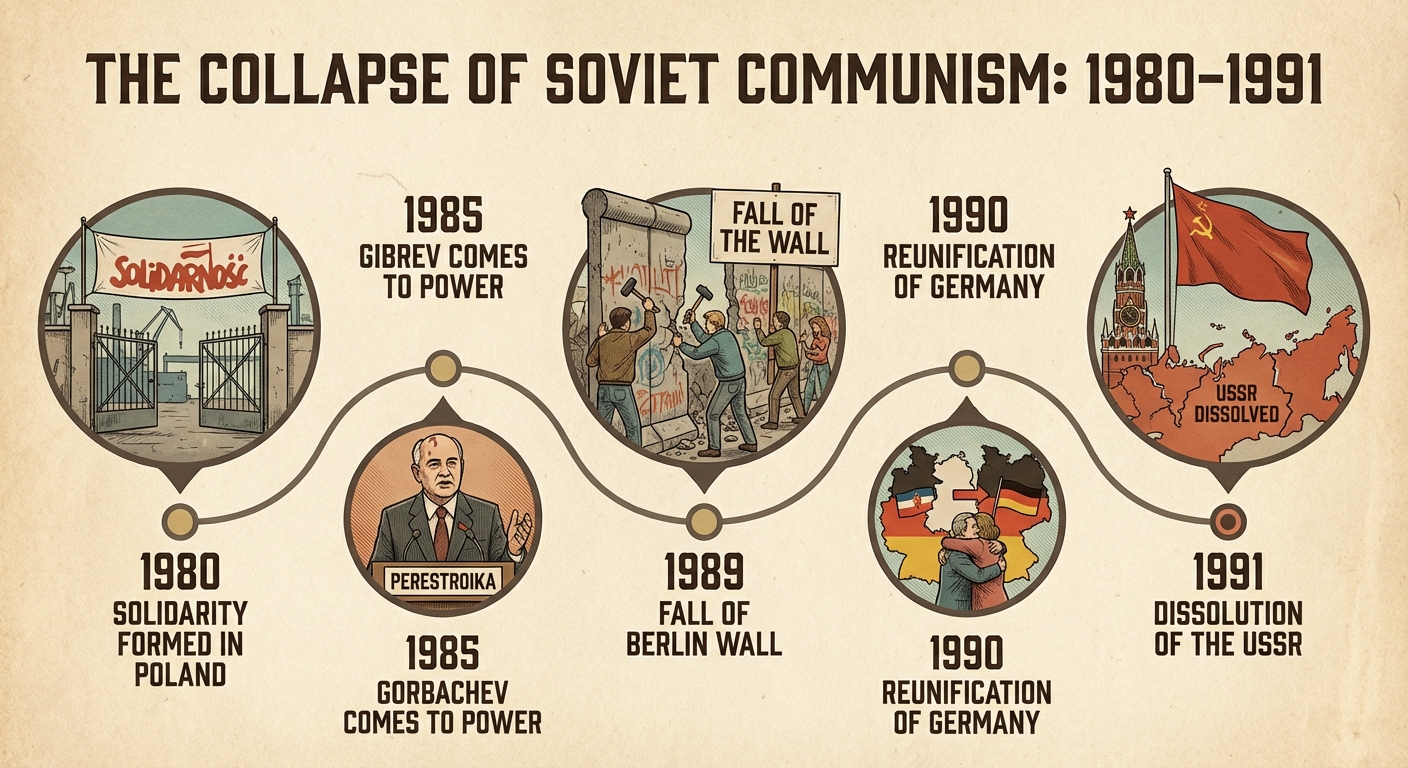
- The Gorbachev Era (1985–1991): Mikhail Gorbachev introduced two radical reforms:
- Glasnost (Openness): Ended censorship involved free speech.
- Perestroika (Restructuring): Introduced limited free-market practices.
- Crucially: Gorbachev renounced the Brezhnev Doctrine, refusing to use force to keep satellite states compliant.
The Year of Miracles (1989)
- Poland: The Solidarity movement, led by Lech Wałęsa (and supported by Pope John Paul II), forced free elections.
- Fall of the Berlin Wall (Nov 9, 1989): East Germans demonstrated for travel rights; the border opened, and the wall was dismantled physically and metaphorically.
- Velvet Revolution: Peaceful overthrow of communism in Czechoslovakia led by playwright Václav Havel.
Dissolution of the Soviet Union (1991)
Following a failed coup by hardliners, the USSR officially dissolved on December 26, 1991. Boris Yeltsin became the president of the Russian Federation.
9.6 European Integration: The European Union
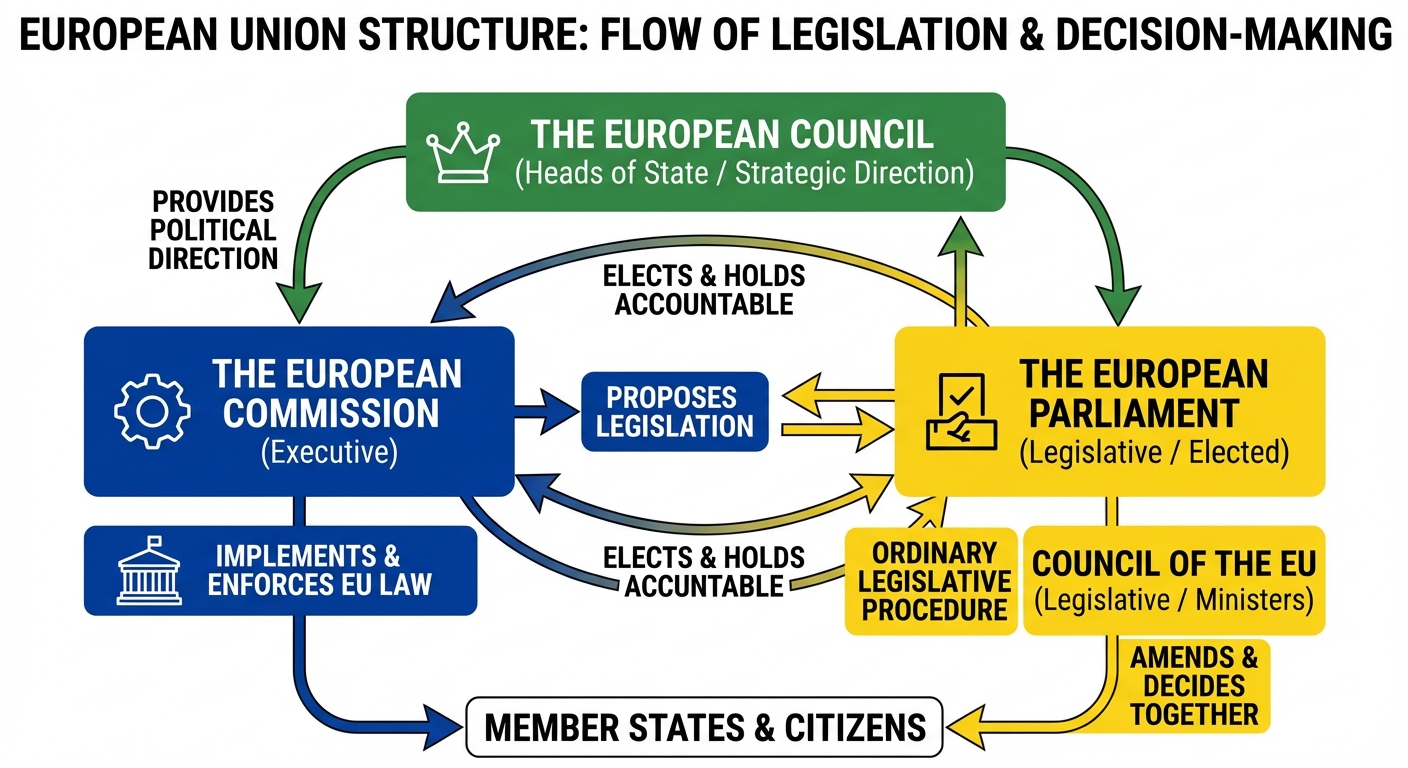
The drive for unity was intended to prevent future wars by integrating economies so tightly that conflict would be impossible.
Evolution of the EU
- ECSC (1951): European Coal and Steel Community (6 nations sharing resources mainly to control German rearmament).
- Treaty of Rome (1957): Created the European Economic Community (EEC) or "Common Market"—eliminated tariffs.
- Maastricht Treaty (1991): Officially created the European Union (EU). Proposed a common currency (Euro) and common citizenship.
- The Euro (1999/2002): A common currency adopted by most (but not all) member states (The Eurozone).
Challenges to Integration
- Euroskepticism: Fear of losing national sovereignty to bureaucrats in Brussels.
- Brexit (2016 vote, 2020 exit): The UK voted to leave the EU, citing immigration control and sovereignty.
- Debt Crisis (2009): Southern European economies (Greece, Italy, Spain) required bailouts, creating tension with wealthier Northern nations (Germany).
9.7 Society and Culture in the 20th & 21st Century
Feminism (Second Wave)
While First Wave feminism focused on suffrage, Second Wave Feminism (1960s-70s) focused on work, sexuality, and reproductive rights.
- Simone de Beauvoir: Wrote The Second Sex (1949), arguing that "One is not born, but rather becomes, a woman," challenging patriarchal social constructs.
- Margaret Thatcher: The "Iron Lady," first female PM of the UK (1979–1990), though a conservative who often clashed with feminist groups.
Philosophy and Arts
- Existentialism: Jean-Paul Sartre and Albert Camus argued that in a godless world, humans must define their own meaning through action.
- Postmodernism: Distrust of "grand narratives" (like communism or pure science); emphasized relativity, irony, and the fragmentation of truth.
- Vatican II (1962–1965): Modernized the Catholic Church (Mass in vernacular languages) to address the contemporary world.
Migration and Demographics
- Guest Workers (Gastarbeiter): West Germany invited Turkish workers in the 1960s to fill labor shortages.
- 2015 Refugee Crisis: Millions fled the Syrian Civil War and instability in the Middle East to Europe, fueling the rise of right-wing nationalist parties.
Technological Developments
- Big Science: Government-funded research led to the Space Race, nuclear power, and the Internet.
- Medical Advances: Antibiotics (penicillin), In-vitro fertilization (IVF), and genetic engineering.
Common Mistakes & Pitfalls
- Confusing 1989 and 1991:
- 1989 = Fall of the Berlin Wall and end of communism in Eastern Europe (Satellite states).
- 1991 = Dissolution of the Soviet Union itself.
- Misunderstanding the "Welfare State": Students often label Western European welfare states as "Socialist" or "Communist." They are Capitalist (free market) economies with high taxes and high social benefits. They remain democracies.
- The EU vs. Europe: The European Union does not include every country in Europe (e.g., Switzerland, Norway, and now the UK are not members).
- Conflating NATO and the EU: NATO is a military alliance (includes USA/Canada). The EU is an economic/political union. Some countries are in one but not the other.
- Prague Spring (1968) vs. Velvet Revolution (1989): Both happened in Czechoslovakia. 1968 failed (violent repression); 1989 succeeded (peaceful transition).