Unit 5 Comprehensive Review: Agriculture and Rural Land Use
Introduction to Agriculture and Land Use
Agriculture is the deliberate modification of Earth's surface through cultivation of plants and rearing of animals to obtain sustenance or economic gain. It is the core of the Primary Economic Sector.
Economic Sectors Overview
To understand agriculture's role, you must understand economic sectors:
- Primary Sector: Extracting natural resources directly from the earth (Agriculture, mining, fishing, forestry). Dominant in Least Developed Countries (LDCs).
- Secondary Sector: Processing raw materials into finished goods (Manufacturing, industry).
- Tertiary Sector: Service-based economic activities (Retail, law, teaching). Dominant in More Developed Countries (MDCs).
Key Density Concepts
Understanding population pressure on land is crucial for this unit. Use these formulas:
- Arithmetic Density:
- Physiological Density: (High physiological density suggests pressure on food production).
- Agricultural Density:
- Note: Developed countries have low agricultural density because technology allows few farmers to feed many people. Developing countries have high agricultural density.
Rural Settlement Patterns and Survey Methods
How people divide and settle land reflects their culture, history, and geography.
Rural Settlement Patterns
- Clustered Settlements (Nucleated): Homes are grouped closely together near a central node (church, well, market). Common in Europe and parts of Africa/Asia to share resources and defense.
- Dispersed Settlements: Homes are spread far apart with land separating them. Common in the North American Midwest and Australia (promoted by mechanization and land abundance).
- Linear Settlements: Buildings run along a fixed landscape feature like a road, river, or dike. Common in French America (Quebec, Louisiana).
Rural Survey Methods
North America uses three distinct systems to define property boundaries:
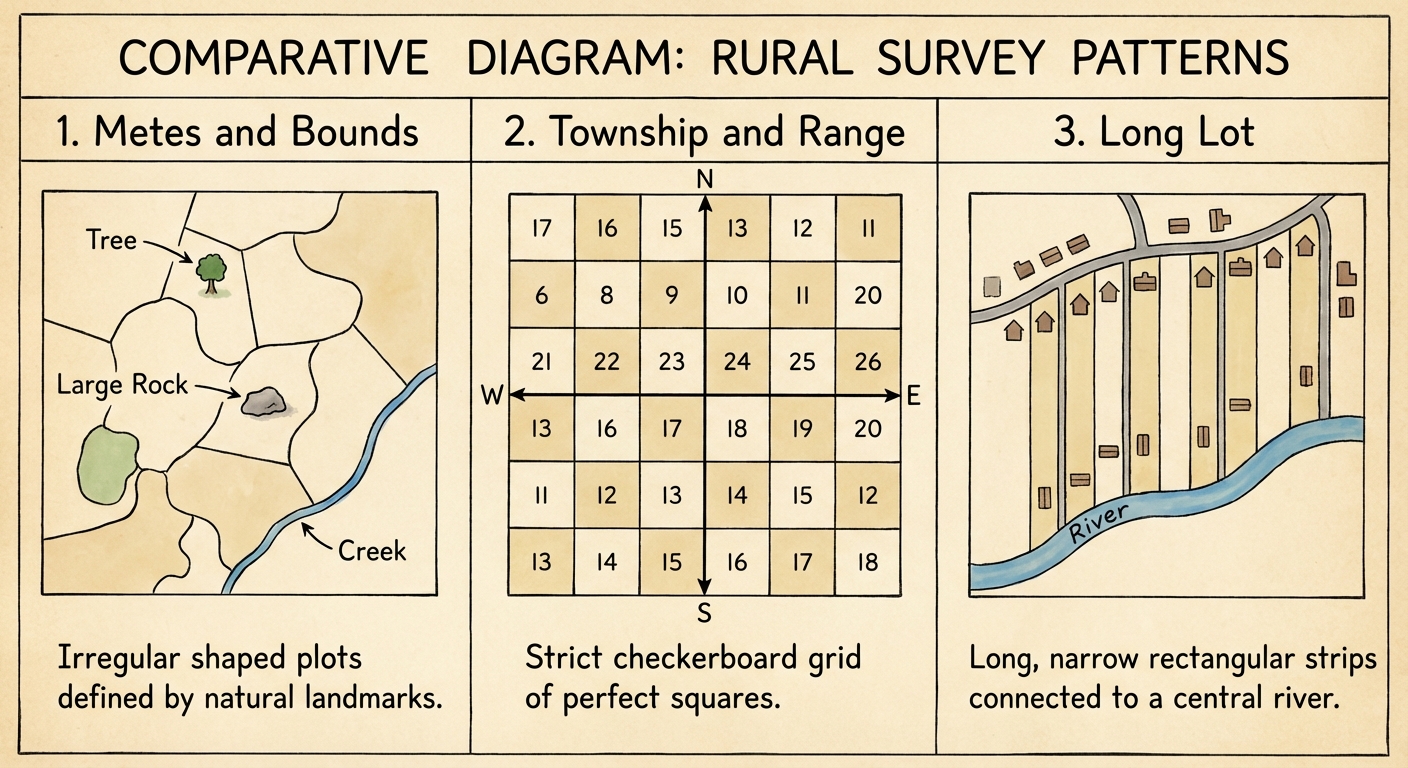
- Metes and Bounds:
- Origin: English.
- Method: Uses physical features (trees, rocks, streams) to define irregular boundaries.
- Location: U.S. East Coast (13 colonies).
- Township and Range:
- Origin: U.S. Land Ordinance of 1785 (Thomas Jefferson).
- Method: A rigid grid system dividing land into 6x6 mile townships and 1x1 mile sections.
- Location: U.S. Midwest and West.
- Long Lot System:
- Origin: French.
- Method: Narrow parcels stretching back from a river or road to give every farmer access to transport/water.
- Location: Quebec, Louisiana, Texas.
Common Mistakes
- Mistake: Confusing High Agricultural Density with High Total Population.
- Correction: A country can have a small population but high agricultural density if it has very little arable land and inefficient farming (lots of farmers).
Agricultural Origins and Revolutions
Agriculture has evolved through three major distinct revolutions.
The First Agricultural Revolution (Neolithic Revolution)
Occurred approx. 10,000 BCE. The shift from hunting/gathering to settled farming.
- Process: Domestication of plants (Vegetative planting first, then Seed agriculture) and animals.
- Result: Reliable food supply $\rightarrow$ Population boom $\rightarrow$ Job specialization $\rightarrow$ Civilization.
Major Hearths of Domestication
| Region | Key Crops | Key Animals |
|---|---|---|
| Fertile Crescent (Southwest Asia) | Wheat, Barley, Oats | Sheep, Goats, Cattle, Pigs |
| Southeast Asia | Taro, Mango, Coconut | Chickens |
| East Asia | Rice, Soybeans | |
| Sub-Saharan Africa | Yams, Sorghum, Coffee | |
| Mesoamerica | Maize (Corn), Beans, Squash | Turkeys |
| Andean Highlands | Potatoes | Llamas, Alpacas |
The Columbian Exchange
After 1492, the global movement of plants and animals between the Afro-Eurasia (Old World) and the Americas (New World).
- To Old World: Maize, potatoes, tomatoes, tobacco (led to population boom in Europe).
- To New World: Wheat, sugar, coffee, horses, cattle, sheep (and diseases).
The Second Agricultural Revolution
Occurred roughly 1700s–1900, concurrent with the Industrial Revolution.
- Key Drivers: Mechanization and transport.
- Enclosure Acts (UK): Consolidated small common lands into large, privately owned farms, pushing peasants to cities (provides labor for factories).
- Innovations:
- Crop Rotation: Preserving soil nutrients (e.g., Norfolk four-field system).
- Mechanization: Seed drill (Jethro Tull), Cotton Gin, Steel Plow, McCormick Reaper.
The Third Agricultural Revolution (The Green Revolution)
Began mid-20th Century (1950s/60s). Focus on biotechnology and genetic modification.
- Father of Green Rev: Norman Borlaug.
- Key Technologies:
- High-Yield Varieties (HYVs): Specially bred wheat, corn, and rice (shorter stalks, more grain).
- Chemical Fertilizers & Pesticides.
- Irrigation expansion.
- Impact: Saved millions from starvation (especially in India and Mexico).
Pros vs. Cons of Green Revolution
| Positives | Negatives |
|---|---|
| Drastic increase in food resulting in lower prices. | Environmental damage (runoff, soil depletion). |
| Reduced reliance on food imports for LDCs (India became self-sufficient). | High cost of seeds/chemicals forces small farmers into debt. |
| Prevents famine. | Loss of biodiversity (monoculture). |
| Gender Gap: Technology often controlled by men, displacing female labor. |
Agricultural Production Regions (Derwent Whittlesey)
Whittlesey identified 11 main agricultural regions, split between Subsistence and Commercial.
1. Subsistence Agriculture (Mostly LDCs)
Production of food primarily for consumption by the farmer's family.
- Shifting Cultivation (Slash-and-Burn):
- Where: Tropical rainforests (Amazon, Central Africa).
- Method: Clear land, burn vegetation (ash provides nutrients), farm for 3-5 years until soil depletes, move to new plot.
- Issue: Sustainable only with low population output; causes deforestation.
- Pastoral Nomadism:
- Where: Drylands/Arid regions (North Africa, Central Asia).
- Method: Herding animals (camels, goats) to find pasture. Uses Transhumance (seasonal migration between mountains and lowlands).
- Intensive Subsistence (Wet Rice Dominant):
- Where: S.E. Asia, East India, S.E. China.
- Method: Terracing, flooding fields (Sawah), labor-intensive, double-cropping.
2. Commercial Agriculture (Mostly MDCs)
Production of food primarily for sale off the farm.
- Plantation Farming:
- Status: Commercial agriculture found in LDCs (Tropics/Subtropics).
- Crops: Cash crops (Cotton, Coffee, Rubber, Bananas, Tea).
- Structure: Often owned by MNCs (Multinational Corporations) from MDCs; legacy of colonialism.
- Mixed Crop and Livestock:
- Where: U.S. Midwest, Central Europe.
- Method: Crops (corn/soy) are grown to feed animals; animals provide manure and meat/eggs/dairy (primary income).
- Dairy Farming:
- Where: Near urban centers (NE United States, NW Europe).
- Concept: Milkshed (the radius where milk can be supplied without spoiling). Improvements in refrigeration have expanded the milkshed.
- Mediterranean Agriculture:
- Where: Areas with hot/dry summers and mild/wet winters (California, Chile, Mediterranean basin, South Africa, SW Australia).
- Crops: Olives, grapes, figs, citrus (Horticulture).
- Livestock Ranching:
- Where: Arid/Semi-arid regions (Western U.S., Pampas of Argentina, Australia).
- Method: Extensive grazing over large areas (unsuitable for crops).
- Grain Farming:
- Where: Great Plains (US/Canada), Ukraine, Russia.
- Method: Highly mechanized wheat production (Spring Wheat belt vs. Winter Wheat belt).
- Commercial Gardening (Truck Farming):
- Where: U.S. Southeast.
- Crops: Apples, lettuce, tomatoes. relies on migrant labor; products sold fresh or canned.
Intensive vs. Extensive (The Classification Rule)
- Intensive: High inputs of labor/capital per unit of land. (e.g., Market Gardening, Rice farming, Plantation).
- Extensive: Low inputs of labor/capital per unit of land. (e.g., Ranching, Shifting Cultivation, Nomadic Herding).
Spatial Organization: The Von Thünen Model
Proposed by Johann von Thünen (1826) to explain rural land use patterns based on transportation costs and land value (Bid-Rent Theory).
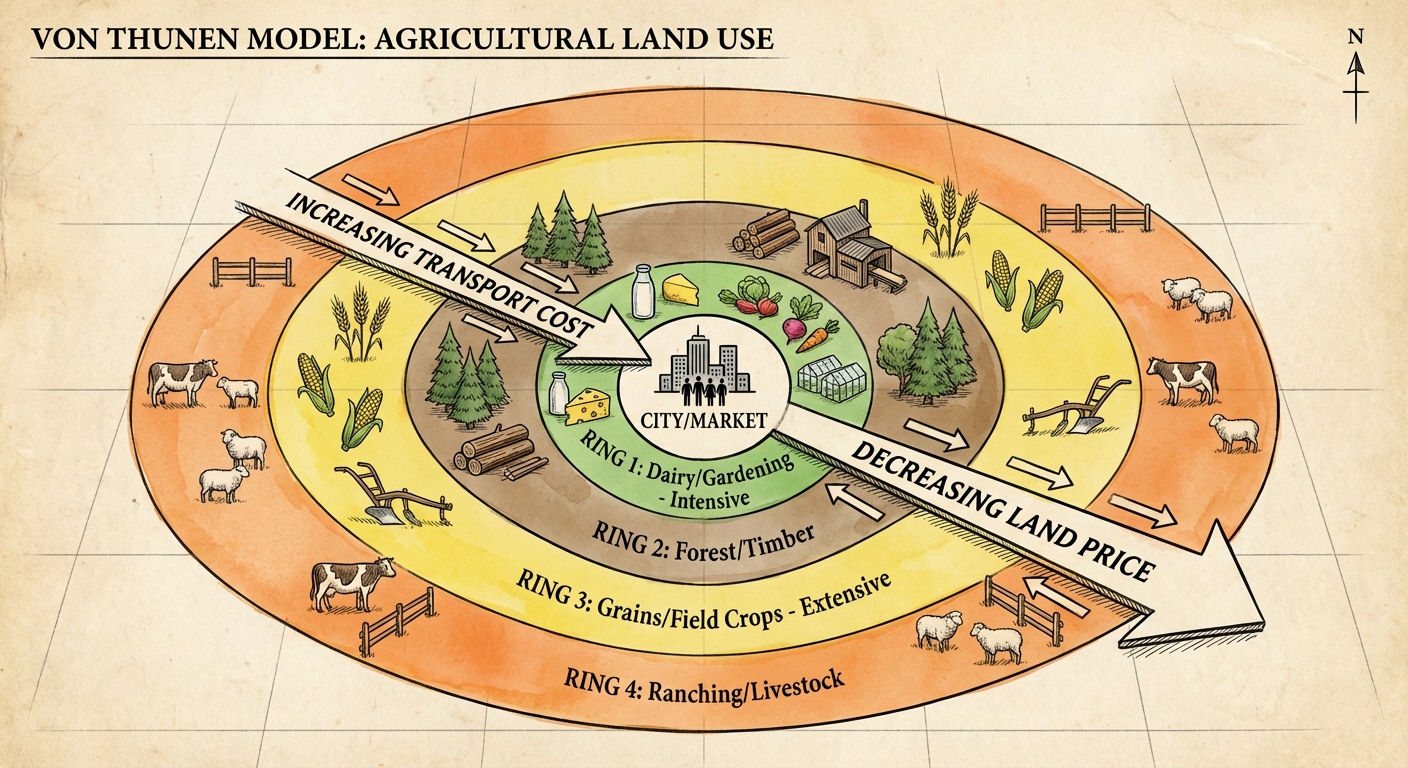
The Bid-Rent Theory
- Land closest to the market is most expensive.
- Land farthest away is cheapest.
- Formula for profit:
- P = Profit, V = Value of commodity, E = Production expenses, T = Transportation costs.
The Rings (Center Outward)
- Market/Urban Center: The consumers.
- Ring 1: Horticulture & Dairying: Perishable items (milk, strawberries) and difficult to transport items. Needs to be close to market. High land rent, intensive land use.
- Ring 2: Forestry: Wood for building/fuel. Heavy and expensive to transport, so must be relatively close.
- Ring 3: Grains/Field Crops: Grains are light, non-perishable, and easy to store/transport. Extensive land use.
- Ring 4: Ranching/Livestock: Animals can walk to market (historically); requires vast amounts of cheap land.
Limitations & Changes
- Assumptions: Flat terrain (isotopic plain), consistent soil, ox-cart transport.
- Modern deviations: Refrigeration (milksheds expanded), improved transport (trucks/trains), forests no longer needed for fuel near cities.
Modern Global Agriculture
Agribusiness
Commercial agriculture characterized by the integration of different steps in the food-processing industry, usually through ownership by large corporations.
- Vertical Integration: A company owns the farm, the processing plant, the trucking, and the marketing (e.g., Tyson Foods).
- Commodity Chains: The global network of labor and production processes that results in the finished commodity.
Global Issues
- Neocolonialism: LDCs produce cash crops (coffee, cocoa) for MDCs at the expense of their own local food security.
- Fair Trade movement: Attempts to ensure small farmers in LDCs get a fair price and living wage (often organic/sustainable).
- Food Deserts: Urban or rural areas with limited access to fresh, nutritious food (common in low-income areas).
Environmental Consequences
- Desertification: Human actions (overgrazing) causing land to deteriorate to a desert-like condition (e.g., The Sahel in Africa).
- Salinization: Accumulation of salts in soil due to excessive irrigation in arid regions; poisons crops.
- Slash and Burn: Causes deforestation and loss of carbon sinks (Rainforests).
- Aquifer Depletion: Draining underground water reserves faster than they replenish (e.g., Ogallala Aquifer in US).
Contemporary Trends
- GMOs (Genetically Modified Organisms): Genes spliced to resist pests (Bt corn) or tolerate weedkillers (Roundup Ready). Common in US/Americas; controversial/banned in EU.
- Organic Farming: Farming without synthetic chemicals. Fastest growing sector in MDCs.
- Aquaculture (The Blue Revolution): Cultivation of seafood under controlled conditions. Has overtaken wild fishing in volume. Problems: high fish waste, disease spread.
- Women in Agriculture:
- In LDCs, women make up ~43% of the ag workforce (much higher in parts of Africa/Asia) but often lack land rights, credit, and education.
- In MDCs, women are increasingly involved in agribusiness management and niche markets (organic/local).
Common Mistakes to Avoid
- Confusing Subsistence vs. Commercial: Just because a farm is in a "poor" country doesn't mean it is subsistence. Plantations in LDCs are commercial (crops are for export, not the worker's family).
- Forestry in Von Thünen: Students forget the second ring is wood. Remember, in 1826, wood was fuel (heavy/essential). It is not there because trees strictly "grow better" there, but because of transport cost.
- Green Revolution vs. Sustainability: The Green Revolution was about quantity (feeding people), not environmental sustainability. In fact, it often relied on unsustainable chemical use.
- Terracing: This is NOT just an aesthetic choice. It is a necessary modification of the landscape in hilly regions (East Asia, Andes) to reduce soil erosion and capture water for rice.