Comprehensive Guide to Dictionary SAT Advanced Math
Equivalent Expressions and Polynomial Operations
The ability to rewrite expressions into equivalent forms is fundamental to the Advanced Math section. You must recognize underlying structures and manipulate polynomials, radicals, and rational exponents with fluency.
1. Operations with Polynomials
Polynomials are expressions consisting of variables and coefficients involving only non-negative integer exponents.
- Addition/Subtraction: You can only combine like terms (terms with the same variable and same exponent).
- Example: $(3x^2 + 5x) - (x^2 - 2x) = 2x^2 + 7x$
- Multiplication: Use the Distributive Property (FOIL for binomials).
- Rule: $(a+b)(c+d) = ac + ad + bc + bd$
2. Rational Exponents and Radicals
The SAT frequently tests the relationship between fractional exponents and roots. You must memorize this conversion:
| Rule Name | Formula | Example |
|---|---|---|
| Product Rule | $x^a \cdot x^b = x^{a+b}$ | $x^2 \cdot x^3 = x^5$ |
| Power Rule | $(x^a)^b = x^{ab}$ | $(x^2)^3 = x^6$ |
| Negative Exponent | $x^{-a} = \frac{1}{x^a}$ | $2^{-3} = \frac{1}{8}$ |
3. Factoring Techniques
Factoring is the reverse of multiplication. It is the primary tool for solving quadratic equations. Look for these patterns:
- Greatest Common Factor (GCF): Always check this first. $4x^2 - 8x \rightarrow 4x(x - 2)$.
- Difference of Squares: $a^2 - b^2 = (a-b)(a+b)$.
- Perfect Square Trinomials: $a^2 \pm 2ab + b^2 = (a \pm b)^2$.
4. Rational Expressions
These are fractions where the numerator and denominator are polynomials.
- Simplifying: Factor both top and bottom, then cancel common factors. Note: You cannot cancel terms separated by addition/subtraction.
- Equivalent Forms: To determine if two rational expressions are equivalent, find a common denominator or perform polynomial long division.
Nonlinear Equations in One Variable
This section focuses on solving equations where the variable has an exponent other than 1 (principally quadratics), or the variable appears in a denominator or radical.
1. Solving Quadratic Equations
Standard form:
There are three main ways to solve standard quadratics:
- Factoring: Use the Zero Product Property. If $(x-3)(x+5)=0$, then $x=3$ or $x=-5$.
- Completing the Square: Useful for converting to vertex form (discussed later).
- The Quadratic Formula: A universal solvent for any quadratic equation.
2. The Discriminant and Number of Solutions
The expression under the square root in the quadratic formula, $b^2 - 4ac$, is called the Discriminant. It tells you the nature of the solutions without solving the equation.
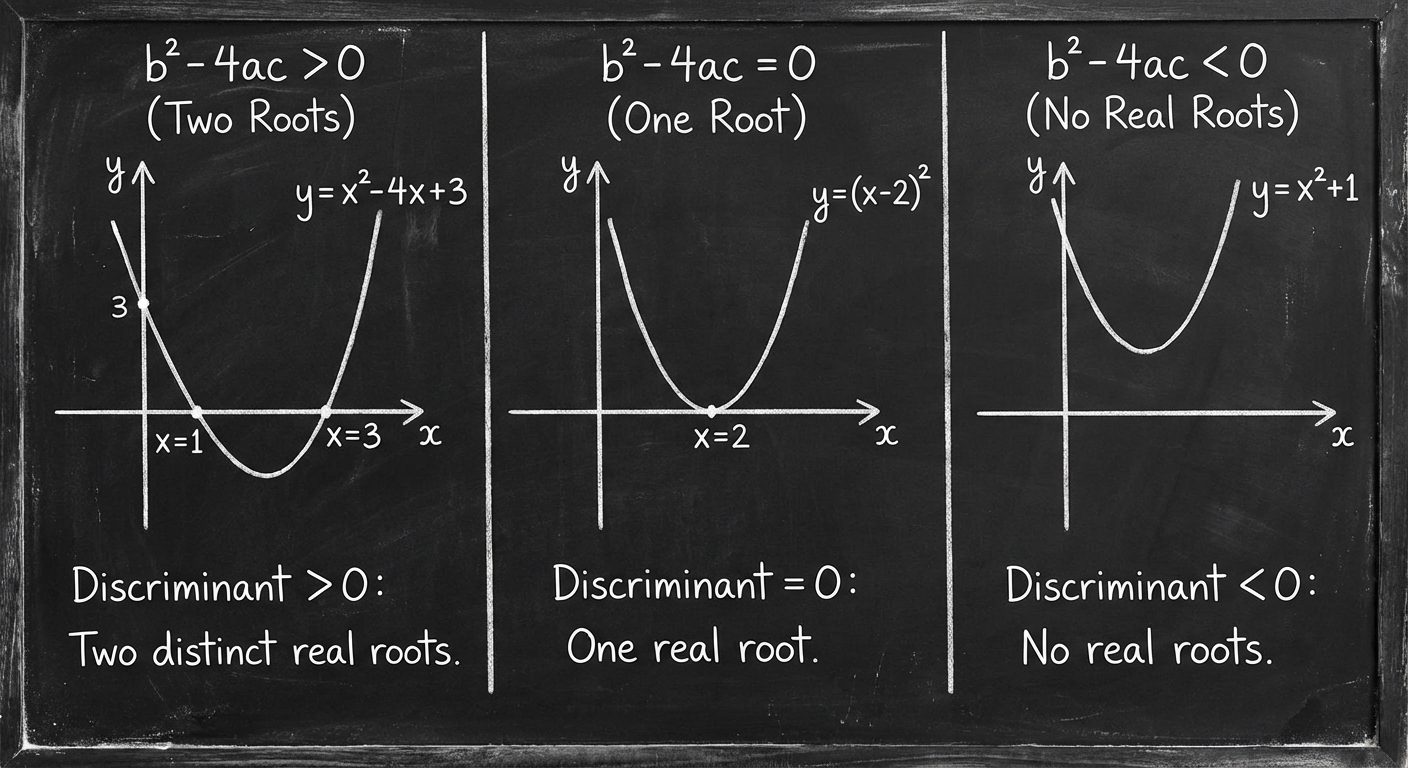
- If $b^2 - 4ac > 0$: Two distinct real solutions ($x$-intercepts).
- If $b^2 - 4ac = 0$: One real solution (a "double root"; the vertex touches the x-axis).
- If $b^2 - 4ac < 0$: No real solutions (2 complex/imaginary solutions; graph does not touch x-axis).
3. Radical and Rational Equations
- Radical Equations: Isolate the radical, square both sides, and solve.
- Rational Equations: Multiply the entire equation by the least common denominator to eliminate fractions.
Crucial Step: When solving these types of equations, you MUST check for Extraneous Solutions. These are "solutions" derived algebraically that do not make the original equation true (often resulting in division by zero or a square root of a negative).
Systems of Equations in Two Variables
In Advanced Math, systems often involve one linear equation and one nonlinear equation (usually a quadratic), or two nonlinear equations.
1. Methods of Solution
- Substitution: This is usually the most efficient method for nonlinear systems. Isolate $y$ in the linear equation and plug it into the quadratic equation.
- Elimination: Useful only if term structures align perfectly (e.g., both equations have a $y$ term with the same coefficient).
2. Geometric Interpretation
A solution to a system is a coordinate point $(x, y)$ where the graphs intersect.
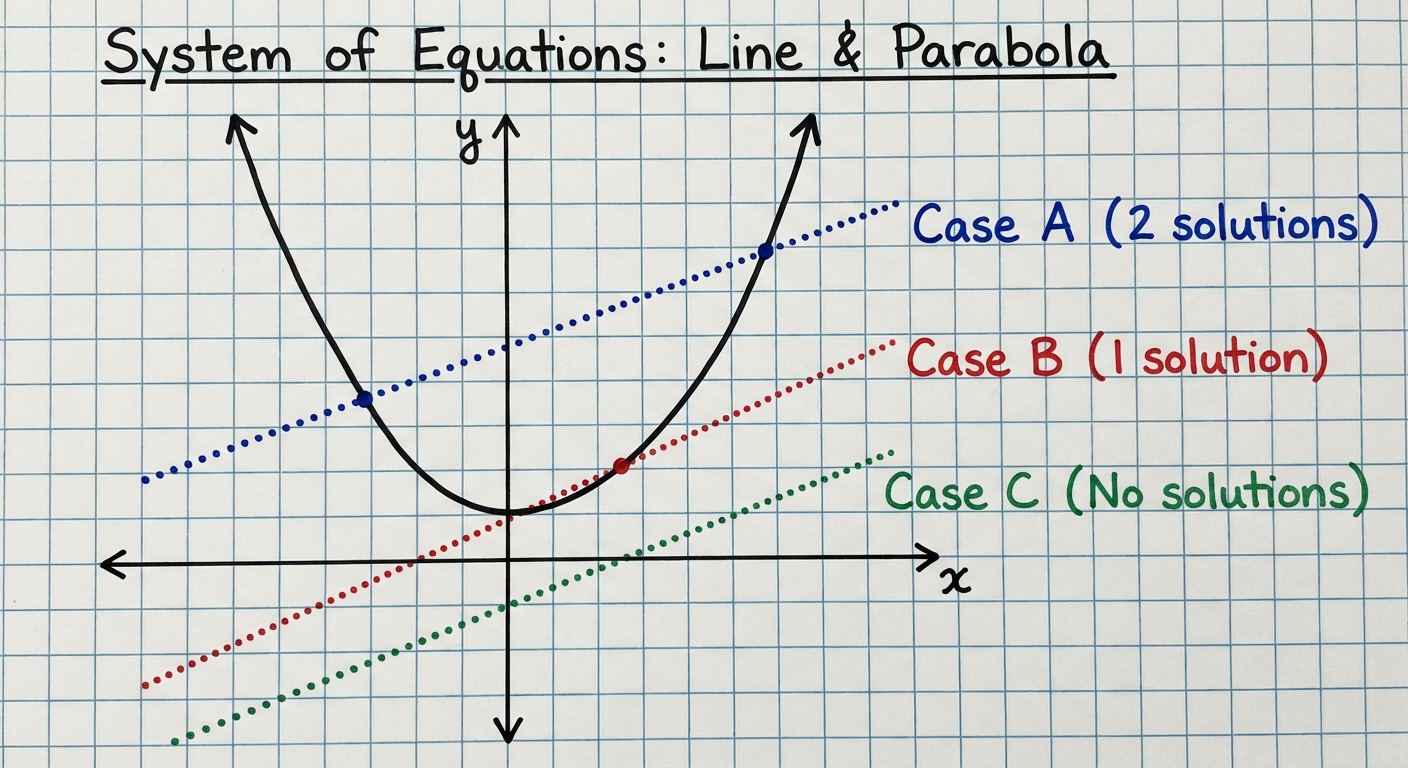
- 2 Solutions: The line cuts through the parabola.
- 1 Solution: The line is tangent to the parabola.
- 0 Solutions: The line and parabola never meet.
Common Exam Question: "For what value of constant $k$ does the system have exactly one solution?"
Strategy: Set equations equal, move everything to one side to form a new quadratic, and set the discriminant of that new quadratic to 0.
Nonlinear Functions
Understanding function notation $f(x)$ and the behavior of graphs is essential.
1. Quadratic Functions (Parabolas)
You must be able to switch between forms to extract information:
Standard Form: $y = ax^2 + bx + c$
- $c$ is the $y$-intercept.
- If $a > 0$, opens Up (Minimum). If $a < 0$, opens Down (Maximum).
Vertex Form: $y = a(x-h)^2 + k$
- Vertex is at $(h, k)$. This is the most useful form for finding max/min values.
- To find vertex from Standard Form: $x = -\frac{b}{2a}$.
Intercept Form: $y = a(x-p)(x-q)$
- $x$-intercepts are at $p$ and $q$.
- The vertex $x$-coordinate is the average of intercepts: $\frac{p+q}{2}$.
2. Exponential Functions
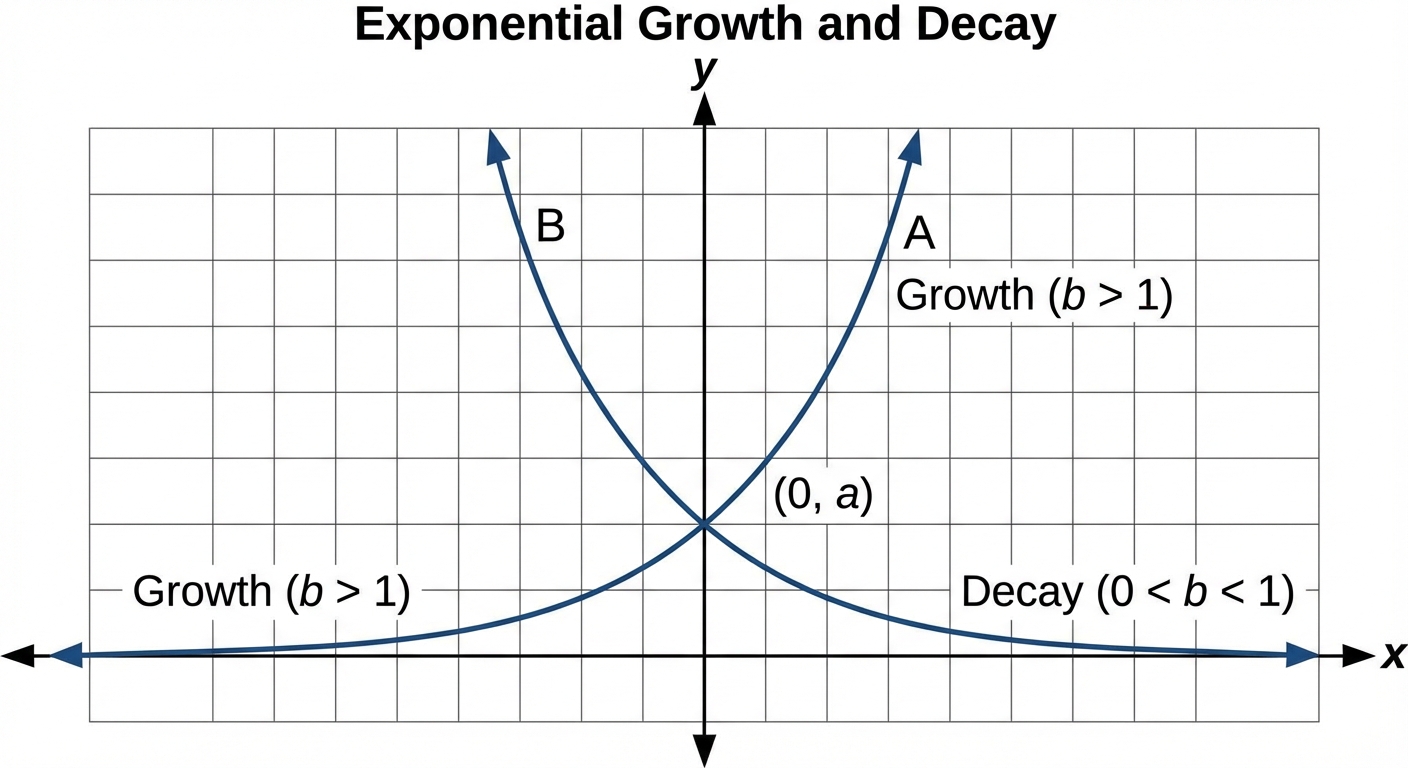
Generic form:
- $a$: The initial value (y-intercept when $x=0$).
- $b$: The growth factor.
- Growth: $b > 1$ (e.g., population doubling).
- Decay: $0 < b < 1$ (e.g., radioactive half-life).
3. Function Transformations
Given a parent function $f(x)$:
- $f(x) + k$: Shift vertical (up $k$).
- $f(x - h)$: Shift horizontal (Right $h$). Note the sign flip!
- $-f(x)$: Reflection over x-axis.
- $cf(x)$: Vertical stretch (if $c > 1$) or compression (if $0 < c < 1$).
Common Mistakes & Pitfalls
The "Freshman Dream" Error:
- Mistake: Thinking $(x+3)^2 = x^2 + 9$.
- Correction: You must FOIL. $(x+3)^2 = (x+3)(x+3) = x^2 + 6x + 9$.
Dividing by Variable:
- Mistake: Evaluating $x^2 = 5x$ by dividing both sides by $x$ to get $x=5$.
- Correction: You lost the solution $x=0$. Always move to one side and factor: $x(x-5) = 0$.
Forgetting Extraneous Solutions:
- Mistake: Solving $\sqrt{x}=-3$, squaring both sides ($x=9$), and circling 9 as the answer.
- Correction: $\sqrt{9} = 3$, not $-3$. The equation has no solution. Always check radical/rational answers.
Vertex Form Signs:
- Mistake: Thinking the vertex of $y = 2(x+4)^2 - 5$ is $(4, -5)$.
- Correction: The form is $(x-h)$. Therefore, $x+4$ means $h = -4$. The vertex is $(-4, -5)$.