Applications of Integration: Average Value and Particle Motion
Finding the Average Value of a Function
In differential calculus, you learned how to find the average rate of change (the slope of the secant line). In integral calculus, we answer a different question: What is the average height of a function over an interval?
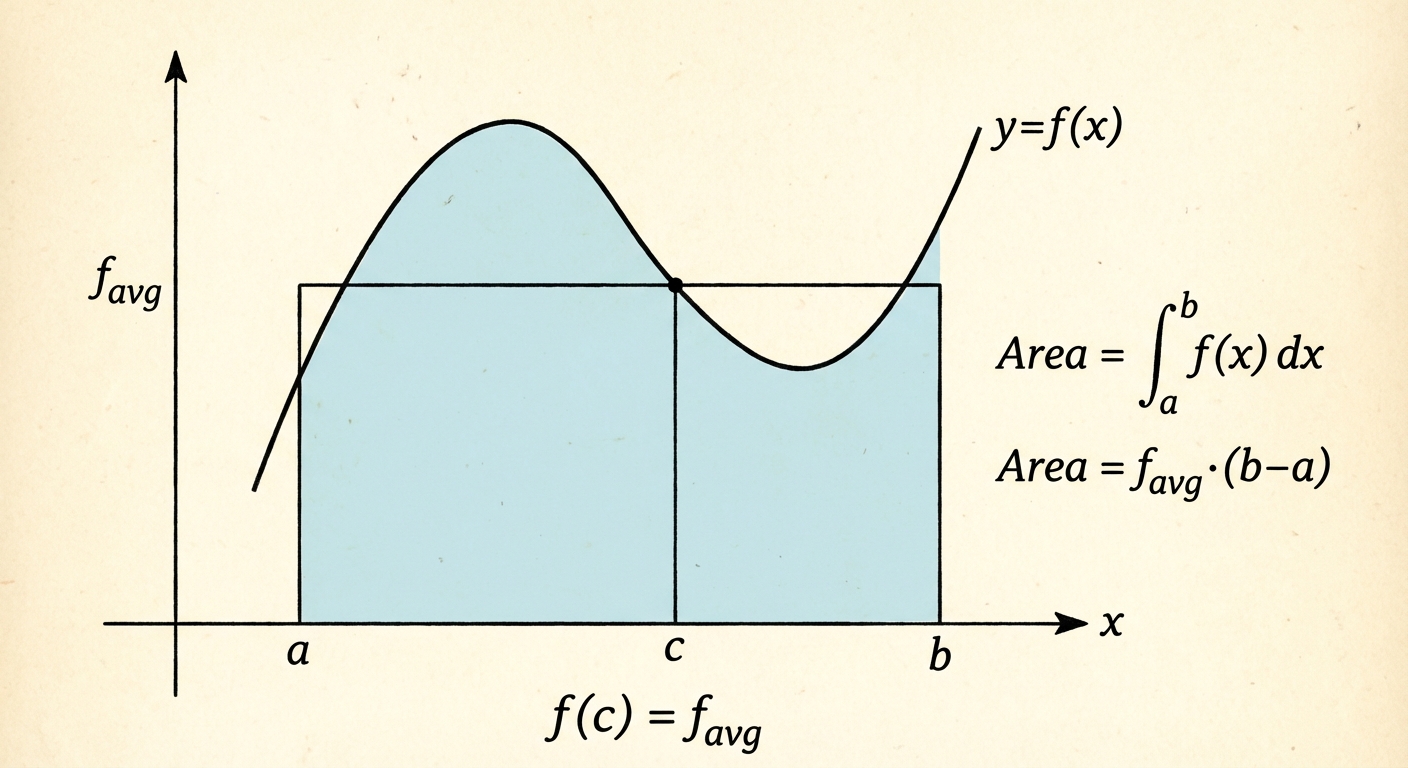
The Average Value of a continuous function $f(x)$ represents the distinct height the function would assume if it were a flat, constant horizontal line while maintaining the same total area under the curve.
The Definition and Formula
If $f$ is integrable on the closed interval $[a, b]$, then the average value of $f$ on this interval is defined as:
To understand this conceptual logic:
- $\int_a^b f(x) \, dx$ represents the Area under the curve.
- $(b-a)$ represents the Width of the interval.
- Since $\text{Area} = \text{Width} \times \text{Height}$, it follows that $\text{Height} = \frac{\text{Area}}{\text{Width}}$.
The Mean Value Theorem for Integrals (MVT-I)
The Mean Value Theorem for Integrals guarantees that a continuous function assumes its average value at least once on the interval.
Theorem: If $f$ is continuous on $[a, b]$, there exists at least one number $c$ in $(a, b)$ such that:
Or, equivalently:
This theorem tells us there is a rectangle with height $f(c)$ and width $(b-a)$ that has exactly the same area as the region under the curve $f(x)$.
Connecting Position, Velocity, and Acceleration
Motion problems are a staple of the AP Calculus BC exam. While Unit 4 covered motion using derivatives, Unit 8 applies integrals to move "backwards" from acceleration to velocity, or velocity to position. This relies heavily on the Net Change Theorem.
Notation and Relationships
Let $s(t)$ or $x(t)$ represent position, $v(t)$ represent velocity, and $a(t)$ represent acceleration.
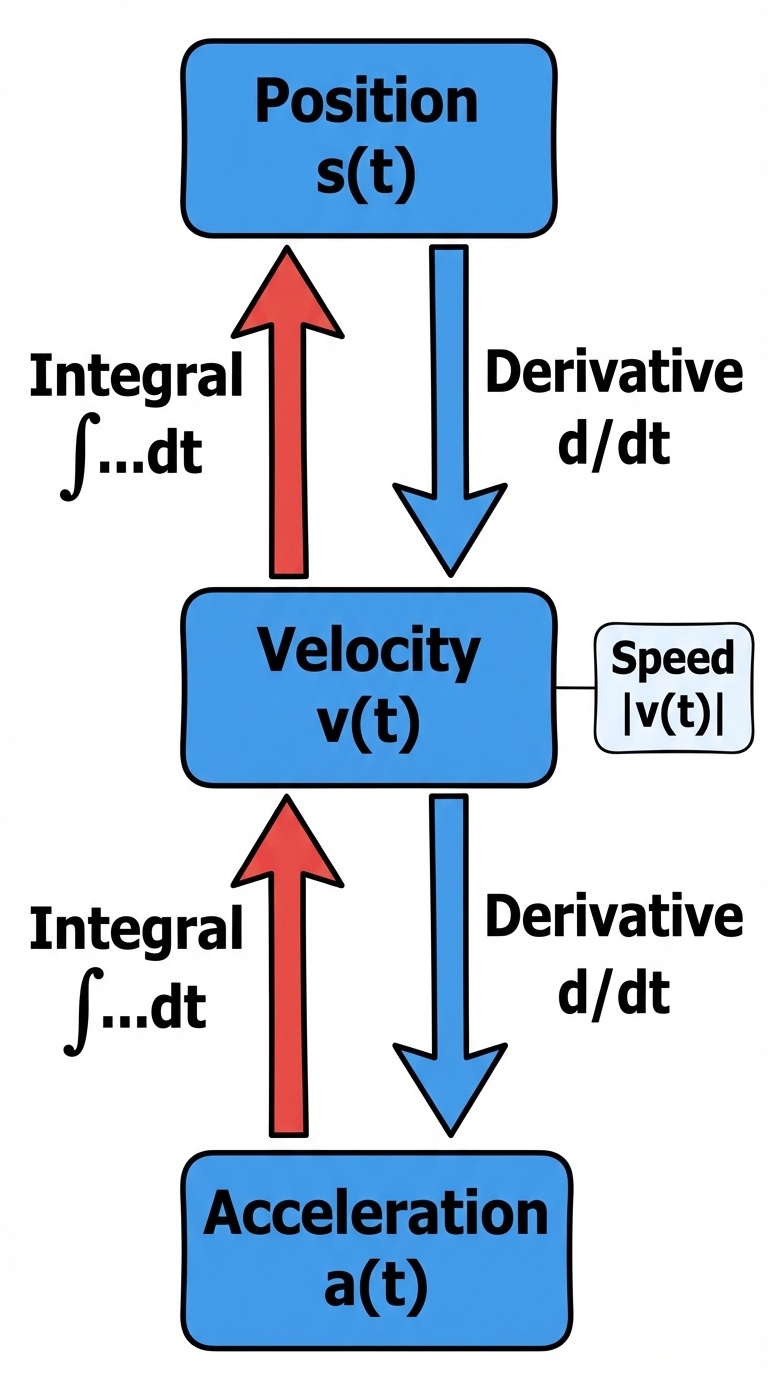
| Quantity | Relationship (derivative) | Relationship (integral) |
|---|---|---|
| Position $s(t)$ | $s(t) = s(0) + \int_0^t v(x) \, dx$ | |
| Velocity $v(t)$ | $v(t) = s'(t)$ | $v(t) = v(0) + \int_0^t a(x) \, dx$ |
| Acceleration $a(t)$ | $a(t) = v'(t) = s''(t)$ | |
| Speed | $ | v(t) |
Displacement vs. Total Distance Traveled
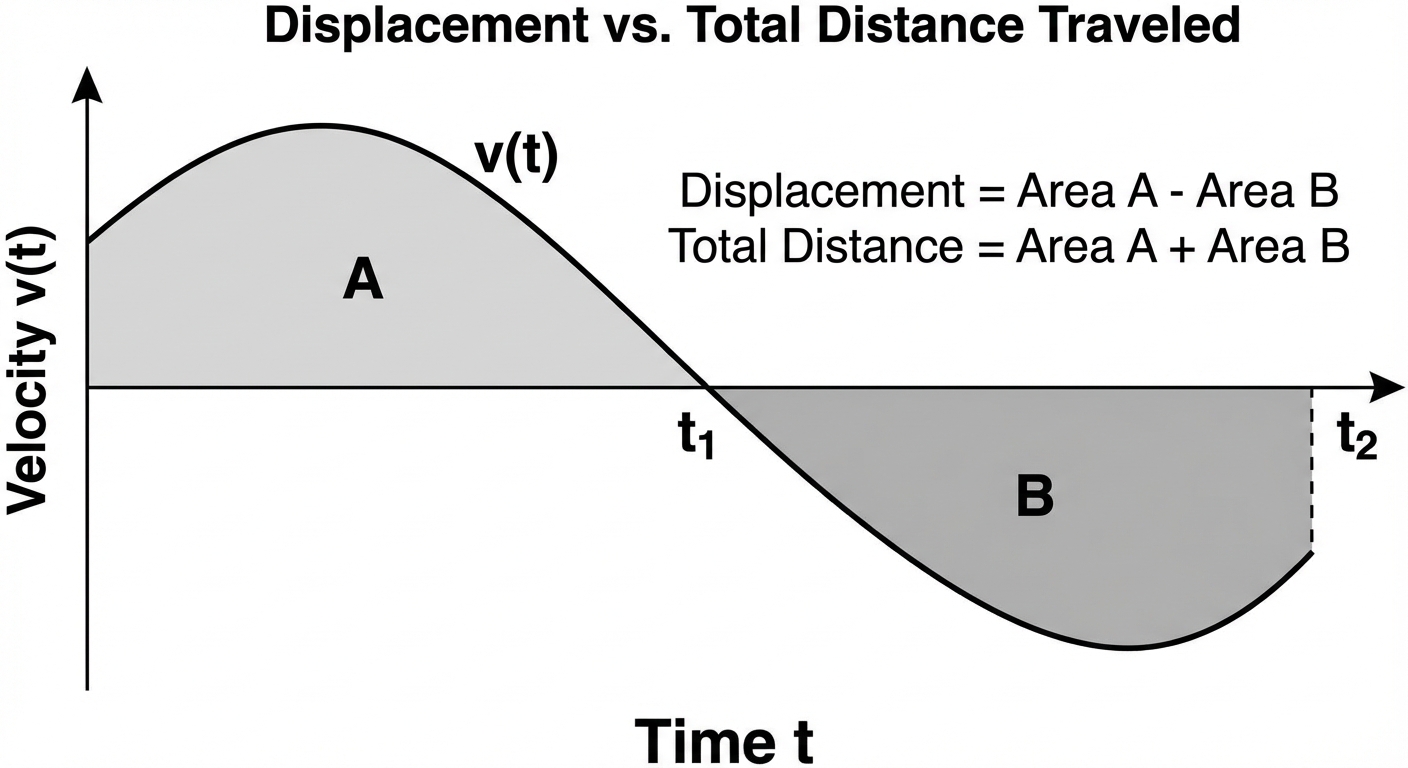
This is the most critical distinction in particle motion problems. You must determine if the question asks for the net change in position or the total ground covered.
1. Displacement
Displacement is the net change in position. It is a vector quantity (direction matters). Positive and negative areas cancel each other out.
2. Total Distance Traveled
Total distance accumulates all movement regardless of direction. It is a scalar quantity. We must integrate the absolute value of velocity (which is speed).
To calculate this manually without a calculator:
- Find where $v(t) = 0$ (where the particle stops/turns around).
- Split the integral into sub-intervals at these turning points.
- Integrate $v(t)$ on each interval, take the absolute value of each result, and sum them.
Finding Current Position
A common exam question asks for the particle's position at a specific time $t=b$, given the velocity function and an initial position at $t=a$. You must use the Fundamental Theorem of Calculus:
Mnemonic: $\text{Final Position} = \text{Initial Position} + \text{Displacement}$
Worked Examples
Example 1: Average Value
Problem: Find the average value of $f(x) = 3x^2 - 2x$ on the interval $[1, 4]$.
Solution:
Using the formula $\frac{1}{b-a} \int_a^b f(x) \, dx$:
Set up the integral:
Find the antiderivative:
Evaluate:
Multiply by the width fraction:
The average value is 16.
Example 2: Particle Motion
Problem: A particle moves along the x-axis with velocity $v(t) = t^2 - 4$ for $0 \le t \le 3$. The initial position is $x(0) = 5$.
Part A: What is the displacement from $t=0$ to $t=3$?
Displacement is -3 units.
Part B: What is the total distance traveled?
First, find when $v(t) = 0$: $t^2 - 4 = 0 \implies t = 2$ (within interval) and $t = -2$ (ignore).
Split integral at $t=2$:
Part C: What is the position at $t=3$?
Common Mistakes & Pitfalls
Average Rate of Change vs. Average Value
- Mistake: Students see the word "Average" and immediately write difference quotient $\frac{f(b)-f(a)}{b-a}$.
- Correction:
- Average Rate of Change (Average Slope) = $\frac{f(b)-f(a)}{b-a}$
- Average Value (Average Height) = $\frac{1}{b-a}\int_a^b f(x) dx$
- Note: The Average Velocity is the Average Value of the Velocity function, which simplifies mathematically to the Average Rate of Change of Position. Be careful with phrasing.
Forgetting Initial Position
- Mistake: When asked for the position at $t=5$, students calculate only $\int_0^5 v(t) dt$.
- Correction: The integral only gives the change in position (displacement). You must add the starting position: $s(5) = s(0) + \int_0^5 v(t) dt$.
Confusing Total Distance and Displacement
- Mistake: Integrating $v(t)$ without absolute values when asked for total distance.
- Correction: Always check if the velocity changes signs (i.e., the particle turns around). If it does, $\int v(t) dt \neq \int |v(t)| dt$.