AP Calculus AB Unit 2 Study Guide: Derivative Meaning, Limit Definition, Notation, Differentiability, and Core Rules
The derivative as an instantaneous rate of change
A big idea in calculus is that you can describe how fast something is changing even when the change is happening continuously. The tool for this is the derivative. Before you learn shortcut rules, it’s essential to understand what the derivative means as a rate of change and as a slope.
From average rate of change to instantaneous rate of change
There are two closely related ways to describe “rate of change.” The first is the average rate of change over an interval, which comes from the slope formula you already know (often said as “rise over run”). For two points and , the slope is often stated as:
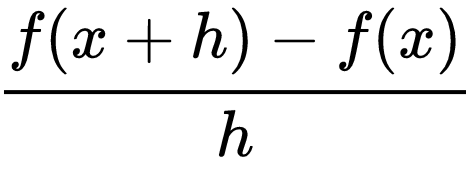
For a function , the average rate of change from to is the slope of the secant line through and :
This measures the “overall steepness” across an interval.
The second is the instantaneous rate of change at a specific point (for example, a speed “right now” or a slope “right here”). You get it by taking the same secant-slope idea but shrinking the interval until it becomes a single point. In other words, it’s the difference quotient with a limit as (fully developed in the next section).
Slopes on curves: secant lines and tangent lines
For a straight (linear) graph, slope is constant and you can compute it directly with “rise over run.” For a curved graph, the slope generally changes from point to point, so we approximate the slope at a point by using a secant line through two nearby points.
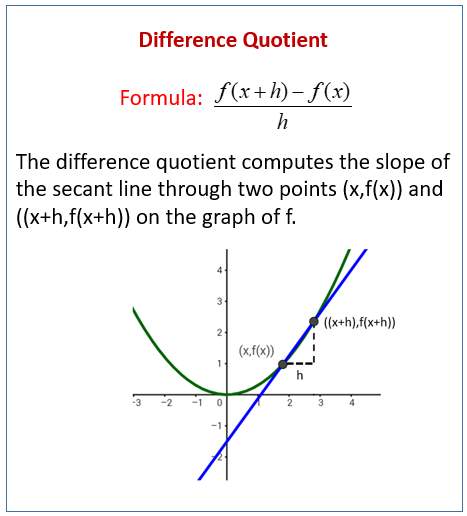
As the two points get closer, the secant line slope becomes more accurate for the slope at the point. In the limit, the secant line becomes the tangent line at that point.
It’s common to hear “a tangent line touches the curve at exactly one point.” What’s always true is that the tangent line matches the curve’s direction at that point. It can still cross the curve and remain tangent there.
Geometric meaning: slope of the tangent line
At a point on a smooth curve, the derivative represents the slope of the tangent line at that point. If , interpret it as: near , the function is increasing at a rate of about 3 units up for every 1 unit to the right.
Physical meaning: velocity as a derivative
If is position as a function of time, then average velocity on an interval is:
Instantaneous velocity at time is the derivative:
Worked example: average vs instantaneous (conceptual)
Suppose a car’s position is given by:
Average velocity from to :
Instantaneous velocity at is the slope of the tangent line at , which you cannot get from a single interval calculation alone; you need the limiting process that defines the derivative.
Exam Focus
- Typical question patterns:
- Interpret a derivative value in context (slope or rate of change, with units).
- Compare average rate of change on an interval to instantaneous rate at a point.
- Use a sign of the derivative (positive, negative, zero) to describe increasing/decreasing behavior.
- Common mistakes:
- Treating average rate of change as “the derivative” without taking a limit.
- Forgetting units: if output is meters and input is seconds, derivative units are meters per second.
- Thinking a tangent line “touches once” only; tangent lines can cross the curve and still be tangent at the point.
The limit definition of the derivative
The derivative is defined using a limit of slopes of secant lines. This is the foundation that makes every differentiation rule trustworthy.
The difference quotient
Start with two nearby inputs: and . The slope of the secant line through and is:
This expression is called the difference quotient. When is small, it approximates the instantaneous rate of change.
Defining the derivative as a limit
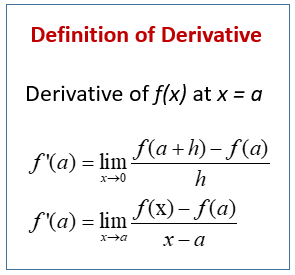
To get the exact instantaneous rate of change, take the limit as approaches 0:
You’ll also see an equivalent form at a specific point :
Both definitions express the same idea: shrink the interval to zero width so a secant slope becomes a tangent slope.
Why a limit is necessary (and why you can’t plug in )
If you try to substitute directly into the difference quotient, you get an undefined form:
The limit asks: as gets extremely small (but not equal to 0), does the expression approach a single number? If yes, that number is the derivative.
One-sided derivatives
Sometimes the slope behavior from the left and right differs. Define:
A function is differentiable at only if both one-sided derivatives exist and are equal.
Worked example: derivative from the definition
Find the derivative of:
Start with the definition:
Substitute :
Expand:
Simplify the numerator:
Factor out :
Cancel (this removes the issue):
Now take the limit:
Common algebra obstacles
Most “derivative from definition” problems are really algebra skills disguised as calculus. You often must simplify the difference quotient by expanding and canceling, factoring, or rationalizing (especially with square roots). If you don’t successfully remove the factor of in the denominator, you’ll be stuck.
Worked example: definition with a square root (rationalizing)
Find for:
Use the definition:
Multiply numerator and denominator by the conjugate:
Use difference of squares in the numerator:
Simplify:
Cancel :
Now take the limit:
Exam Focus
- Typical question patterns:
- Compute using the definition at a specific point.
- Find a formula for using the definition for a given function.
- Use one-sided derivatives to test differentiability at a point.
- Common mistakes:
- Plugging in immediately and concluding the derivative “doesn’t exist.”
- Expanding incorrectly (especially or ).
- Rationalizing incorrectly or forgetting to multiply both numerator and denominator by the conjugate.
Derivative notation and the derivative as a function
Once you understand the limit definition, the next key shift is this: the derivative isn’t just a number at one point. It’s usually a new function that describes the slope behavior everywhere the original function is differentiable.
Notation you must recognize
AP Calculus uses multiple notations for derivatives. They all represent the same underlying idea but are used in different contexts.
| Meaning | Common notation | Notes |
|---|---|---|
| Derivative of at | Common in function language | |
| Derivative of with respect to | Emphasizes input/output rate relationship | |
| Operator notation | Useful when differentiating expressions | |
| Derivative at a point | A single number (slope at ) |
You should also recognize common second derivative notation (even if most second-derivative applications come later):
| Function | First derivative | Second derivative |
|---|---|---|
| or |
A crucial interpretation difference:
- is a number.
- is a function (a rule that outputs slopes).
The derivative function as a slope machine
If you compute , then you can plug in any -value to get the slope of the original function at that point. For instance, if:
then:
That means the tangent line to at has slope 6.
Connecting derivatives to graphs
These core connections are worth memorizing because they power many graph and interpretation questions:
- If on an interval, then is increasing there.
- If on an interval, then is decreasing there.
- If at a point, the tangent line is horizontal there (but that does not automatically guarantee a max or min).
The tangent line equation (linearization at a point)
If you know the derivative at a point, you can write the equation of the tangent line.
At :
- Point on the curve:
- Slope:
Tangent line:
Worked example: tangent line from derivative at a point
Let:
Find the tangent line at .
First compute values:
Derivative:
Slope at :
Tangent line equation:
Simplified form:
A subtle but common confusion
Students sometimes think is “the slope” and therefore must be constant. In reality, for most functions the slope changes from point to point, so typically varies with .
Exam Focus
- Typical question patterns:
- Interpret as a slope or a rate of change in words.
- Write the equation of a tangent line using and .
- Given a formula for , evaluate it at specific points and interpret the results.
- Common mistakes:
- Mixing up (a number) with (a function).
- Using the point by accident instead of .
- Thinking a horizontal tangent line automatically means the function has a maximum or minimum there.
Differentiability and continuity
The derivative is not guaranteed to exist everywhere. Understanding when a function is differentiable helps you reason about graphs and avoid invalid calculations.
What it means to be differentiable
A function is differentiable at if the limit defining the derivative exists and is a finite real number:
If this limit does not exist (or is infinite), the function is not differentiable at .
Differentiability implies continuity
A key theorem you must know:
If a function is differentiable at , then it is continuous at .
The contrapositive is often the useful test:
If a function is not continuous at , then it cannot be differentiable at .
Be careful: the converse is false. A function can be continuous but not differentiable.
Where differentiability fails (graph features)
There are four classic situations where a function is continuous but not differentiable, or not even continuous.
1) Corners
A corner happens when the left-hand slope and right-hand slope are finite but not equal. A typical example is an absolute value graph. At a corner, and both exist but are not equal.
2) Cusps
A cusp is like a corner but with slopes becoming infinite in opposite directions. The one-sided derivatives may approach and .
3) Vertical tangents
A vertical tangent occurs when the slope becomes infinite in the same direction from both sides. The derivative does not exist as a finite real number.
4) Discontinuities
If the function has a hole, jump, or asymptote at , it is not continuous and therefore not differentiable.
Worked example: continuous but not differentiable
Consider:
At , the graph has a corner. The left-hand slope is and the right-hand slope is , so the derivative at 0 does not exist. Yet the function is continuous at 0. Continuity means “no breaks,” while differentiability means “smooth enough to have a single tangent slope.”
Why this matters for calculus rules
Differentiation rules (power rule, product rule, etc.) require that the function be differentiable where you apply them. If you apply a rule at a point where the derivative doesn’t exist, you can produce meaningless results. For example, you cannot correctly claim “the derivative of at 0 is 0” just because the graph looks symmetric.
Exam Focus
- Typical question patterns:
- Decide whether a function is differentiable at a point using a graph (look for corners, cusps, vertical tangents, discontinuities).
- Use the statement “differentiable implies continuous” to justify conclusions.
- Use one-sided derivatives (or one-sided behavior) to explain nondifferentiability.
- Common mistakes:
- Assuming continuity automatically means differentiability.
- Confusing a vertical tangent with “derivative equals 0”; it’s the opposite situation (slope blows up).
- Missing corners when a graph is drawn roughly; always check if left and right tangent slopes match.
Linearity rules: constants, constant multiples, sums, and differences
Once you have the derivative defined, you want efficient tools to compute derivatives without redoing the limit definition every time. The first set of tools are called linearity properties because they tell you how derivatives interact with adding functions and scaling them.
Why these rules matter
Using the limit definition every time is tedious, so these rules let you break complicated expressions into simpler pieces whose derivatives you already know.
Constant rule
If is a constant number, then:
Intuition: a constant function is a horizontal line, and a horizontal line has slope 0 everywhere.
Example: If:
then:
Constant multiple rule
If is a constant and is differentiable, then:
Meaning: multiplying a function by a constant multiplies every slope by that same constant (you can “pull the constant out”).
Sum and difference rules
If and are differentiable, then:
Worked example: using linearity
Differentiate:
Using linearity, differentiate term-by-term (the power rule is introduced next, but the setup is the key structure):
Then apply constant multiple and constant rule:
Common misconception: “derivative distributes over everything”
Linearity works for addition/subtraction and constant multiples, but not for multiplication or division of non-constant functions. For example:
Products and quotients need special rules.
Exam Focus
- Typical question patterns:
- Differentiate polynomials or sums of basic functions using linearity.
- Identify which derivative rules apply to an expression (linearity vs product/quotient).
- Simplify an expression before differentiating to make linearity easier to apply.
- Common mistakes:
- Treating a product like a sum and differentiating term-by-term when terms are multiplied.
- Forgetting that the derivative of a constant is 0.
- Dropping negative signs when applying the difference rule.
The power rule (and how it connects back to limits)
The power rule is one of the most important derivative shortcuts because it handles polynomials efficiently.
The rule
For any real number (in AP Calculus AB, you’ll most often use integers and simple rationals):
A helpful description is: “multiply down and decrease the power.”
Why it’s believable
You already proved a special case from the limit definition:
The general proof uses algebra (binomial expansion for integers). The main idea is that in the difference quotient for , you can factor out an from the numerator, cancel it, and then evaluate the limit.
Using the power rule on polynomials
A polynomial is a sum of power functions, so linearity plus the power rule differentiates any polynomial.
Worked example: polynomial derivative
Differentiate:
Apply the power rule term-by-term:
So:
Quick examples that match the “multiply down, decrease the power” idea
- For:
the derivative is:
- For:
the derivative is:
Negative exponents and rational exponents
The power rule still works for negative and rational powers (on domains where the function is defined).
Worked example: negative exponent
Differentiate:
Power rule:
Rewrite with positive exponents if you want:
Worked example: rational exponent
Differentiate:
Power rule:
Rewrite:
This matches the limit-definition result for and is a great consistency check.
Derivatives of linear functions as a special case
For , derivative is constant:
That fits the power rule because:
Common pitfalls
- Forgetting to subtract 1 from the exponent.
- Incorrectly applying the power rule to expressions that are not simple powers (for example, a product like needs algebra or the product rule).
Exam Focus
- Typical question patterns:
- Differentiate polynomials and power functions, including negative and rational exponents.
- Use derivatives to find tangent slopes at specified points.
- Combine power rule with linearity in multi-term expressions.
- Common mistakes:
- Treating as (forgetting the multiplier ).
- Applying the rule to something like directly (that requires chain rule, a later unit).
- Ignoring domain restrictions for rational exponents (for example, requires in real-valued contexts).
Exponential and logarithmic derivatives: and
Some derivative rules are so fundamental that they are often taught as “memory derivatives” because it’s faster to know them than to re-derive them each time.
The derivative of
The natural exponential function is special because its rate of change equals its value:
Worked example: exponential derivative
Differentiate:
Use constant multiple and constant rule:
So:
The derivative of
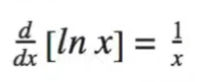
The natural logarithm is the inverse of . Its derivative is:
Domain note: (and its derivative rule) applies for in real-valued contexts.
Worked example: logarithmic derivative
Differentiate:
Use linearity and known derivatives:
Why these are “fundamental properties”
These derivative rules act like building blocks for more advanced differentiation techniques later (especially the chain rule). In many AP problems, you’ll differentiate expressions that include a mix of powers, exponentials, logs, and trig functions.
Common misconceptions
- Confusing with . On the AP exam, means natural log (base ). If appears, it is typically base 10 unless stated otherwise.
- Copying the function incorrectly (for example, thinking the derivative of is another logarithm). The derivative is .
Exam Focus
- Typical question patterns:
- Differentiate expressions involving and combined with polynomials.
- Evaluate derivatives at specific points, often with context (growth rate at a time).
- Interpret the meaning of in terms of proportional growth.
- Common mistakes:
- Writing (incorrectly mixing with the power rule).
- Forgetting the domain restriction for .
- Treating as if it were a product; log properties are algebra, and differentiating compositions is a later skill.
Trigonometric derivatives: and
Trigonometric functions connect calculus to periodic motion: springs, sound waves, rotating objects, and alternating current. These are also commonly treated as “memory derivatives.”

Core derivative rules
These are the trig derivatives you are expected to know in AP Calculus AB Unit 2:
A common way to remember the second one is: cosine’s derivative is negative sine.
Why the negative sign appears
If you look at the graph of near , it starts at 1 and decreases as increases a little, so the slope at 0 is negative. The negative sign ensures the derivative matches that behavior.
Radians matter
These derivative rules are correct when angles are measured in radians, not degrees. AP Calculus assumes radian measure unless explicitly stated. The limit-definition derivations rely on:
Worked example: trig derivatives
Differentiate:
Apply linearity and the trig rules:
So:
Connecting trig derivatives to motion
If position is sinusoidal, its derivative shifts phase:
- Derivative of sine is cosine (a phase shift).
- Derivative of cosine is negative sine (phase shift plus reflection).
In physics language: if position oscillates like , velocity oscillates like .
Exam Focus
- Typical question patterns:
- Differentiate expressions involving and combined with polynomials.
- Evaluate derivatives at key angles (like 0, , ) using known trig values.
- Use derivative signs to describe where a trig function is increasing/decreasing.
- Common mistakes:
- Dropping the negative in .
- Using degrees in a calculus context.
- Confusing the derivative with the original function.
The product rule
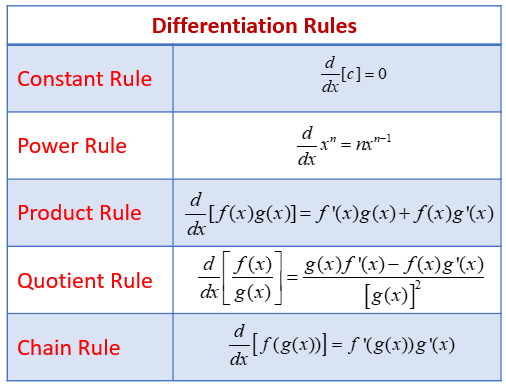
Linearity rules do not handle multiplication of two non-constant functions. If you need the derivative of a product, you use the product rule.
The rule
If and are differentiable, then:
You will also see it written with placeholders like and :
Why it works (conceptual)
The product changes because changes while is momentarily treated as fixed, and because changes while is momentarily treated as fixed. The product rule adds those two contributions.
Memory aids
- “Derivative of first times second, plus first times derivative of second.”
- A compact mnemonic some students use is “1d2 + 2d1” (first times derivative of second, plus second times derivative of first).
Worked example: product rule with polynomials
Differentiate:
Identify:
Differentiate each:
Apply product rule:
Substitute:
Simplify:
So:
Worked example: product rule with trig and exponential
Differentiate:
Let:
Then:
Product rule:
Factor if desired:
When expanding is possible (and when product rule saves time)
If you have two polynomials multiplied, like:
you can multiply it out and then use the power rule, but that can take time and can introduce algebra errors. The product rule is often faster and safer.
Common misconception: “just multiply the derivatives”
A frequent incorrect idea is:
That is not true in general.
Exam Focus
- Typical question patterns:
- Differentiate a product of two functions where each is simple on its own (polynomial times trig, polynomial times exponential, etc.).
- Identify when you must use product rule instead of expanding (sometimes either works, but product rule is safer).
- Evaluate the derivative at a point after differentiating.
- Common mistakes:
- Writing only one term (for example, and forgetting ).
- Using product rule when the expression is actually a sum.
- Expanding incorrectly if you choose to expand first.
The quotient rule
Division creates another situation where linearity does not apply. When you have one function divided by another, the quotient rule is a reliable method.
The rule
If and are differentiable and , then:
Using placeholders and :
Understanding the structure and memory aids
The numerator is a subtraction of two products, and the denominator is the square of the original denominator.
A common memory aid is:
- “Low d-high minus high d-low over low squared.”
Written compactly as a mnemonic:
- “low d high - high d low / low^2”
Just be careful with parentheses and signs when you substitute.
Worked example: quotient rule with polynomials
Differentiate:
Let:
Compute derivatives:
Apply quotient rule:
Simplify numerator:
So:
Worked example: quotient rule leading to a trig derivative
Differentiate:
Let:
Derivatives:
Quotient rule:
Simplify numerator:
Use the identity :
This is commonly written as:
Common pitfalls
- Forgetting parentheses, especially around the entire numerator.
- Squaring only part of the denominator. The whole denominator function is squared.
- Sign errors: the quotient rule has a subtraction in the numerator.
- Writing:
This is not a valid general rule.
Exam Focus
- Typical question patterns:
- Differentiate rational functions (polynomial over polynomial) using the quotient rule.
- Differentiate expressions like trig over trig or exponential over polynomial.
- Evaluate the derivative at a point while respecting domain restrictions (denominator cannot be zero).
- Common mistakes:
- Writing (incorrect; that is not a rule).
- Forgetting to square the denominator function.
- Losing a negative sign in the numerator subtraction.
Putting the rules together: strategy, structure, and correctness
By the end of Unit 2, you should be able to look at a function and decide which differentiation tools apply, while also keeping the meaning of the derivative in mind.
A practical strategy for choosing a rule
When you see an expression, classify how it’s built by its outermost operation:
- Sums and differences: use linearity.
- Constant multiples: pull the constant out.
- Powers of : use the power rule.
- and : use their special rules.
- and : use trig rules.
- Products: use product rule (or expand first if that is simpler and safe).
- Quotients: use quotient rule (or simplify first if possible).
Worked example: mixed rules
Differentiate:
This is a quotient: numerator is and denominator is . Use quotient rule.
Let:
Then:
To find , use the product rule because is a product.
Let:
Then:
Product rule:
Now apply quotient rule:
Substitute:
You can simplify, but even without full simplification, the structure is correct and gradeable. If you do simplify:
Factor out in the numerator:
Correctness includes domain awareness
Your derivative is valid on the domain where the original function is defined and where the derivative rules apply. For rational functions, remember division by zero is not allowed. In the previous example, .
Interpreting your result
Even when the task is computational, it helps to ask:
- Does the derivative look like it could represent a slope/rate?
- Are there obvious sign mistakes (for example, forgetting the negative in cosine’s derivative)?
- Does the derivative have domain restrictions inherited from the original function?
Common structural errors to avoid
- Applying product rule to something that is actually a composition, like (composition is handled by chain rule in the next unit).
- Overusing quotient rule when simplification makes the problem easier. For instance:
for .
Exam Focus
- Typical question patterns:
- Differentiate functions that require multiple rules (for example, quotient rule with a numerator that needs product rule).
- Decide whether to simplify first or apply a rule directly, then justify with correct algebra.
- Compute and interpret for a complicated-looking expression.
- Common mistakes:
- Using chain rule patterns prematurely (a later unit skill) instead of product/quotient and algebra.
- Algebra errors after differentiating correctly.
- Ignoring domain restrictions (like denominator equals zero) when evaluating derivatives at points.