Unit 4: The Cell Cycle and Division Mechanisms
The Cell Cycle
The Cell Cycle Overview
The Cell Cycle is the highly ordered sequence of events that a cell passes through from the time it is formed during parent cell division until its own division. It is essential for the reproduction of cells, growth of organisms, and tissue repair.
Interphase: The Preparation Phase
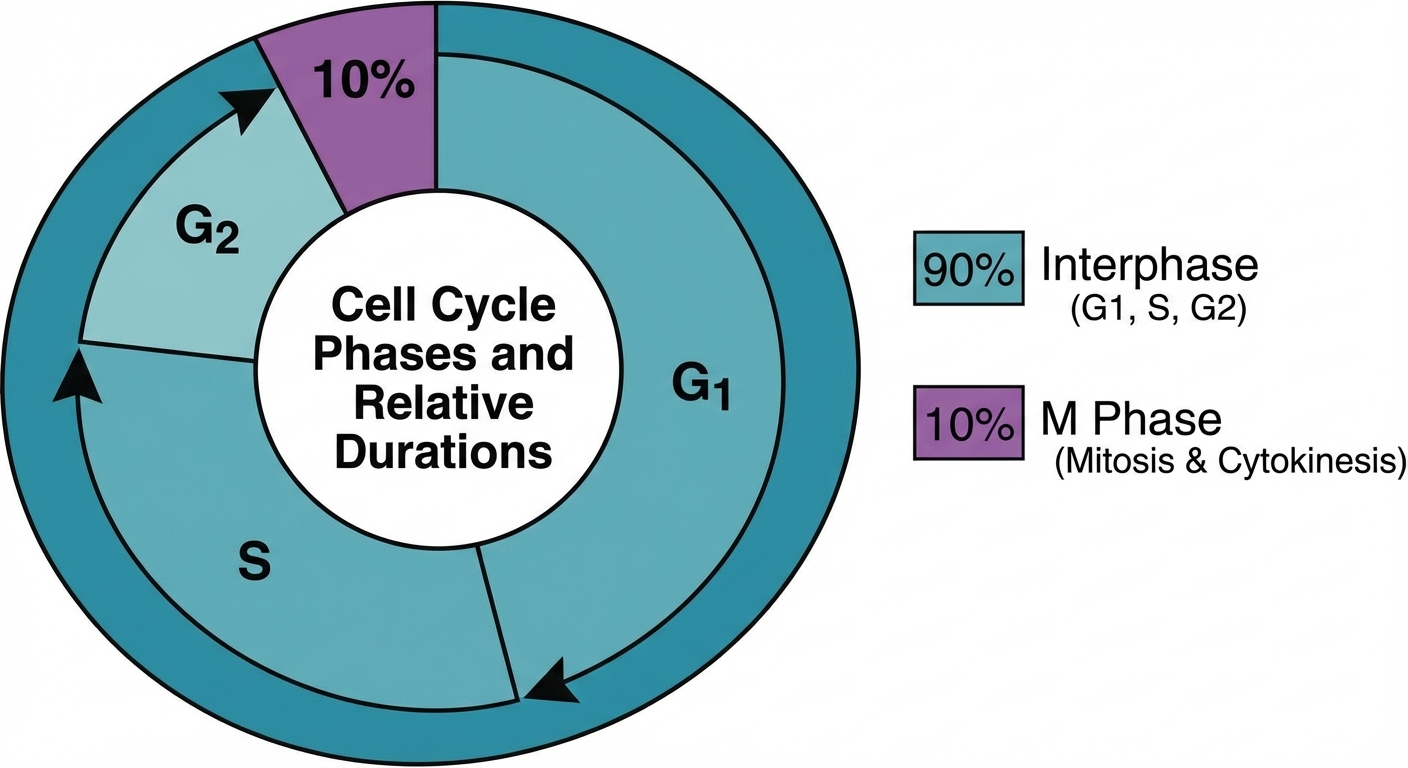
Contrary to common belief, cells spend approximately 90% of their life in Interphase. It is not a resting phase; the cell is metabolically active and preparing for division. It consists of three sub-phases:
G1 Phase (First Gap):
- Activity: vigorous growth and normal metabolic roles.
- The cell synthesizes proteins and produces organelles.
- Checkpoints: The cell ensures internal and external conditions are right for division.
S Phase (Synthesis):
- Activity: DNA Replication.
- At the end of this phase, chromosomes consist of two identical sister chromatids attached at the centromere.
- Key Concept: The amount of DNA doubles, but the number of chromosomes remains the same until they separate in anaphase.
G2 Phase (Second Gap):
- Activity: Preparation for division.
- The cell synthesizes enzymes and proteins necessary for cell division (like tubulin for the spindle apparatus).
- Centrosomes replicate.
The G0 Phase
Some cells exit the cell cycle and enter a nondividing state called G0 (quiescence).
- Temporary: Some cells (like liver cells) wait here until called back by external signals (like injury).
- Permanent: Mature nerve cells and muscle cells often stay here permanently and never divide again.
Mitosis and Cytokinesis (M-Phase)
M-Phase includes both Mitosis (division of the nucleus) and Cytokinesis (division of the cytoplasm). The goal is to produce two genetically identical daughter cells.
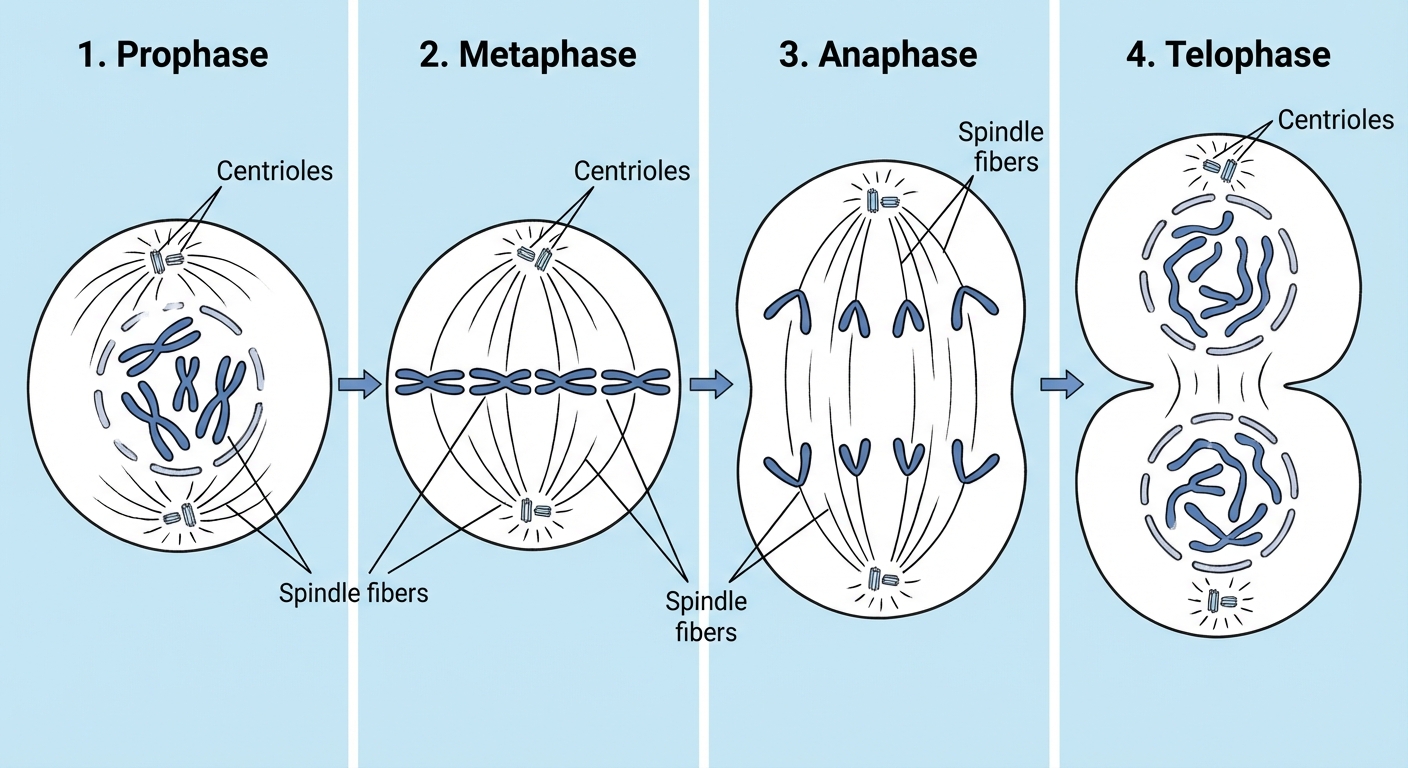
Stages of Mitosis (PMAT)
Prophase:
- Chromatin condenses into visible chromosomes.
- The nucleolus disappears and the nuclear envelope breaks down.
- The mitotic spindle begins to form from centrosomes moving to opposite poles.
Metaphase:
- Centrosomes are at opposite poles.
- Chromosomes align at the metaphase plate (the equator of the cell).
- Spindle fibers (kinetochore microtubules) attach to the kinetochores of the chromosomes.
Anaphase:
- The shortest stage.
- Sister chromatids part and become independent chromosomes.
- Motor proteins "walk" the chromosomes along microtubules toward opposite poles.
- Result: Each end of the cell has an equivalent and complete collection of chromosomes.
Telophase:
- Two daughter nuclei form; nuclear envelopes reappear.
- Chromosomes become less condensed (return to chromatin state).
- Mitosis is complete.
Cytokinesis
Cytokinesis usually begins during late anaphase or telophase, but the mechanism differs between animal and plant cells.
| Feature | Animal Cells | Plant Cells |
|---|---|---|
| Mechanism | Cleavage | Cell Plate Formation |
| Structure | Cleavage Furrow formed by a contractile ring of actin microfilaments. | Cell Plate formed by vesicles from the Golgi apparatus. |
| Outcome | Pinches the cell in two like a drawstring. | Fuses with the plasma membrane to create a new cell wall. |
Mnemonic for Mitosis
P-MAT:
- Prophase (Prepare)
- Metaphase (Middle)
- Anaphase (Apart)
- Telophase (Two nuclei)
Regulation of the Cell Cycle
The cell cycle is driven by a specific chemical control system, similar to a clock, regulated by both internal and external controls.
Molecular Checkpoints
Checkpoints are stop/go signals that regulate the cycle.
G1 Checkpoint (Restriction Point):
- The most critical checkpoint.
- Checks for: Cell size, nutrients, growth factors, and DNA damage.
- Outcome: If "Go" signal is received, the cell usually completes S, G2, and M phases. If "Stop," it enters G0.
G2 Checkpoint:
- Checks for: DNA replication completeness and DNA damage.
- Ensures the cell is ready to enter Mitosis.
M Checkpoint (Spindle Checkpoint):
- Occurs during Metaphase.
- Checks for: All chromosomes being properly attached to spindle fibers.
- Prevents daughter cells from ending up with missing or extra chromosomes (aneuploidy).
Cyclins and CDKs
Two key types of proteins regulate these checkpoints:
Cyclins:
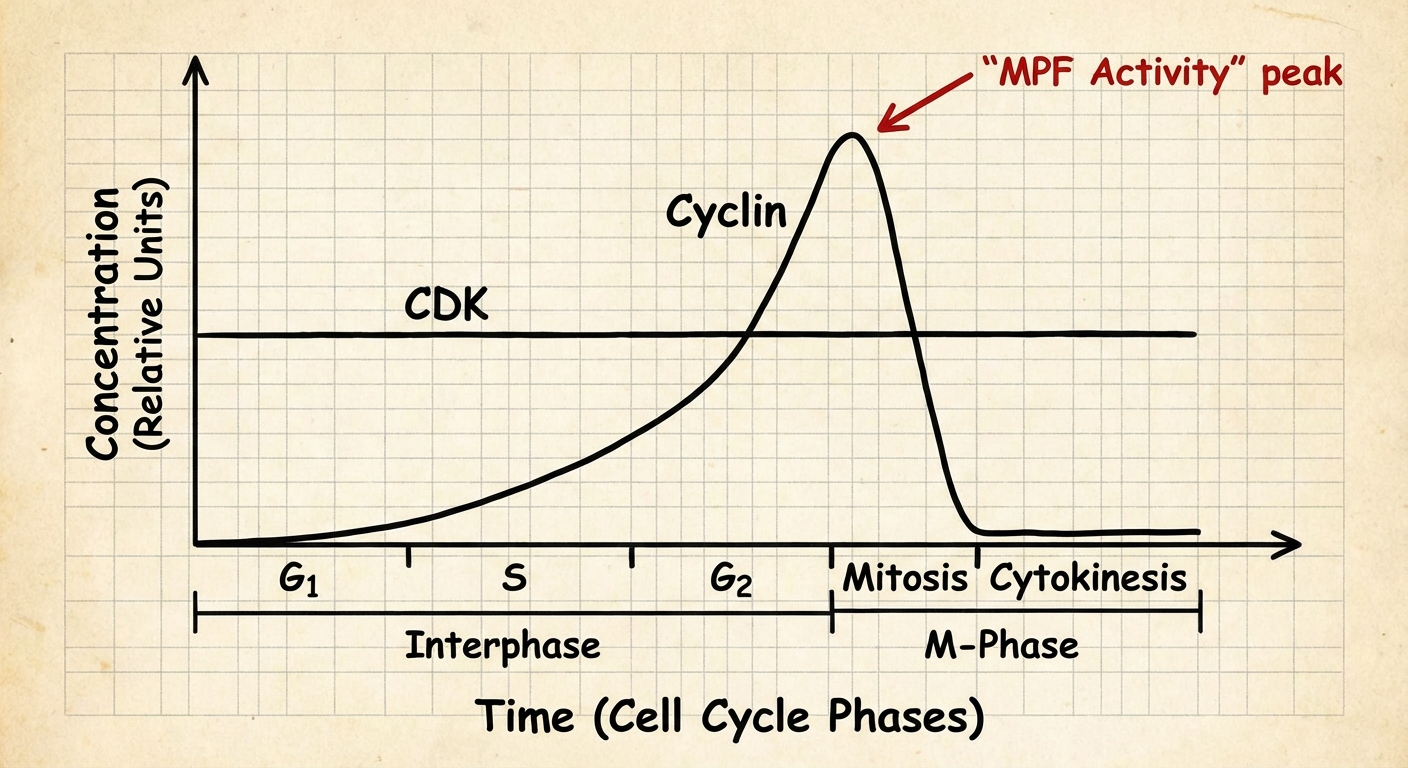
- Proteins whose concentration fluctuates (cycles) throughout the cell cycle.
- Synthesis increases during interphase and degradation occurs during mitosis.
Cyclin-Dependent Kinases (CDKs):
- Enzymes that are constant in concentration but inactive unless attached to a cyclin.
- When active, they phosphorylate target proteins to drive the cell cycle forward.
Example: MPF (Maturation-Promoting Factor)
- MPF triggers the cell's passage past the G2 checkpoint into the M phase.
- During Anaphase, the cyclin component of MPF is degraded, turning off the MPF signal and allowing the cell to exit mitosis.
External Signals
- Growth Factors: Proteins released by certain cells that stimulate other cells to divide (e.g., PDGF).
- Density-Dependent Inhibition: Crowded cells stop dividing when they touch one another.
- Anchorage Dependence: To divide, most animal cells must be attached to a substratum (like the extracellular matrix).
Disruptions to the Cell Cycle: Cancer
Cancer results from a loss of cell cycle control. Cancer cells do not heed the normal signals that regulate the cell cycle; they divide excessively and invade other tissues.
The Genetic Basis of Cancer
Proto-oncogenes vs. Oncogenes:
- Proto-oncogenes: Genes that code for proteins that stimulate normal cell growth and division (The "Gas Pedal").
- Oncogenes: Mutated versions that are hyperactive, causing excessive division.
Tumor Suppressor Genes:
- Genes that inhibit cell division (The "Brake Pedal").
- They repair DNA, control cell adhesion, and inhibit the cell cycle.
- p53 Gene: Known as the "Guardian of the Genome." If DNA is damaged, p53 halts the cell cycle to repair DNA. If repair is impossible, p53 triggers Apoptosis (programmed cell death). A mutation in p53 is found in over 50% of human cancers.
Common Mistakes & Pitfalls
Chromatin vs. Chromosomes vs. Chromatids:
- Mistake: Using these terms interchangeably.
- Correction: Chromatin is the loose, uncoiled DNA during Interphase. Chromsomones are the condensed, tight DNA during M-Phase. Sister Chromatids are the identical halves of a duplicated chromosome. During Anaphase, when chromatids separate, they are immediately considered individual chromosomes.
Interphase is "Resting":
- Mistake: Thinking nothing happens in Interphase.
- Correction: The cell is growing, replicating DNA, and synthesizing proteins. It is metabolically very active.
Counting Chromosomes:
- Mistake: Thinking chromosome number doubles in S phase.
- Correction: In S phase, DNA mass doubles, but chromosome count stays the same (they just go from single-chromatid to double-chromatid structures). Chromosome count only doubles temporarily during Anaphase and acts normal again after Cytokinesis.
Cytokinesis vs. Mitosis:
- Mistake: Saying Mitosis creates cells.
- Correction: Mitosis divides the nucleus. Cytokinesis divides the cytoplasm/cell body.