AP Precalculus Unit 4 Guide: Parametrics, Vectors, and Motion
4.1 Parametric Functions and Planar Motion
Understanding the Parameter
In previous units, we typically dealt with explicit functions where $y$ is defined directly in terms of $x$ (e.g., $y = f(x)$). However, in the real world, horizontal and vertical positions often depend on a third variable—usually time.
A Parametric Function defines a set of points $(x, y)$ on a plane where both coordinates are functions of an independent variable called the parameter, typically denoted as $t$.
Here, for every value of $t$ in a specified domain, you calculate a coordinate pair $(x(t), y(t))$ to plot on the Cartesian plane. The collection of these points traces a plane curve.
Key Characteristics:
- Independent: $t$ drives the function.
- Dependent: $x$ and $y$ are dependent on $t$.
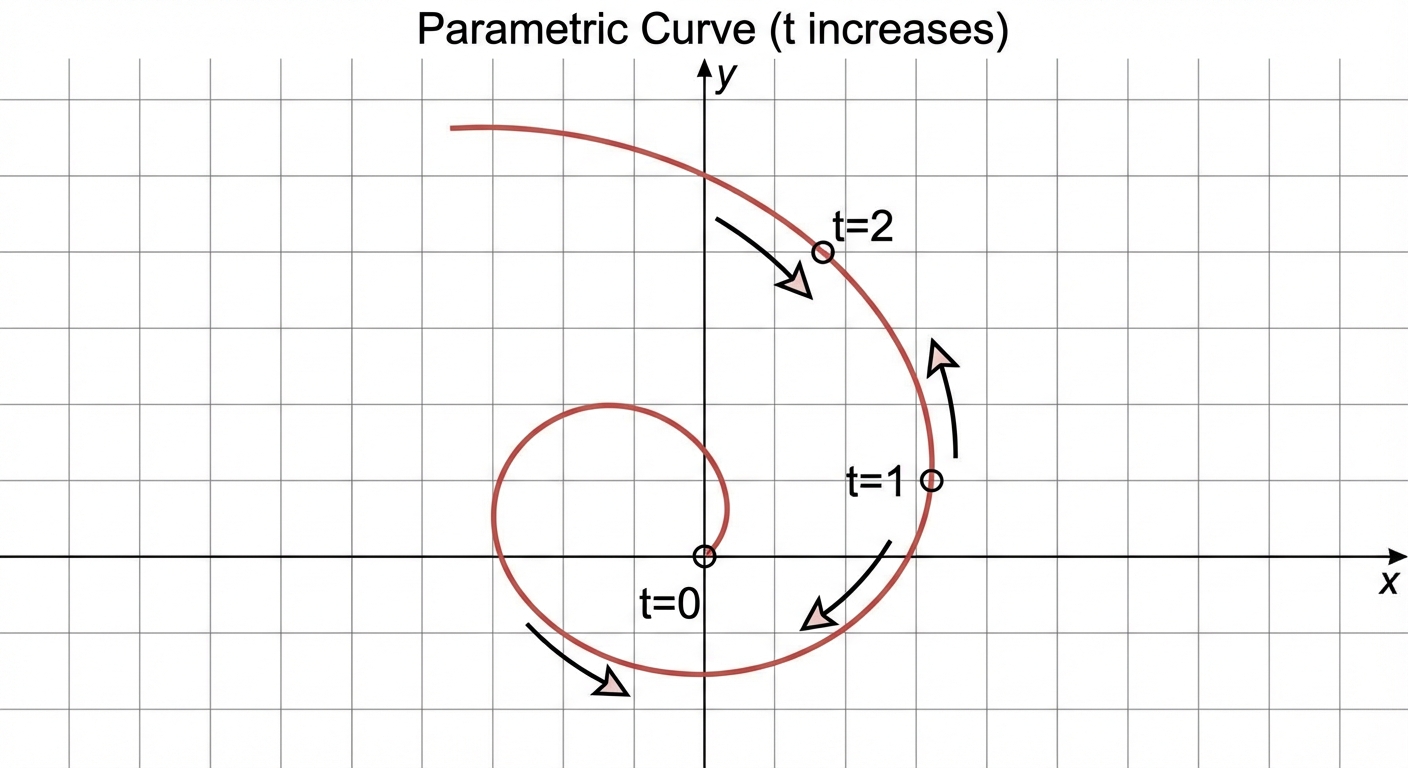
- Orientation: Unlike static graphs, parametric curves have a direction or orientation. As $t$ increases, the graph moves from an initial point to a terminal point.
Eliminating the Parameter
To understand the shape of the graph, we often convert parametric equations into a rectangular (Cartesian) equation relating only $x$ and $y$. This process is called eliminating the parameter.
Steps:
- Solve one of the parametric equations for $t$. (Choose the simpler one).
- Substitute that expression for $t$ into the other equation.
- Simplify to find the relationship between $x$ and $y$.
Example:
Given $x = 2t - 1$ and $y = t^2 + 1$ for $t \ge 0$.
- Solve for $t$ in the $x$-equation: $t = \frac{x+1}{2}$.
- Substitute into $y$:
Crucial Domain Check:
Since $t \ge 0$, and $x = 2t - 1$, then $x \ge 2(0) - 1$, so $x \ge -1$. The rectangular equation is a parabola, but the parametric graph is only the right half of that parabola starting at $x = -1$.
4.2 Implicitly Defined Functions and Conic Sections
Many parametric equations describe shapes that are not functions (they fail the vertical line test), such as circles, ellipses, and hyperbolas. These are often easier to analyze using trigonometric identities.
Parametrizing Circles and Ellipses
We utilize the Pythagorean identity:
| Conic Section | Standard Rectangular Form | Parametric Form ($0 \le t \le 2\pi$) |
|---|---|---|
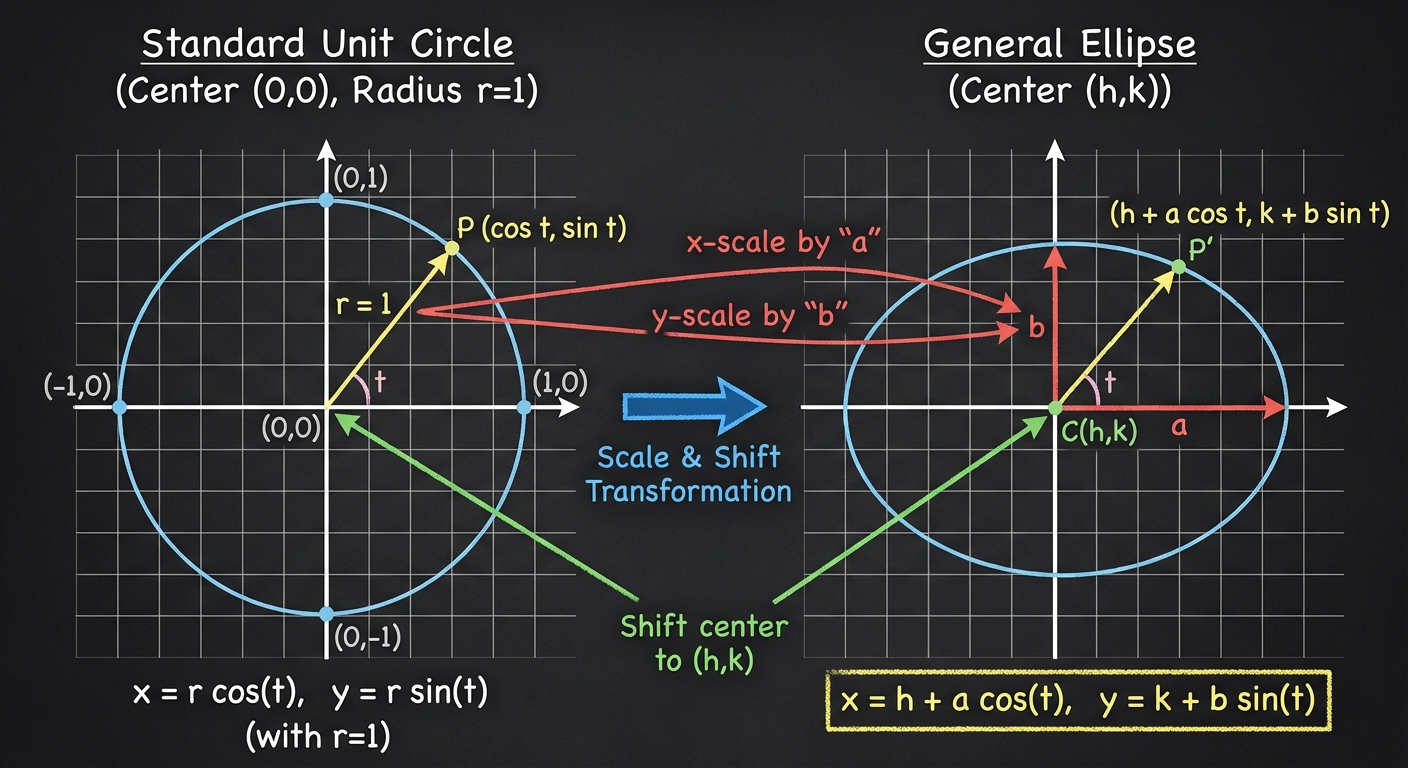
| Circle | $(x-h)^2 + (y-k)^2 = r^2$ | $x = h + r\cos(t)$ $y = k + r\sin(t)$ |
| Ellipse | $\frac{(x-h)^2}{a^2} + \frac{(y-k)^2}{b^2} = 1$ | $x = h + a\cos(t)$ $y = k + b\sin(t)$ |
In these forms, $(h, k)$ represents the center. For the ellipse, $a$ is the horizontal stretch (distance from center to horizontal vertex) and $b$ is the vertical stretch.
Parametrizing Hyperbolas
For hyperbolas, we use the identity:
- Horizontal Transverse Axis: $x = h + a\sec(t)$ and $y = k + b\tan(t)$
- Vertical Transverse Axis: $x = h + a\tan(t)$ and $y = k + b\sec(t)$
Note: The domain of $t$ must be restricted to avoid asymptotes where tangent and secant are undefined.
4.3 Parametric Functions Modeling Projectile Motion
One of the most common applications of parametrics in AP Precalculus is modeling the path of an object thrown or fired near Earth's surface.
The Setup
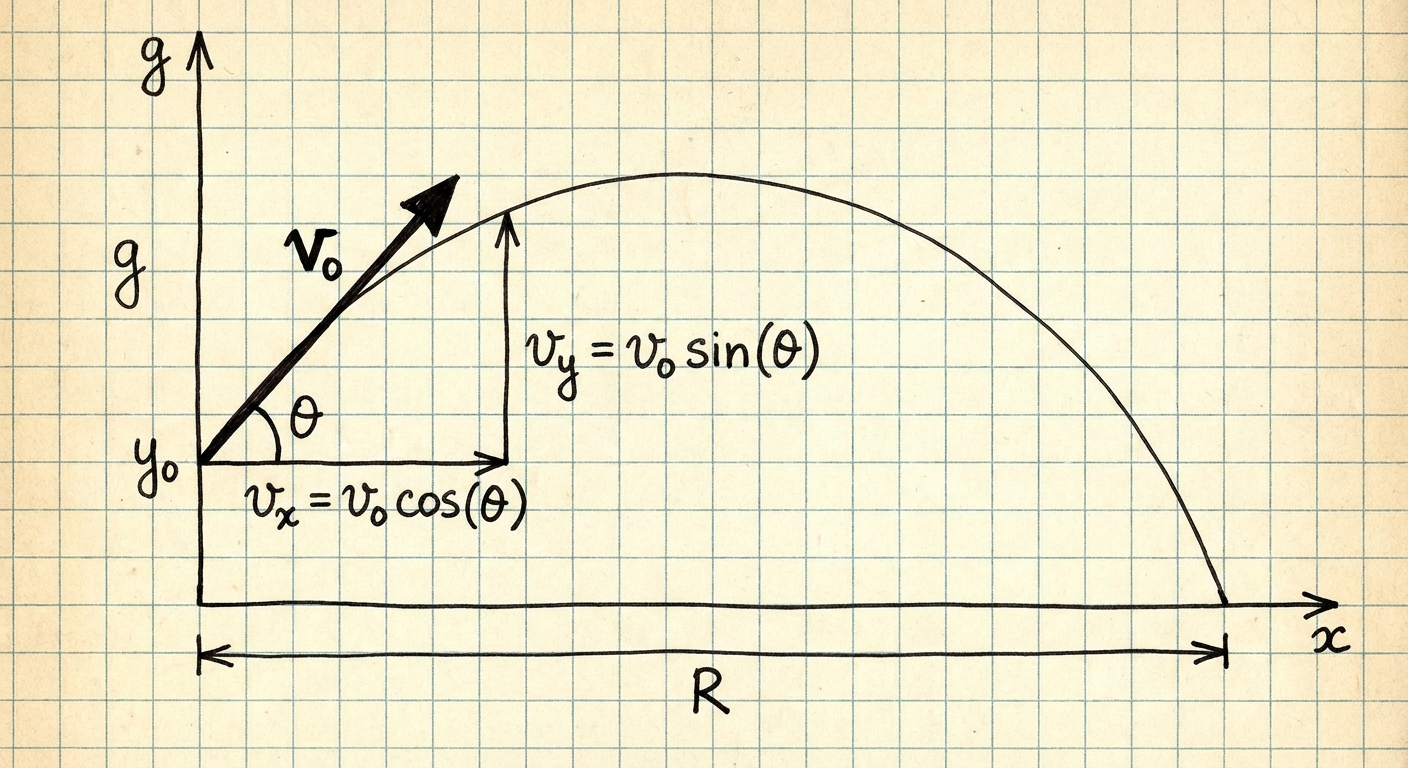
When an object is launched with an initial velocity $v_0$ at an angle $\theta$ relative to the horizontal, the velocity has two components:
- Horizontal Velocity: $vx = v0 \cos(\theta)$
- Vertical Velocity: $vy = v0 \sin(\theta)$
The Equations of Motion
Assuming air resistance is negligible, the only force acting on the object is gravity ($g$). The position of the object at time $t$ is given by:
Horizontal Position (Constant Velocity):
Vertical Position (Affected by Gravity):
Variables:
- $v_0$: Initial speed (velocity magnitude)
- $\theta$: Launch angle
- $(x0, y0)$: Initial position (often $(0, \text{height})$)
- $g$: Acceleration due to gravity ($9.8 \text{ m/s}^2$ or $32 \text{ ft/s}^2$)
Worked Example: The Golf Shot
A golfer hits a ball with an initial velocity of 150 ft/s at an angle of $30^{\circ}$. The ball is hit from the ground ($x0=0, y0=0$).
Set up the equations:
- $x(t) = (150 \cos 30^{\circ})t \approx 129.9t$
- $y(t) = -16t^2 + (150 \sin 30^{\circ})t = -16t^2 + 75t$
(Note: used $g=32$ ft/s$^2$, so $\frac{1}{2}g = 16$)
Find when the ball hits the ground:
Set $y(t) = 0$.
$t = 0$ (start) or $t = \frac{75}{16} \approx 4.69$ seconds.Find the horizontal distance:
Substitute the flight time into $x(t)$.
$x(4.69) = 129.9(4.69) \approx 609$ feet.
Common Mistakes & Pitfalls
Calculator Mode Errors
- The Problem: Solving projectile motion or conic problems involves sine and cosine. If your calculator is in Radian mode but you input an angle in Degrees (e.g., $\cos(30)$ where 30 is meant to be degrees), your answers will be wrong.
- The Fix: Always check the top of your calculator screen. If the problem gives degrees, use Degree mode.
Ignoring Domain Limits (The "Hidden" Domain)
- The Problem: When eliminating the parameter, students often simply write down the rectangular equation (e.g., $y = x^2$) without checking the domain of $t$.
- The Fix: If $x = \sqrt{t}$, then $x$ must be $\ge 0$. The resulting rectangular graph $y=x^4$ (if $y=t^2$) is only valid for $x \ge 0$.
Orientation Omission
- The Problem: Start and end points matter. A common exam question asks for the direction of motion.
- The Fix: Always verify direction by plotting $t=0$, then $t=1$. The arrow points from $t=0$ to $t=1$.
Gravity Units
- The Problem: Mixing up metric and imperial units.
- The Fix: If the problem uses feet, use $g=32$ (so $\frac{1}{2}g = 16$). If it uses meters, use $g=9.8$ (so $\frac{1}{2}g = 4.9$).