AP Calculus BC Unit 2: The Derivative & Fundamental Properties
Rates of Change & The Definition of the Derivative
Calculus is fundamentally the study of change. In Unit 2, we move from limits (Unit 1) to the concept of the Derivative, which measures the instantaneous rate of change of a function.
Average vs. Instantaneous Rate of Change
Before defining the derivative, it is crucial to understand the difference between average and instantaneous change.
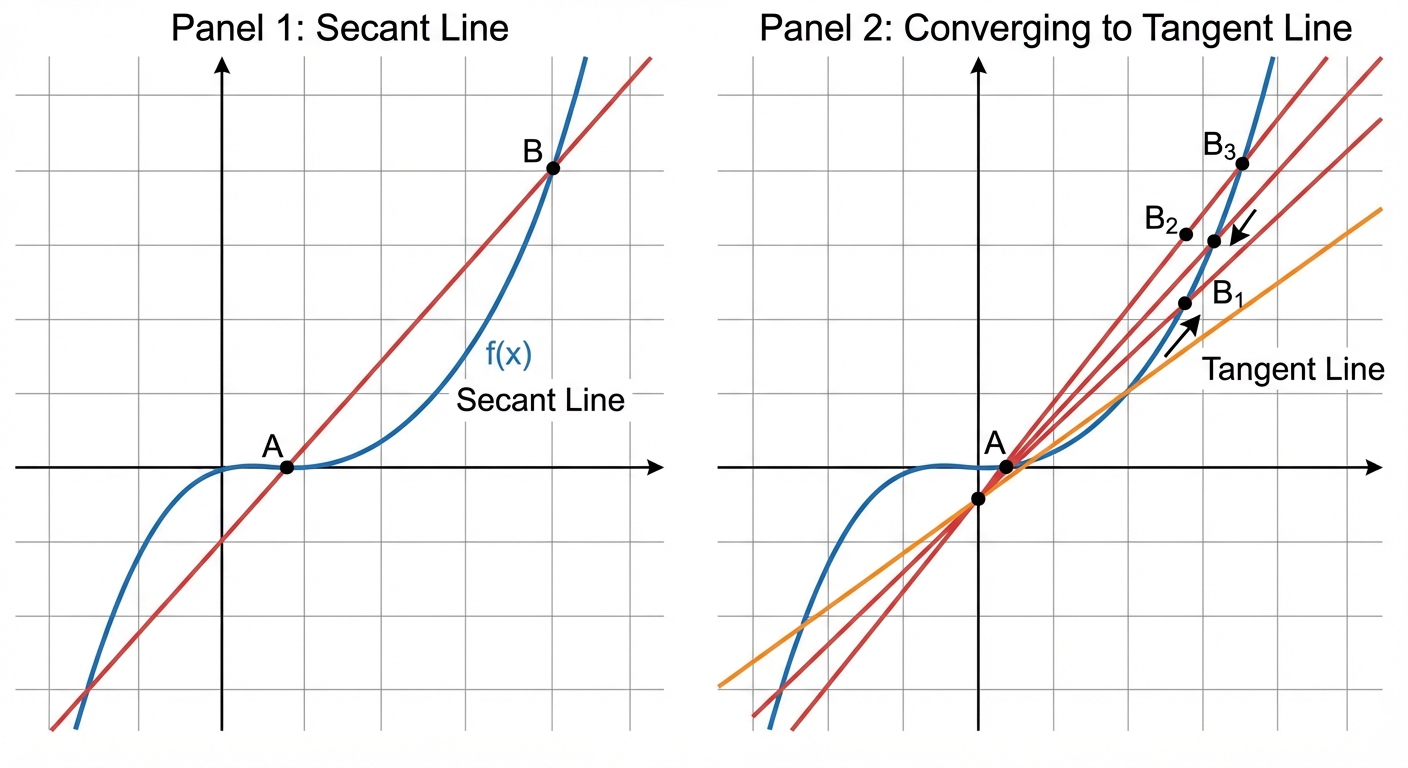
Average Rate of Change (AROC): This measures how a function changes over a specific interval $[a, b]$. Geometrically, this is the slope of the secant line connecting $(a, f(a))$ and $(b, f(b))$.
Note: This formula is essentially the standard slope formula $\frac{y2 - y1}{x2 - x1}$.Instantaneous Rate of Change: This measures the rate of change at a specific single moment in time. Geometrically, this is the slope of the tangent line that touches the curve at exactly one point.
The Limit Definition of the Derivative
Because we cannot calculate the slope with only one point (division by zero), we use limits to bring the two points of a secant line infinitesimally close together.
There are two essential forms of the derivative definition you must recognize for the AP Exam. The derivative of $f$ at point $x$ is denoted as $f'(x)$.
1. The $h$ Definition (Limit of the Difference Quotient)
This represents the distance between two $x$-values ($h$) shrinking to zero.
Use this when finding the general derivative function $f'(x)$.
2. The Alternative Definition (Derivative at a Point)
This is often used to find the derivative at a specific constant $c$ (or $a$).
Use this when evaluating the derivative at a specific number.
Derivative Notation
Calculus uses different notations depending on the context (and the mathematician who invented it). You must be fluent in all of them.
| Notation Type | Symbol(s) | Context |
|---|---|---|
| Lagrange | $f'(x)$, $y'$ | Prime notation. Used for general functions. |
| Leibniz | $\frac{dy}{dx}$, $\frac{d}{dx}[f(x)]$ | Differential notation. Shows the ratio of infinitesimal changes. |
| Higher Order | $f''(x)$, $\frac{d^2y}{dx^2}$ | Second derivative (rate of change of the rate of change). |
Estimating Derivatives
Sometimes you are given a table of data or a graph rather than an explicit equation. You must be able to estimate the derivative.
Estimating from a Table
To estimate $f'(c)$ given a table of values, calcualte the Average Rate of Change using the two points closest to $c$ surrounding it.
Example:
Given the table below, estimate $f'(3)$.
| x | 1 | 2 | 4 | 5 |
|---|---|---|---|---|
| f(x) | 2 | 5 | 9 | 15 |
We calculate the slope of the secant line between $x=2$ and $x=4$:
Estimating from a Graph
The derivative at a point is the slope of the tangent line. On a graph, look at the steepness of the curve.
- Positive Slope: $f'(x) > 0$ (Function is increasing)
- Negative Slope: $f'(x) < 0$ (Function is decreasing)
- Horizontal Tangent: $f'(x) = 0$ (Function is at a peak, valley, or plateau)
Differentiability & Continuity
A critical concept in Unit 2 is the relationship between continuity and differentiability.
The Fundamental Theorem of Differentiability
If a function is differentiable at $x=c$, it MUST be continuous at $x=c$.
However, the converse is FALSE: A function can be continuous but NOT differentiable. Differentiability is a stricter condition—it requires the graph to be "smooth."
When Does a Derivative Fail to Exist?
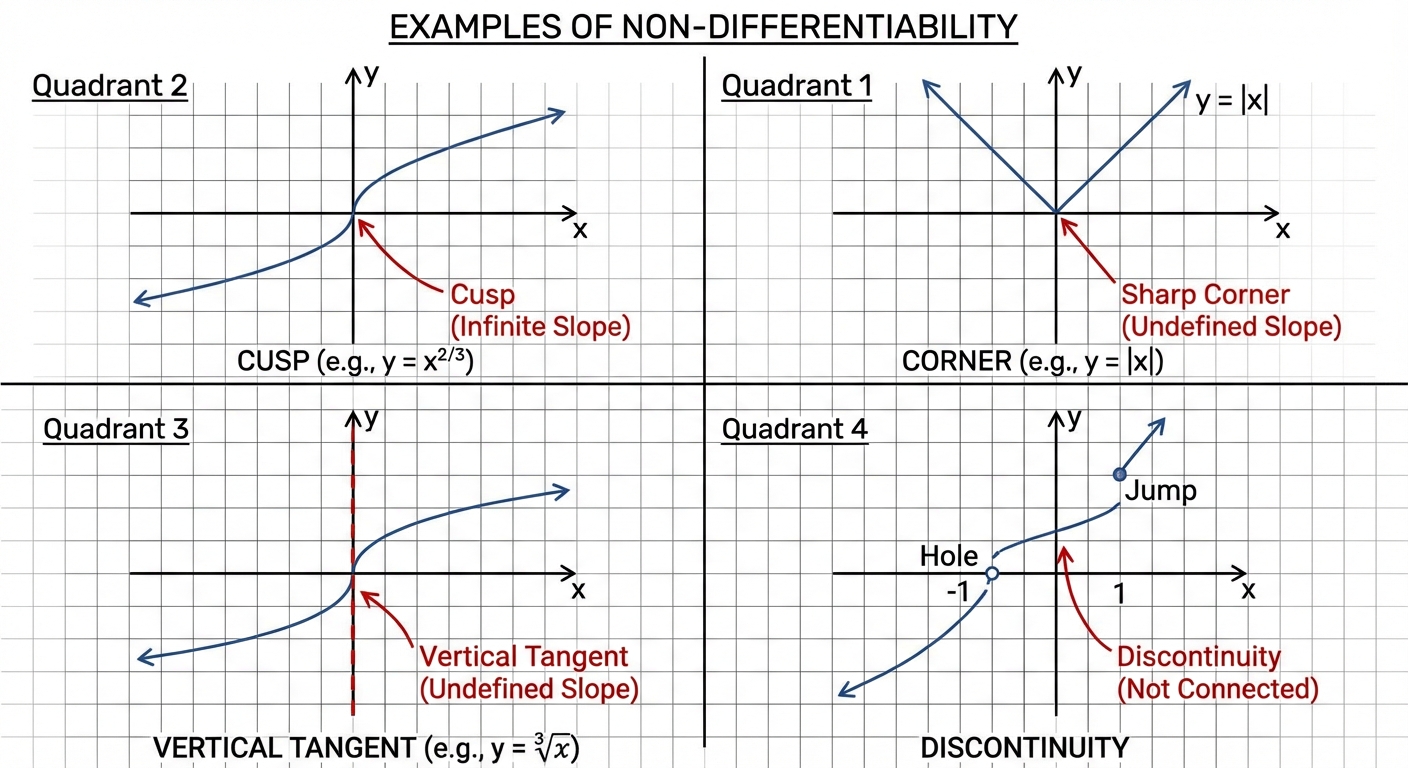
A function $f(x)$ is not differentiable at $x=c$ if:
- Discontinuity: The graph breaks (holes, jumps, asymptotes). If it's not continuous, it's not differentiable.
- Corner Points: The graph has a sharp turn (e.g., $y=|x|$ at $x=0$). The slope from the left does not equal the slope from the right.
- Cusps: An extreme sharp point where the slopes approach $\infty$ and $-\infty$ (e.g., $y=x^{2/3}$).
- Vertical Tangents: The curve is continuous and smooth, but momentarily vertical. The slope is undefined (infinity) (e.g., $y=\sqrt[3]{x}$ at $x=0$).
Basic Derivative Rules
Using the limit definition for every problem is inefficient. We use proof-based rules to find derivatives quickly.
Empirical Rules
Constant Rule: The derivative of a constant is 0. (A horizontal line has 0 slope).
Power Rule: "Multiply down, decrease power."
Example: $\frac{d}{dx}[x^4] = 4x^3$Constant Multiple Rule: You can pull constants out of the derivative.
Sum/Difference Rule: The derivative of a sum is the sum of the derivatives.
Exponential & Logarithmic Rules
These must be memorized:
- The Natural Exponential: This is the only function that is its own derivative.
- The Natural Log:
Advanced Derivative Rules
When functions are multiplied or divided, you CANNOT simply take the derivatives individually. You must use the Product and Quotient rules.
The Product Rule
Used for $f(x) = u(x) \cdot v(x)$.
Mnemonic: "First d-Second plus Second d-First" ($1 d2 + 2 d1$).
Example: Let $f(x) = x^2 \sin(x)$
The Quotient Rule
Used for $f(x) = \frac{u(x)}{v(x)}$.
Mnemonic: "Low d-High minus High d-Low, all over Low squared."
Alternatively: "Lo-d-Hi minus Hi-d-Lo, draw the line and square below."
Important: Order matters in subtraction! You must start with "Low d-High".
Trigonometric Derivatives
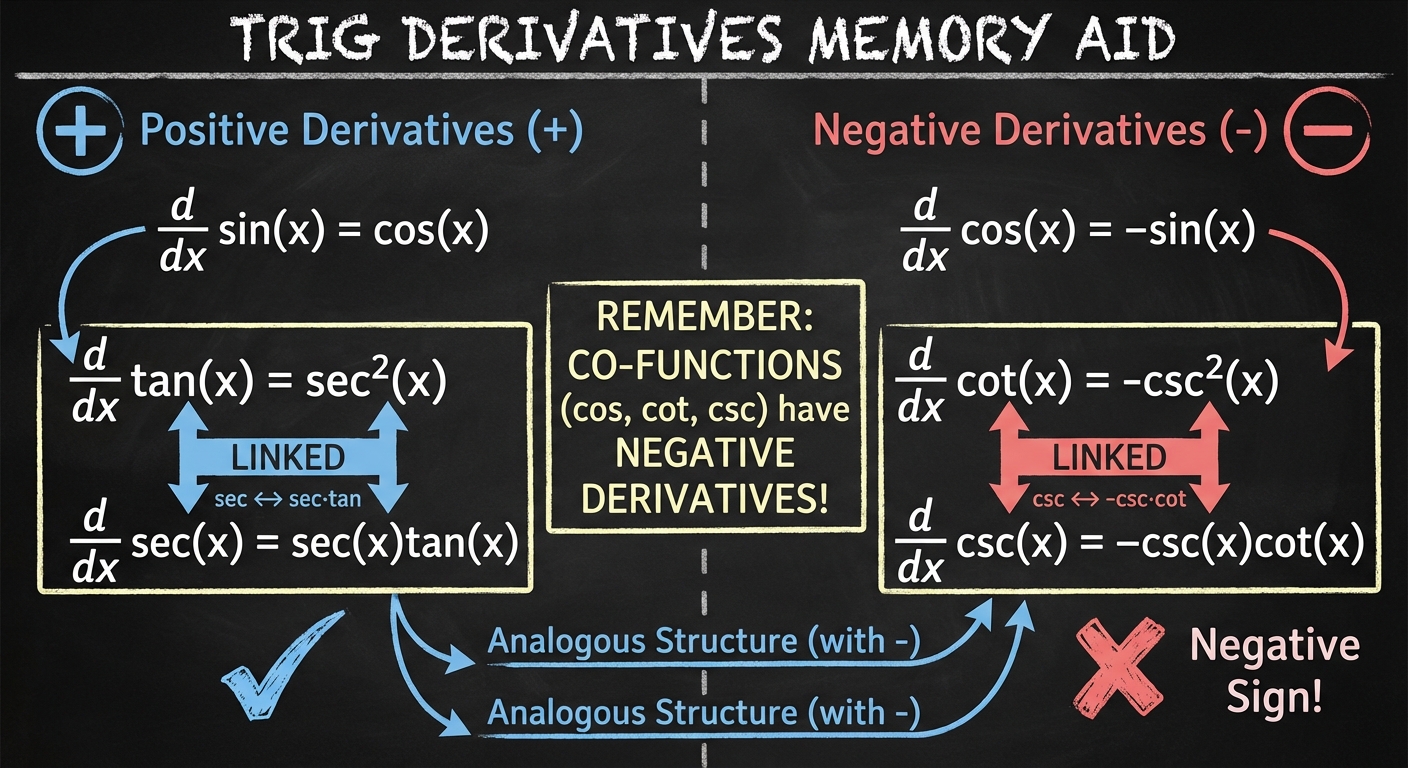
You must memorize the derivatives of all 6 trigonometric functions. They often come in pairs.
| Function | Derivative | Pattern Note |
|---|---|---|
| $\sin(x)$ | $\cos(x)$ | Positive |
| $\cos(x)$ | $-\sin(x)$ | Cofunctions have negative derivatives |
| $\tan(x)$ | $\sec^2(x)$ | Related to Secant |
| $\csc(x)$ | $-\csc(x)\cot(x)$ | Negative, "C"o-pair |
| $\sec(x)$ | $\sec(x)\tan(x)$ | Related to Tangent |
| $\cot(x)$ | $-\csc^2(x)$ | Negative, "C"o-pair |
Tips for Memorization
- The "Co" Rule: If the function starts with "C" (Cos, Cot, Csc), the derivative is negative.
- Tan and Cot are squares ($\, sec^2, csc^2$).
- Sec and Csc are product pairs ($\sec\tan, \csc\cot$).
Common Mistakes & Pitfalls
Distributing the Derivative:
- Wrong: $\frac{d}{dx}[x^2 \sin x] = 2x \cos x$
- Right: You must use the Product Rule. ($2x\sin x + x^2\cos x$)
Order in Quotient Rule:
- Evaluating "High d-Low" first gives you the wrong sign. Always start with the denominator ($v \cdot u'$).
Tangent Line Equation:
- Students often find the slope $f'(c)$ and stop. If the question asks for the equation of the tangent line, use point-slope form:
- Students often find the slope $f'(c)$ and stop. If the question asks for the equation of the tangent line, use point-slope form:
Notation Errors:
- Dropping the limit notation ($\lim_{h \to 0}$) while doing the algebra steps. You must write $\lim$ in every step until you actually plug in $h=0$.
Confusing Differentiability:
- Assuming that because a graph is continuous, it is differentiable that point. Always check for sharp corners (like absolute value graphs).