Model Comparison: Linear Equations & Inequalities
═══════════════════════════════════════
Gemini 3 Pro
═══════════════════════════════════════
What You Need to Know
Heart of Algebra accounts for approximately 33% of the SAT Math section, making it the single most weighted topic. Mastery here is essential for a high score.
You must be fluent in translating word problems into linear equations and interpreting the meaning of slope and intercepts in real-world contexts.
Pay special attention to the conditions that create no solution or infinitely many solutions; these are frequent, high-value conceptual questions.
Efficiency matters: know when to use substitution vs. elimination for systems, and when to plug in answers rather than solving algebraically.
Solving Linear Equations
At its core, a linear equation expresses a relationship between variables that produces a straight line when graphed. The SAT requires you to solve these for a specific variable, often requiring simplification first.
The Golden Rule of Algebra
Whatever operation you perform on one side of the equation, you must perform on the other to maintain equality. Your goal is to isolate the variable (e.g., ).
Distribute:
Combine Like Terms:
Isolate Variables: Subtract from both sides:
Solve: Add 1 to both sides:
Number of Solutions
Not every equation results in a single value for . There are three possibilities:
One Solution: The variable terms are different on both sides. Example: .
No Solution: The variable terms are identical, but the constants are different. The lines are parallel and never intersect.
Example: (Simplifies to , which is false).
Infinitely Many Solutions: Both sides are identical. The lines are the same.
Example: (Simplifies to , or , which is always true).
Exam Focus
Why it matters: This is the foundation of the section. If you cannot solve for quickly and accurately, you will struggle with the harder word problems.
Typical question patterns:
"What is the value of ?"
"For what value of does the equation have no solution?" (Hint: Set the slopes/variable coefficients equal to each other).
Rearranging formulas to isolate a specific variable (e.g., "Solve for in terms of and ").
Common mistakes:
Forgetting to distribute the negative sign to all terms inside parentheses: becomes , not .
Confusing "no solution" with . is a valid solution; is no solution.
Graphing Linear Equations
Visualizing linear equations is crucial. You must recognize the three primary forms of a linear equation.
Key Forms
Form | Equation | Useful For… |
|---|---|---|
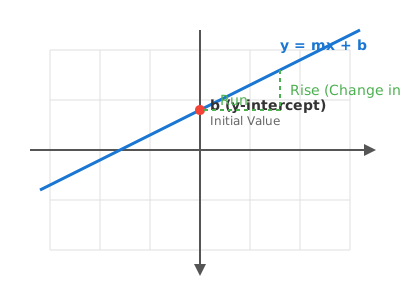
Slope-Intercept | Quickly identifying slope () and y-intercept (). | |
Standard Form | Finding intercepts quickly (set to find , and vice versa). | |
Point-Slope | Writing an equation given a slope and any point . |
Interpreting Slope and Intercepts
In SAT word problems, abstract math concepts translate to physical meanings:
Slope (): The Rate of Change. Look for keywords like "per," "each," "every," or "rate."
Positive slope: Increasing rate.
Negative slope: Decreasing rate.
Y-Intercept (): The Initial Value or Starting Amount. The value of when (time zero, zero items sold, flat fee).
Exam Focus
Why it matters: Approximately 20-30% of Heart of Algebra questions ask you to interpret a graph or a linear model in context.
Typical question patterns:
"What is the meaning of the number 15 in the equation ?" (Answer: The cost per hour).
Matching an equation to a given graph or scatterplot.
Common mistakes:
Mixing up and intercepts.
Calculating slope as instead of .
Linear Inequalities
Inequalities work almost exactly like equations, with one major twist regarding division and negative numbers.
Solving Rules
The Negative Flip: If you multiply or divide both sides of an inequality by a negative number, you MUST flip the direction of the inequality symbol.
-2x > 10 \rightarrow \frac{-2x}{-2} < \frac{10}{-2} \rightarrow x < -5
Graphing Inequalities
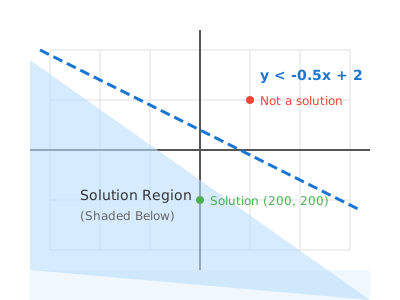
When graphing y > mx + b or :
Boundary Line:
Use a dashed line for strict inequalities (< or >, meaning points on the line are NOT solutions).
Use a solid line for inclusive inequalities ( or , meaning points on the line ARE solutions).
Shading:
y > … or : Shade the region above the line.
y < … or : Shade the region below the line.
Test Point Method: Pick a point like . If it makes the inequality true, shade that side. If false, shade the other.
Exam Focus
Why it matters: These questions test your attention to detail (solid vs. dashed lines) and logical reasoning.
Typical question patterns:
"Which of the following ordered pairs satisfies the inequality?"
Identifying the correct graph for a given inequality word problem (e.g., budget constraints).
Common mistakes:
Forgetting to flip the sign when dividing by a negative.
Shading the wrong side of a vertical line (x > 3 is shaded to the right).
Systems of Linear Equations
A system consists of two or more linear equations with the same variables. The solution is the ordered pair where the lines intersect—the point that makes both equations true.
Solving Methods
Substitution: Best when one variable is already isolated ().
Plug the expression for into the other equation.
Elimination: Best when equations are in Standard Form ().
Multiply equations to match coefficients, then add or subtract the equations to eliminate a variable.
Example:
Add them: . Then back-solve for .
Systems Classification
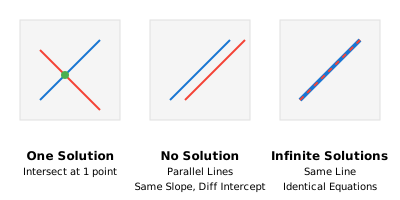
Just like single equations, systems have three outcomes:
One Solution: Slopes are different. Lines intersect at one point.
No Solution: Slopes are the same, but y-intercepts are different (Parallel lines).
Infinite Solutions: Slopes are the same AND y-intercepts are the same (Same line).
Exam Focus
Why it matters: Systems appear frequently as word problems involving two different rates or items (e.g., "chickens and cows," "adult and child tickets").
Typical question patterns:
"If the system has no solution, what is the value of ?"
Solving for a combination of variables directly (e.g., finding directly from rather than finding and separately).
Common mistakes:
Stopping after finding and forgetting to solve for .
Using the wrong method: Trying to use substitution on a messy standard-form system usually leads to arithmetic errors. Use elimination for standard form.
Quick Review Checklist
Can you isolate a variable in a complex equation without losing negative signs?
Do you know when to flip the inequality sign?
Can you look at and immediately identify the slope as and the start value as ?
Can you write a linear equation from a word problem involving a rate and a flat fee?
Do you know the condition for two lines to be parallel (same slope)?
Can you solve a system of equations using elimination?
Can you determine if a point is a solution to a system of inequalities by looking at a graph?
Final Exam Pitfalls
The "Undefined Slope" Trap
Mistake: Thinking a horizontal line has undefined slope.
Correction: Horizontal lines () have a slope of 0. Vertical lines () have an undefined slope.
The "Infinite Solutions" Constant
Mistake: When asked for value that gives infinite solutions for , solving for instead of matching coefficients.
Correction: For infinite solutions, the left side must exactly match the right side. Therefore, must equal .
Misinterpreting "Zero"
Mistake: Thinking means "no solution."
Correction: is a specific location on the graph. "No solution" means the equation is mathematically impossible (like ).
Solving for the Wrong Thing
Mistake: Solving for when the question asks for .
Correction: Circle what the question asks for. If it asks for , and you find , make sure you calculate . Often, you can find the expression directly without solving for first.
═══════════════════════════════════════
GPT 5.2 Pro
═══════════════════════════════════════
What You Need to Know
The College Board’s SAT Math Heart of Algebra focuses on building, manipulating, and interpreting linear equations, linear inequalities, and systems of linear equations—often in real-world contexts.
You must be fluent at isolating variables, rewriting lines in different forms, and interpreting slope and intercepts as rates and starting values.
A common SAT skill is translating words/tables/graphs into equations or inequalities, then solving and checking solutions against constraints.
Systems questions often test whether a system has one solution, no solution, or infinitely many solutions, and what that means in context.
Curriculum alignment (what this section covers on the official SAT): These notes follow the College Board SAT Math framework for the Heart of Algebra domain—linear equations in one variable, linear equations in two variables (lines), linear inequalities, and systems of linear equations (including interpreting solutions and solution types).
Solving linear equations
Linear equations are equations where the variable(s) appear only to the first power (no products of variables like , no powers like ).
Core solving principles
Use inverse operations to isolate the variable.
Maintain equality: whatever you do to one side, do to the other.
Clear fractions early by multiplying by the least common denominator (LCD).
Always consider extraneous restrictions from a context (e.g., time ).
Common linear forms you’ll see
One-variable:
Variables on both sides:
With parentheses:
With fractions:
Worked example 1 (variables on both sides)
Solve .
1) Distribute:
2) Subtract from both sides:
3) Add :
4) Divide by :
Worked example 2 (clearing fractions)
Solve .
1) LCD of and is . Multiply both sides by :
2) Simplify:
3) Combine and solve:
Real-world modeling (typical SAT setup)
If a gym charges a start-up fee plus monthly cost, write , i.e., a linear model like .
Exam Focus
Why it matters: SAT Heart of Algebra frequently tests whether you can solve and rearrange linear equations accurately and efficiently, often as a step inside a word problem.
Typical question patterns:
Solve for (including distribution, fractions, variables on both sides).
Rearrange a formula to solve for a specific variable (literal equations).
Create a linear equation from a short context, then solve.
Common mistakes:
Distributing incorrectly, especially with negatives: (it equals ).
Forgetting to multiply every term by the LCD when clearing fractions.
Arithmetic slips after moving terms—do a quick substitution check when possible.
Graphing linear equations
A linear equation in two variables graphs as a line in the coordinate plane.
Key line forms (know how to convert)
Form | Equation | What it shows best |
|---|---|---|
Slope-intercept | Slope and -intercept | |
Standard | Easy to spot intercepts; common on SAT | |
Point-slope | Line through a point with slope |
Slope: (rise over run).
Intercepts:
-intercept: point where .
-intercept: point where .
Graphing methods (choose the fastest)
1) From : plot , then use slope (rise/run) for a second point.
2) From intercepts (standard form): find - and -intercepts by setting the other variable to .
3) From two points: compute slope, then use point-slope or slope-intercept.
Worked example 1 (standard to slope-intercept)
Rewrite in slope-intercept form.
1) Subtract :
2) Divide by :
So slope and -intercept .
Worked example 2 (slope from two points)
Find the slope through and .
Interpretation (heavily tested)
is a rate of change (e.g., dollars per hour).
is an initial value (value when input ).
Memory aid: “Slope is Rate”—if is time, is “per unit time.”
Exam Focus
Why it matters: Many Heart of Algebra items test interpreting or constructing linear models from graphs, tables, and contexts—not just plotting.
Typical question patterns:
Convert between and .
Interpret slope/intercept from a context or graph (what does mean?).
Identify a line given a graph (parallel/perpendicular lines may appear, but usually via slope reasoning).
Common mistakes:
Sign errors when solving for (especially moving to the other side).
Mixing up intercept meanings: is the value at , not where the graph crosses the -axis.
Using instead of .
Linear inequalities
A linear inequality looks like a linear equation but uses <, , >, or . Its solution set is a range of values.
Solving one-variable inequalities
You solve like equations except:
If you multiply or divide both sides by a negative, you flip the inequality symbol.
Memory aid: “Negative? Reverse.”
Worked example 1 (flip the sign)
Solve .
1) Subtract :
2) Divide by (flip to ):
Worked example 2 (compound inequality)
Solve -1<2x+3\le 9.
1) Subtract everywhere:
-4<2x\le 6
2) Divide by :
-2<x\le 3
Inequalities in context (constraints)
SAT problems often include constraints like:
Quantity can’t be negative: .
Integer constraints (sometimes implied by context): number of people/items.
Always check whether the question asks for:
the solution set,
the least/greatest possible value,
or the number of solutions that satisfy multiple conditions.
Exam Focus
Why it matters: Inequalities are a core Heart of Algebra skill—especially translating wording like “at least” or “no more than” into symbols and solving.
Typical question patterns:
Solve an inequality and select the correct number line interval.
Translate a statement (e.g., “no less than ”) into form.
Combine inequalities (compound or from multiple constraints).
Common mistakes:
Forgetting to flip the sign when dividing/multiplying by a negative.
Confusing wording: “at most” means , “at least” means .
Ignoring domain constraints from the story (e.g., time, distance, quantities).
Systems of linear equations
A system of linear equations is a pair (or more) of linear equations with the same variables. The solution is the point that satisfies both.
What solutions mean (important concept)
For two lines:
One solution: lines intersect once.
No solution: lines are parallel (same slope, different intercepts).
Infinitely many solutions: same line (equivalent equations).
Main solution methods
1) Substitution: solve one equation for a variable, substitute into the other.
2) Elimination: add/subtract equations to eliminate a variable (often fastest on SAT).
Worked example 1 (elimination)
Solve the system:
Add the equations (eliminate ):
Substitute into :
Solution: .
Worked example 2 (no solution vs infinite solutions)
Consider:
Rewrite the second equation:
(false)
So there is no solution (the lines are parallel).
Systems in real-world contexts
Common SAT setups:
Ticket prices: adult , student with two purchase scenarios.
Mixture/cost comparisons: two linear conditions leading to a unique intersection.
Strategy: define variables clearly, write two equations, then solve.
Exam Focus
Why it matters: Systems are central to Heart of Algebra because they test solving skills plus interpretation of intersections and constraints.
Typical question patterns:
Solve a system by elimination/substitution.
Determine whether a system has , , or infinitely many solutions.
Build a system from a word problem and interpret the solution.
Common mistakes:
Sign errors during elimination (especially when subtracting one equation from another).
Declaring “no solution” just because you got fractions—fractions are valid solutions.
In context problems, forgetting what and represent (label units).
Quick Review Checklist
Can you solve a linear equation with variables on both sides (including distribution)?
Can you clear fractions using an LCD and solve accurately?
Do you know how to convert into ?
Can you find slope from two points using ?
Can you interpret and in a real-world linear model?
Can you solve one-variable inequalities and remember when to flip the sign?
Can you translate “at least / at most / no less than / no more than” into or ?
Can you solve a system by elimination and check your solution?
Can you recognize when a system has no solution or infinitely many solutions?
Final Exam Pitfalls
Forgetting to reverse the inequality when multiplying/dividing by a negative — always flip < to > (and to ) in that step.
Misreading intercepts — in is the value when , not the -intercept.
Distribution/sign mistakes — especially with negatives like ; rewrite carefully before combining terms.
Elimination arithmetic slips — when adding/subtracting equations, align like terms and track signs term-by-term.
Ignoring context constraints — if the problem is about time, money, or counts, enforce conditions like (and sometimes integer-only solutions).
═══════════════════════════════════════
Claude Opus 4.6
═══════════════════════════════════════
Generation failed: 400 {"type":"error","error":{"type":"invalidrequesterror","message":"Your credit balance is too low to access the Anthropic API. Please go to Plans & Billing to upgrade or purchase credits."},"requestid":"req011CYmMxuymNcovrJn39fRQx"}