Comprehensive Guide to the Legislative Branch
The Design and Structure of Congress
The United States Congress is the centerpiece of the legislative branch, designed by the framers to be the primary policymaking body of government. Understanding its intricate design is crucial for AP Gov.
Bicameralism: Two Chambers, Different Purposes
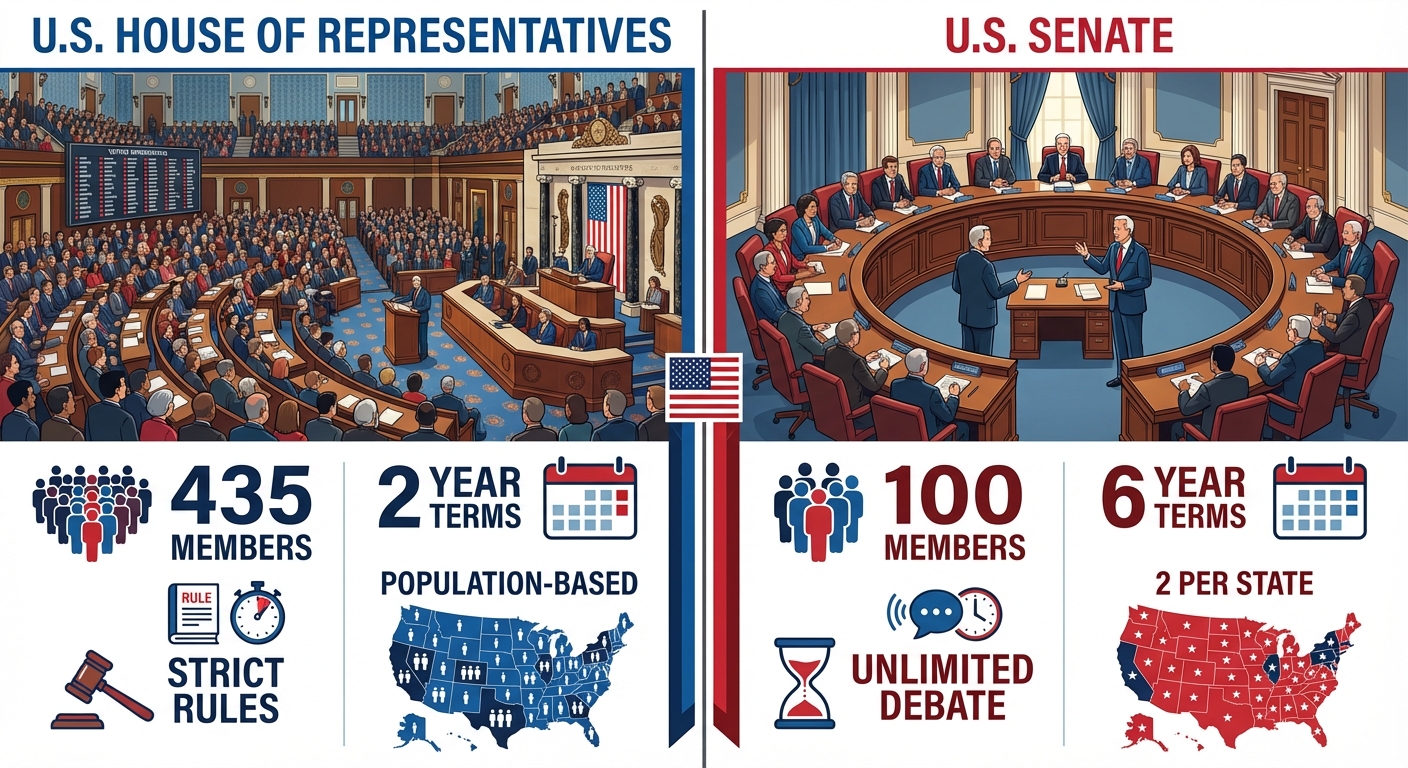
The Constitution established a bicameral legislature (two houses) through the Great Compromise. This division was intended to provide checks and balances within the legislative branch itself, slowing down the legislative process to prevent impulsive governance.
| Feature | House of Representatives | Senate |
|---|---|---|
| Membership | 435 members (based on population) | 100 members (2 per state) |
| Term Length | 2 years | 6 years (staggered terms) |
| Constituency | Local districts (more specialized) | Entire state (broader focus) |
| Structure | Formal, rigid rules, strict hierarchy | Loose rules, more informal |
| Debate | Limited debate time | Unlimited debate (filibuster possible) |
| Key Powers | Initiates revenue (tax) bills; Impeachment charges | Ratifies treaties; Confirms appointments; Impeachment trials |
Following the design principles of the framers, the House is designed to be closer to the people (shorter terms, direct election originally), while the Senate acts as a "cooling saucer" to temper the passions of the House (longer terms, originally elected by state legislatures).
Constitutional Powers and Functions
The authority of Congress is defined primarily in Article I, Section 8 of the Constitution.
Enumerated Powers
These are specific powers explicitly listed in the Constitution (also called expressed powers).
- Power of the Purse: The ability to tax and spend public money. This is Congress's most potent weapon in controlling the executive branch.
- Commerce Clause: The power to regulate interstate and foreign commerce.
- Foreign Policy: Although the President is Commander-in-Chief, Congress has the power to declare war and maintain the armed forces.
Implied Powers
Derived from the Necessary and Proper Clause (Elastic Clause) in Article I, Section 8. This allows Congress to pass laws required to carry out its enumerated powers, dramatically expanding congressional authority over time (e.g., establishing a national bank, environmental regulations).
Congressional Oversight
Beyond making laws, Congress holds the Executive Branch accountable through oversight. This involves committee hearings and investigations to ensure laws are enforced as intended and to investigate corruption.
Congressional Leadership and Committees
Congress is too large to function without strict organization. Leadership and the committee system are the engines that drive legislation.
Leadership Roles
- Speaker of the House: The most powerful member of Congress. Elected by the House majority, they control committee assignments, appoint leaders, and dictate the flow of debate.
- Senate Majority Leader: The true leader of the Senate (since the VP is largely ceremonial). They schedule debates and business.
- Whips: Party leaders who keep the "pack" in line, counting votes and persuading members to vote according to party ideology.
- President of the Senate: The Vice President of the US (breaks ties only).
The Committee System
Because thousands of bills are introduced annually, most work is done in committees, not on the floor. Most bills "die in committee."
- Standing Committees: Permanent committees that handle specific policy areas (e.g., Agriculture, Armed Services).
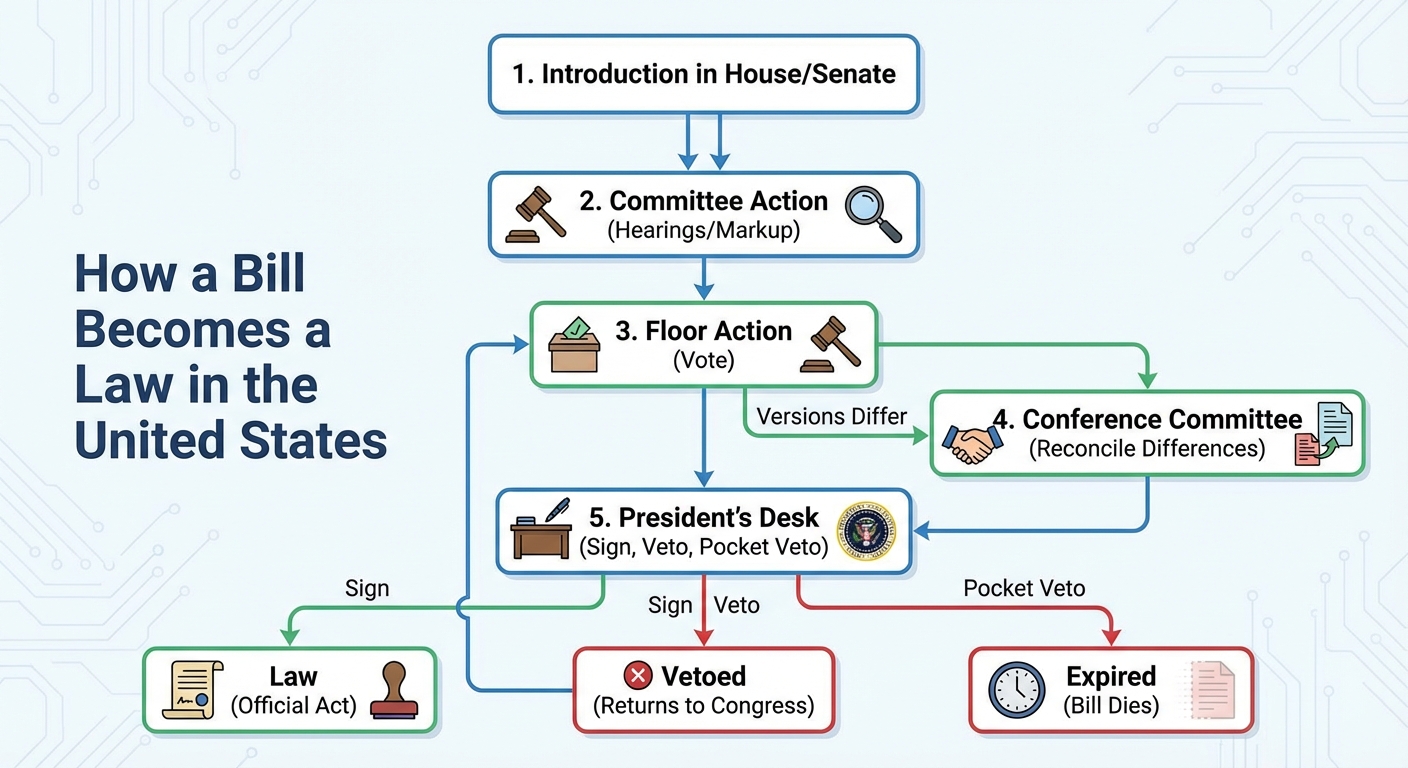
- Conference Committees: Temporary joint committees created to reconcile differences between House and Senate versions of a bill.
- House Rules Committee: Unique to the House. It acts as a "traffic cop," determining if and when a bill reaches the floor and whether amendments are allowed (Open vs. Closed Rule).
Detailed Legislative Process (How a Bill Becomes Law)
Passing a law is intentionally difficult. A bill must survive a gauntlet of hurdles in both chambers.
The House Process
- Introduction: A member drops the bill in the "hopper."
- Committee Action: Hearings, markup (editing), and voting.
- Rules Committee: Sets debate terms.
- Floor Vote: Requires a simple majority ($218+$).
The Senate Process & The Filibuster
The Senate lacks a Rules Committee to limit debate. This leads to unique obstacles:
- Filibuster: A tactic used by a minority to kill a bill by talking indefinitely, preventing a vote.
- Cloture: The only way to end a filibuster. It requires a supermajority of 60 votes (three-fifths of the Senate).
- Unanimous Consent: The Senate often expedites routine business by asking if anyone objects; a single Senator can halt this (a Hold).
Presidential Action
Once a bill passes both chambers in identical form:
- Sign: Becomes law.
- Veto: Rejects the bill. Congress can override with a $2/3$ vote in both houses.
- Pocket Veto: If the President does not sign within 10 days and Congress adjourns, the bill dies.
Congressional Behavior and Representation
How do members decide how to vote? They balance conflicting pressures using three primary models of representation.
Models of Representation
- Delegate Model: The member votes exactly as their constituents wish, regardless of their own personal views.
- Trustee Model: The constituent entrusts the member to use their best judgment. The member may vote against public opinion if they believe it is in the nation's best interest.
- Politico Model: A hybrid approach. Members act as delegates on high-profile issues crucial to voters but as trustees on complex, low-profile issues.
Political Maneuvering
- Logrolling: "I'll vote for your bill if you vote for mine." (Vote trading).
- Pork Barrel Legislation: Legislation that directs specific funds to projects within a member's district (earmarks). While criticized for waste, it helps incumbents win reelection.
Elections, Redistricting, and Gerrymandering
Reapportionment and Redistricting
Every 10 years (Census), the 435 House seats are reallocated among states based on population changes. This is Reapportionment.
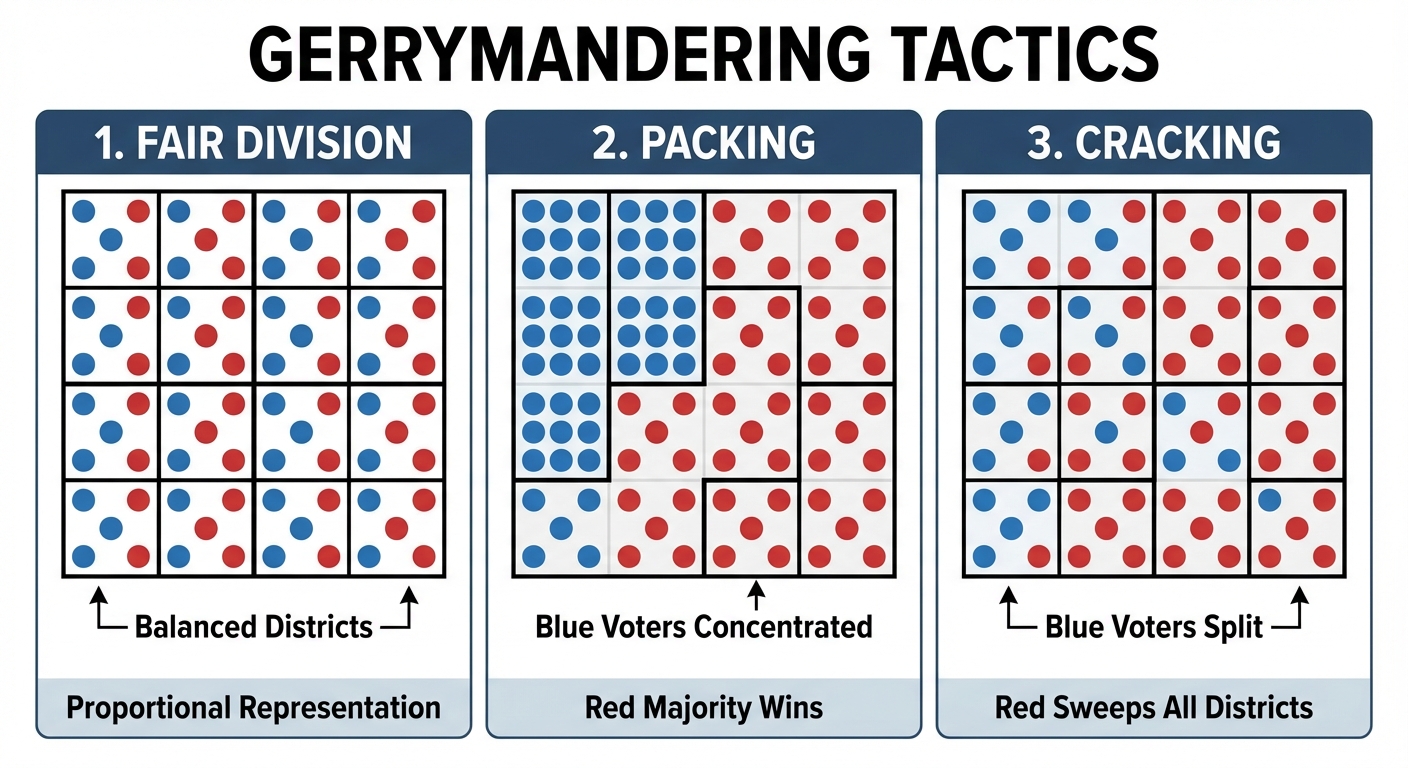
States then redraw their internal district lines, known as Redistricting. When this is done to benefit a specific party, it is called Gerrymandering.
Forms of Gerrymandering
- Packing: concentrating the opposing party's voters into one district to reduce their power elsewhere.
- Cracking: spreading the opposing party's voters across many districts to dilute their voting power.
Essential Supreme Court Cases
Two cases are mandatory for the AP Exam regarding legislative elections:
Baker v. Carr (1962)
- Issue: Tennessee had not redistricted in decades, leading to rural districts having far more voting power than urban ones.
- Holding: Redistricting issues present justiciable questions (courts can intervene). Established the "One Person, One Vote" doctrine enforcing the Equal Protection Clause of the 14th Amendment.
Shaw v. Reno (1993)
- Issue: North Carolina created a bizarrely shaped district to ensure the election of a Black representative.
- Holding: Legislative redistricting must be conscious of race and comply with the Voting Rights Act of 1965, but race cannot be the predominant factor in creating districts (districts cannot be drawn solely based on race). This falls under the strict scrutiny of the Equal Protection Clause.
Common Mistakes & Pitfalls
- Mistake: Confusion between the House Rules Committee and Senate rules.
- Correction: The House Rules Committee strictly limits debate. The Senate allows unlimited debate (filibuster) unless 60 senators vote for Cloture.
- Mistake: Thinking the