Unit 5: Function Analysis Using Derivatives
Determining Intervals of Increase and Decrease
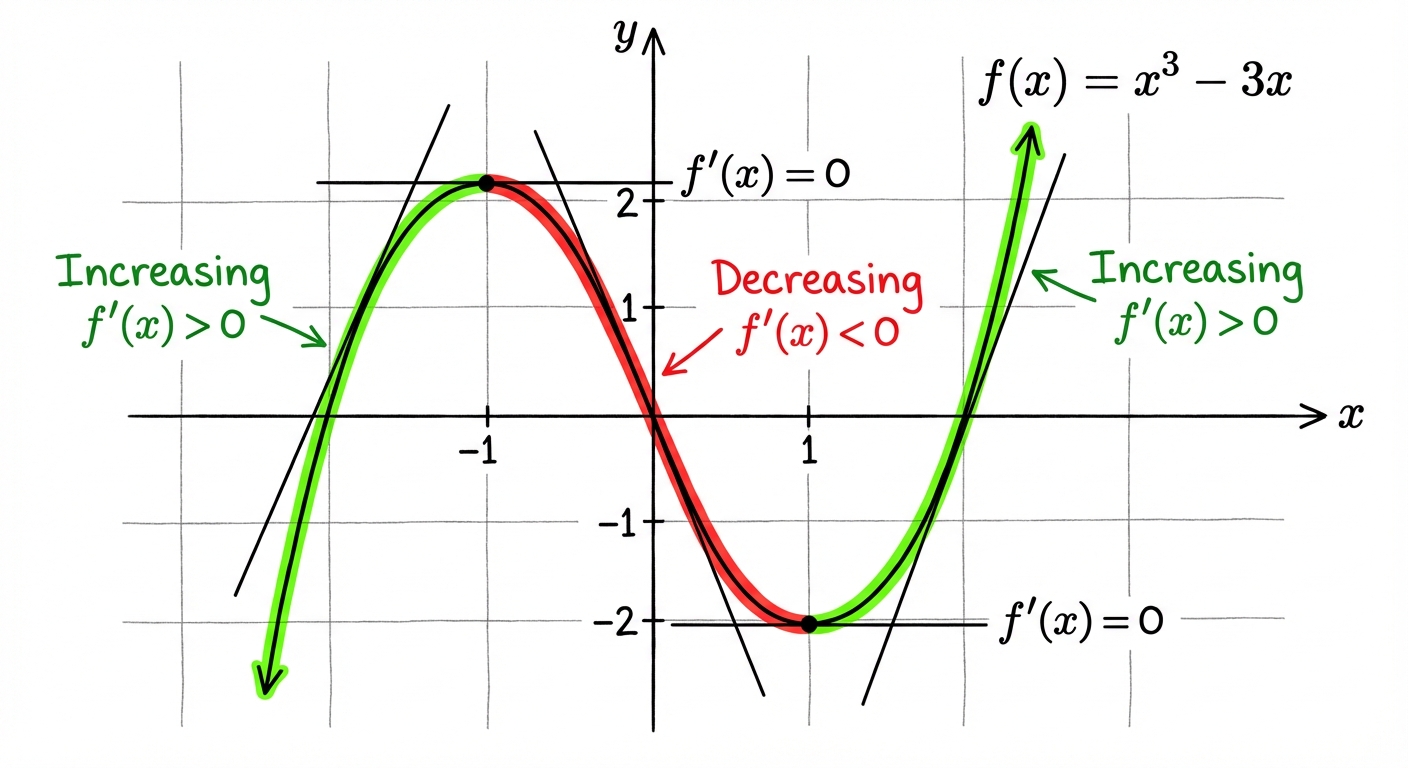
To understand the behavior of a function $f(x)$ without graphing it, we look to the first derivative, $f'(x)$. The first derivative represents the instantaneous rate of change or the slope of the tangent line.
Critical Numbers
Before identifying intervals, you must find the Critical Numbers (or Critical Points). A critical number of a function $f$ is a number $c$ in the domain of $f$ such that:
These are the only locations where a function can change direction (from increasing to decreasing or vice versa).
The Test for Increasing/Decreasing Functions
Once you have identified critical numbers, you divide the domain into test intervals. Within each interval, determine the sign of $f'(x)$.
- Increasing: If f'(x) > 0 for all $x$ in an interval $(a, b)$, then $f$ is increasing on $[a, b]$.
- Decreasing: If f'(x) < 0 for all $x$ in an interval $(a, b)$, then $f$ is decreasing on $[a, b]$.
- Constant: If for all $x$ in an interval, then $f$ is constant.
Worked Example
Problem: Find the open intervals on which $f(x) = x^3 - rac{3}{2}x^2$ is increasing or decreasing.
Solution:
Find the derivative:
Find Critical Numbers: Set $f'(x) = 0$.
Create a Sign Chart: Test values between the critical numbers.
| Interval | Test Value ($x$) | Sign of $f'(x)$ | Behavior of $f$ |
|---|---|---|---|
| $(-\infty, 0)$ | $-1$ | (+) | Increasing |
| $(0, 1)$ | $0.5$ | (-) | Decreasing |
| $(1, \infty)$ | $2$ | (+) | Increasing |
Conclusion: $f$ is increasing on $(-\infty, 0)$ and $(1, \infty)$ and decreasing on $(0, 1)$.
First Derivative Test
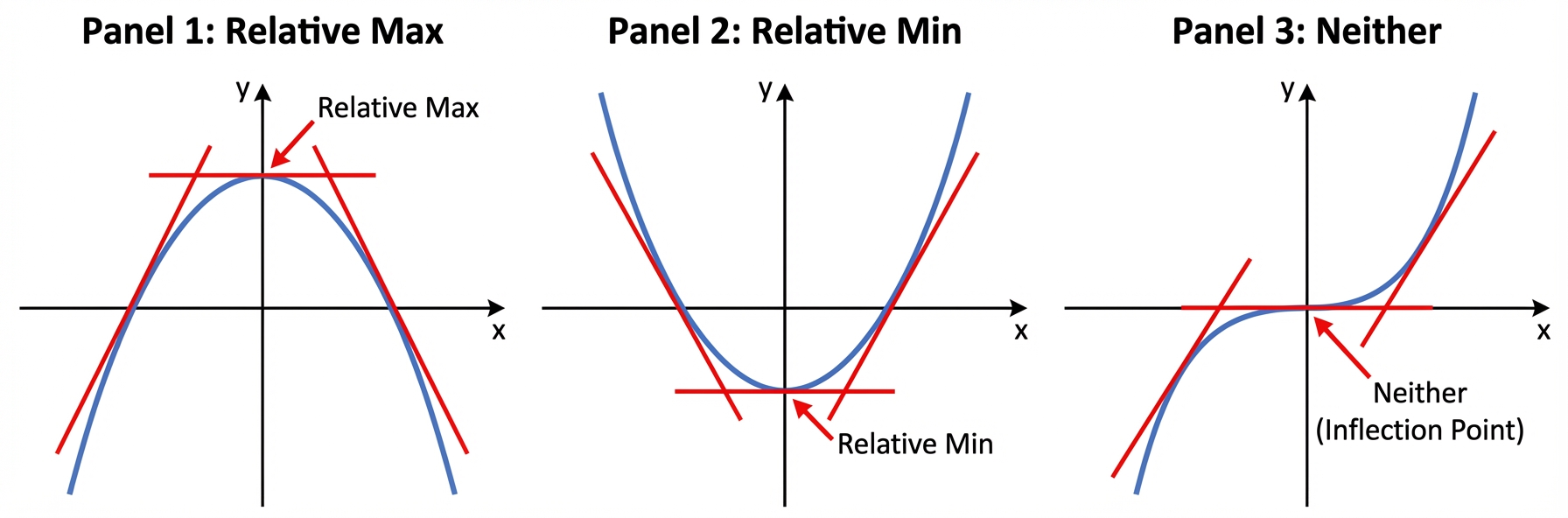
The First Derivative Test is used to determine if a critical number corresponds to a Relative (Local) Maximum, a Relative Minimum, or neither.
The Theorem
Let $c$ be a critical number of a continuous function $f$.
- Relative Maximum: If $f'(x)$ changes from positive to negative at $c$, then $f$ has a local maximum at $(c, f(c))$.
- Relative Minimum: If $f'(x)$ changes from negative to positive at $c$, then $f$ has a local minimum at $(c, f(c))$.
- Neither: If $f'(x)$ is positive on both sides of $c$ or negative on both sides of $c$, then $f(c)$ is neither a max nor a min (it might be a terrace point).
Justification on the AP Exam
When asked to justify a relative extremum, avoid vague phrases like "the slope changes" or "it goes up then down." be specific:
"Function $f$ has a relative maximum at $x=c$ because $f'(x)$ changes from positive to negative at this point."
Determines Concavity and Points of Inflection
While the first derivative tells us direction (increasing/decreasing), the second derivative $f''(x)$ tells us the curvature or shape of the graph.
Testing for Concavity
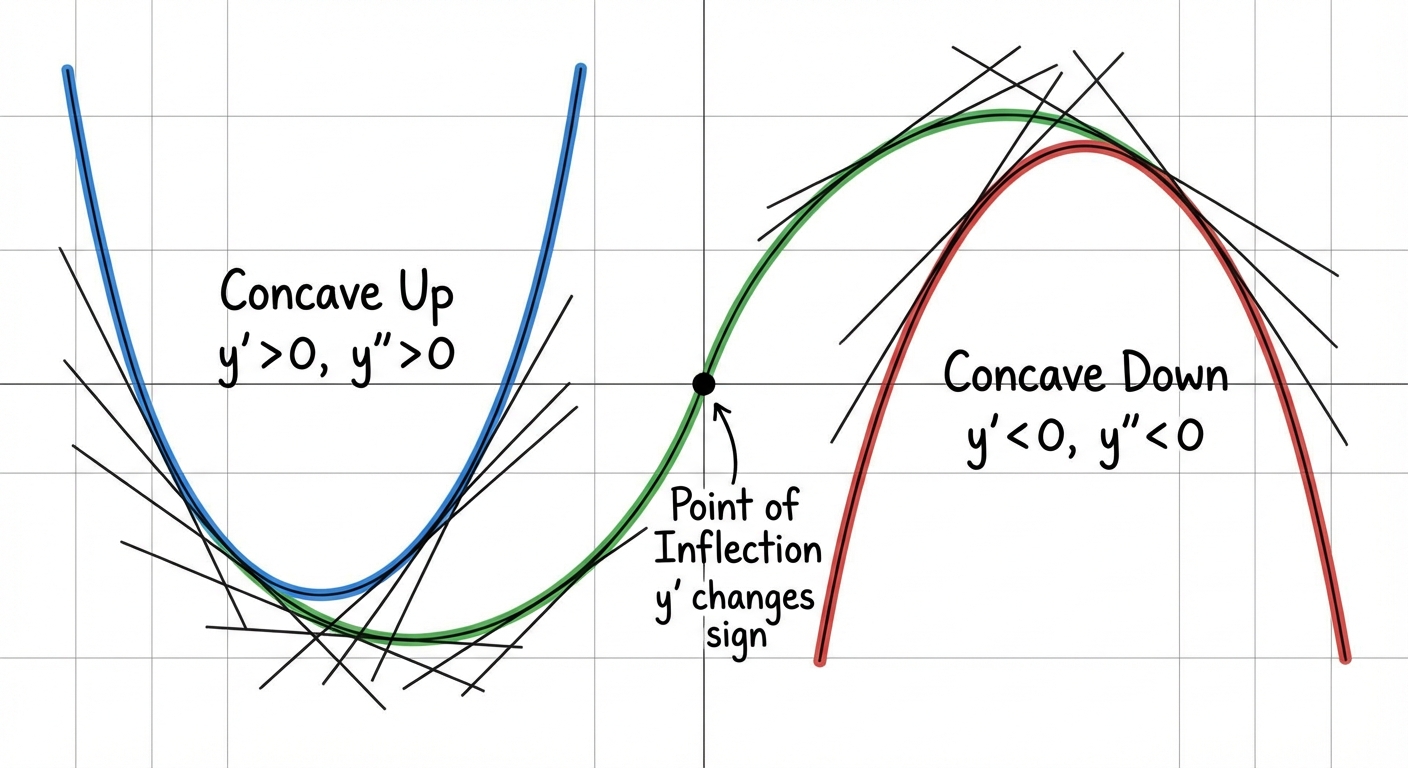
- Concave Up: The graph lies above its tangent lines. Mathematically, f''(x) > 0 on an interval.
- Think: The graph is shaped like a cup $\cup$ (holds water).
- Note: If $f$ is concave up, $f'$ is increasing.
- Concave Down: The graph lies below its tangent lines. Mathematically, f''(x) < 0 on an interval.
- Think: The graph is shaped like a frown $\cap$ (spills water).
- Note: If $f$ is concave down, $f'$ is decreasing.
Points of Inflection (POI)
A Point of Inflection happens at a point $(c, f(c))$ where the graph intersects its tangent line and changes concavity.
Condition for POI:
- $c$ is in the domain of $f$ (assuming $f$ is continuous).
- OR .
- Crucial: $f''(x)$ must change sign at $x=c$ (from + to - or - to +).
Memory Aid: The $f, f', f''$ Ladder
Understanding the relationship hierarchy is vital:
| $f(x)$ | $f'(x)$ | $f''(x)$ |
|---|---|---|
| Increasing $\nearrow$ | Positive (+) | … |
| Decreasing $\searrow$ | Negative (-) | … |
| Concave Up $\cup$ | Increasing $\nearrow$ | Positive (+) |
| Concave Down $\cap$ | Decreasing $\searrow$ | Negative (-) |
| Point of Inflection | Relative Extr. (Max/Min) | Change of Sign |
Second Derivative Test
The Second Derivative Test is an alternative method to classify critical numbers as relative max or min. It uses concavity to determine the nature of a flat spot on the curve.
The Rules
Let $f$ be a function such that $f'(c) = 0$ (meaning we have a horizontal tangent) and $f''$ exists on an open interval containing $c$.
- Relative Minimum: If f''(c) > 0, then $f$ is concave up at $c$. A horizontal tangent in a "cup" shape must be a bottom.
- Result: Local Minimum.
- Relative Maximum: If f''(c) < 0, then $f$ is concave down at $c$. A horizontal tangent in a "frown" shape must be a peak.
- Result: Local Maximum.
- Inconclusive: If , the test fails. You must go back and use the First Derivative Test.
Worked Example
Problem: Classify the critical points of $f(x) = x^4 - 4x^3$ using the Second Derivative Test.
Solution:
Find $f'(x)$ and Critical Numbers:
$f'(x) = 0$ at $x=0$ and $x=3$.Find $f''(x)$:
Apply Test:
- At $x=3$:
Since $36 > 0$, $f$ is Concave Up. Therefore, $x=3$ is a Relative Minimum. - At $x=0$:
Since $f''(0)=0$, the test is inconclusive. We must use the First Derivative Test (Sign Chart). ( Checking chart: $f'$ is negative left of 0 and negative right of 0, so $x=0$ is neither.)
- At $x=3$:
Common Mistakes & Pitfalls
- "It's a POI because $f''(x)=0$": This is false. $f''(x)=0$ creates a candidate for a Point of Inflection. You must verify that the sign of $f''$ actually changes. For example, $f(x)=x^4$ has $f''(0)=0$, but it is not a POI because it is concave up everywhere.
- Confusing the Tests: Students often mix up the First and Second Derivative Tests. Remember: The First Deriv Test looks at the sign change of $f'$ around $c$. The Second Deriv Test looks at the sign of $f''$ exactly at $c$.
- Assuming undefined derivatives aren't extrema: Critical points occur where $f'(x)=0$ AND where $f'(x)$ is undefined (like a sharp corner or cusp defined by $f(x) = |x|$ or $x^{2/3}$). Relative extrema can exist at these sharp points.
- Endpoint Errors: The First and Second Derivative Tests define Relative (Local) extrema, which occur inside open intervals. Absolute extrema can occur at endpoints, but the derivative tests don't "find" endpoints automatically; you must check them separately in optimization problems.