AP Environmental Science Study Notes: Unit 9 — Global Change
9.1 Stratospheric Ozone Depletion
The Ozone Layer (Good Ozone)
- Stratosphere: The layer of the atmosphere approximately 10–30 miles (16–48 km) above Earth. It contains the "ozone layer," which protects biota from harmful UV radiation.
- Ultraviolet Radiation (UV): High-energy radiation from the sun. It is categorized into three types:
- UV-A: Low energy, passes through the atmosphere; causes tanning and skin aging.
- UV-B: Medium energy; causes sunburns and skin cancer. Blocked significantly by ozone.
- UV-C: High energy; responsible for the formation of ozone. Almost entirely blocked by the stratosphere.
- Ozone Formation: A natural cycle occurring in the stratosphere.
- (Oxygen molecules split)
- (Atomic oxygen combines with oxygen gas to form ozone)
Ozone Depletion Mechanism
Human-made chemicals disrupt the natural balance of ozone formation and destruction.
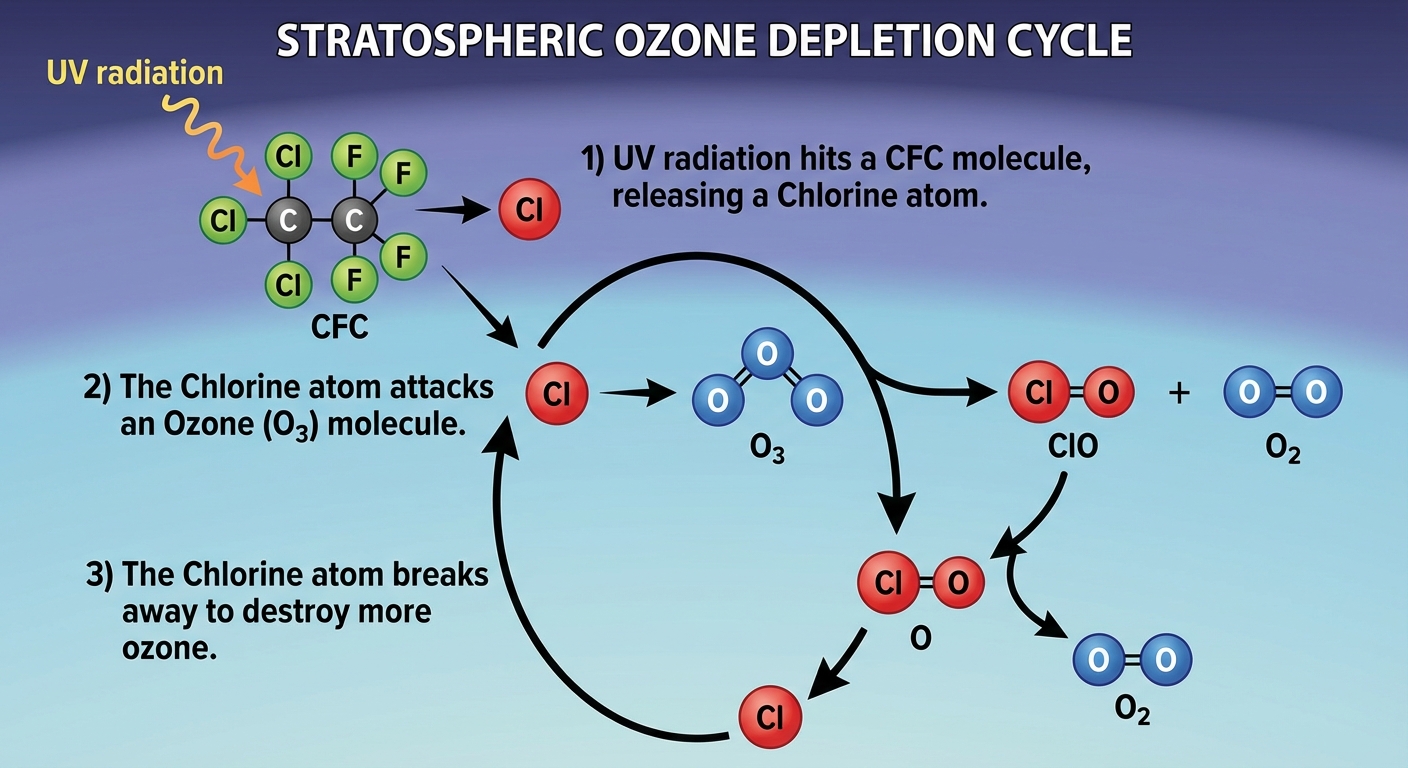
- Chlorofluorocarbons (CFCs): Anthropogenic compounds used in coolants (old ACs/refrigerators), aerosol propellants, and blowing agents for Styrofoam. They are chemically stable in the troposphere but break down in the stratosphere.
- The Chemical Process:
- UV radiation hits a CFC molecule, breaking off a Chlorine atom ().
- The Chlorine atom attacks an Ozone molecule: .
- A free oxygen atom hits the Chlorine Monoxide: .
- Result: The Chlorine atom is free to repeat the process. One Chlorine atom can destroy up to 100,000 Ozone molecules.
Effects of Depletion
- Human Health: Increased cataracts, skin cancer (melanoma), and suppression of the immune system.
- Ecosystems: UV-B radiation damages plant tissue (reducing crop yields) and kills phytoplankton (disrupting aquatic food webs).
Solutions & Legislation
- The Montreal Protocol (1987): A global treaty that phased out the production of CFCs and HCFCs. Considered the most successful international environmental agreement.
- Substitutes: Hydrofluorocarbons (HFCs) replaced CFCs. While HFCs do not deplete ozone, they are essentially potent greenhouse gases.
9.2 The Greenhouse Effect
The Natural Greenhouse Effect
This is a natural process that keeps Earth warm enough to support life. Without it, Earth would be approx. 0°F (-18°C).
- Mechanism:
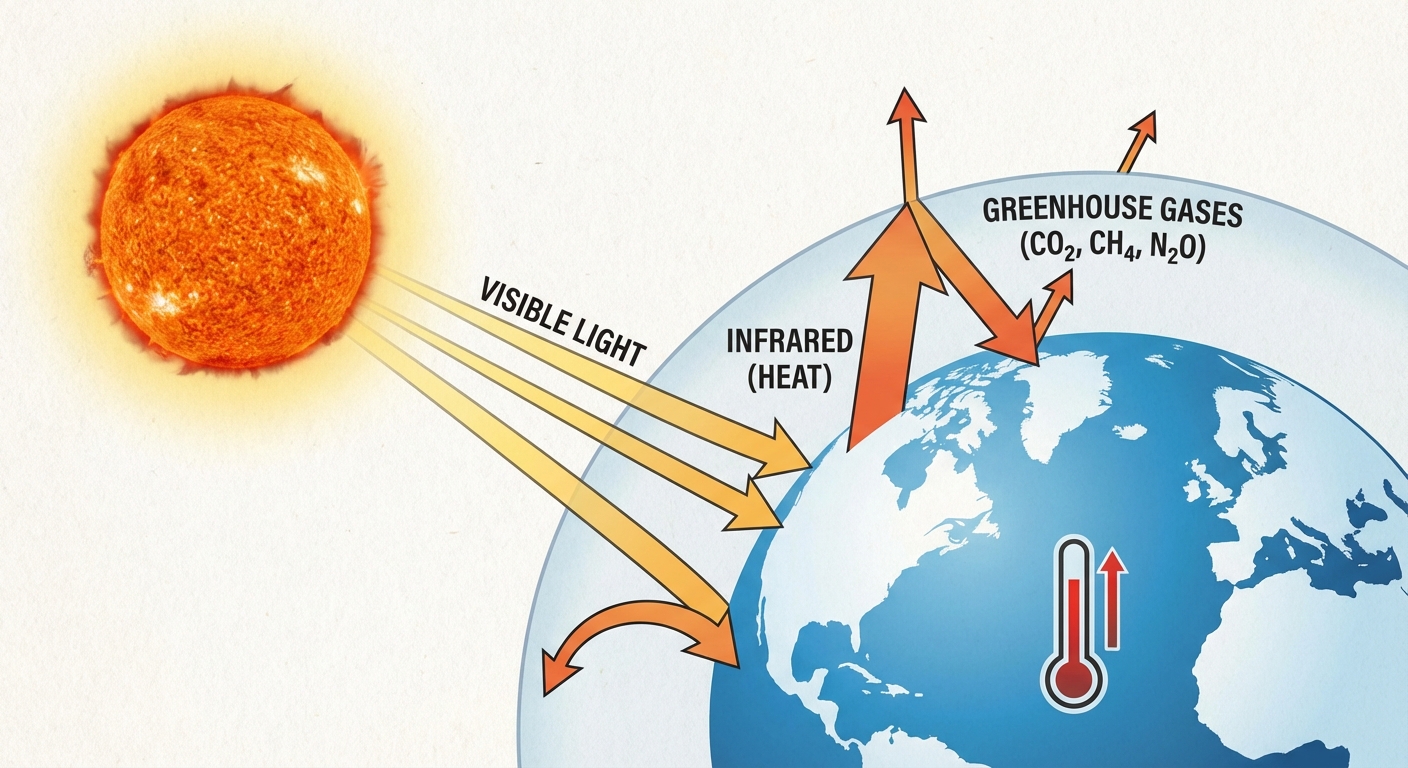
- High-energy visible light from the sun strikes the Earth.
- Earth absorbs this energy and re-radiates it as lower-energy Infrared Radiation (IR) (heat).
- Greenhouse Gases (GHGs) in the atmosphere absorb and trap this outgoing IR radiation, warming the lower atmosphere.
Principal Greenhouse Gases
| Gas | Source | Global Warming Potential (GWP) | Residence Time |
|---|---|---|---|
| Water Vapor () | Evaporation, transpiration. Not anthropogenic, but acts as a positive feedback mechanism. | < 1 | Days |
| Carbon Dioxide () | Burning fossil fuels, deforestation, decomposition. | 1 (Reference) | Years to Centuries |
| Methane () | Livestock (enteric fermentation), landfills, rice paddies, melting permafrost. | ~25x | ~12 years |
| Nitrous Oxide () | Agricultural fertilizers, manure management. | ~300x | ~114 years |
| CFCs/HFCs | Refrigerants, aerosols, industrial processes. | 1,000x - 10,000x | Hundreds of years |
Key Concept: Global Warming Potential (GWP) is a measure of how much heat a gas traps relative to over a specific time horizon.
9.3 & 9.4 Global Climate Change
Causes of Warming
- Antarctic Ice Core Data: Historical data shows a direct correlation between levels and global temperatures over the last 800,000 years. concentrations have recently eclipsed 400ppm, far above historical maximums.
- Ocean Sinks: The ocean absorbs heat and . As water warms, it holds less gas (), releasing it back into the atmosphere (Positive Feedback Loop).
Environmental Impacts
- Sea Level Rise: Caused by two main factors:
- Thermal Expansion: Warm water takes up more volume than cold water.
- Melting Land Ice: Glaciers and ice sheets (Greenland/Antarctica) adding water volume. (Note: Melting sea ice does not directly raise sea levels, like ice melting in a glass of water).
- Disease Vectors: Warmer climates expand the range of vectors like mosquitoes, spreading Malaria, Zika, and West Nile Virus to previously temperate zones.
- Population displacement: Coastal flooding forces migration (climate refugees).
- Changes in Jet Stream: Destabilized jet streams cause prolonged severe weather events (heat domes, polar vortexes).
Effects on Biodiversity
- Habitat Loss: Polar bears losing hunting ice; coastal wetlands submerged.
- Timing Mismatches: Phenological changes (e.g., flowers blooming before pollinators emerge).
- Coral Bleaching: Ocean warming stresses corals, causing them to expel the symbiotic algae (zooxanthellae) that provide them food and color.
9.5 Ocean Acidification
The Chemistry of Acidification
This is distinct from climate change, though they share a cause ().
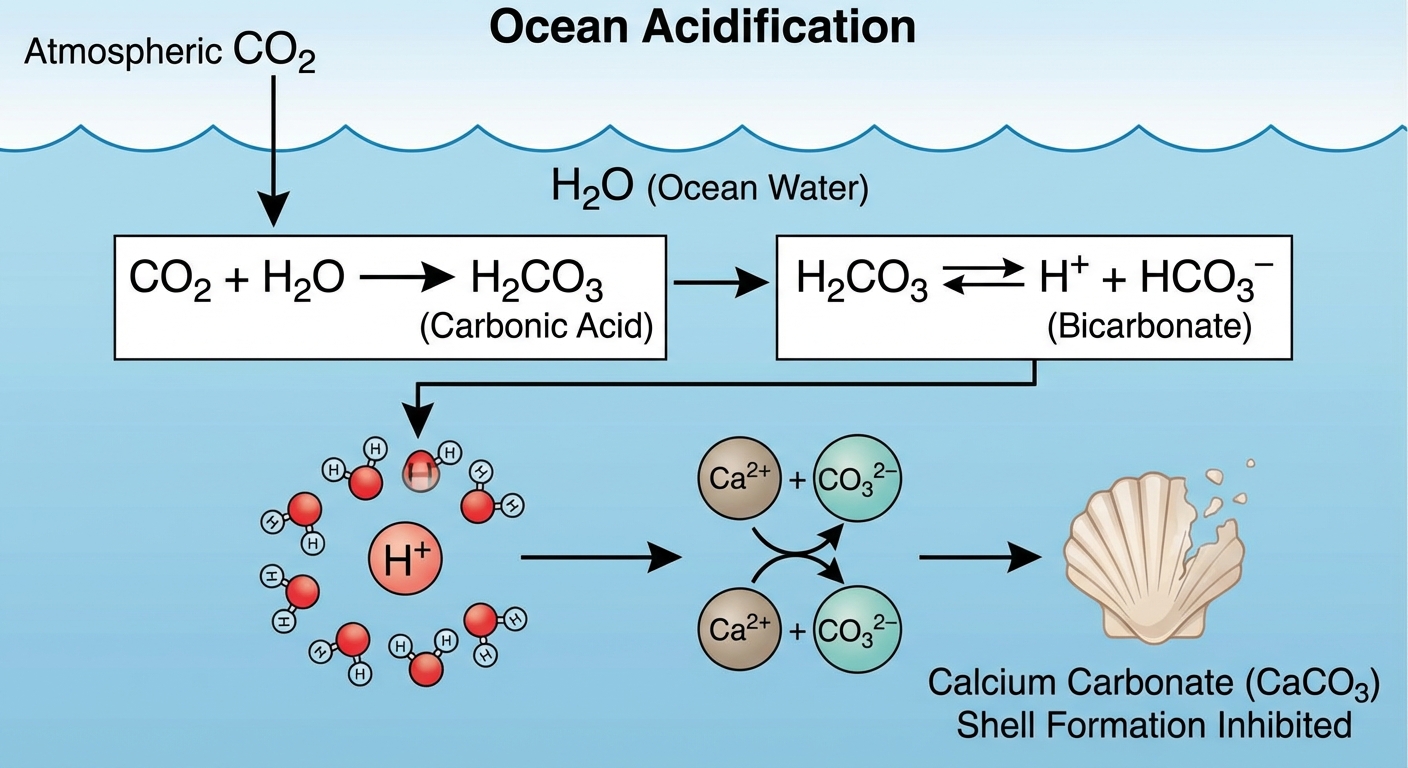
- Absorption: The ocean absorbs anthropogenic from the atmosphere.
- Chemical Reaction: (Carbonic Acid).
- Dissociation: (Bicarbonate).
- Impact on Shells: The increase in ions lowers pH (makes water more acidic). These ions steal carbonate ions () needed by calcifying organisms (corals, oysters, plankton) to build calcium carbonate shells ().
Analogy: Think of ions as bullies stealing the lunch money () that organisms need to build their skeletons.
9.6 - 9.7 Biodiversity & Invasive Species
Invasive Species
Species that live outside their historical range and cause harm. They are often Generalists (r-selected strategies).
- Characteristics: High reproductive rate, broad diet, no natural predators in new area, fast dispersal.
- Examples:
- Zebra Mussels: Clog pipes in the Great Lakes; outcompete natives.
- Kudzu: Vine that outcompetes trees for sunlight in the US South.
- Cane Toads: Introduced in Australia to eat beetles; became a toxic pest.
- Lionfish: Voracious predator in the Caribbean with no natural enemies.
Controlling Invasives
- Mechanical: Physical removal (hunting, pulling weeds).
- Chemical: Herbicides/pesticides (risk of non-target harm).
- Biological: Introducing a natural predator (high risk—predator may become invasive).
9.8 - 9.9 Endangered Species & Human Impacts
HIPPCO: Converting Habitat Loss to Extinction
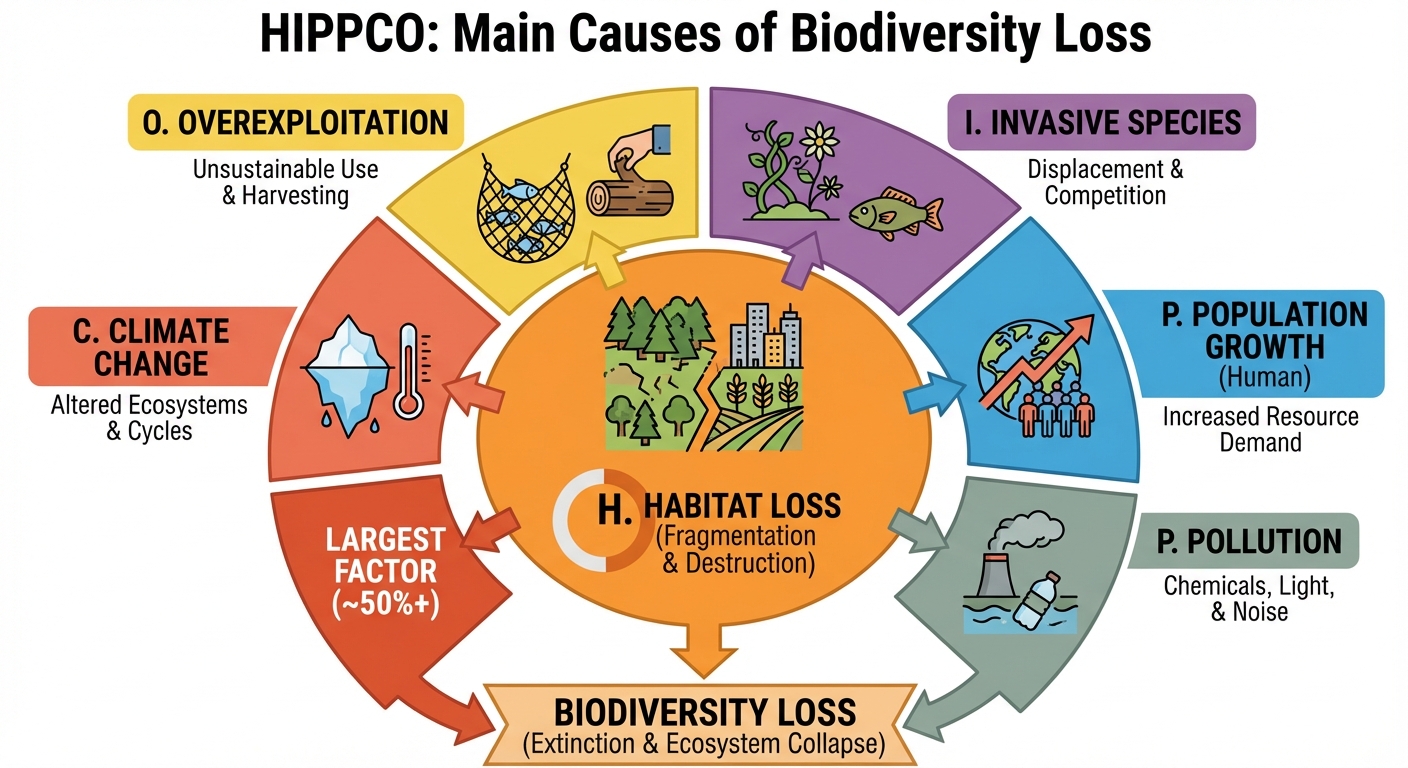
The main drivers of biodiversity loss can be remembered with the mnemonic HIPPCO:
- H - Habitat Loss: The #1 cause. Includes deforestation, wetland draining, and cultivation.
- Habitat Fragmentation: Breaking large habitats into smaller patches creates "edge effects," harming species that need deep core habitat.
- I - Invasive Species: Outcompete natives for resources.
- P - Population Growth (Human): Increased demand for resources exacerbates all other factors.
- P - Pollution: Oil spills, pesticides, biosolids, microplastics.
- C - Climate Change: Changes temperature and precipitation patterns faster than species can adapt.
- O - Overexploitation: Hunting, poaching, and overfishing (e.g., Dodo bird, Passenger Pigeon).
Domestication & Genetic Diversity
- Humans have selected specific crop varieties (monocultures) for high yield, reducing genetic diversity.
- Risk: Low genetic diversity makes crops profoundly vulnerable to disease or environmental changes (e.g., the Irish Potato Famine).
9.10 Conservation & Legislation
Strategies for Conservation
- Wildlife Corridors: Land bridges connecting fragmented habitats to allow gene flow and migration.
- Metapopulation Management: Managing distinct populations that interact occasionally.
Key Laws & Treaties
| Legislation | Scope | Purpose |
|---|---|---|
| ESA (Endangered Species Act) | USA | Identifies threatened/endangered species and protects their habitats. Penalizes harming them. |
| CITES | International | Convention on International Trade in Endangered Species. Bans international transport of body parts (ivory, tiger skins, rare parrots). |
| Kyoto Protocol | International | 1997 treaty to reduce Greenhouse Gas emissions. (USA never ratified). |
| Paris Agreement | International | 2016 agreement to keep global temperature rise below 2°C. |
Common Mistakes & Pitfalls
- Ozone vs. Climate Change: This is the most common error. Ozone depletion does NOT cause global warming.
- Ozone hole = increased UV radiation = Skin cancer.
- Greenhouse effect = Trapped IR heat = Climate change.
- Connection: CFCs are both ozone depleters AND greenhouse gases, but the mechanisms are different.
- Melting Ice: Melting Sea Ice (North Pole/Arctic) does not raise sea levels (Archimedes' principle). Melting Land Ice (Greenland/Antarctica/Glaciers) does raise sea levels.
- Acid Rain vs. Ocean Acidification: Acid rain is caused by and (from coal/cars). Ocean acidification is caused by (carbon emissions).
- "Bad" Chemicals: Do not just say "chemicals run off." Be specific: Fertilizers (Nitrates/Phosphates) cause eutrophication; Pesticides kill non-target species; Sediment suffocates fish eggs.
- Photochemical Smog vs. Stratospheric Ozone: Stratospheric ozone is "good" (protects us). Ground-level ozone (trospheric) is "bad" (lung irritant, part of smog).