Mastering SAT Spatial Reasoning: Geometry & Trigonometry
Note: On the Digital SAT (DSAT), Geometry and Trigonometry questions make up approximately 15% of the Math section. While you are provided with a reference sheet of common formulas, the real challenge lies in recognizing when to use them and manipulating spatial relationships.
Area and Volume
This domain focuses on measuring 2D and 3D space. The test often requires you to work backwards from a given volume to find a dimension, or to handle composite shapes.
2D Area and Perimeter
Prioritize understanding the relationship between dimensions and area, specifically for quadrilaterals and triangles.
- Rectangle: $A = lw$
- Triangle: $A = \frac{1}{2}bh$
- Parallelogram: $A = bh$ (where $h$ is the perpendicular height, not the slant height)
Crucial Concept: The area of any regular polygon can be found if you divide it into congruent triangles.
3D Volume and Surface Area
The SAT reference sheet provides volume formulas for prisms, cylinders, cones, spheres, and pyramids. However, you must memorize the conceptual difference between volume (space inside) and surface area (area of the outer skin).
- Rectangular Prism: $V = lwh$; Surface Area = $2(lw + lh + wh)$
- Cylinder: $V = \pi r^2 h$; Surface Area = $2\pi r^2 + 2\pi r h$
- Sphere: $V = \frac{4}{3}\pi r^3$
- Cone: $V = \frac{1}{3}\pi r^2 h$
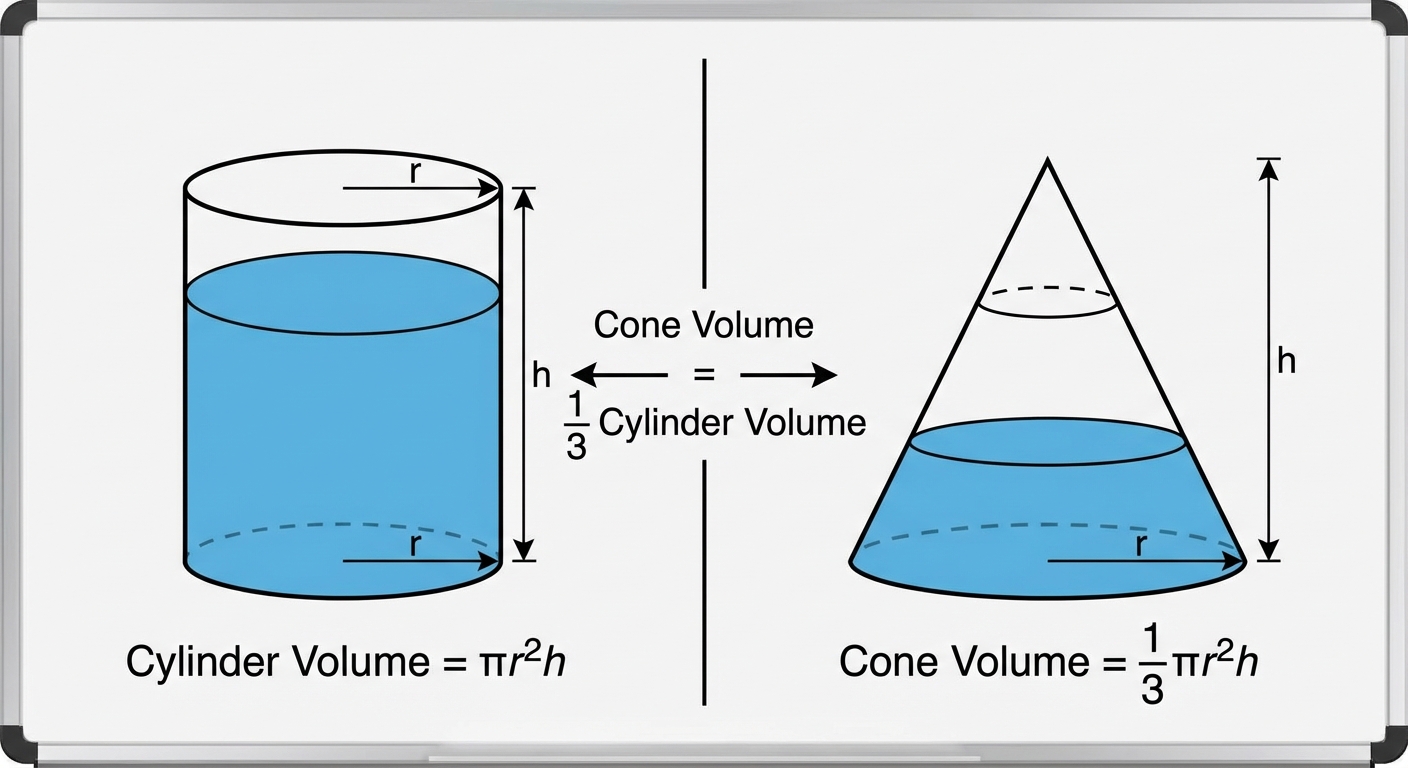
Scale Factors in Area and Volume
This is a high-frequency concept. If two shapes are similar with a linear scale factor of $k$:
- Ratio of lengths = $k$
- Ratio of Areas = $k^2$
- Ratio of Volumes = $k^3$
Example:
If the radius of Sphere A is 3 times the radius of Sphere B ($k=3$), the volume of Sphere A is $3^3 = 27$ times larger, not 3 times larger.
Common Mistakes: Area & Volume
- Slant Height vs. True Height: In cones and pyramids, using the slanted side length instead of the perpendicular height for volume calculations.
- Unit Conversion: Forgetting that 1 square foot is $12 \times 12 = 144$ square inches, not 12.
Lines, Angles, and Triangles
Parallel Lines and Transversals
When two parallel lines are cut by a transversal line, specific angle relationships occur. You generally only have two angle measures: a big one (obtuse) and a small one (acute). All big angles are equal, and all small angles are equal. A big + a small = $180^\circ$.
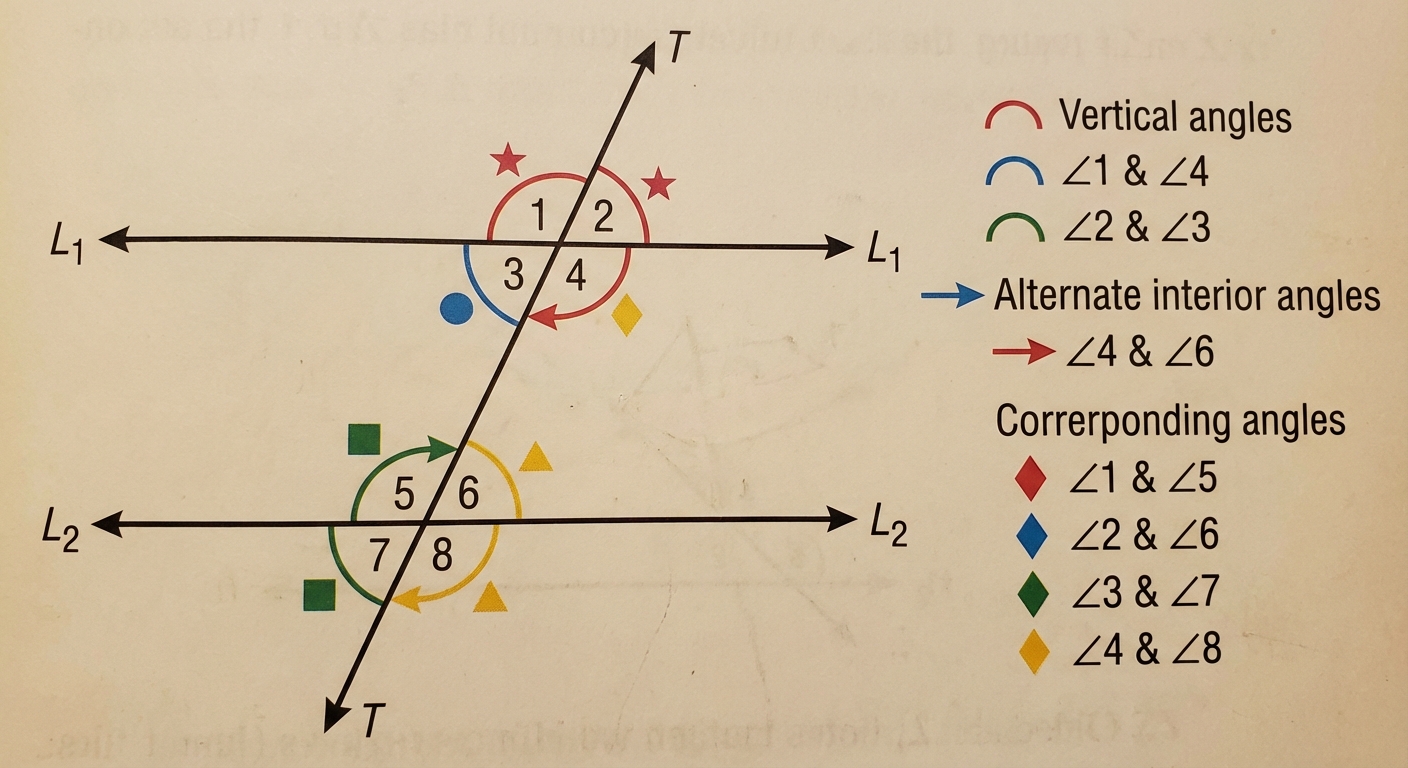
- Vertical Angles: Opposite angles at an intersection are equal.
- Alternate Interior Angles: Equal (Z-pattern).
- Corresponding Angles: Equal (same position at each intersection).
Triangle Theorems
- Triangle Sum Theorem: The sum of interior angles is always $180^\circ$.
- Exterior Angle Theorem: An exterior angle of a triangle is equal to the sum of the two opposite interior angles.
- Isosceles Triangle Theorem: If two sides are equal, the angles opposite those sides are equal.
Similarity & Congruence
- Congruent ($\cong$): Identical shape and size.
- Similar ($\sim$): Same shape, different size. Angles are identical; sides are proportional.
Test Tip: If the SAT tells you two triangles are similar, immediately write down the ratio of corresponding sides: $\frac{A}{a} = \frac{B}{b} = \frac{C}{c}$.
Right Triangles and Trigonometry
Pythagorean Theorem
For any right triangle with legs $a, b$ and hypotenuse $c$:
Pythagorean Triples: Memorize these integer sets to save time:
- 3-4-5
- 5-12-13
- 8-15-17
Special Right Triangles
These are on the reference sheet, but memorizing them is faster.
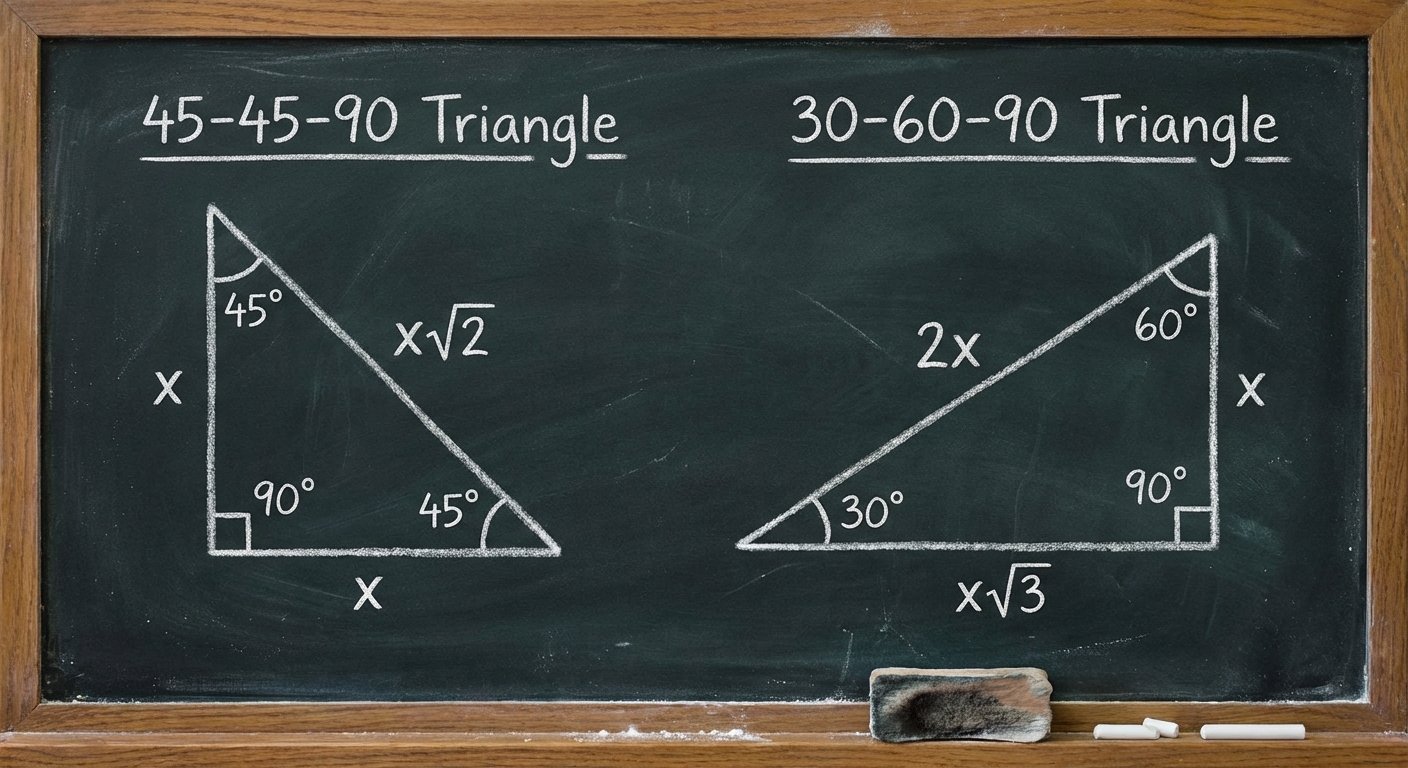
- 45-45-90 (Isosceles Right): Sides are $x, x, x\sqrt{2}$.
- 30-60-90: Sides are $x$ (opposite 30), $x\sqrt{3}$ (opposite 60), $2x$ (hypotenuse).
Trigonometric Ratios (SOH CAH TOA)
For a right triangle with an acute angle $\theta$:
- Sine: $\sin(\theta) = \frac{\text{Opposite}}{\text{Hypotenuse}}$
- Cosine: $\cos(\theta) = \frac{\text{Adjacent}}{\text{Hypotenuse}}$
- Tangent: $\tan(\theta) = \frac{\text{Opposite}}{\text{Adjacent}}$
The Complementary Angle Theorem
In a right triangle, the acute angles sum to $90^\circ$. Therefore:
Example: If $\sin(20^\circ) = a$, then $\cos(70^\circ) = a$. SAT loves to test this relationship algebraically (e.g., finding $x$ where $\sin(3x) = \cos(2x)$).
Trigonometric Pythagorean Identity
For any angle $\theta$:
Common Mistakes: Trigonometry
- Calculator Mode: Ensure your calculator is in Degree mode for geometry problems unless the problem specifically uses $\pi$ (Radians) for calculus-style layouts (rare in simple geometry).
- Identifying Sides: The "Adjacent" side is never the Hypotenuse.
Circles
The Digital SAT emphasizes the algebraic equation of a circle and arc/sector proportions.
Equation of a Circle
The standard equation for a circle with center $(h, k)$ and radius $r$ is:
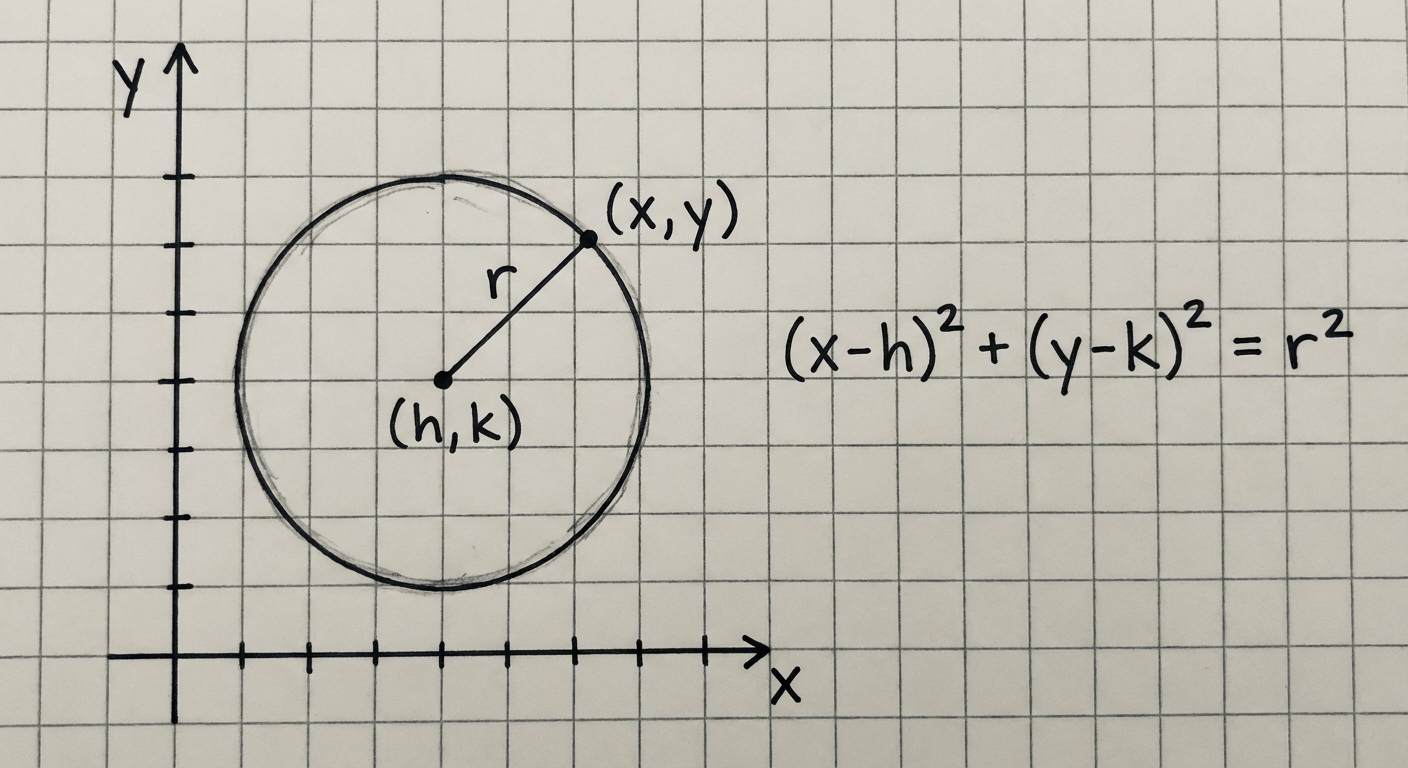
Worked Problem Strategy: Completing the Square
Often, the SAT gives the general form: $x^2 + y^2 + Ax + By + C = 0$. You must complete the square for both $x$ and $y$ to find the center and radius.
- Step 1: Group $x$'s and $y$'s.
- Step 2: Move constants to the right.
- Step 3: Add $(\frac{b}{2})^2$ to both sides for both variables.
- Step 4: Factor into perfect squares.
Angles, Arcs, and Sectors
Radians vs. Degrees:
which means
To convert Degrees to Radians: Multiply by $\frac{\pi}{180}$.Arc Length ($s$): The distance along the curve.
- Degrees: $s = 2\pi r (\frac{\theta}{360})$
- Radians: $s = r\theta$ (Memorize this!)
Sector Area: The area of the "pizza slice".
- Degrees: $A = \pi r^2 (\frac{\theta}{360})$
Central vs. Inscribed Angles:
- Central Angle: Vertex at the center. Measure = Intercepted Arc.
- Inscribed Angle: Vertex on the circle edge. Measure = $\frac{1}{2}$ Intercepted Arc.
Common Mistakes: Circles
- Radius vs. Diameter: The equation uses $r^2$, not $d^2$. If given diameter, immediately divide by 2.
- Sign Errors in Equation: The center is at $(h, k)$. If the equation is $(x+3)^2 + (y-2)^2 = 16$, the center is (-3, 2), not (3, -2).
- Arc Length Formula: Forgetting to convert to radians before using $s = r\theta$.